Key takeaways
- IPS: Usually the safest choice for text, viewing angles, and consistent color across a large screen. Fast IPS models are also strong gaming options.
- IPS Black: Used by displays such as the Dell U3223QE. It improves contrast over conventional IPS, though it does not match the deep blacks of OLED or the stronger contrast of many VA panels.
- VA: Often delivers deeper blacks and strong contrast, making it attractive for movies and HDR gaming. Dark transitions can show more smearing, depending on the model and overdrive setting.
- OLED: Offers excellent contrast and very fast response, but static desktop elements create a greater image-retention concern. Use screen-saving features and avoid leaving fixed windows visible for long periods.
The best 32 inch monitors depend on whether you prioritize sharp text, accurate creative work, smooth gaming, or a desk deep enough to place the screen at a comfortable distance: for most mixed-use setups, a 32-inch 4K display with USB-C is the strongest starting point, while competitive gamers should consider a 144Hz-or-faster model.
Our top picks


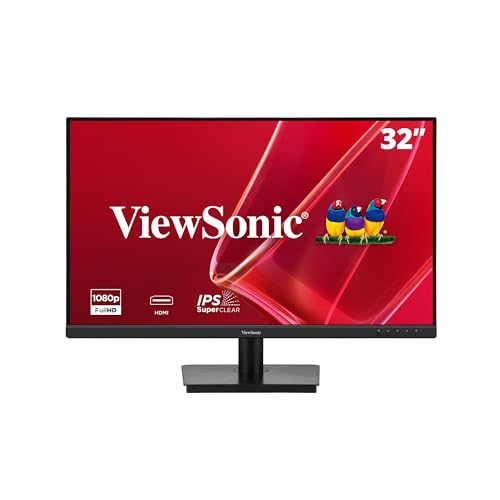

As an Amazon Associate we earn from qualifying purchases at no extra cost to you. Ratings are shown as listed on Amazon.
Best 32 Inch Monitors at a Glance
| Monitor | Best for | Resolution and refresh rate | Panel and key ports | Typical market range |
|---|---|---|---|---|
| Dell UltraSharp U3223QE | Office productivity and USB-C docking | 3840 × 2160, 60Hz | IPS Black; USB-C 90W, DisplayPort, HDMI, USB hub, Ethernet | $700–$900 |
| BenQ PD3225U | Professional design and Mac workstations | 3840 × 2160, 60Hz | IPS; Thunderbolt 4, DisplayPort, HDMI, USB hub | $1,000–$1,200 |
| Gigabyte M32U | One monitor for work and gaming | 3840 × 2160, 144Hz | Fast IPS; DisplayPort 1.4, HDMI 2.1, USB-C, USB hub | $550–$750 |
| LG 32GR93U-B | 4K PC and console gaming | 3840 × 2160, 144Hz | IPS; DisplayPort 1.4, HDMI 2.1, USB hub | $500–$700 |
| Samsung Odyssey Neo G8 32 | High-end HDR gaming | 3840 × 2160, up to 240Hz | Quantum Mini-LED VA; DisplayPort 1.4, HDMI 2.1 | $900–$1,300 |
How to Choose Among the Best 32 Inch Monitors
Resolution: 4K is usually the right fit
At 32 inches, 4K provides about 138 pixels per inch. That produces noticeably cleaner text and finer interface details than 2560 × 1440, which is approximately 92 pixels per inch at the same size. For spreadsheets, documents, coding, photo editing, and video timelines, the extra workspace is useful as well as sharper.
A 4K monitor does require scaling on many computers. A 125% or 150% scaling setting often makes text comfortable while retaining more usable space than a lower-resolution display. If your graphics card cannot drive modern games at 4K, a 1440p 32-inch screen can be a sensible budget choice, but it will look less crisp for close-up office work.
Refresh rate: 60Hz versus 144Hz or 240Hz
60Hz is adequate for email, writing, programming, spreadsheets, and color-focused work. A 144Hz monitor makes cursor movement, scrolling, and games feel smoother, and it is a better match for a powerful gaming PC. The improvement is most apparent when the computer can consistently produce high frame rates.
240Hz is specialized. The Samsung Odyssey Neo G8 32 can make sense for fast competitive games, but it costs more and places greater demands on the graphics card. For many players, 4K at 144Hz is a better balance than 4K at 240Hz.
Panel type and image behavior
- IPS: Usually the safest choice for text, viewing angles, and consistent color across a large screen. Fast IPS models are also strong gaming options.
- IPS Black: Used by displays such as the Dell U3223QE. It improves contrast over conventional IPS, though it does not match the deep blacks of OLED or the stronger contrast of many VA panels.
- VA: Often delivers deeper blacks and strong contrast, making it attractive for movies and HDR gaming. Dark transitions can show more smearing, depending on the model and overdrive setting.
- OLED: Offers excellent contrast and very fast response, but static desktop elements create a greater image-retention concern. Use screen-saving features and avoid leaving fixed windows visible for long periods.
Head-to-Head Picks by Setup
Best for office productivity: Dell UltraSharp U3223QE
The U3223QE is designed around desk work rather than high-refresh gaming. Its 4K IPS Black panel, USB-C connection with up to 90W laptop charging, integrated USB hub, and Ethernet port can replace several desk accessories. DisplayPort output also supports a compatible daisy-chain arrangement.
Choose it when one cable for a laptop, wired networking, keyboard, and mouse matters more than gaming speed. Its 60Hz refresh rate and business-oriented design are less compelling if gaming is a major part of your day.
Best for creative work: BenQ PD3225U
The PD3225U targets designers, photographers, editors, and Mac users who need a 4K 32-inch canvas. Its Thunderbolt 4 connectivity supports high-bandwidth laptop docking and display daisy-chaining, while factory-oriented color features and multiple color modes suit creative workflows.
Check your computer and cable requirements before buying: Thunderbolt 4 is not interchangeable with every USB-C port, and a cable that only supports charging or USB 2.0 will not provide the expected display performance.
Best mixed-use value: Gigabyte M32U
The M32U combines 4K resolution with a 144Hz refresh rate, making it one of the more versatile choices for a home office that also serves as a gaming station. DisplayPort handles a PC, while HDMI 2.1 is useful for current-generation consoles and compatible graphics hardware. Its KVM feature can help share peripherals between two computers.
It is not the best choice for demanding color-critical work without calibration, and its USB-C connection should be checked for the exact charging and display capabilities you need.
Best for 4K gaming: LG 32GR93U-B
The LG 32GR93U-B is a straightforward gaming-focused 4K IPS monitor with a 144Hz refresh rate, adaptive-sync support, and HDMI 2.1 inputs. It suits players who want sharp game images without moving to a curved VA or OLED display.
Compared with the M32U, the deciding factor is often connectivity and price rather than basic image quality. Pick the LG when gaming features and console compatibility matter more than office-style docking.
Best for high-end HDR gaming: Samsung Odyssey Neo G8 32
The Odyssey Neo G8 32 combines a 4K 240Hz panel with a curved VA design and Mini-LED backlighting. Its local dimming can provide stronger HDR impact than conventional edge-lit IPS monitors, while the high refresh rate is aimed at enthusiast gaming.
Its curve, contrast behavior, and premium price make it less universally suitable for design or shared office use. Also confirm that your graphics card, DisplayPort connection, or HDMI 2.1 setup can support the resolution and refresh rate you intend to use.
Desk Depth Is a Buying Specification
A 32-inch 16:9 monitor is roughly 27.9 inches wide and 15.7 inches tall before accounting for its stand. The important measurement is viewing distance: place the screen about 28–36 inches from your eyes as a practical starting range, then adjust scaling and font size.
Consider a simple fit calculation. If your desk is 24 inches deep and a stand consumes about 8 inches from front to back, the panel may sit only 16 inches from the desk edge. With your chair close to that edge, the screen can be too near. A monitor arm or a desk at least 28–30 inches deep gives more flexibility, particularly for curved models with large stands.
Measure the monitor’s stand depth, not just the advertised screen size. VESA mounting can recover desk space, but confirm the monitor supports the mount pattern and that the arm is rated for its weight.
Decision Matrix
| Your situation | Best match | Why | What to compromise on |
|---|---|---|---|
| Mostly documents, coding, and video calls | Dell U3223QE | Sharp 4K text, USB-C docking, Ethernet, ergonomic office features | 60Hz gaming |
| Creative work with a Thunderbolt laptop | BenQ PD3225U | Color-oriented workflow and Thunderbolt 4 connectivity | Higher price and 60Hz limit |
| Work during the day and PC/console gaming at night | Gigabyte M32U | 4K, 144Hz, HDMI 2.1, USB hub, and KVM versatility | Less specialized color and HDR performance |
| Competitive or enthusiast gaming | Samsung Odyssey Neo G8 32 | 240Hz refresh rate, curved VA contrast, Mini-LED HDR | Cost, curve, and greater GPU requirements |
| Limited budget but still want 4K gaming | LG 32GR93U-B | 4K 144Hz gaming without flagship pricing | Fewer productivity-focused docking features |
Ownership Details That Affect the Choice
Dust the panel with a clean microfiber cloth and use a small amount of manufacturer-approved cleaner on the cloth rather than spraying the screen. Avoid paper towels, household glass cleaner, and pressing on the LCD surface. Keep ventilation clear, especially on Mini-LED and high-refresh displays.
The parts most likely to become inconvenient first are the stand, cables, USB hub, and software configuration rather than the panel itself. A poor-quality DisplayPort or HDMI cable can cause flicker, limited refresh rates, or intermittent signal loss. Keep a certified cable suited to the required bandwidth, enable the correct input version in the monitor menu when necessary, and update graphics drivers before assuming the display is defective.
Final Recommendation
Buy the Dell U3223QE for a polished productivity workstation, the BenQ PD3225U for a Thunderbolt-centered creative desk, and the Gigabyte M32U for the broadest work-and-gaming balance. Choose the LG 32GR93U-B when 4K 144Hz gaming is the priority at a more moderate price, and move to the Samsung Odyssey Neo G8 32 only when premium HDR and 240Hz gaming justify its cost and desk space.