Key takeaways
- One side starts first: the puck may be tilted, tamped unevenly, or poorly distributed.
- Several thin jets spray outward: this commonly indicates channeling caused by clumps, voids, cracks, or an imperfect seal around the basket edge.
- The entire bottom turns pale quickly: the grind may be too coarse, the dose too low, or the shot too fast.
- A slow drip with no stable stream: the grind may be too fine, the dose too high, or the basket overfilled.
- Flow looks even but tastes harsh or thin: visual symmetry cannot diagnose every problem; dose, ratio, water temperature, and coffee freshness still matter.
The best bottomless portafilter for most home espresso machines is a correctly sized 58 mm model with a rigid stainless-steel body, a comfortable handle, and a basket matched to your dose; a 54 mm or 51 mm version is the better choice when your machine uses a proprietary group size.
A bottomless portafilter removes the spouts that normally hide the underside of the basket. When the shot starts, you can see whether water exits evenly—or exposes channeling, an uneven tamp, poor distribution, or an incorrect grind. That visibility makes it a diagnostic tool, not automatically an upgrade in flavor.
Our top picks



As an Amazon Associate we earn from qualifying purchases at no extra cost to you. Ratings are shown as listed on Amazon.
Best bottomless portafilters by situation
| Best for | Recommended type or example | Typical basket size | Why choose it | Main limitation |
|---|---|---|---|---|
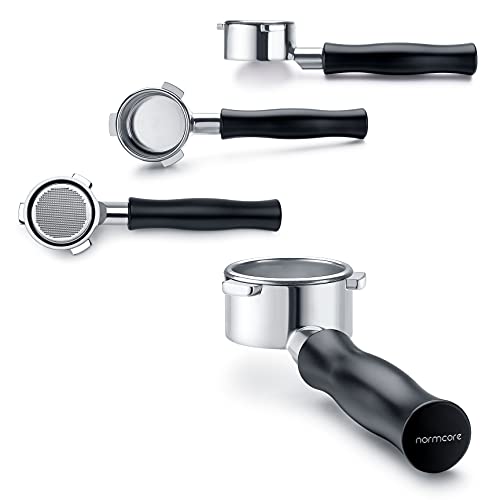
| Standard 58 mm home machine | Normcore Bottomless Portafilter 58 mm | 18–22 g | Broad compatibility, removable handle options, commonly sold with a basket | Confirm the lug shape and basket quality for your exact group |
| Premium fit and finish | Pesado 58.5 mm portafilter | 18–22 g | Machined metal construction and a more substantial feel | Higher general market price, often about $100–$180 |
| Rancilio Silvia owner | Rancilio OEM-style or compatible 58 mm bottomless model | 14–21 g | Designed around the Silvia’s 58 mm group and familiar locking geometry | Not every generic 58 mm handle locks correctly |
| Breville 54 mm machine | Breville-compatible 54 mm bottomless portafilter | 16–18 g | Preserves the machine’s original smaller group format | 54 mm baskets and accessories are less interchangeable |
| Gaggia Classic owner | Gaggia-compatible 58 mm bottomless portafilter | 14–18 g | Works with the Classic’s compact 58 mm group when the lugs are correct | Basket depth and handle clearance vary by version |
The examples above are starting points rather than universal fits. Portafilter diameter alone does not guarantee compatibility: locking ears, ear thickness, basket-retaining geometry, and the distance from the basket to the shower screen all matter.
Head-to-head: what separates the best options?
1. Basket size and usable dose
A 58 mm basket is the easiest format to customize. It is widely available in 14–18 g, 18–22 g, and larger sizes, including precision baskets from IMS and VST. The wider puck is relatively shallow, so it gives you more room to distribute grounds evenly and inspect the extraction pattern.
Breville’s 54 mm format can produce excellent espresso, but its narrower basket usually has a deeper puck for the same dose. That makes distribution more sensitive to clumps and uneven tamping. A 51 mm basket, common on some compact or entry-level machines, can be perfectly serviceable but offers fewer third-party choices.
Do not choose a basket solely because it holds more coffee. Start with the dose recommended for the basket. For example, an 18 g basket may work poorly at 14 g because the puck is too shallow, while forcing 22 g into it can leave too little headspace and cause the puck to contact the shower screen.
2. Handle ergonomics
Handle shape affects workflow more than extraction. A straight cylindrical handle is easy to replace and clean, but can feel slippery with wet hands. Flared or contoured handles provide a more secure grip during locking and removal. Wood feels warm and distinctive but needs more care around water and detergent; nylon or POM handles tolerate daily washing better; aluminum and stainless steel are durable but may feel cold.
Check the handle angle and length if your machine sits beneath a low cabinet. A long handle can collide with the drip tray or force the machine away from the wall. A compact handle is useful in a small kitchen, while a heavier handle can make the portafilter feel more balanced during tamping.
3. Build materials
Stainless steel is the practical default for the basket cradle because it resists corrosion and does not retain coffee oils as readily as porous materials. A stainless body with a polymer handle is usually lighter and easier to use repeatedly. Fully metal versions feel substantial but may weigh 450–600 g with a basket, compared with roughly 250–400 g for lighter designs.
Look for a basket that is easy to remove without damaging the retaining spring. The spring will usually wear before the metal body does. Replacement springs are inexpensive, but an overly loose spring can let the basket fall out when knocking out the puck. A portafilter with a permanently bonded decorative handle may also be harder to repair than one using a standard threaded connection.
Decision matrix: match the portafilter to your routine
| Your situation | Best choice | Prioritize | Avoid |
|---|---|---|---|
| New to espresso and learning technique | Moderately priced 58 mm bottomless model | Removable handle, supplied 18 g basket, clear fit information | Buying several baskets before correcting distribution |
| Daily use, several drinks | Stainless body with a washable polymer handle | Comfort, replacement basket availability, easy cleaning | Unsealed wood that stays wet between shots |
| Small kitchen or low cabinets | Short-handle or compact design | Overall length, locking clearance, drip-tray access | Oversized handles chosen only for appearance |
| Precision-focused enthusiast | Machined 58 mm body with an IMS or VST basket | Accurate basket holes and dose range | Assuming a precision basket fixes bad puck preparation |
| Proprietary 54 mm or 51 mm machine | Machine-specific bottomless model | Exact lug pattern and basket depth | Generic 58 mm accessories with an adapter |
How a bottomless portafilter reveals extraction problems
Lock in the portafilter, start the shot, and watch the underside rather than immediately changing the grind. A good extraction often begins with a few dark points that join into an even flow, then produces a centered, steady stream. The visual pattern is useful, but it should be considered alongside shot time, beverage weight, and taste.
- One side starts first: the puck may be tilted, tamped unevenly, or poorly distributed.
- Several thin jets spray outward: this commonly indicates channeling caused by clumps, voids, cracks, or an imperfect seal around the basket edge.
- The entire bottom turns pale quickly: the grind may be too coarse, the dose too low, or the shot too fast.
- A slow drip with no stable stream: the grind may be too fine, the dose too high, or the basket overfilled.
- Flow looks even but tastes harsh or thin: visual symmetry cannot diagnose every problem; dose, ratio, water temperature, and coffee freshness still matter.
Setup: a reliable first shot
- Verify the portafilter diameter and lug pattern against the machine manual or the manufacturer’s compatibility list.
- Install the basket and measure its dose range. Begin near the middle—for example, 18 g in an 18–22 g basket.
- Grind directly into the basket, break up clumps with a thin distribution tool, and level the coffee.
- Tamp level with consistent pressure. A perfectly level tamp matters more than pressing with extreme force.
- Lock the portafilter in gently and place a cup beneath it. Bottomless portafilters can spray during early attempts, so protect nearby surfaces.
- Record dose, beverage weight, and time. If 18 g in produces 36 g out in 30 seconds but the flow sprays, improve distribution before making a large grind adjustment.
A simple sizing calculation helps prevent overfilling. If your basket is rated for 18–22 g and you use 20 g, a 1:2 starting ratio targets about 40 g of espresso. That ratio is a reference point, not a rule: darker coffee may suit a shorter yield, while lighter coffee may need more water and a longer extraction.
Ownership, cleaning, and common mistakes
Rinse the portafilter and basket after each use, wipe coffee oils from the underside, and remove the basket periodically for a deeper wash. Backflush the machine according to its manual. Avoid leaving a wet puck in the basket, since oils and residue can collect around the holes and retaining spring.
The most common mistake is blaming the portafilter for a problem caused by the grinder. A bottomless design exposes channeling but does not prevent it. A poor grinder, inconsistent dose, stale coffee, or a damaged group gasket can all create disappointing shots. Replace the group gasket when it becomes hard, flattened, or leaky; replace the basket if holes are visibly damaged or blocked after cleaning.
Final buying advice
Choose a machine-specific fit first, then choose the basket dose, handle comfort, and material. For a standard 58 mm machine, a well-fitting stainless model in the roughly $30–$80 general market range is enough to learn from; premium machined options commonly cost about $100–$180. The most useful bottomless portafilter is not the heaviest or most decorative one—it is the model that accepts a suitable basket, locks securely, feels comfortable, and lets you correct the extraction mistake it makes visible.