Key takeaways
- Built for the Next Generation of Gaming
- Discrete graphics required
- Compatible with Intel 600 series and 700 series…
The best CPU for gaming right now is the AMD Ryzen 7 9800X3D for most builders, the Ryzen 5 7600 or Core Ultra 5 245K for budget rigs, and the Ryzen 9 9950X3D if you stream or do heavy productivity alongside gaming. The right pick depends on your resolution, GPU tier, and whether your workload is pure FPS or mixed use — below we break down the actual performance math so you can match a chip to your situation.
Our top picks
 Intel Core i7-12700KF Gaming Desktop Processor 12
- Built for the Next Generation of Gaming
- Discrete graphics required
- Compatible with Intel 600 series and 700 series…
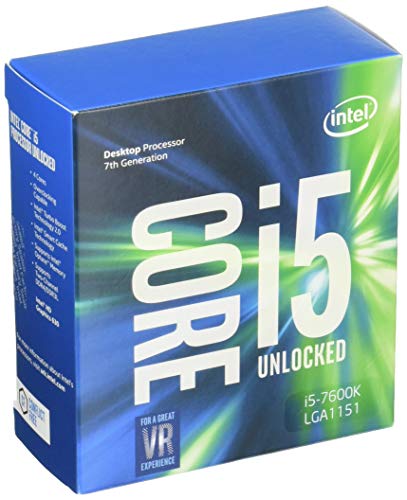 Intel BX80677I57600K 7th Gen Core Desktop Processors
- Socket LGA 1151
- Intel 200/1001 Series Chipset Compatibility (1
- Intel HD Graphics 630
As an Amazon Associate we earn from qualifying purchases at no extra cost to you.
Quick Picks by Situation
- Best overall: AMD Ryzen 7 9800X3D — the fastest gaming CPU on the market, typically $470–$500.
- Best value / 1440p sweet spot: AMD Ryzen 5 9600X or Ryzen 7 7700X — $200–$300.
- Best budget / 1080p build: AMD Ryzen 5 7600 or Intel Core i5-12400F — $130–$200.
- Best hybrid (gaming + streaming/editing): AMD Ryzen 9 9950X3D or Intel Core Ultra 9 285K — $650+.
- Best drop-in AM4 upgrade: Ryzen 7 5700X3D — under $250 and still very strong at 1440p.
Why the 9800X3D Still Wins in 2026
AMD’s 3D V-Cache design stacks extra L3 cache directly on the die — 96MB total on the 9800X3D — which slashes memory latency in games. In CPU-bound scenarios (1080p with a high-end GPU, esports titles, simulation games like Factorio or Microsoft Flight Simulator), it outpaces even the much more expensive Core Ultra 9 chips by roughly 10–15% on average. Because the cache is now below the cores, it also overclocks properly and runs cooler than the 7800X3D it replaces.
The catch: its advantage shrinks as resolution rises. At 4K, the GPU becomes the bottleneck and the 9800X3D’s lead over a $200 chip can drop to low single digits. If you’re on a 4K monitor, spending $500 on the CPU is mostly wasted money — put it toward the GPU instead.
Spec and Price-to-Performance Comparison
| CPU | Cores/Threads | Boost Clock | L3 Cache | TDP | Socket | Street Price (2026) |
|---|---|---|---|---|---|---|
| Ryzen 7 9800X3D | 8 / 16 | 5.2 GHz | 96 MB | 120 W | AM5 | $470–500 |
| Ryzen 7 7800X3D | 8 / 16 | 5.0 GHz | 96 MB | 120 W | AM5 | $340–380 |
| Ryzen 9 9950X3D | 16 / 32 | 5.7 GHz | 128 MB | 170 W | AM5 | $680–720 |
| Ryzen 5 9600X | 6 / 12 | 5.4 GHz | 32 MB | 65–105 W | AM5 | $210–250 |
| Ryzen 5 7600 | 6 / 12 | 5.1 GHz | 32 MB | 65 W | AM5 | $180–200 |
| Ryzen 7 5700X3D | 8 / 16 | 4.1 GHz | 96 MB | 105 W | AM4 | $220–250 |
| Core Ultra 5 245K | 14 (6P+8E) | 5.2 GHz | 24 MB | 125 W | LGA1851 | $270–300 |
| Core Ultra 7 265K | 20 (8P+12E) | 5.5 GHz | 30 MB | 125 W | LGA1851 | $370–400 |
| Core i5-12400F | 6 / 12 | 4.4 GHz | 18 MB | 65 W | LGA1700 | $110–130 |
Cost Per Frame: The Math That Actually Matters
Take a 1440p build with an RTX 5070-class GPU. Realistic average framerates across a mixed game library:
- 9800X3D: ~150 fps average → $485 ÷ 150 = ~$3.23 per frame
- 9600X: ~135 fps average → $230 ÷ 135 = ~$1.70 per frame
- Core i5-12400F: ~118 fps average → $120 ÷ 118 = ~$1.02 per frame
The 9800X3D is a luxury item in pure value terms — you’re paying a ~90% price premium over the 9600X for ~11% more frames at 1440p. That premium only makes sense if you game at 1080p on a 240Hz+ monitor, play cache-sensitive titles, or want the best regardless of cost. At 4K those gaps compress further, often below 5%.
One hidden cost: platform. AM4 chips like the 5700X3D reuse cheap DDR4 and existing motherboards. Moving to AM5 adds roughly $250–350 for a B650 board and 32GB of DDR5 — factor that into any “budget” comparison.
Matching the CPU to Your Resolution and GPU
1080p high-refresh esports
Here the CPU is the bottleneck with any GPU above midrange. The 9800X3D is genuinely worth it — it delivers the 1% lows that keep a 360Hz monitor fed in Valorant, CS2, and Fortnite. Value alternative: 7800X3D.
1440p mainstream
The sweet spot where CPU and GPU share the load. A 9600X, 7700X, or Core Ultra 5 245K pairs cleanly with GPUs in the $400–700 range. Stepping up to the 9800X3D buys single-digit gains — only worth it if your GPU is flagship-class.
4K
Almost entirely GPU-bound. Even a 7600 or 12400F loses under 8% to the 9800X3D in most titles. Spend the difference on a faster GPU or a better monitor.
Decision Matrix
| Your situation | Pick |
|---|---|
| Competitive 1080p, 240Hz+, flagship GPU | Ryzen 7 9800X3D |
| 1440p, mid-to-high GPU, budget-conscious | Ryzen 5 9600X or Core Ultra 5 245K |
| 4K or GPU budget under $500 | Ryzen 5 7600 — save the rest for the GPU |
| Gaming plus streaming, video editing, rendering | Ryzen 9 9950X3D or Core Ultra 7 265K |
| Already on AM4, just want more FPS cheaply | Ryzen 7 5700X3D |
Ownership Realities
X3D chips run warmer under sustained loads than their TDP suggests — a decent $40–60 tower cooler or 240mm AIO is worth it, and the 9950X3D really wants a 280mm+ liquid cooler. Intel’s Core Ultra chips benefit heavily from fast DDR5 (8000MT/s kits show measurable gains); if you pair a 265K with slow 5600MT/s memory you leave real performance on the table. AM5 has a promised upgrade path through at least 2027, so the socket itself is an investment; LGA1851’s future is less certain. Common mistake: pairing a $500 CPU with a $300 GPU — the CPU sits idle waiting on frames. Match CPU spend to roughly half your GPU spend for balanced builds.
FAQ
Is the 7800X3D still worth buying in 2026?
Yes — it’s within ~7% of the 9800X3D in games and now costs $100+ less. It’s the smart buy if you find it discounted.
Do I need DDR5 for gaming?
For AM5 and LGA1851 you have no choice. If you’re staying on AM4 or LGA1700, DDR4 is fine — the 5700X3D exists precisely for that path.
Intel or AMD for pure gaming?
AMD’s X3D chips lead outright. Intel’s Core Ultra K-series is competitive on price and stronger in multi-threaded work, so it’s the better hybrid pick at equal cost.