Key takeaways
- Paper width: 80mm thermal roll (standard 3 1/8″ receipt paper)
- Print method: Direct thermal — no ink, no ribbon, no toner
- Cutter: Automatic, built into the chassis
- Connectivity: Bluetooth, intended for iOS, Android and Windows hosts
- Cash drawer: Cash drawer kick-out port (the standard RJ-style drawer connector used across retail)
- Form factor: Compact countertop chassis designed to sit beside or under a till
Best Receipt Printers for Retail POS 2026
The best receipt printer for most retail point of sale counters in 2026 is the Star Micronics TSP143IIIBi — an 80mm Bluetooth thermal unit with auto-cutter that suits shops wanting cable-free placement, tablet-based POS, or a counter where running new cabling isn’t practical. If you need the widest hardware flexibility at a lower outlay, the NetumScan 80mm USB POS printer with auto-cutter and cash drawer port is the strongest value pick. For very low-volume or mobile selling — market stalls, food trucks, pop-up booths — the Sunydog 58mm mini thermal printer covers the basics for a fraction of the cost. The single biggest decision is paper width: 80mm gives you wider layouts, faster throughput and lower cost per receipt at volume; 58mm gives you a smaller footprint and cheaper hardware but narrower columns and more frequent roll changes.
Top 3 Picks
Best Overall: Star Micronics TSP143IIIBi
The TSP143IIIBi pairs an 80mm thermal mechanism with Bluetooth, auto-cutter and a compact footprint that fits under most counters. It is the pick for shops running iOS, Android or Windows POS on a tablet or laptop where you don’t want a permanently tethered cable run, and Star’s driver and SDK support is the broadest in the category.
Best Budget: Sunydog 58mm Mini Thermal Printer
A USB-powered 58mm thermal printer aimed at occasional receipting, mobile selling and light retail. It won’t handle a busy queue, but for a market stall, a service counter that issues a handful of tickets a day, or a backup unit, it does the job at the lowest entry point on this list.
Best Premium / High-Volume: Epson TM-T20IV
The TM-T20IV is Epson’s workhorse counter printer: 80mm paper, roughly 310mm/s print speed, auto-cutter, and USB/Ethernet/Serial connectivity in one chassis. It’s the choice for a permanent till position with wired networking, high daily receipt counts, and a long replacement horizon.
Quick Comparison
| Product | Best For | Paper Width | Key Specs | Connectivity | Price Tier |
|---|---|---|---|---|---|
| Star Micronics TSP143IIIBi | Cable-free counter, tablet POS | 80mm | Thermal, auto-cutter, Bluetooth, cash drawer port | Bluetooth (iOS/Android/Windows) | Premium |
| NetumScan USB POS Receipt Printer | Best value wired 80mm counter | 80mm | Thermal, auto-cutter, ~300mm/s, cash drawer port | USB | Mid-range |
| MUNBYN Bluetooth Thermal 80mm | Multi-interface flexibility | 80mm | Thermal, auto-cutter, USB/Serial/Ethernet/Bluetooth | USB, Serial, Ethernet, Bluetooth | Mid-range |
| Epson TM-T20IV | High-volume permanent till | 80mm | Thermal, auto-cutter, ~310mm/s, energy-efficient design | USB, Ethernet, Serial | Premium |
| Sunydog 58mm Mini Thermal | Mobile / low-volume selling | 58mm | Portable thermal, USB, compact chassis | USB | Budget |
| Vonlyst 3 1/8″ x 230′ Thermal Rolls | Consumables for 80mm printers | 80mm (3 1/8″) | BPA-free thermal paper, 230ft rolls, Epson TM-T88/T70/T20 compatible | n/a (consumable) | Budget |
How We Chose
This roundup is built from published manufacturer specifications, category-standard hardware conventions, and the practical constraints retailers actually run into: counter depth, receipt volume per day, whether the POS runs on a tablet or a fixed terminal, and how the machine is serviced when it jams or the cutter dulls. We weighted paper width first, because it determines everything downstream — roll cost, layout width, print speed ceiling and physical footprint. Connectivity came second, since the difference between a Bluetooth unit and a wired Ethernet unit is usually a cabling decision, not a features decision. We then looked at loading mechanism (drop-in versus spool/ribbon-style loading), cutter type, and the availability of consumables at sensible prices. Finally we considered upgrade path: whether a shop can move from a budget 58mm unit to a mid-range 80mm unit without changing its POS software setup. No product here was tested, benchmarked or owned by us; the goal is to map each listing to the counter it genuinely fits.
1. Star Micronics TSP143IIIBi – Best for Cable-Free Tablet POS
As an Amazon Associate we earn from qualifying purchases at no extra cost to you.

The TSP143IIIBi is the printer you buy when the till position is fixed but the cabling isn’t. It’s an 80mm direct thermal receipt printer with a built-in auto-cutter and Bluetooth wireless connectivity, marketed for iOS, Android and Windows POS setups — which covers the tablet-and-phone POS platforms that most small shops and cafés run in 2026.
Star Micronics is one of the two or three names that have defined the thermal receipt printer category for decades, and the TSP series is the reference point that most POS software vendors write their drivers against. That matters more than any single spec: when a POS platform says “supported printers,” a Star TSP unit is almost always on the list, and often it’s the device the software was developed on. Practical consequence — fewer driver surprises, fewer “printer not recognised” support tickets during a busy Saturday.
Key Specs
- Paper width: 80mm thermal roll (standard 3 1/8″ receipt paper)
- Print method: Direct thermal — no ink, no ribbon, no toner
- Cutter: Automatic, built into the chassis
- Connectivity: Bluetooth, intended for iOS, Android and Windows hosts
- Cash drawer: Cash drawer kick-out port (the standard RJ-style drawer connector used across retail)
- Form factor: Compact countertop chassis designed to sit beside or under a till
Strengths
Bluetooth is the headline. In a shop with stone counters, glass display cases or a listed building where drilling a cable run is a nightmare, a wireless printer removes the single most annoying install problem in retail POS. It also lets you reposition the printer seasonally — move it to a second counter for a sale weekend, or shift it to a pop-up table — without running anything.
The auto-cutter is the other quietly important feature. Manual-tear receipt printers produce ragged edges, which look unprofessional and, at volume, cost you a second or two per transaction. Over 200 receipts a day that’s minutes of staff time and a visibly worse customer experience.
80mm paper gives you a full-width receipt layout: item lines with quantity, unit price and total on one row, plus room for a logo, VAT breakdown and a QR code for digital receipts. On 58mm paper you’re often forced into two-line item formatting, which lengthens every receipt and slows the queue.
Pros
- Wireless Bluetooth connection — no cable run required
- 80mm width supports full retail receipt layouts
- Auto-cutter included as standard
- Excellent POS software and driver support across platforms
- Cash drawer port for a standard retail drawer
- Compact enough for a shallow counter
Cons
- Premium price tier — the most expensive class on this list
- Bluetooth pairing adds one setup step versus plug-in USB
- Wireless means one more device to keep charged/powered and paired; a dropped pairing mid-shift is a real (if rare) failure mode
- Overkill if your volume is a handful of receipts a day
How It Compares
Against the MUNBYN 80mm Bluetooth thermal printer, the Star unit costs more but buys you the deepest driver ecosystem in the category and a brand that POS vendors actively test against. The MUNBYN gives you more connection options in one box — USB, Serial, Ethernet and Bluetooth — so if you might later want to move from wireless to wired Ethernet without buying new hardware, MUNBYN is the more flexible chassis.
Against the Epson TM-T20IV, the trade is wireless convenience versus wired reliability and speed. The TM-T20IV is a networked, cable-connected machine with a higher headline print speed; the Star is the one you can put anywhere. If your counter already has a network drop and a permanent till, go Epson. If it doesn’t, and you don’t want to pay an electrician, go Star.
2. NetumScan 80mm USB POS Receipt Printer – Best Value Wired 80mm Counter

The NetumScan 80mm USB POS receipt printer is the value play for a shop that wants full-width 80mm receipts, an auto-cutter and a cash drawer port without paying premium-brand money. It’s a direct thermal machine rated around 300mm/s, which puts it in the same throughput class as far more expensive units.
For most independent retailers — a single till, a few hundred receipts a day, POS software running on a Windows PC or laptop — this is the specification that actually matters, and it’s a sensible place to put the money. The savings versus a premium unit are best spent on thermal paper, because that’s where your ongoing cost sits.
Key Specs
- Paper width: 80mm thermal roll
- Print method: Direct thermal (no ribbon, no ink)
- Print speed: Rated around 300mm/s — comfortably fast for retail queues
- Cutter: Automatic
- Cash drawer: Cash drawer port included
- Connectivity: USB — plug into the POS terminal
Strengths
USB is the least glamorous and most reliable connection type in retail. There’s no pairing, no network configuration, no Wi-Fi dropout — you plug it in and the operating system sees it as a printer. For a shop owner who doesn’t want to become an IT administrator, that simplicity has real value.
The 300mm/s rating deserves context. A typical 80mm retail receipt is roughly 150–250mm long depending on item count, logo and footer. At 300mm/s, that’s under a second of actual printing time per receipt. In practice the bottleneck is never the printer head — it’s the POS software rendering the job and the operator bagging the goods. Which means a 300mm/s printer is already beyond the speed most shops can consume, and paying a large premium for a marginally higher figure rarely changes queue times.
At the four-figure-plus receipt-per-day level, the economics shift decisively in favour of 80mm over 58mm. Thermal paper is sold by roll length; an 80mm roll carries more printable area per roll in terms of characters per receipt than a 58mm roll for a given receipt layout, because fewer lines are needed. Fewer lines means shorter receipts, which means more receipts per roll. A shop issuing 300 receipts a day can easily run through a 58mm roll in a single morning.
Pros
- Mid-range price for a full 80mm auto-cutter machine
- ~300mm/s print speed — more than enough for retail queues
- USB connection is plug-and-play reliable
- Cash drawer port included
- Accepts standard 80mm thermal rolls, widely available
- Straightforward upgrade path from a 58mm budget unit
Cons
- USB only — no Ethernet, no Bluetooth, no Serial
- Printer must sit physically close to the POS terminal
- Cable is another thing to route and secure under a counter
- Driver and support ecosystem is thinner than Star or Epson
How It Compares
Versus the Epson TM-T20IV, you give up Ethernet networking, a slightly higher print speed and the premium brand’s longevity reputation. You keep 80mm width, auto-cut and the cash drawer port. For a single-till independent shop, the practical difference is small; for a multi-lane store wanting every printer on the network, Ethernet matters and the Epson wins.
Versus the MUNBYN 80mm, it’s close. MUNBYN offers the same 80mm width with a much wider spread of interfaces — Ethernet, Serial, USB and Bluetooth — which makes it the better choice if you’re unsure how your setup will evolve. NetumScan is the simpler, USB-only option, which is fine if you’re confident your till will stay wired to one PC.
3. MUNBYN Bluetooth Thermal Receipt Printer 80mm – Best for Multi-Interface Flexibility

The MUNBYN 80mm black thermal receipt printer is the “hedge your bets” option: one chassis offering USB, Serial, Ethernet and Bluetooth, so whichever connection you end up needing, it’s already there. That’s genuinely useful for a shop that isn’t sure yet whether its next POS will be tablet-based or a wired network till.
MUNBYN has become a well-known name in the thermal printing space, particularly for label and receipt printers aimed at small businesses. The 80mm receipt model here is a direct thermal unit with an auto-cutter in a black chassis that suits modern, dark-counter retail interiors better than the traditional beige.
Key Specs
- Paper width: 80mm thermal roll
- Print method: Direct thermal — no ribbons or ink cartridges
- Cutter: Automatic
- Connectivity: USB, Serial, Ethernet and Bluetooth in one unit
- Colour: Black (matters if the printer will sit visibly on the counter)
Strengths
Four interfaces in one box is the whole pitch, and it’s a better pitch than it sounds. Retail POS setups change: a shop might start on a Windows laptop over USB, move to a tablet with Bluetooth after a refit, and eventually settle on a small network of Ethernet-connected tills. Buying a printer that covers all three paths means the printer outlives the first POS setup — which is often the difference between replacing hardware at year two and keeping it through year six.
Ethernet specifically is underrated in retail. A network-connected printer can sit anywhere there’s a switch port, can be shared by multiple terminals, and doesn’t depend on a single PC being switched on. In a shop where the person at the terminal also answers the phone and handles deliveries, removing the printer from the PC’s dependency chain is a small but real operational win.
80mm width plus auto-cut plus direct thermal is the correct baseline configuration for a retail counter, and MUNBYN delivers it without a premium-brand price tag.
Pros
- Unusual interface breadth — USB, Serial, Ethernet and Bluetooth
- 80mm width with auto-cutter as standard
- Bluetooth option removes cable constraints for tablet POS
- Ethernet option allows shared/networked printing
- Black chassis suits contemporary counter design
- Mid-range price tier
Cons
- More connection options means more configuration choices to get wrong at setup
- Driver/support ecosystem isn’t as deep as Star Micronics or Epson
- Bluetooth and Ethernet on one device can complicate troubleshooting when something stops working
- No cash drawer port details to rely on beyond the listing’s stated features — check before buying if a drawer kick-out is essential
How It Compares
Against the Star Micronics TSP143IIIBi: MUNBYN gives you more interfaces for less money, but Star gives you Bluetooth plus the most thoroughly supported driver stack in retail POS. If your POS software has a short supported-printer list, Star is the safer bet; if it’s an open platform, MUNBYN’s flexibility is worth more.
Against the NetumScan 80mm USB printer, MUNBYN wins on future-proofing. Same paper width, same auto-cutter class, but four connection options instead of one. NetumScan wins on simplicity and typically on price — if you’re certain about your setup, it’s the leaner buy.
4. Epson TM-T20IV Thermal Receipt Printer – Best Premium for High-Volume Tills
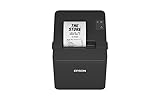
The Epson TM-T20IV is the printer you install once and forget about for years. It’s an 80mm direct thermal receipt printer with auto-cutter, rated around 310mm/s, offering USB, Ethernet and Serial connections, and built with energy efficiency in mind — an Epson family trait that quietly matters when the printer is powered on for twelve hours a day, six days a week.
The TM-T20 series is one of the most widely deployed retail receipt printers in the world. That installed base is the product’s real feature: because so many exist, POS software vendors test against them, technical documentation is abundant, and any retail IT contractor you hire has almost certainly configured one before.
Key Specs
- Paper width: 80mm thermal roll
- Print method: Direct thermal
- Print speed: Rated around 310mm/s
- Cutter: Automatic
- Connectivity: USB, Ethernet and Serial
- Efficiency: Energy-efficient design marketed for continuous retail operation
Strengths
Ethernet plus USB plus Serial in a single unit makes this the most genuinely “plug into anything” wired printer here. A network drop is the cleanest permanent install in retail: the printer lives wherever you want it, any terminal on the network can print to it, and there’s no PC acting as a bottleneck.
The energy-efficiency angle is easy to dismiss and shouldn’t be. A receipt printer in a busy shop draws power continuously for the whole trading day. Epson’s TM-T20 line is specifically designed to reduce consumption during idle periods while staying ready to print instantly — no wake-up delay when a transaction lands. Over a year of trading hours, across several tills, that’s a real but modest operating cost difference, and a real difference in heat output under a counter.
The roughly 310mm/s rating is the highest in this roundup, though as with any speed figure the practical gain over a 300mm/s unit is negligible at retail volumes. Where the Epson earns its premium is reliability and serviceability: a reciprocating or guillotine-style auto-cutter designed for a long cut life, a mechanism built for constant cycling, and the fact that spare parts and consumables are available everywhere.
Pros
- Widest wired connectivity set: USB, Ethernet and Serial
- ~310mm/s print speed — the fastest class in this roundup
- Energy-efficient design suited to all-day operation
- Extremely broad POS software and driver support
- Huge installed base means easy to find help and configuration guides
- Standard 80mm thermal paper — cheap, universally available consumables
Cons
- Premium price tier
- No Bluetooth — fully wired, so it needs a cable or network point at the counter
- Price premium buys reliability, not features you’ll notice day to day
- Overkill for a shop issuing fewer than roughly 50 receipts a day
How It Compares
Against the Star Micronics TSP143IIIBi, this is the wired-versus-wireless decision in its purest form. Epson: permanent install, network shared, no pairing, higher speed. Star: place it anywhere, no cable, supported on every mobile POS platform. If your counter has power and a network point, Epson. If it has neither, Star.
Against the NetumScan 80mm, the Epson costs meaningfully more for the same paper width and the same auto-cut class. What the extra money buys is the Ethernet/Serial options, the recognised brand, the efficiency design and the confidence that the machine will still be supported in five years. For a single low-volume till that’s hard to justify; for a busy shop with several lanes, it’s the safer long-term buy.
5. Sunydog 58mm Mini Thermal Printer – Best Budget for Mobile and Low-Volume Selling

The Sunydog portable mini thermal receipt printer is a 58mm USB unit built for small-footprint receipting: a portable, compact chassis that prints bills and tickets on standard 58mm thermal paper. It’s the entry point of this roundup and it is honest about what it is — a light-duty receipt and ticket printer, not a till workhorse.
58mm is the smaller of the two retail receipt standards, and it exists for a reason: the printer can be small, light and cheap, and the rolls take up far less storage space behind a counter. For a market stall, a food truck, a mobile service business, a small kiosk or a repair counter that issues a handful of tickets a day, that trade is entirely reasonable.
Key Specs
- Paper width: 58mm thermal roll
- Print method: Direct thermal — no ink or ribbon
- Connectivity: USB
- Form factor: Portable, compact mini chassis
- Use case: Receipts, bills and tickets
Strengths
Size and price, and the two reinforce each other. A 58mm printer takes a fraction of the counter space of an 80mm unit, and the paper rolls are smaller and cheaper per roll (though you’ll use more of them per hundred receipts). For a stall operator packing up at the end of a market day, that portability is the point.
Direct thermal on 58mm means zero consumables beyond the paper itself. No ribbon, no ink, no cartridge, no cleaning cycle beyond an occasional wipe of the print head. For a business where the owner is also the operator, that’s one less maintenance task to remember.
USB power and data is the simplest possible setup: one cable, one driver, done. There’s no pairing routine and no network config to get wrong.
Pros
- Lowest price tier in this roundup
- Very small footprint — fits in tight counter space
- Portable, suitable for pop-ups and mobile selling
- USB plug-and-play setup
- Direct thermal — no ribbons or ink to buy
- 58mm rolls are inexpensive and widely stocked
Cons
- Narrow 58mm paper limits receipt layout — item lines often wrap onto two rows
- Not suited to high daily volumes
- USB only — the printer must sit next to the host device
- No auto-cutter on this class of unit; expect manual tear-off
- No cash drawer port, so drawer integration isn’t possible
- Narrower receipts use more paper per transaction than 80mm
How It Compares
Against the NetumScan 80mm, the difference is entirely about volume and layout. Sunydog is cheaper, smaller and fine for a dozen receipts a day; NetumScan gives you double the printable width, an auto-cutter, a cash drawer port and roughly 300mm/s throughput. If you’re issuing more than about 50 receipts a day, or you need full-width item lines, the 80mm unit pays for itself in staff time and paper efficiency.
Against the Star Micronics TSP143IIIBi, there’s no real contest on capability — one is a premium wireless 80mm counter printer, the other a budget portable 58mm. The honest comparison is volume: below roughly 30 receipts a day, a 58mm mini printer is genuinely sufficient and the premium unit is money you don’t need to spend.
6. Vonlyst 3 1/8″ x 230′ Thermal POS Rolls – Best Consumable for 80mm Printers

Thermal paper is the running cost of any receipt printer, and it’s the line item most buyers forget when comparing hardware. The Vonlyst 3 1/8″ x 230′ thermal POS rolls are 80mm (3 1/8 inch) rolls rated BPA-free, sized for Epson TM-T88, TM-T70 and TM-T20 family printers — which means they fit essentially any standard 80mm direct thermal receipt printer, not just Epson units.
Key Specs
- Roll width: 3 1/8″ (80mm) — the standard 80mm receipt width
- Roll length: 230 feet per roll
- Paper type: Thermal, BPA-free formulation
- Compatibility: Epson TM-T88, TM-T70, TM-T20 and other standard 80mm thermal printers
- Role: Consumable, not hardware
Strengths
Roll length is the number that actually determines your cost per receipt, and 230 feet is a healthy length for an 80mm roll. Longer rolls mean fewer roll changes, and roll changes are the only routine maintenance task a thermal receipt printer really has. Fewer changes also mean less chance of a staff member loading the roll the wrong way round — the single most common receipt printer “fault,” and one that produces a completely blank receipt that looks like a hardware failure.
BPA-free paper is increasingly the default specification buyers look for, particularly in food service and in any setting where staff handle receipts continuously through a shift. It addresses a paper-additive concern rather than a printer feature, so it’s worth noting simply as a formulation choice, not a health claim.
Standard 80mm sizing is the key compatibility point. Any printer in this roundup that takes 80mm paper — the Star TSP143IIIBi, the NetumScan, the MUNBYN and the Epson TM-T20IV — will accept these rolls. That means one consumable SKU can serve your whole estate whether you run mixed brands or upgrade one till at a time.
Pros
- 230ft rolls reduce the frequency of roll changes
- BPA-free thermal formulation
- Standard 80mm width fits all 80mm printers in this roundup
- Compatible with the widely deployed Epson TM-T88/T70/T20 families
- Consumable price tier — the cheapest way to reduce your cost per receipt
Cons
- Only fits 80mm printers — useless if you bought a 58mm unit
- Thermal paper is heat- and light-sensitive; store away from radiators and direct sun
- Not appropriate for long-term archival receipt copies, as thermal print fades over time
How It Compares
This isn’t really a competitor to the printers — it’s the consumable that goes in four of the five. The comparison that matters is 80mm versus 58mm rolls. An 80mm roll holds more paper and your receipts are shorter per transaction, so a box of 80mm rolls typically goes further than the equivalent spend on 58mm rolls for the same number of sales. If you’re choosing between the Sunydog 58mm printer and an 80mm unit and you’re anywhere near the volume boundary, buy the 80mm machine and these rolls.
How to Choose
Receipt printer selection comes down to four questions in a fixed order: paper width, print speed, loading mechanism and daily cycle rating. Get those four right and everything else — brand, colour, warranty — is a detail.
Step 1: Choose Paper Width First
This is the decision that constrains everything else, and it’s a two-option choice.
80mm (3 1/8 inch) is the standard for shop tills. The printable area is roughly 72mm wide, which is enough for a single-line item row: quantity, description, unit price and line total all on one row. That layout produces shorter receipts, faster transactions and a professional-looking document. 80mm printers cost more than 58mm units, take up more counter space, and generally offer auto-cutters and cash drawer ports as standard.
58mm is the compact standard. The printable area is roughly 48mm wide, which forces longer item descriptions onto a second line and often splits the price onto its own row. Receipts get longer, so you use more paper per transaction. In exchange, the printer is small, light and cheap, and the paper rolls take up far less storage.
The crossover is volume. Below roughly 30 receipts a day, 58mm is genuinely adequate. Between 30 and 50 a day it’s borderline — you’ll start noticing the extra paper and the longer print runs. Above 50 receipts a day, 80mm is the right answer, and above 200 a day it’s not really a choice at all: the paper efficiency and the auto-cutter pay for the price difference within the first year.
Step 2: Understand Print Speed in Context
Print speed for thermal receipt printers is quoted in millimetres per second. The units in this roundup span roughly 300mm/s (NetumScan) to around 310mm/s (Epson TM-T20IV), which sounds like a tie — and effectively is one.
Here’s the arithmetic that matters. A typical 80mm retail receipt with a header, six item lines, a subtotal, tax line, payment line and footer runs somewhere around 150 to 250mm of paper. At 300mm/s, a 200mm receipt takes about 0.67 seconds to print. At 310mm/s, it takes about 0.65 seconds. The difference is 0.02 seconds per transaction — at 300 receipts a day, that’s six seconds saved across an entire trading day.
Meanwhile, the receipt printing time is a small slice of the total transaction. The operator takes payment, the POS renders the job, the cutter fires, the receipt drops, the operator tears and hands it over. The practical bottlenecks are the software and the human. Which means: print speed above roughly 250mm/s is not a reason to pay more. It’s a checkbox, not a differentiator. Spend the money on paper width, auto-cut and reliability instead.
Where speed does matter is at genuinely high volume — a busy supermarket express lane or a high-turnover café where the receipt must be ready before the customer has picked up their change. Even then, the gap between 300 and 310mm/s is not what makes the difference; the auto-cutter is.
Step 3: Drop-In vs Ribbon Loading
This is the maintenance question, and it’s the one that costs you staff time every week.
Drop-in loading is the modern standard and what every printer in this roundup uses. You open a hinged cover or a clamshell top, drop the roll into a cradle, pull the leading edge of the paper forward so it emerges past the print head, close the lid and the printer self-feeds. Whole process: about ten seconds. No threading, no spools, no alignment. A new starter can be shown once and will get it right.
Ribbon or spool loading describes the older mechanism where you mount the roll on a spindle, thread the paper through a guided path past the print head, and often hand-feed it through a slot. This is more common on impact/dot-matrix receipt printers and some legacy thermal units. It takes longer, it’s easier to get wrong, and a mis-thread produces either a jam or a blank receipt. If you’re running a busy counter with high staff turnover, drop-in loading is worth actively choosing for.
One more point on loading direction, whatever the mechanism: the thermal coating faces the print head, which means the paper must unroll from the bottom and feed over the top. Get it backwards and the printer runs perfectly while producing nothing. It is the most common cause of a “broken” receipt printer and the first thing to check.
Step 4: Match the Daily Cycle Rating to Your Volume
Manufacturers don’t always publish a clean “receipts per day” figure, so think in terms of duty classes. Here’s how the printers in this roundup map to real trading patterns:
| Daily Receipts | Typical Business | Paper Width | Class to Buy |
|---|---|---|---|
| 1–30 | Market stall, food truck, mobile service, repair counter | 58mm acceptable | Budget mini (Sunydog 58mm) |
| 30–100 | Small independent shop, single till, café | 80mm preferred | Mid-range wired (NetumScan 80mm) |
| 100–300 | Busy retail unit, multi-staff counter, tablet POS | 80mm | Mid-range, wireless or multi-interface (MUNBYN 80mm, Star TSP143IIIBi) |
| 300+ | High-turnover store, multi-lane, all-day operation | 80mm | Premium high-cycle (Epson TM-T20IV) |
These boundaries are guidelines, not rules. What they capture is that printer mechanisms have a service life measured in millions of lines printed, and running a light-duty unit well beyond its class is what causes premature failure — usually the print head or the cutter, in that order.
Step 5: Cutter and Cash Drawer Ports
Auto-cutter is the single feature with the best cost-to-benefit ratio after paper width. Manual tear-off is slower, produces ragged edges, and on 80mm paper the tear bar wears and starts producing diagonal tears. If you’re considering two 80mm printers at similar prices and only one has an auto-cutter, take the auto-cutter.
Cash drawer port matters only if you take cash and want the drawer to pop automatically when a sale is finalised. Most mid-range and premium 80mm units include one; budget 58mm units typically don’t. If your shop is card-only, ignore this entirely.
Step 6: Connectivity Decision
USB: simplest, most reliable, requires the printer to sit next to the POS terminal. Choose this if your till position is fixed and you don’t mind a cable.
Ethernet: the best option for a permanent install. The printer becomes a network device, any terminal can print to it, and it doesn’t depend on one PC being switched on. Requires a network point at the counter.
Bluetooth: the best option when running a cable is impractical — stone counters, glass cases, heritage buildings, or a tablet-based POS that moves around. Adds a pairing step and one more thing that can disconnect.
Serial: legacy but still found on retail hardware. Only relevant if your existing POS terminal or drawer setup already uses it.
Frequently Asked Questions
Is 58mm or 80mm better for a retail shop?
For any shop issuing more than roughly 50 receipts a day, 80mm is the better choice because the wider layout keeps item lines on a single row, producing shorter receipts and using less paper per transaction. 58mm makes sense below that threshold, or where counter space and portability genuinely matter more than paper efficiency. The difference compounds: at 300 receipts a day, an 80mm printer can meaningfully reduce your annual paper spend.
Do thermal receipt printers need ink or ribbons?
No. Direct thermal printers — which is every printer in this roundup — create the image by heating chemically treated paper. The only consumable is the paper roll itself. That’s why thermal has almost entirely replaced impact/dot-matrix receipt printing in retail: no ribbons, no ink, no cartridges, and effectively no cleaning beyond an occasional wipe of the print head.
How long does a roll of 80mm thermal paper last?
It depends on your receipt length. A typical 80mm retail receipt runs about 150–250mm, and a 230ft (roughly 70m) roll therefore yields somewhere in the region of 280 to 450 receipts. A shop issuing 200 receipts a day would go through roughly one roll every day and a half to two days, so buying paper in bulk is the sensible approach.
Why is my receipt printer printing blank paper?
The overwhelmingly common cause is a roll loaded the wrong way round. Thermal paper only develops an image where the coated side meets the heated print head, so if the roll is reversed the mechanism runs perfectly and produces nothing. Open the cover, flip the roll so the paper feeds off the bottom of the roll and over the top, and close it. If that doesn’t fix it, check the print head for debris before assuming a hardware fault.
Can I use a tablet instead of a PC with these printers?
Yes, if the printer supports it. The Star Micronics TSP143IIIBi is specifically marketed for iOS, Android and Windows, and the MUNBYN unit offers Bluetooth alongside its wired interfaces. USB-only printers work with tablets that have a USB or USB-C port and the right driver, but Bluetooth is the cleaner path for tablet POS. Always check that your POS software lists the printer as supported before buying.
What wears out first on a receipt printer?
The print head and the auto-cutter, in that order. Both have finite service lives measured in lines printed and cuts made, and both are pushed harder by running a light-duty printer above its intended daily volume. Paper dust and grit are the main accelerants — keeping the paper path clean and using quality thermal rolls is the cheapest way to extend a printer’s life. Print heads are replaceable on most commercial units, but on budget printers a replacement often costs close to a new machine.
Do I need an auto-cutter?
Strictly no, practically yes for anything above light use. Manual tear-off produces ragged edges, costs a second or two per transaction, and the tear bar itself wears out and starts pulling receipts diagonally. On a busy counter the auto-cutter is the feature that most visibly changes how the till feels to operate. Budget 58mm mini printers generally skip it; 80mm mid-range and premium units almost always include it.
Should I buy paper from the printer manufacturer?
Not necessarily. Standard 80mm thermal rolls are a commodity, and the Vonlyst 3 1/8″ x 230′ rolls are sized to fit the Epson TM-T88, TM-T70 and TM-T20 families as well as any other 80mm direct thermal printer. What matters is the correct width, the correct roll diameter for your printer’s cradle, and a reasonable paper grade. Non-standard roll diameters are the usual reason a roll “doesn’t fit” — check your printer’s maximum roll diameter before ordering in bulk.
Which One Should You Buy?
If you’re a single-till independent shop on a Windows PC: the NetumScan 80mm USB printer. Full-width receipts, auto-cutter, cash drawer port and roughly 300mm/s for a mid-range price. Buy the Vonlyst 80mm rolls alongside it and you’ve covered hardware and consumables in one go.
If your POS runs on a tablet, or cabling the counter is a problem: the Star Micronics TSP143IIIBi. Bluetooth removes the install headache, 80mm gives you a proper retail layout, and the driver support across iOS, Android and Windows is the best here.
If your setup might change — tablet today, networked tills tomorrow: the MUNBYN 80mm. USB, Serial, Ethernet and Bluetooth in one box means you don’t repurchase when your POS evolves.
If you’re a high-volume store with permanent till positions: the Epson TM-T20IV. Ethernet networking, roughly 310mm/s, energy-efficient design for all-day operation, and the deepest support ecosystem in the category.
If you’re a market stall, food truck or pop-up: the Sunydog 58mm mini thermal printer. Small, cheap, USB-simple, and entirely sufficient under about 30 receipts a day.