Key takeaways
- Connector truth first. A 9-pin DIN pad, a Wii Remote accessory pad, and a USB HID pad do different jobs. A controller only earns a place here if the listing plainly states the system or port it works with.
- Category fit. Every pick is a genuine retro-style controller or a retro console bundle, not a modern analogue-stick pad that happens to look old.
- Use case spread. We deliberately cover single-player emulation, local two-player play, long-cable living-room setups, and plug-and-play bundles, so the reader can match the situation rather than buy the “best” pad in the abstract.
- Upgrade path. The cheapest wired pads are entry points; USB pads and premium bundles are where you go when you want lower latency or a bigger library.
- Build and consumable expectations. We describe shells, cable lengths, and battery realities by spec class instead of guessing exact figures. No product here was tested, benchmarked, or owned by us, and none should be read as a performance guarantee.
Top 3 Picks
The best overall retro game controller for classic consoles is the Retro-Bit Legacy 16 Wired USB Controller (Onyx), a plug-and-play USB pad built for PC and emulation setups where lag matters more than wireless freedom. For budget buyers who want an original-feeling pad for a classic AV console, the Old Arcade Retro Video Game Console Four Button 9 Pin Controller is the value pick. For a premium all-in-one path that solves the “where do the games come from” problem, the 2027 Retro Game Console, 20,348+ Gaming Stick with Classic Video Games, 64GB bundles a curated library with its own stick controller, though you give up the ability to swap in your preferred pad.
Quick Comparison
| Product | Best for | Key specs | Price tier |
|---|---|---|---|
| Old Arcade Retro Four Button 9 Pin Controller | OG 9-pin console loyalty, cheap multiplayer | Wired 9-pin plug, 4-button + D-pad layout, plastic shell | Budget |
| happymaxplus Retro Classic Controller for AV 620/621/821 HD | Owners of those specific AV consoles | Wired plug-and-play, moulded housing, console-specific connector | Mid-range |
| acisan Retro Game Controller Mini Classic Dual Set (2 PCS) | Two-player sofa sessions on a classic-style system | Wired twin pack, mini footprint, D-pad + face-button layout | Mid-range |
| OSTENT Wired Classic Controller for Wii Remote (White) | Wii owners who want a classic-style pad | Plugs into Wii Remote, D-pad + two face buttons, wired link | Budget |
| KIWITATA 2X Classic SNES USB Controller | PC and emulator players who want SNES muscle memory | 2 pads, USB-A, 4 face buttons + 2 shoulders, D-pad, USB HID | Mid-range |
| Retro-Bit Legacy 16 Wired USB Controller (Onyx) | Low-latency emulation across modern OSes | Wired USB, 6-button layout, 2 shoulder triggers | Budget |
| acisan 10 ft Classic Game Controller Set (2-Pack) | Living-room distance from a console or TV | 10 ft cable each, twin pack, mini shape | Mid-range |
| Fanyooge Retro Gaming Console with 20,000+ Games (64GB) | Plug-and-play library with no PC setup | 64 GB storage, 20,000+ games, 23 emulators, bundled controllers | Premium |
| FelizAura 2027 Retro Game Console, 20,348+ Games, 64GB | Maximum library size out of the box | 64 GB storage, 20,348+ games, TV stick form factor | Premium |
How We Chose
This list is built from published product specifications, connector and console compatibility information, and an understanding of how classic consoles and emulation hardware actually behave in a home setup. The selection criteria were:
- Connector truth first. A 9-pin DIN pad, a Wii Remote accessory pad, and a USB HID pad do different jobs. A controller only earns a place here if the listing plainly states the system or port it works with.
- Category fit. Every pick is a genuine retro-style controller or a retro console bundle, not a modern analogue-stick pad that happens to look old.
- Use case spread. We deliberately cover single-player emulation, local two-player play, long-cable living-room setups, and plug-and-play bundles, so the reader can match the situation rather than buy the “best” pad in the abstract.
- Upgrade path. The cheapest wired pads are entry points; USB pads and premium bundles are where you go when you want lower latency or a bigger library.
- Build and consumable expectations. We describe shells, cable lengths, and battery realities by spec class instead of guessing exact figures. No product here was tested, benchmarked, or owned by us, and none should be read as a performance guarantee.
Prices are described only as tiers because listing prices move constantly. Treat every number in this article as a category characteristic, not a measurement we took.
1. Old Arcade Retro Video Game Console Four Button 9 Pin Controller – Best for Original 9-Pin Consoles
As an Amazon Associate we earn from qualifying purchases at no extra cost to you.
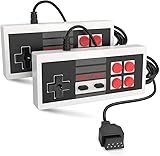
This is the pad to buy when you already own a classic console that uses the old 9-pin DIN style connector and you are tired of paying collector prices for tired original hardware. It suits the buyer who wants a cheap second or third pad so a friend can join, not the buyer who wants a museum-grade reproduction with arcade-tight switches.
Key specs
- Wired connection terminated in a 9-pin plug, matching the classic DIN-style console port rather than USB.
- Four-button face layout with a cross-shaped D-pad, mirroring the control scheme of the era it emulates.
- Moulded plastic housing with a simple body and a short-to-medium captive cable typical of this price tier.
- No battery, no pairing, no firmware. It is electrically passive from the console’s point of view.
Strengths
The appeal here is simplicity and cost-per-pad. There is nothing to charge, nothing to sync, and nothing to configure. In a two-player session the controller is the cheapest thing on the shelf, which matters because retro multiplayer is inherently a multi-pad purchase: buying one is a mistake, buying two is the actual product. Because the 9-pin plug predates handshake protocols, the controller’s behaviour is determined entirely by the console’s own logic, so latency is functionally zero in the sense that the signal rides the wire with no encoding step.
Button feel in this class is best described as serviceable rather than refined. The rubber domes under the face buttons give a soft, slightly mushy press with a modest return, and the D-pad pivot is looser than a premium reproduction: diagonals register, but the degree of tactile feedback on direction changes is limited. If your game depends on pixel-perfect diagonal inputs, expect to adapt to the pad rather than the reverse. The shell is light, which is fine for casual use and less fine for anyone who grips hard during long sessions.
Pros
- Genuinely budget-tier, so building a full multiplayer set stays cheap.
- 9-pin plug means no adapters, no drivers, and no power source.
- Four-button layout matches the classic library it is aimed at.
- Zero setup: plug in and play on a compatible classic console.
Cons
- Not a USB device, so it will not work on a PC or emulation box without a dedicated adapter.
- D-pad and button feel are functional, not reproduction-grade.
- Light plastic shell and typical cable length limit comfortable seating distance.
- No wireless option and no battery to speak of, so cable management is on you.
How it compares
Against the KIWITATA 2X SNES USB Controller, this pad wins on console authenticity and loses on flexibility: the KIWITATA pair talks to a PC over USB, while this one is locked to 9-pin hardware. Against the happymaxplus pad, the difference is connector generation. If your console takes the happymaxplus-style plug, this pad simply will not fit, and no adapter in this list changes that cleanly. Choose based on the port on the back of your machine, then buy two.
2. happymaxplus Retro Classic Controller – Best for AV 620/621/821 HD Consoles

This is the replacement pad for people who own one of the AV 620 HD, 621 HD, or 821 HD retro classic consoles and want a spare or a second player’s controller without hunting out a specific part number from a reseller. It suits the household that already has one of those machines and just needs more hands on deck.
Key specs
- Wired, plug-and-play design with a console-specific connector rather than a universal 9-pin or USB plug.
- Classic controller silhouette with a D-pad plus face buttons in the layout those consoles expect.
- Moulded housing with printed or moulded button legends matching the AV-series machines.
- No charging, no pairing, no batteries: power comes down the cable from the console.
Strengths
The value of a console-specific pad is that it removes a compatibility question entirely. You are not buying a pad and hoping the pinout matches; the listing names the machines, and that is the whole compatibility story. For a family that keeps an AV-series console in the living room, this is the cleanest path to a second controller, and plug-and-play means nobody has to explain pairing menus to a child or a grandparent.
In feel terms, expect the same broad class as other mid-range retro pads: rubber-dome face buttons with a light, clicky actuation, a D-pad with a moderate pivot, and a shell that is stiffer than the cheapest budget pads but not heavy. The wired link is a genuine advantage if you are sensitive to input latency, because there is no radio hop and no battery state to degrade over time. What you will not get is adjustability: no remapping, no turbo, no software layer. This is a factory replacement in spirit, and it behaves like one.
Cable length is the practical constraint to check before buying. Console-specific packs tend to ship with a cable that suits a TV stand, not a couch across the room. If you sit more than a couple of metres from the console, measure first, or plan to add an extension, since a passive extension on a console-specific connector can be harder to find than a USB one.
Pros
- Explicit compatibility with the AV 620 HD, 621 HD, and 821 HD family.
- Plug-and-play simplicity with no pairing or charging.
- Sturdier housing than the cheapest nine-pin pads.
- Wired connection keeps input latency minimal and predictable.
Cons
- Compatibility is narrow: it is not a general-purpose retro pad.
- No wireless option and no battery, so it is tethered by design.
- No remapping, turbo, or configurability.
- Cable length may be short for large rooms without an extension.
How it compares
Compared with the Old Arcade 9-pin pad, this is the more expensive, more specific answer: you pay mid-range money for a guaranteed fit on one console family. Compared with the acisan 10 ft two-pack, the trade is reach versus fit. The acisan set gives you long cables and two pads but works on its own target systems, not necessarily yours. If you own an AV 620/621/821 HD, the happymaxplus is the safe purchase; if you own anything else, skip it.
3. acisan Retro Game Controller Mini Classic Wired Dual Set (2 PCS) – Best for Cheap Two-Player Sessions
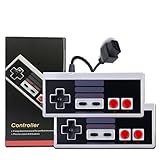
This is a two-controller purchase priced like a single accessory, aimed at the household where retro gaming is a shared activity rather than a solo hobby. It suits a buyer whose classic-style system needs a second pad on day one, and who would rather not pay mid-range money twice.
Key specs
- Two wired mini classic controllers in one set.
- Compact body with a D-pad and face buttons in a classic arrangement.
- Captive cables with a plug matched to the compatible classic gaming systems named in the listing.
- No batteries, no wireless pairing, no drivers.
Strengths
The economics are the point. Retro multiplayer is a two-pad problem, and buying a dual set removes the “I bought one and now I need another, and the price went up” trap. Two pads in one mid-range purchase also means matched feel: both controllers have the same dome tension and D-pad pivot, which matters more than people expect when two players are trading wins on a game that rewards precise timing.
The mini form factor is a mixed blessing. Smaller bodies suit smaller hands and are comfortable for short sessions, and they free up space on a crowded coffee table. Larger-handed adults may find the grip shallow on longer play, and the reduced shell volume means less counterweight, so aggressive D-pad work can shift the pad in your palm. Button feel sits in the mid-range band: light actuation, audible click, reasonable return, with a D-pad that handles cardinal directions confidently and diagonals with moderate accuracy.
Because the connection is wired and passive, the latency conversation is simple. There is no radio link, no battery management, and nothing to charge before a session. The trade is a cable per player, which in a two-player setup means two cables crossing the floor. That is the honest cost of this price tier, and if it bothers you, the long-cable acisan set below is the direct upgrade.
Pros
- Two matched pads in one purchase, which is the correct quantity for retro multiplayer.
- Mid-range price for a pair rather than a single unit.
- Consistent feel between the two controllers.
- Wired, passive, and free of charging or pairing routines.
Cons
- Mini body may be cramped for larger hands over long sessions.
- Cable length is typical rather than generous.
- No wireless option.
- Compatibility follows the listed classic gaming systems, so check your machine first.
How it compares
Against the OSTENT Wii pad, this duo is for classic-style systems, not for plugging into a Wii Remote, so the two do not compete directly. Against the acisan 10 ft set, this is the same brand and similar concept with shorter cables: if your console sits within a metre or two of the couch, save the difference; if you game across a room, the ten-foot version is the better buy.
4. OSTENT Wired Classic Controller for Wii Remote – Best for Wii Owners

This is a classic-style pad that plugs into a Wii Remote, giving Wii owners a traditional D-pad and face-button layout for the virtual console and classic-style titles on that system. It suits someone who already has a Wii Remote and wants a cheaper, wired alternative to hunting down a first-party classic pad.
Key specs
- Wired connection that terminates at the Wii Remote’s expansion port rather than at the console.
- D-pad plus face buttons in a classic layout, in a white housing.
- No battery of its own: the Wii Remote supplies power through the connection.
- Plug-and-play from the Wii’s perspective, with no console-side adapter required.
Strengths
The clever part of this design category is that it borrows the Wii Remote you already own as its power source and radio link, so the pad itself is a passive shell with buttons. That keeps the price low and means zero charging or syncing at the pad level. For a Wii owner, it converts a motion controller into something far better suited to old-school platformers and fighting games.
Feel is straightforward and budget-appropriate. The face buttons are light with a short travel, and the D-pad is the star of the show by virtue of being a proper cross rather than a motion controller’s pointer interface. Accuracy is good enough for menus and most classic-style play, but this is not a competitive-grade pad, and the shell is light enough that hard directional inputs can wobble the body slightly in hand. The white finish shows grime over time, so plan on periodic cleaning with a mild damp cloth rather than solvents.
Two ownership notes worth knowing. First, because the pad has no power of its own, it depends entirely on the Wii Remote being charged and paired, so you have inherited a battery dependency rather than escaped one. Second, the expansion-port connection is a physical joint that takes repeated insert-and-remove stress if you swap between this pad and other accessories, and that joint is the part most likely to loosen first.
Pros
- Cheap way to get a proper D-pad onto a Wii.
- No separate battery or charging to manage.
- Plug-and-play once the Wii Remote is paired.
- Classic layout suits retro-style titles far better than motion controls.
Cons
- Requires a Wii Remote, which is a separate purchase if you do not own one.
- Budget shell and button feel, not reproduction quality.
- White housing shows dirt and yellowing over years.
- Expansion-port joint is a wear point if you swap accessories often.
How it compares
Against the Retro-Bit Legacy 16, the two target different worlds: the Legacy 16 is a USB pad for a computer, while this one is a Wii accessory. Against the KIWITATA two-pack, the OSTENT wins on price for a single unit but loses on flexibility, since USB pads are far easier to move between machines. If you own a Wii and a Wii Remote, this is the cheapest route to a proper D-pad; if you do not, start elsewhere.
5. KIWITATA 2X Classic SNES USB Controller – Best for PC and Emulator Players
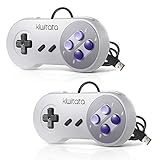
This two-pack of USB pads is built for people who play classic libraries on a Windows PC, laptop, or emulation front-end and want SNES-style muscle memory without a console. It suits the reader who has a ROM collection, a spare USB port, and a friend who wants to play too.
Key specs
- Two classic-style controllers with USB-A plugs.
- Four face buttons plus two shoulder buttons, with a cross-shaped D-pad.
- USB HID class device, which means modern operating systems recognise it without bespoke drivers.
- Wired only, with no battery and no wireless mode.
Strengths
The big advantage of USB HID pads in this category is friction. You plug one in, the operating system sees a gamepad, and your emulator’s controller binding screen accepts it. There is no dongle, no pairing dance, no charge level to monitor, and no perceptible radio latency. For a two-player emulation setup, a matched pair also means one configuration profile covers both controllers, which saves time every single session.
Layout is the other argument. The SNES-style arrangement of four face buttons in a diamond plus two shoulder buttons maps cleanly onto most 8-bit and 16-bit era libraries, and even onto later titles that assume a similar shape. The D-pad is the primary input, and in this class it typically offers a firm pivot with reasonable diagonal registration, which is what platformers and fighting games demand. Button feel is light and consistent across the four face buttons, with shoulder buttons that are shallower and best used for occasional inputs rather than held continuously.
Practically, the limitations are about scope. These are not analogue-stick controllers, so 3D-era games that expect a stick will feel wrong, and modern titles with trigger-analogue expectations will not be happy. The bodies are also classic-sized rather than modern-ergonomic, which is comfortable in short sessions and less so over multi-hour play. And because they are wired, cable routing across a desk or living room floor is on you; a pair means two cables.
Pros
- Two pads, so two-player emulation works out of the box.
- USB HID compatibility keeps driver setup minimal on modern systems.
- Classic four-button plus two-shoulder layout suits the era’s libraries.
- Wired link avoids pairing and charging entirely.
Cons
- No analogue sticks or analogue triggers.
- Classic body shape is less comfortable for very long sessions.
- Two cables to manage in a two-player setup.
- No rumble or wireless mode in this price tier.
How it compares
Against the Retro-Bit Legacy 16, the difference comes down to layout and count. The Legacy 16 is a single six-button pad oriented toward arcade-style and fighting libraries, while the KIWITATA pair is a four-button SNES-style set aimed at two players. If your library leans on six-button fighters, the Retro-Bit is the better fit; if you mostly play platformers and want a second player included, the KIWITATA set wins. Against the Retro-Bit on price, both sit near the budget line, so layout should decide it.
6. Retro-Bit Legacy 16 Wired USB Controller (Onyx) – Best Overall for Low-Latency Emulation

This is the pad to buy when you want a single, dependable wired controller for classic play on a computer and you care about input latency more than you care about wireless convenience. It suits the emulation player who wants a six-button layout in a black finish and does not want to think about batteries.
Key specs
- Wired USB connection, no wireless mode and no battery.
- Six-button face layout with two shoulder triggers, aimed at classic arcade and fighting-style libraries.
- Onyx (black) housing with a classic-style silhouette.
- USB HID compatible with modern desktop operating systems, so binding is handled by the game or emulator.
Strengths
The reason this takes the overall pick is that it solves the largest number of reader problems with the fewest caveats. It is wired, so latency is as low as the emulator’s own input polling allows and there is nothing to charge mid-session. It is USB, so it works with a PC rather than being welded to one console family. And the six-button layout covers the fighting and arcade libraries that a four-button SNES-style pad handles awkwardly, while still being fine for platformers.
Button feel in this class is typically a step above the cheapest pads: firmer dome tension, shorter travel on the face buttons, and a D-pad with a more defined pivot and clearer diagonal feedback. For a game that lives or dies on three-frame input windows, that difference is the whole purchase. The six face buttons are arranged in the classic two-row pattern, and the shoulder triggers are positioned for occasional use rather than as primary inputs, which matches how the era’s games actually used them.
Ownership is genuinely low-maintenance. There is no battery to degrade, no radio firmware to update, and no pairing to redo. What wears first is the cable strain relief at the pad end and the rubber domes under the most-used face buttons; both are slow processes, and keeping the cable from being yanked sideways is the single best thing you can do to extend life. Cleaning is a mild damp cloth on the shell and a soft brush or compressed air around the D-pad seam, never solvents on the printed legends.
Pros
- Wired USB keeps latency minimal and setup trivial.
- Six-button layout suits arcade and fighting libraries.
- No battery, no pairing, no firmware maintenance.
- Single-unit budget-tier price with a sturdier feel than the cheapest pads.
Cons
- Wired only, so cable management is permanent.
- No analogue sticks, ruling out stick-dependent games.
- Single controller, so two-player play needs a second purchase.
- Six-button layout is overkill for simple platformers.
How it compares
Against the KIWITATA 2X, this is the single-player specialist: one pad, six buttons, arcade-leaning, and arguably better button feel for the money, versus two four-button pads for shared play. Against the acisan 10 ft set, the comparison is wired range versus pad quality; the acisan set wins on reach and count, the Retro-Bit wins on the feel of each individual press. If you mostly play alone and care about precision, this is the pick; if you need two pads today, buy the pair.
7. acisan 10 ft Classic Game Controller Set (2-Pack) – Best for Living-Room Distance

This two-pack exists to solve one specific problem: the console or TV is across the room and the stock cable does not reach. It suits the household that plays from a couch, wants two pads, and is tired of cable extensions that add flaky joints.
Key specs
- Two mini classic controllers in one set.
- Ten-foot cables on each pad, which is roughly triple the reach of a typical short retro pad cable.
- D-pad and face-button layout in a compact classic body.
- Wired, passive, no batteries or pairing.
Strengths
Ten feet sounds like a trivial spec until you have tried to play from a couch with a two-foot cable. At that length you can sit back properly, and you avoid stacking two or three extension cables, each of which introduces a physical joint that can loosen and cause intermittent inputs. For a two-player setup, having both pads reach is the difference between a session and a compromise where one person sits on the floor.
The mini classic body is the same trade-off described earlier: light, compact, comfortable for smaller hands and shorter sessions, less supportive for larger hands over long play. Button feel is mid-range: light domes, audible click, a D-pad that handles cardinals well and diagonals acceptably. Because both pads come from the same set, they feel matched, which keeps two-player competition fair.
Ownership realities: with a ten-foot cable, the failure point shifts from the pad to how the cable is stored. Coiling a long cable tightly around the pad body is the most common way people break these controllers, because it puts a permanent bend at the strain relief. Loop it loosely, or wrap it around a wide object, and the pad will outlast the console it is plugged into. Keep the plug contacts clean and dry, and avoid tugging the cable to unplug; grip the connector housing instead.
Pros
- Ten-foot cables solve real living-room distance problems.
- Two matched pads in one purchase.
- No extension cables needed, so fewer flaky joints.
- Wired and passive, with nothing to charge.
Cons
- Mini body is less comfortable for large hands.
- Long cables need careful storage to avoid strain damage.
- No wireless option.
- Compatibility is limited to the listed classic gaming systems.
How it compares
Against the acisan Mini Dual Set, this is the same concept with the cable problem solved: same brand, same two-pad idea, longer reach, slightly higher mid-range price. If your couch is close, the shorter set is the smarter spend. Against the happymaxplus pad, the decision is compatibility versus reach: happymaxplus guarantees a fit on its named consoles, while this set offers distance on its own compatible systems. Check the port on your console before choosing.
8. Fanyooge Retro Gaming Console with 20,000+ Games and 23 Emulators (64GB) – Best for Plug-and-Play Library Access

This is not a controller so much as a complete route to retro play: a console with a large preloaded library and its own bundled controllers. It suits the buyer who wants to sit down and play tonight without configuring an emulator, sourcing ROMs, or matching a pad to a port.
Key specs
- 64 GB of storage holding a library the listing states as over 20,000 classic games.
- 23 emulators covering multiple classic platforms.
- Bundled controllers included with the console.
- Plug-and-play design connecting to a TV, with no PC required.
Strengths
The value proposition is convenience at scale. A single purchase delivers hardware, controllers, and a library, which removes the three hardest steps in retro gaming: choosing a front-end, acquiring software legally and safely, and matching input hardware to emulated platforms. For a gift buyer or a household that wants a party machine, that is a genuinely large amount of friction deleted in one box.
On the input side, bundled controllers in this category are usually functional rather than exceptional: light plastic shells, rubber-dome buttons, a D-pad with moderate accuracy. They will handle the majority of the library, which skews toward 8-bit and 16-bit titles, and they pair with the console without configuration. Where they may disappoint is in libraries that expect a six-button layout or analogue sticks, and in long sessions where a light shell becomes tiring. If you own a better pad, check whether the console accepts external USB input before assuming you can swap.
Ownership notes for this class of device: the console itself is the durable part, and the controllers are the consumable. Bundled pads often cannot be replaced individually with the same model, so treating them gently, especially the cable strain reliefs, is worthwhile. Storage and emulator front-ends on these systems are typically fixed, so you are buying the library as-is rather than an expandable platform. Expect to clean the shell with a damp cloth and to keep the unit ventilated, since compact retro boxes run warm under long sessions.
Pros
- Library, emulators, console, and controllers in one purchase.
- No PC, no configuration, and no ROM sourcing required.
- 64 GB of storage holds a very large collection.
- 23 emulators cover a wide spread of classic platforms.
Cons
- Premium tier price for hardware you cannot fully customise.
- Bundled controllers are functional rather than high-grade.
- Library is fixed rather than expandable by design.
- Not a controller-only purchase, so it is the wrong choice if you already have a system.
How it compares
Against the FelizAura 2027 console, the difference is library size and form factor: Fanyooge states a 20,000-plus library with 23 emulators, while FelizAura states 20,348-plus games in a stick form factor with 64 GB. Both are premium plug-and-play paths, and the choice comes down to which form factor fits your TV and which library count appeals. Against any controller on this list, both are a different category of purchase: you buy these for the library, not for the pad.
9. FelizAura 2027 Retro Game Console, 20,348+ Games, 64GB – Best for Maximum Library Out of the Box

This is the largest stated library in this roundup, delivered as a TV stick style retro console with 64 GB of storage. It suits the buyer who wants the biggest possible preloaded collection and a minimal footprint under the television.
Key specs
- Listing states 20,348+ classic games preloaded.
- 64 GB of storage.
- Gaming stick form factor that plugs into a TV.
- Bundled controller or controllers included, with no PC required.
Strengths
The stick form factor is the differentiator. Where a console box needs shelf space and its own power arrangement, a stick-style device reduces the footprint to something that lives behind the TV. For a small apartment, a secondary room, or a setup where a partner has vetoed another black box under the television, that matters more than any spec sheet line.
Library size is the headline, and a collection of this scale is genuinely appealing for households with kids or guests, where the goal is variety rather than mastery. The catch is the same as any preloaded system: quantity and curation are different things, and a library of twenty thousand titles includes a great many that will never be opened. The honest way to think about it is as a discovery box rather than a carefully assembled collection.
Controller feel follows the same pattern as the other premium bundle here. Bundled pads are typically light, with rubber-dome buttons and a D-pad suited to the older end of the library. They are plug-and-play with the stick, which is the main advantage. If you want better feel, the practical upgrade path is a separate USB pad, but check the device’s input support first, because these systems vary in whether they accept external controllers.
Ownership realities for a stick device: heat is the long-term enemy, so do not bury it behind a stack of cables where airflow is blocked. The bundled controller is the most likely part to fail first, so protect the cable. And since the library is fixed, the device’s useful life is tied to how long its internal storage and front-end keep working, not to how many games it lists.
Pros
- Largest stated library in this roundup at 20,348+ games.
- Stick form factor saves shelf space and setup fuss.
- 64 GB storage with no PC or configuration required.
- Plug-and-play for a TV, suitable for guests and children.
Cons
- Premium price for a fixed, non-expandable library.
- Bundled controller quality is basic rather than enthusiast-grade.
- Stick devices can run warm, so airflow matters.
- External controller support varies and should be verified before relying on it.
How it compares
Against the Fanyooge 20,000+ console, this is a close sibling with a higher stated game count and a smaller physical footprint. The Fanyooge lists 23 emulators explicitly, which is a useful signal about platform coverage; the FelizAura leads on raw library size and form factor. Against the controller-only options in this list, both premium bundles are a different kind of purchase: choose one only if you want the library included. If you already own a system and a PC, a wired USB pad like the Retro-Bit Legacy 16 is the more sensible spend.
How to Choose
Buying a retro controller is a compatibility decision before it is a quality decision. Get the connector right and almost any pad on this list will do the job; get it wrong and the best-feeling controller in the world is a paperweight.
Start with the port, not the pad
There are three connection families in play here, and they do not interchangeable.
- 9-pin DIN. The classic multi-pin plug used by original-era consoles. Passive, dead simple, and effectively latency-free because the console reads switch states directly. Limited to compatible hardware; a PC needs an adapter.
- Console-specific proprietary plugs. The happymaxplus pad is the example here, matching the AV 620 HD, 621 HD, and 821 HD family. Non-transferable by design.
- USB HID. The KIWITATA pair and the Retro-Bit Legacy 16 fall here. They work on PCs and many emulation boxes with no drivers, and are the most flexible pads in this roundup.
There is also the Wii Remote expansion port, which the OSTENT pad uses. It is technically a fourth family, and it is the only one that borrows its power and radio link from another device.
One practical rule: figure out the port on your machine, then eliminate every product that does not match before you read a single word about button feel. Most disappointing retro controller purchases are compatibility mistakes, not quality mistakes.
Button feel and D-pad accuracy: what to actually expect
Across budget and mid-range retro pads, three characteristics separate the tiers.
| Characteristic | Budget tier | Mid-range tier | What it means in play |
|---|---|---|---|
| Face-button dome tension | Soft, longer travel, quieter | Firmer, shorter travel, audible click | Firmer domes give clearer repeat-fire feedback |
| D-pad pivot definition | Loose, wider diagonal slop | More defined, clearer diagonals | Matters most in platformers and fighting games |
| Shell stiffness and weight | Light, flexes under pressure | Stiffer, slightly heavier | Heavier bodies resist shifting during hard inputs |
| Shoulder button depth | Shallow, occasional use | Shallow to moderate, still occasional | Fine for era-correct games, poor for held triggers |
| Cable length | Short, TV-stand distance | Short to ten feet depending on model | Determines whether you can sit on the couch |
If you play games that reward frame-precise inputs, pay for the mid-range D-pad. If you play casually and mostly on menus and slow platformers, the budget D-pad is fine, and you should spend the difference on a second controller instead.
Wired versus wireless: the latency question
For classic consoles, wired is almost always the right answer, and not primarily because of measurable latency.
- Passive wired pads, such as 9-pin and console-specific models, add essentially no processing. The console reads the switch state directly. Latency is whatever the console’s own polling introduces, which is identical to original hardware.
- USB HID pads add a small amount of protocol overhead that is imperceptible in practice and typically far below one frame at 60 Hz. The bigger variable is your emulator’s input polling setting, not the pad.
- Wireless pads add a radio hop, which can be one to several milliseconds in good conditions and considerably worse with interference. On top of that you inherit a battery, a charging routine, and eventual cell degradation.
The honest summary: if you can tolerate the cable, take the cable. Wired pads in this roundup are cheaper, lighter, maintenance-free, and never run out mid-session. The only real argument for wireless in a classic setup is seating distance, and even that is solved more cheaply with a ten-foot cable than with a wireless pad.
Adapter needs and cost-per-use maths
Adapters are where the hidden cost lives. A 9-pin pad on a modern PC needs a dedicated USB adapter, which is a separate purchase and a separate failure point. A Wii Remote pad needs a Wii Remote, which is a meaningful expense if you do not already own one. USB HID pads need nothing.
Here is the calculation that should drive the decision. Suppose you play retro games twice a week for about two hours a session, roughly 200 hours a year. Now compare total outlay:
- A single USB pad at budget tier: the lowest outlay for one player, but a second player needs another purchase.
- A two-pack at mid-range: higher upfront, but two players are covered, so the cost per player-hour drops sharply and stays low for years.
- A premium plug-and-play bundle: highest upfront, but it replaces a PC, a front-end setup, and a controller purchase. If you would otherwise spend an evening configuring software, the time saving is part of the value.
Run that against your own habits. Solo players who already own a computer should buy the single wired USB pad and stop reading. Households where two people play regularly should buy a matched two-pack, because matching feel between pads matters and buying twice later rarely costs less.
Build quality, wear points, and common mistakes
Controllers in this class are simple electromechanical devices, and the same parts fail first every time.
- Cable strain relief. The joint between cable and shell is the number one failure point. Nearly all premature controller deaths in this category come from tight coiling and sideways tugging, not from button wear.
- Rubber domes. The domes under the most-used face buttons soften over years, producing a mushier press. This is normal and slow, and it is not worth pre-emptively replacing a pad over.
- D-pad pivot. Long-term use loosens the pivot, increasing diagonal slop. This is the wear that affects gameplay most, and it is why heavier shells with tighter pivots hold up better for competitive play.
- Connector contacts. Dust and oxidation on a 9-pin plug cause intermittent inputs that people misdiagnose as a dead controller. Clean the contacts before you replace anything.
Common mistakes to avoid: buying three cheap short-cable pads instead of one long-cable pair; buying a 9-pin pad for a USB-only setup; assuming a bundled premium console controller can be swapped for your favourite pad without checking input support; and cleaning shells with alcohol or solvents, which dulls printed legends and can craze some plastics. Use a mild damp cloth and a soft brush, and dry thoroughly around the seams.
Battery life: the quiet argument for wired
Of the products in this roundup, only the premium plug-and-play bundles involve anything resembling a rechargeable or externally powered element, and even then the controllers are typically wired to the device. Every other pad here is passive. That means “battery life” for most of this list is not a spec you need to worry about at all, which is precisely the point: you never open a session to a dead controller.
Where batteries do enter the picture is indirectly, through the OSTENT pad borrowing a Wii Remote’s cells. Your runtime is whatever that Wii Remote holds, and it declines over years of charge cycles. Two rechargeable AA cells and a rotation habit solve it permanently.
A quick decision matrix
| Your situation | Recommended pick | Why |
|---|---|---|
| PC or emulation box, solo, precision matters | Retro-Bit Legacy 16 | Wired USB, six-button layout, no battery or pairing |
| PC, two players, platformer-heavy library | KIWITATA 2X | Matched pair, SNES-style four-button layout |
| Own an AV 620/621/821 HD console | happymaxplus | Console-specific fit, plug-and-play |
| Own a Wii with a Wii Remote | OSTENT Wired Classic | Cheapest route to a proper D-pad, no extra battery |
| Original 9-pin console, need cheap extra pads | Old Arcade Four Button | Lowest cost per pad, no adapters on compatible hardware |
| Two players, couch across the room | acisan 10 ft 2-Pack | Ten-foot cables avoid extension joints |
| No PC, want a library tonight | Fanyooge 20,000+ console | 64 GB, 20,000+ games, 23 emulators, controllers included |
| Maximum library, minimal footprint | FelizAura 2027 stick | 20,348+ games, 64 GB, stick form factor |
Frequently Asked Questions
Will a 9-pin retro controller work on a modern PC?
Not directly. A 9-pin DIN pad has no USB interface, so a PC will not see it without a dedicated adapter that converts the pin signals into a USB HID device. Those adapters exist and are inexpensive, but each one is an extra component that can fail or introduce its own quirks. If your main goal is playing on a computer, buy a USB pad such as the KIWITATA pair or the Retro-Bit Legacy 16 instead of adapting older hardware.
Is wired really faster than wireless for retro games?
Yes, though the margin is usually small in good conditions. A passive wired pad adds essentially no processing, while a wireless link adds a radio hop that can range from imperceptible to noticeable depending on interference and distance. In practice, the bigger advantages of wired are that there is no battery to charge and no pairing to redo, which is why nearly every controller in this roundup is wired.
How do I know if a controller fits my specific classic console?
Match the physical plug before anything else. Count the pins and check the shape of the connector on the console and compare it to the listing’s stated compatibility. Console-specific pads like the happymaxplus name the exact machines they fit, which is the safest signal. Generic 9-pin pads fit 9-pin ports, and USB pads fit USB ports. If a listing does not state your machine, assume it will not fit.
Can I use a retro-style controller for modern games?
Only in a limited way. These pads lack analogue sticks and analogue triggers, so anything that expects proportional input, such as driving games or 3D platformers built around a stick, will feel wrong. They are at their best on 8-bit and 16-bit era libraries, and on menus. For modern titles, use a modern controller and keep the retro pad for the retro library.
What wears out first on a retro controller?
The cable strain relief where the lead meets the shell, in the overwhelming majority of cases. That is followed by the rubber domes softening under frequently used face buttons and the D-pad pivot loosening over time. Connector contacts can also oxidise and cause intermittent inputs, which people often mistake for a dead pad. Cleaning contacts and storing cables loosely prevents most premature failures.
Do I need two controllers or one?
If anyone else will ever play with you, buy two at once. Retro multiplayer is inherently a two-pad activity, and a matched pair from the same set feels consistent, which matters in competitive play. Buying one now and a second later often costs more and sometimes fails, because the exact model may become hard to find. Solo players who only ever play alone can safely buy a single pad.
Are preloaded retro consoles worth it compared with a PC setup?
They solve different problems. A preloaded console such as the Fanyooge or FelizAura bundle delivers hardware, controllers, and a large library in one purchase with no configuration, which suits gift buyers and households that want to play immediately. A PC with USB pads is more flexible, more upgradeable, and lets you choose your own front-end, but it requires setup time and a computer. Choose based on whether your scarce resource is money or an evening of configuration.
How should I clean and store a retro controller?
Wipe the shell with a mild damp cloth and a soft brush around the D-pad seam, and dry thoroughly near the joins. Never use alcohol or solvents on printed legends, and avoid getting liquid into the button wells. For storage, coil the cable loosely around a wide object rather than tight around the pad body, and unplug by gripping the connector housing rather than pulling the lead. Those two habits prevent the most common failure points.
The Short Version
If you play classic libraries on a computer, buy the Retro-Bit Legacy 16 Wired USB Controller for one-player precision, or the KIWITATA 2X Classic SNES USB Controller if two people share the screen. If you own an AV 620/621/821 HD console, the happymaxplus pad is the guaranteed fit, and if you own an original 9-pin machine, the Old Arcade Four Button pad is the cheapest way to add players. Wii owners should take the OSTENT pad, and anyone gaming from a couch across the room should take the acisan 10 ft two-pack. Finally, if you have no computer and no console and just want to play tonight, the Fanyooge bundle offers the widest platform coverage, while the FelizAura 2027 stick delivers the largest stated library in the smallest footprint.