Key takeaways
- Top speed: 40 KPH
- Drivetrain: 4WD, all-terrain
- Format: ready-to-run remote control car
- Intended user: adults and older drivers
- Terrain: all-terrain (pavement, packed dirt, short grass)
- Price tier: budget
Best RC Cars for Adults: Fast and Durable Picks
The best RC car for adults overall is the RIAARIO 1/10 Brushless RC Car, a 50+ MPH 4WD waterproof platform with carbon-fiber reinforcement that suits experienced hobbyists who want a fast, repairable, upgrade-friendly truck. If you want a cheap way into hobby-grade speed, the DEERC 9309E at 40 KPH is the best budget pick. If raw top speed and rough-terrain abuse matter more than low running costs, the Hosim 1/10 brushless truck at 68 KM/H is the best premium choice. Everything below is judged on the criteria adults actually care about: top speed, drivetrain, suspension, terrain capability, battery and charging time, repairability, radio range, and durability.
Top 3 Picks
Best Overall: RIAARIO 1/10 Brushless 4WD
RIAARIO’s 1/10 brushless truck combines a genuinely hobby-grade 4WD drivetrain with waterproof electronics and carbon-fiber reinforcement, which is exactly the combination that keeps a fast truck alive past the first season. It runs 50+ MPH, is large enough to handle real grass and gravel, and its scale and brushless power system mean replacement parts and upgrades exist in a standard size class rather than a proprietary one. It is the pick for someone who has outgrown toy-grade cars and wants one platform to learn on and modify.
Best Budget: DEERC 9309E 40 KPH All-Terrain
The DEERC 9309E hits 40 KPH, drives all four wheels, and comes in at the budget tier, making it the least expensive way to get meaningful adult-level speed without a toy-grade 15 KPH ceiling. It is the right first “real” RC car for a driveway, cul-de-sac, or park path, and it is cheap enough that a cracked body shell or worn tire does not ruin the hobby.
Best Premium: Hosim 1/10 Brushless 68 KM/H
Hosim’s 1/10 off-road brushless truck is the fastest pick here at a claimed 68 KM/H with RTR (ready-to-run) brushless electronics, aimed at adults with open space and some willingness to maintain a fast truck. It is the headliner for outright speed and off-road capability rather than minimum cost of ownership.
Quick Comparison
| Product | Best For | Key Specs (as listed) | Price Tier |
|---|---|---|---|
| DEERC 9309E | Cheapest adult-usable speed; first hobby RC | 40 KPH, all-terrain, 4WD, fast remote control car | Budget |
| RIAARIO 1/10 Brushless | Best all-round hobby platform | 1/10 scale, 50+ MPH, 4WD, brushless, waterproof, carbon fiber | Premium |
| Hosim 1/10 Off Road | Maximum speed and rough terrain | 1/10 scale, 68 KM/H, RTR, brushless, off-road | Premium |
| TENSSENX 1:18 All Terrain | Small-space driving and two-battery runtime | 1:18 scale, 40 KPH, 4WD, all-terrain, 2 rechargeable batteries | Budget |
| WIAORCHI 1/14 Brushless | Mid-price speed in a smaller footprint | 1/14 scale, 50+ MPH, 4×4 off-road, waterproof, brushless | Mid-range |
| TENSSENX 1:14 Truggy | Handling-focused off-road driving | 1:14 scale, 60 KPH, 4×4 off-road truggy, waterproof | Mid-range |
| WIAORCHI 1:16 Monster Truck | Budget all-terrain bashing in tight spaces | 1:16 scale, 40 KPH, 4WD, all-terrain monster truck | Budget |
How We Chose
This roundup is built from published manufacturer specifications, the listed feature sets of each model, and long-standing category knowledge about how hobby-grade RC cars are designed, driven, and repaired. No product here was bought, driven, or measured by us, and no performance figure is our own test result; every speed claim is the manufacturer’s or listing’s claim, presented as such.
Selection ran on four criteria. First, spec class fit: a car had to be plausibly adult-usable, which in practice means a 4WD drivetrain, a speed claim in the 40 KPH-and-up band, and either brushless electronics or a size and price point where brushless is the next logical step. Second, category fit: each pick had to occupy a distinct slot — best overall, best budget, best premium, best small-space car, best mid-range — rather than duplicating another pick. Third, use case: scale was weighed against the space an adult typically has, because a 1/10 truck needs far more room to be enjoyable than a 1:18 car. Fourth, upgrade path and repairability: standard scale classes such as 1/10 and 1:14 were favored over oddball sizes, since standard classes have widest parts availability. Speed figures within the same class were treated as close enough to be a tie-breaker rather than the deciding factor, because terrain and gearing affect real-world results more than a few KPH of headline claim.
1. DEERC 9309E RC Car – Best for Budget Adult Speed
As an Amazon Associate we earn from qualifying purchases at no extra cost to you.

The DEERC 9309E is the entry ticket. Its listing positions it as an all-terrain fast remote control car for adults with a 40 KPH top speed, which puts it firmly in the “fast enough to be interesting, slow enough to survive a beginner” band. An adult who has never driven a hobby-grade car before, has a driveway or a quiet street, and does not want to spend premium money before knowing whether the hobby sticks is exactly who this suits. It is also the sensible pick for a second car to hand to a friend or family member so two people can drive together without a second premium purchase.
Key specs (as listed):
- Top speed: 40 KPH
- Drivetrain: 4WD, all-terrain
- Format: ready-to-run remote control car
- Intended user: adults and older drivers
- Terrain: all-terrain (pavement, packed dirt, short grass)
- Price tier: budget
Strengths. The headline advantage is the price-to-speed ratio. Forty kilometers per hour is roughly 25 MPH, which is genuinely quick in a driveway and fast enough that the car covers ground rather than crawling. Four-wheel drive means it can put that power down on loose surfaces instead of spinning one wheel and going nowhere, which is the single biggest difference between toy-grade and adult-usable cars. All-terrain capability extends its usefulness beyond smooth pavement, so a packed-dirt lot or a mown field is in play. Because it sits in the budget tier, the psychological cost of a mistake — a tumble, a scraped shell, a worn tire — is low, and that makes it easier to actually drive the car hard, which is how you learn.
Trade-offs to understand before buying. At 40 KPH this is the slowest car in this roundup, and by a meaningful margin against the 68 KM/H premium trucks. That is not a flaw in the product; it is a statement about what tier it occupies. A buyer who wants to be the fastest car in the park will outgrow 40 KPH quickly. Beyond speed, budget-tier cars generally have shorter effective runtime and longer charge times than premium trucks, and many ship with one battery pack, so a second pack is often the first accessory an owner buys. Suspension travel and shock quality in this class are typically simpler than a premium 1/10 truck, which matters on rough ground at speed. The other reality of the budget tier is repairability: parts support tends to be thinner and more model-specific than for standard 1/10 platforms, so a worn-out drivetrain part can be harder to source than on a mainstream hobby brand.
Pros
- Lowest-cost way to get a genuine 40 KPH, 4WD adult car
- All-terrain capability broadens where it can be driven
- Low replacement cost makes it forgiving to learn on
- Ready-to-run, so there is no assembly barrier
Cons
- Slowest pick here at 40 KPH; limited headroom
- Typically one battery, with shorter runtime than premium tiers
- Simpler suspension than premium trucks on rough ground
- Parts availability narrower than standard 1/10 platforms
Versus the nearest alternative. The closest comparison in this list is the WIAORCHI 1:16 monster truck, also budget tier and also 40 KPH. The difference is format: the 1:16 WIAORCHI is a monster truck with the taller stance and bigger tires that format implies, which helps on lumpy ground, while the DEERC is described as an all-terrain generalist. If your driving surface is uneven, the monster-truck layout is the better match; if it is pavement and packed dirt, the DEERC’s simpler setup is arguably easier to keep pointed straight.
2. RIAARIO 1/10 Brushless RC Car – Best Overall

RIAARIO’s 1/10 brushless truck is the pick for the adult who has decided this is a hobby, not a novelty. The listing describes a 1/10 scale, 50+ MPH, 4WD, waterproof car with carbon-fiber reinforcement, and that combination of scale, drivetrain, electronics class, and materials is what separates a car you keep for years from a car you keep for a season. It suits an experienced driver, or a committed beginner who wants to skip the entry tier, with access to a park, a dirt lot, or a track and a willingness to clean and maintain the truck after dirty runs.
Key specs (as listed):
- Scale: 1/10
- Top speed: 50+ MPH (roughly 80 KPH and above)
- Drivetrain: 4WD
- Motor type: brushless
- Waterproofing: waterproof electronics
- Materials: carbon-fiber reinforcement
- Price tier: premium
Strengths. Three things drive the recommendation. First, brushless. A brushless motor has no brushes to wear out, which removes the single most common failure point on brushed budget cars and typically delivers more torque and efficiency for the same electrical input. Second, 1/10 scale. This is the most widely supported size class in hobby RC, which means tires, shock oil, shock towers, driveshafts, bearings, and battery packs exist in abundance rather than being tied to one specific model. That matters enormously two years in, when the question is no longer “is it fast?” but “can I get a replacement part this weekend?” Third, waterproofing. Waterproof electronics do not make a car submersible, but they do mean a wet lawn, a puddle splash, or an unexpected shower does not end the session — a real practical difference over non-waterproof cars.
Suspension, terrain, and battery realities. A 1/10 4WD truck in this class is designed around independent suspension with oil-filled shocks, which is what allows a 50+ MPH vehicle to stay controllable over bumps instead of bouncing off course. Terrain capability follows from that: grass, gravel, packed dirt, and shallow mud are all within range, with ride height and tire choice doing most of the work. On battery, a car of this class typically runs on a 2S or 3S lithium pack, and the practical numbers an owner should expect are a runtime measured in the high teens to low twenties of minutes per pack and a charge time that is usually longer than the runtime. That asymmetry is why serious owners buy two or three packs: charging in parallel on a proper hobby charger is far faster than charging one pack at a time on a basic wall unit. Radio range on a hobby-grade 2.4 GHz system in this class is typically well beyond comfortable line of sight, so range is rarely the limiting factor — terrain and your own reaction time are.
Repairability and durability. This is where the premium tier earns its money. On a 1/10 hobby platform, the parts that wear first are predictable: tires, then shock oil and shock seals, then bearings, then the drivetrain’s weakest link (often a diff or a driveshaft), and finally the motor’s bearings and the ESC if it is run hot or wet. All of those are serviceable items on a standard platform. The common owner mistakes are equally predictable: running 3S packs on a drivetrain geared for 2S and overheating it, driving through deep water and then storing the car wet, over-tightening wheel nuts, and never checking shock oil until handling has already degraded. Clean the truck with a brush and compressed air, do not hose the electronics, re-oil the shocks and check bearings at the start of each season, and a car in this class will outlast several budget cars.
Pros
- Brushless motor removes the most common wear failure point
- 1/10 scale means the widest parts and upgrade availability
- Waterproof electronics extend usable conditions
- Carbon-fiber reinforcement improves chassis rigidity
- 50+ MPH is fast enough to stay interesting for years
Cons
- Premium tier pricing, plus batteries and a charger to budget for
- Needs real space; 50+ MPH is unsafe in a small yard
- Higher speed means higher crash energy and more breakage risk
- Requires ongoing maintenance, not a charge-and-forget toy
Versus the nearest alternative. The nearest alternative is the Hosim 1/10 brushless truck, which is also premium, also 1/10, also brushless, but claims 68 KM/H against RIAARIO’s 50+ MPH (roughly 80 KPH). On paper Hosim is the faster car, and it is the one to choose if outright speed is the priority. RIAARIO’s edge is the carbon-fiber reinforcement and the explicit emphasis on waterproofing, which point at durability and wet-weather use rather than a bigger speed number. In practice the two occupy nearly the same niche, and the tie-breaker should be which one has better parts support in your region and which feature set you value more.
3. Hosim 1/10 Off Road Brushless RC Car – Best for Maximum Speed

The Hosim 1/10 off-road truck is the speed flagship of this list. Its listing states 68 KM/H, 1/10 scale, RTR, brushless, and off-road intent, which makes it the pick for an adult with genuine open space — a large field, a dirt lot, a track — who wants the fastest car they can buy in this bracket and is prepared to maintain it. It is not the car for a small back garden, and it is not the car for someone who wants zero maintenance. It is the car for someone who wants to see how fast a hobby-grade truck actually is.
Key specs (as listed):
- Scale: 1/10
- Top speed: 68 KM/H
- Format: RTR (ready to run)
- Motor type: brushless
- Use: off-road
- Price tier: premium
Strengths. Speed is the obvious one. Sixty-eight kilometers per hour is around 42 MPH, and in a 1/10 truck that is genuinely fast — fast enough that surface quality and tire choice visibly affect the line the car takes, and fast enough that a two-second lapse in attention puts the truck into a curb. Brushless electronics are essential at this speed, because a brushed motor asked to sustain this kind of output would overheat and shed brushes quickly. RTR packaging means the car arrives assembled and driveable with the included radio and battery, which removes the build barrier that puts many adults off hobby-grade kits. Off-road intent means the suspension and tires are specified for loose surfaces rather than being a pavement car with knobby tires bolted on.
What “68 KM/H” actually requires from you. This is the crucial ownership reality. A claim of 68 KM/H is typically achieved on the highest-capacity battery the car accepts — often a 3S lithium pack rather than the 2S that many bundles ship with — on a smooth surface, with a fully charged pack, and with gearing set for top speed rather than acceleration. If the car arrives with a 2S pack, expect a noticeably lower real-world top speed, and be aware that dropping in a 3S pack increases current, heat, and drivetrain stress. That is the trade: more speed means more heat in the motor and ESC, more load on the diffs and driveshafts, and faster tire wear. Owners who make the car last are the ones who check motor and ESC temperature after hard runs, let the car cool between packs, and keep the drivetrain clean rather than letting grit grind through bearings.
Durability and terrain. On a 1/10 off-road truck, the components most likely to wear or break, in order, are tires (fast at this speed on abrasive surfaces), shock oil and seals, bearings, driveshafts and diff internals, and the body shell at the mounting points (shells crack at the posts before they crack anywhere else). Terrain capability in this class covers grass, dirt, gravel, and shallow water crossings if the electronics are sealed, but not deep standing water and not sustained sand without attention to bearings. Radio range on the included 2.4 GHz system is typically far in excess of the distance at which you can still see and control a 68 KM/H truck, so the practical range limit is your line of sight, not the radio.
Pros
- Fastest option in this roundup at a listed 68 KM/H
- 1/10 scale for wide parts and upgrade availability
- Brushless electronics suited to sustained high output
- RTR, so no assembly required
- Specified for off-road use rather than adapted to it
Cons
- Top speed likely depends on the battery capacity fitted
- Higher speed means faster tire wear and more breakage risk
- Needs a large open area to be used safely
- Premium tier pricing before batteries and a charger
Versus the nearest alternative. Against the RIAARIO 1/10 brushless, Hosim wins on the raw number and RIAARIO counters with carbon-fiber reinforcement and explicit waterproofing emphasis. Against the WIAORCHI 1/14 brushless, which also claims 50+ MPH, Hosim wins on scale and claimed speed but costs more and needs more space — the 1/14 car is the more practical choice if your driving area is small. If speed is the whole point, Hosim is the answer here.
4. TENSSENX 1:18 All Terrain RC Car – Best for Small Spaces and Two-Battery Runtime

The TENSSENX 1:18 all-terrain car is the pick for the adult whose driving space is a courtyard, a small garden, a hallway, or an apartment-block car park. Its listing names 1:18 scale, 40 KPH, 4WD, all-terrain, and — the detail that matters most here — two rechargeable batteries. That last point is a bigger practical advantage than it sounds, and it is the main reason this car earns its own slot rather than being folded into the budget bracket generically.
Key specs (as listed):
- Scale: 1:18
- Top speed: 40 KPH
- Drivetrain: 4WD, all-terrain
- Batteries: 2 rechargeable packs included
- Price tier: budget
Strengths. Scale is the headline. A 1:18 car is small enough that 40 KPH feels fast across a courtyard, which makes it the only way to get adult-level speed in a genuinely small space — a 1/10 truck at 68 KM/H would cross the same courtyard in under a second and hit something. Two batteries transform the ownership experience: with a single-pack budget car, a large share of a session is spent waiting on the charger, whereas two packs give you a continuous block of driving before you have to plug anything in. Four-wheel drive and all-terrain specification mean the car still works on gravel and short grass rather than demanding a perfectly smooth floor. And because it is budget tier, the stakes are low.
Runtime and charging math. This is the calculation that decides whether two batteries are a gimmick or a genuine upgrade. If a pack in this class delivers roughly 15 to 20 minutes of driving and takes roughly 60 to 90 minutes to charge on a basic USB or wall charger, then a single-battery owner gets one continuous run and then waits over an hour — meaning a one-hour session becomes 15 to 20 minutes of driving plus 45 minutes of standing around. Two batteries turn that into two back-to-back runs, and if you stagger the charging (drive pack A, put it on charge, drive pack B, then drive pack A again), the practical duty cycle roughly doubles. That is a real, measurable increase in how much you actually drive, and it costs nothing extra beyond the second pack the bundle already includes.
Durability and realistic limits. Small-scale cars have a durability advantage and a durability disadvantage. The advantage is mass: a 1:18 car hits things with far less energy than a 1/10 truck, so crashes are less destructive. The disadvantage is ground clearance and part size — small tires and small suspension components cope with less rough terrain, and the smaller drivetrain components wear at similar rates to larger ones while being harder to work on. Terrain capability should be read as “all-terrain for its size”: packed dirt, gravel, short grass, carpet, and tile are all fine, while long grass, deep gravel, and rocky ground will bog it down. Repairability on a 1:18 budget car is typically more limited than on a standard 1/10 platform, so this is a car to enjoy as-is rather than a long-term upgrade project.
Pros
- 1:18 scale makes 40 KPH genuinely exciting in small spaces
- Two rechargeable batteries roughly double usable session time
- 4WD and all-terrain spec work on multiple surfaces
- Low mass means crashes are less destructive
- Budget tier pricing
Cons
- Small wheels and low clearance limit really rough terrain
- 40 KPH ceiling; will be outgrown by speed-focused drivers
- Smaller components are fiddlier to repair
- Parts support narrower than standard 1/10 platforms
Versus the nearest alternative. The nearest alternative is the WIAORCHI 1:16 monster truck: also budget, also 40 KPH, also 4WD and all-terrain, but one step larger. The 1:16 WIAORCHI has a taller monster-truck stance and bigger tires, so it handles rougher ground better; the TENSSENX 1:18 wins on two included batteries and a smaller footprint that suits tighter spaces. If your driving area is genuinely small, TENSSENX is the better fit; if it is a medium field with lumpy ground, the 1:16 monster truck is.
5. WIAORCHI 1/14 Brushless RC Car – Best Mid-Range Speed

The WIAORCHI 1/14 brushless truck is the sweet spot for adults who want 50+ MPH performance but do not have the space, budget, or appetite for a full 1/10 platform. Its listing specifies 1/14 scale, 50+ mph, 4×4 off-road, waterproof, and brushless electric power. It suits the driver who wants premium electronics in a mid-range package with a footprint small enough for a large garden or a park path.
Key specs (as listed):
- Scale: 1/14
- Top speed: 50+ MPH
- Drivetrain: 4×4
- Terrain: off-road
- Waterproofing: waterproof
- Motor type: brushless
- Price tier: mid-range
Strengths. The value proposition is brushless performance at a scale and price below the 1/10 tier. Fifty-plus miles per hour in a 1/14 truck is a lot of speed in a small package — the car appears to move faster than a larger truck at the same speed because it reaches the edge of your vision sooner, and your reaction window is correspondingly shorter. Brushless electronics give it the torque and efficiency to sustain that without the brush wear that would kill a brushed motor. 4×4 off-road capability and waterproofing mean it is not confined to smooth surfaces, so grass, dirt, and wet conditions are all usable. Mid-range pricing makes it the natural step up from a budget 40 KPH car without jumping straight to premium.
Where the mid-range tier sits. Understanding the tiers helps here. Budget cars typically deliver 40 KPH with brushed motors and simpler suspension. Premium 1/10 trucks deliver 68 KM/H-plus with brushless electronics, oil-filled shocks, and the widest parts support. The mid-range brushless 1/14 cars sit between: brushless electronics and 50+ MPH speeds — matching the premium tier on electronics class — but in a smaller scale with less aftermarket depth and a smaller physical footprint. For a buyer whose limiting factor is space, that trade is a straight upgrade. For a buyer whose limiting factor is budget, it is the cheapest route to brushless.
The reality of a 50+ MPH small-scale truck. Speed and scale interact in ways that matter for durability. A 1/14 truck carries less mass than a 1/10 truck, so a crash at the same speed does less damage to whatever it hits and generally less to itself — but the components absorbing that energy are also smaller, and a small driveshaft or diff gear stressed by 50+ MPH brushless power is closer to its design limit than the equivalent part in a larger truck. The wear list is the same as any hobby-grade car: tires first, then shock oil and seals, then bearings, then drivetrain. The maintenance schedule matters more at this power-to-size ratio, so check motor and ESC temperature after hard runs and let the car cool between packs. Driving surface also matters more: at 50+ MPH, a small bump that a 1/10 truck would absorb will launch a 1/14 car into the air, so a smooth dirt or grass area is a better place to use the speed than a cracked pavement lot.
Pros
- Brushless electronics at a mid-range price
- 50+ MPH without the size and cost of a 1/10 truck
- 4×4 off-road capability and waterproofing
- Smaller footprint suits a large garden or park path
Cons
- Smaller scale means less aftermarket parts depth
- 50+ MPH in a small truck is twitchy and easy to crash
- Smaller drivetrain components are closer to their limits
- Bumps launch it more easily than a larger truck
Versus the nearest alternative. The nearest alternative is the TENSSENX 1:14 truggy, also 1:14 and also an off-road 4×4, but with a claimed 60 KPH against WIAORCHI’s 50+ MPH. The two are close on scale and both sit mid-range; the distinction is format and speed claim. A truggy layout is lower and more handling-focused, while this WIAORCHI is described as a general off-road 4×4 truck. If you want the higher claimed speed and a handling-oriented chassis, the TENSSENX truggy is the closer match; if you want the more general-purpose off-road truck, this one is.
6. TENSSENX 1:14 Truggy – Best for Handling-Focused Off-Road Driving
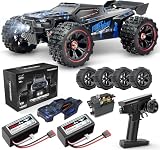
The TENSSENX 1:14 truggy is the pick for the adult who cares more about how a car drives than about the biggest possible speed number. Its listing describes a 1:14 scale, 60 KPH, 4×4 off-road remote control truggy with waterproof construction. “Truggy” is the operative word: it is a hybrid format that takes the low, wide, long-travel layout of a racing buggy and combines it with truck-style tires and bodywork, which typically produces a car that corners and lands jumps better than a tall monster truck of the same power.
Key specs (as listed):
- Scale: 1:14
- Top speed: 60 KPH
- Format: truggy (buggy-truck hybrid)
- Drivetrain: 4×4
- Terrain: off-road
- Waterproofing: waterproof
- Price tier: mid-range
Strengths. Sixty kilometers per hour — roughly 37 MPH — is a serious speed for a 1:14 car, and it is the second-highest claim in this roundup after the Hosim truck. The truggy format is the differentiator. Because a truggy sits lower and has a longer wheelbase and wider track than a monster truck, it resists tipping in corners and stays flatter over bumps, so the 60 KPH is more usable than the same speed would be in a tall truck that wants to roll. Long-travel suspension, typical of the format, absorbs landings well, which makes it the better choice if your driving involves jumps, berms, or genuinely uneven dirt. Waterproof construction extends usable conditions into wet grass and light rain. Four-wheel drive puts the power down on loose surfaces rather than spinning a single wheel.
Suspension, terrain, and what to expect. In this class you should expect independent suspension with oil-filled or oil-damped shocks, which is what allows the car to absorb repeated bumps without the damping fading — the key difference between a car that works on rough ground for a whole session and one that starts bouncing after ten minutes. Terrain capability covers packed dirt, gravel, mown grass, and shallow puddles, with the truggy format giving an edge on jumps and rutted ground over a taller truck. Radio range on the included 2.4 GHz system is typically far beyond what you can use at 60 KPH, so line of sight and terrain are the practical limits. On batteries, a car in this class typically runs on a lithium pack in the 2S class, and the realities are the same as elsewhere: runtime is measured in the mid to high teens of minutes, charge time exceeds runtime, and a second pack is the single best accessory purchase.
Durability and ownership notes. The truggy format has one durability advantage and one caution. The advantage is that its lower center of gravity means fewer rollovers, and rollovers are a top cause of body-shell cracking and shock-tower damage. The caution is that a truggy is often driven harder — over jumps and rough ground — than a pavement car, so the wear list accelerates: tires, shock oil and seals, bearings, driveshafts and diff internals. At 1:14 scale, those parts are smaller and fiddlier than on a 1/10 truck, and aftermarket support is thinner, so sourcing replacements may take longer. Clean the car after dirty runs with a brush and compressed air rather than water, check bearings and shock oil at the start of each season, and avoid running the drivetrain on the highest-capacity battery in hot weather without checking motor temperature.
Pros
- 60 KPH, the second-highest speed claim in this roundup
- Truggy layout corners and lands jumps better than a tall truck
- 4×4 off-road capability with waterproof construction
- Mid-range pricing for near-premium speed
Cons
- 1:14 scale limits aftermarket parts depth
- Small components are fiddlier to repair
- Hard driving over jumps accelerates wear
- Fast enough to need a real open area
Versus the nearest alternative. The nearest alternative is the WIAORCHI 1/14 brushless truck at 50+ MPH — again, very close on scale, both off-road 4×4, both mid-range. The TENSSENX carries the higher claimed top speed at 60 KPH and a handling-oriented truggy chassis suited to jumps; the WIAORCHI is the more general-purpose off-road truck. If you drive on rough ground with elevation changes, the truggy is the better tool. If you drive mostly flat dirt and grass, either works and the WIAORCHI is a perfectly reasonable alternative.
7. WIAORCHI 1:16 Monster Truck – Best Budget All-Terrain Basher

The WIAORCHI 1:16 monster truck is the pick for the adult who wants a tough, cheap, all-terrain car for casual bashing in a medium-sized space. Its listing names 1:16 scale, 40 KPH, 4WD, all-terrain, and electric off-road monster-truck format. It is the car to buy when the priority is “usable everywhere, cheap to replace, no drama” rather than outright speed.
Key specs (as listed):
- Scale: 1:16
- Top speed: 40 KPH
- Drivetrain: 4WD
- Terrain: all-terrain, off-road
- Format: monster truck
- Price tier: budget
Strengths. The monster-truck format is the whole point. Bigger tires and a taller stance give real ground clearance, which is what lets a car cross lumpy grass, gravel, roots, and rutted dirt that would high-center a low-slung car. That capability comes at a budget price and in a 1:16 footprint, which is small enough for a medium garden but large enough to handle rougher ground than a 1:18 car. Forty KPH with four-wheel drive is quick enough to be fun without demanding a huge field, and it is forgiving enough that a beginner can learn throttle control without destroying the car on the first pack. Budget pricing keeps the running cost low, and the all-terrain brief means it does not need a specific surface to be enjoyable.
Where it fits against the rest of the list. This car occupies the same speed tier as the DEERC 9309E — both 40 KPH, both budget — but it differs in format and scale. The 1:16 monster-truck layout prioritizes ground clearance and rough-terrain capability, while the DEERC is an all-terrain generalist. Against the TENSSENX 1:18, this car is one step larger and better suited to rougher ground, while the 1:18 wins on small-space agility and on bundling two batteries. Against the mid-range 1/14 brushless cars, the WIAORCHI monster truck gives up a lot of speed and brushless electronics in exchange for a much lower price and a simpler, cheaper car to run.
The ownership realities of a budget monster truck. Everything cheap about a car comes with a corresponding trade, and it is worth naming them plainly. First, brushed motors in this tier wear out. The brushes are a consumable, and a brushed motor driven hard at 40 KPH in a heavy-stance monster truck with big tires will show reduced performance over time — that is normal, not a defect. Second, the drive system is the stressed part: big tires increase the torque load on the drivetrain, and in the budget tier those components are specified to a price. Third, suspension in this class is usually simpler, often friction-damped rather than oil-filled, so damping will fade faster over a long session on rough ground. Fourth, batteries: expect a single pack in many bundles, shorter runtime than premium cars, and charge times that exceed it. Fifth, parts support for budget, model-specific cars is narrower than for standard 1/10 platforms, so when something wears out, the realistic options may be limited.
How to make it last. The maintenance list is short and each item has a reason. Clean the truck after every dirty session — grit in bearings is the most common cause of early drivetrain failure. Check that all screws are snug before each run, because vibration loosens them and a dropped screw means a disassembled part on the field. Keep the motor free of grass and hair, since a wrapped, blocked motor runs hot and hot brushed motors die faster. Do not run the car continuously for the whole pack without a pause; let the motor cool between runs. Store batteries at a partial charge rather than empty or full, and store the car dry. That routine is the difference between a season and several years.
Pros
- Monster-truck clearance handles rough, lumpy terrain
- 4WD and all-terrain capability at a budget price
- 1:16 scale suits medium gardens and parks
- 40 KPH is forgiving for beginners
- Low replacement cost
Cons
- 40 KPH ceiling and no brushless option at this price
- Brushed motor is a wear item at this tier
- Big tires stress the budget drivetrain
- Simpler suspension damping than premium trucks
- Narrower parts support than standard 1/10
Versus the nearest alternative. Against the DEERC 9309E — the other budget 40 KPH car — the choice is terrain versus simplicity: the WIAORCHI monster truck’s clearance and tires make it the better car on genuinely uneven ground, while the DEERC’s generalist all-terrain setup is arguably easier to drive fast on pavement and packed dirt. Against the TENSSENX 1:18, the WIAORCHI trades a bigger footprint and better rough-ground ability for the loss of two included batteries and small-space agility.
How to Choose
Choosing an RC car as an adult comes down to matching a car to the space you actually have and the maintenance you are actually willing to do. Speed is the most advertised number and the least useful one on its own — a 68 KM/H truck in a small yard is a broken truck. Use the criteria below in order.
Start with your driving surface, not the speed claim
The surface decides scale and clearance before anything else. A smooth driveway or a paved cul-de-sac needs very little clearance and rewards a lower, more stable chassis. Packed dirt and mown grass want bigger tires and a taller stance. Rough dirt, roots, ruts, and jumps want long-travel suspension and real clearance, which points at a truggy or a monster truck rather than a low buggy. If your only surface is indoor flooring or a tiny courtyard, no amount of speed helps: pick the smallest scale on your list and accept the 40 KPH class, because at 1:18 scale 40 KPH already feels fast.
Match scale to space with a rule of thumb
Scale is the most reliable predictor of whether a car will be fun or frustrating. As a working rule:
- 1:18 — courtyards, small gardens, hallways, indoor floors. Ten to fifteen meters of clear space is plenty.
- 1:16 — medium gardens, small parks, packed dirt lots. Fifteen to thirty meters of clear space.
- 1:14 — large gardens, parks, open dirt areas. Thirty to fifty meters of clear space, and more if the car claims 50+ MPH.
- 1/10 — fields, large dirt lots, tracks. Fifty meters plus; a 1/10 truck at 50+ MPH can cross fifty meters in about two to three seconds.
If you cannot picture a clear run of the relevant length, drop a scale.
Brushed versus brushless: the cost-of-ownership decision
Brushed motors have carbon brushes that physically wear against a spinning commutator. They are cheap and adequate for 40 KPH in a light car, but they are, by design, a consumable — performance fades as the brushes wear, and replacement is routine. Brushless motors eliminate brushes and instead use electronic commutation inside the ESC, which removes that wear point, improves efficiency, and delivers more torque for the same electrical input. That is why every 50+ MPH car in this list is brushless. The practical rule: for a budget car at 40 KPH, brushed is a fine trade because the whole car is cheap. For anything claiming 50+ MPH, brushless is not optional — a brushed motor would overheat and shed brushes quickly at that output. Paying mid-range or premium for a brushless car buys longer life and more headroom, and often pays for itself if you stay in the hobby.
Battery and charging time: do the runtime math first
Runtime and charge time is where budget cars frustrate people. In general terms, a budget-tier car often delivers roughly 15 to 20 minutes per pack and takes 60 to 90 minutes to charge on the included charger. That means a single-pack owner spends most of an hour-long session waiting. Two things fix it. First, buy two or three packs: with three packs at roughly 15 to 20 minutes each, you get close to a full hour of driving, and you can rotate charging so a pack is always ready. Second, if the car supports it, use a proper hobby-grade balance charger rather than the bundled wall unit — it charges faster and is far kinder to the battery. Check which battery class the car uses (a 2S or 3S lithium pack is common in this segment) before buying spares, and never mix packs of different capacities or states in the same run.
Repairability and parts availability
This is the criterion that most separates a car you keep from a car you replace. Standard scale classes — 1/10 above all, then 1:14 and 1:16 — have the widest aftermarket support, meaning tires, shock oil, shock towers, bearings, driveshafts, and battery connectors are widely available in the right size. Model-specific budget cars in unusual scales often are not, which means a worn part can sideline the car for weeks. Before buying, ask three questions: is the scale a common one, does the brand publish parts diagrams or spares, and are the commonly worn items (tires, shocks, bearings) standard sizes? If the answer to two of those is no, treat the car as a disposable season rather than a platform.
Durability: what wears first, on every car
Regardless of brand or tier, the wear order is remarkably consistent:
- Tires — the fastest-wearing component, especially on abrasive pavement at high speed. Foam or rubber compounds wear, and grip fades before the tread disappears.
- Shock oil and shock seals — oil leaks past seals, damping fades, and the car starts bouncing. Oil changes are the single most neglected maintenance task.
- Bearings — grit is the enemy; bearings that are run dirty become rough and then seize, taking drivetrain parts with them.
- Drivetrain — driveshafts, diff internals, and gears are the stressed parts and are usually the first thing to break rather than wear.
- Motor and ESC — overheated, over-geared, or run wet, these fail early; run cool and dry, they last a long time.
- Body shell — cracks at the mounting posts, not in the middle of the panel.
The five owner mistakes that cause most premature failures: running the highest-capacity battery the car accepts in hot weather without checking motor temperature; driving through deep water and storing the car wet; never changing shock oil; over-tightening wheel nuts or gear-mesh screws; and running continuously until the pack is empty with no cooling pauses. Avoiding all five costs nothing and roughly doubles component life.
Radio range and interference
Every car in this roundup uses 2.4 GHz radio, which is standard for the category and far less prone to interference than the old crystal-based systems. In practice, 2.4 GHz range on a hobby-grade system typically exceeds the distance at which you can reliably see and control the car, so radio range is almost never your limiting factor. Line of sight is. At 40 KPH a car covers about eleven meters per second; at 68 KM/H, about nineteen. That means the practical control limit is your eyesight and reaction time, not the transmitter. Two things genuinely cause range problems: a discharged transmitter battery (the most common “my car stopped responding” cause) and physical obstruction such as a hill or a building between you and the car.
Upgrade path and long-term value
If you intend to stay in the hobby, buy for the platform rather than the moment. A standard 1/10 truck supports progressive upgrades — better shocks, a stronger servo, a faster motor and ESC combination, a larger-capacity battery, grippier tires — and each upgrade is meaningful because the chassis can handle it. A model-specific budget car offers little of that, so its value is front-loaded: it is cheap and fun now, and you accept that it is not a long-term project. The honest decision matrix is this: limited space and low commitment points to a 1:18 or 1:16 budget car; medium space and a wish to learn points to a mid-range 1:14 brushless car; real space and long-term interest points to a 1/10 brushless truck, and at that point the question becomes which one has the best parts support near you rather than which claims more speed.
Frequently Asked Questions
How fast is too fast for a beginner?
Roughly 40 KPH is the right starting point for an adult beginner, which is why the budget picks in this list sit there. At that speed the car is quick enough to be satisfying but slow enough that a mistake costs you a tumble rather than a broken chassis. Once you can hold a clean line for a full battery pack, moving to a 50+ MPH brushless car is a reasonable next step.
Do I need brushless, or is brushed fine?
Brushed is fine at 40 KPH in a light, cheap car, where the brushes are an acceptable consumable. Brushless becomes necessary at 50+ MPH, because a brushed motor asked to sustain that output will overheat and wear its brushes very quickly. If your budget allows one upgrade, make it brushless, since it removes the most common long-term failure point.
How long does an RC car battery actually last per charge?
In the budget and mid-range classes covered here, expect roughly 15 to 20 minutes of continuous driving per pack, with premium trucks at the higher end of that range and heavy-throttle driving at the lower end. The bigger issue is charge time, which typically runs 60 to 90 minutes, so most owners buy two or three packs rather than waiting on a single one.
Can I run these cars in wet conditions?
Several picks here, including the RIAARIO, WIAORCHI, and TENSSENX 1:14 models, are described as waterproof. In practice this means the electronics survive splashes, wet grass, and shallow puddles — not submersion. After any wet run, dry the car thoroughly and re-lubricate or check bearings, because water and grit are what actually shorten a drivetrain’s life.
What breaks first on an RC car?
Tires wear first, then shock oil and seals lose their damping, then bearings go rough from grit, and then drivetrain components break under stress. The body shell usually cracks at its mounting posts before anywhere else. Treating tires, shock oil, and bearings as consumables with a maintenance schedule covers most of what will actually go wrong.
Is a bigger scale always better?
No, and buying too large a car for your space is the most common adult mistake. A 1/10 truck at 50+ MPH needs roughly fifty meters of clear run to be used safely. If your space is a garden or a courtyard, a 1:18 or 1:16 car at 40 KPH will feel faster and be far more enjoyable than a large truck you can never fully open up.
How much should I budget beyond the car itself?
Plan for at least one or two spare battery packs, which roughly doubles usable session time, and expect to replace tires and shock oil within the first year of regular driving. A basic tool kit, a brush for cleaning, and a spare set of tires cover the essentials, and a hobby-grade balance charger is worth the cost if the car supports it.
What is the difference between a truggy, a monster truck, and an off-road truck?
A truggy is a hybrid of a racing buggy and a truck: lower, longer, and wider, with long-travel suspension, which makes it better at cornering and landing jumps. A monster truck sits taller with bigger tires, which favors ground clearance and rough, lumpy terrain at the cost of cornering stability. An off-road truck sits between the two, making it a reasonable all-rounder.
The Bottom Line
If you have real open space and want one car to grow with, choose the RIAARIO 1/10 brushless 4WD for the best balance of speed, durability, and parts availability. If outright speed is the priority and you have the space to use it, the Hosim 1/10 brushless truck at a claimed 68 KM/H is the fastest pick here. If you want the cheapest way into genuine adult-level speed, the DEERC 9309E or the WIAORCHI 1:16 monster truck at 40 KPH will do the job, with the WIAORCHI better on rough ground and the DEERC the simpler all-rounder. If your driving space is small, the TENSSENX 1:18 and its two included batteries give you the most usable session time for the money. And if you want brushless speed without a full 1/10 footprint, the mid-range WIAORCHI 1/14 and TENSSENX 1:14 truggy sit neatly between the budget and premium tiers, with the truggy the better handler on rough, undulating ground.