Key takeaways
- Compare the best mechanic stethoscopes and electronic chassis ear kits for pinpointing engine ticks, bearing growls, squeaks, and rattles faster.
Disclosure: As an Amazon Associate, I earn from qualifying purchases.
A strange noise is only useful if you know where it comes from. A ticking that sounds like a lifter can be an exhaust leak, and a growl that feels like a transmission problem can be one tired wheel bearing. A mechanic’s stethoscope replaces guesswork with elimination: touch the probe to a component, listen, move to the next one, and follow the sound as it grows louder or quieter.
The tools in this roundup fall into two families. Mechanical stethoscopes use a metal probe and diaphragm chamber to carry vibration straight to your ears, ideal for engine-bay sounds on a stationary vehicle. Electronic chassis ear kits clamp microphone sensors onto suspension, brake, and drivetrain parts so you can compare several locations during a road test, the only reliable way to chase noises that appear at speed. Both types localize a noise rather than diagnose it, so confirm the cause with inspection and tests before replacing anything.
How to Choose
Start with the kind of noise you chase most. If your work is mostly under the hood with the engine idling, a mechanical probe stethoscope is simple, needs no batteries, and is ready the second you pick it up. If you regularly hunt squeaks, clunks, and bearing hums that only show up while driving, an electronic kit with clamp-on sensors is the right tool, because a probe cannot reach a spinning hub or loaded suspension part from the driver’s seat.
On a mechanical scope, sensitivity comes from the diaphragm. A thin diaphragm in a well-sealed sound chamber picks up faint ticks and injector clicks that a cheap, thick diaphragm smears into mush. Probe length matters too: a longer probe reaches alternator bearings and water pump housings without putting your hand near belts. Earpieces that seal well block shop noise and make quiet sounds easier to judge.
For electronic kits, channel count is the headline spec. Four channels cover most jobs; six lets you tag both front corners, both rear corners, and a couple of suspects in one drive instead of three. Note whether the clamps connect by cable or wireless transmitter: wired leads are dependable but need careful routing away from hot and moving parts, while wireless transmitters are faster to place and remove. Battery format matters too, since a kit that eats disposable cells can sit dead in its case, while a rechargeable control unit stays ready.
Whichever type you pick, a fitted case is more than a nicety. Diaphragms dent, clamps get lost, and leads tangle, so molded storage helps a kit survive in a working toolbox.
The Best Mechanic Stethoscopes
Lisle 52500 Mechanic’s Stethoscope

Specs
- Sound chamber with an ultra-thin diaphragm that amplifies component noise
- Includes a metal probe and a replaceable diaphragm assembly (Lisle part 52810)
- Suited to engines, transmissions, differentials, and bearings
- Fully mechanical, with no batteries or electronics
The Lisle 52500 is the classic workshop stethoscope, built around a sound chamber and ultra-thin diaphragm that significantly amplify component sounds. Touch the probe to an alternator case, a valve cover, or a differential housing and the noise’s character changes clearly as you move from a healthy part to a failing one, making it easy to work through a row of injectors or idler pulleys one at a time. It is purely mechanical, so it never needs charging and shrugs off engine-bay grime. Replacement probes and diaphragm assemblies are catalog parts, extending its life well beyond disposable no-name scopes. For stationary, engine-running noise work, this is the benchmark.
GEARWRENCH Mechanic’s Stethoscope – 835D
Specs
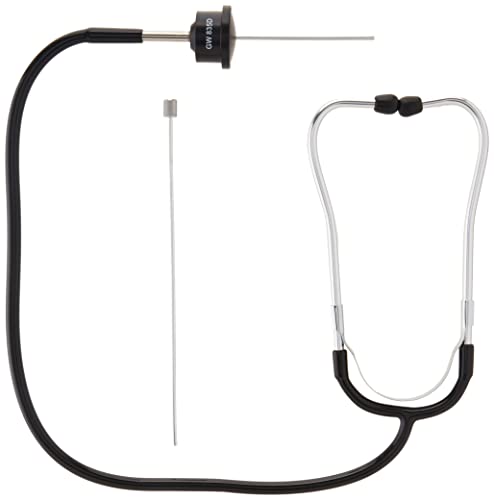
- Model 835D from GEARWRENCH (KD Tools), UPC 082171008351
- Durable steel listening probe for contact listening on housings and covers
- Flexible tubing with earpieces that help shut out shop noise
- Fully mechanical, with no power source required
The GEARWRENCH 835D takes the same proven approach in GEARWRENCH’s own long-running design, sold for years under the KD Tools name. Its steel probe transmits a crisp signal from valve covers, timing cases, and accessory brackets, and the flexible tube and snug earpieces keep feedback clear enough to separate a valve tick from an injector click in a noisy shop. It is at its best on everyday jobs: confirming which pulley bearing is rough, checking whether a water pump growls, or verifying that a tick follows one cylinder. Nothing needs charging or pairing, so it can live in a top drawer and be in your ears seconds after a car rolls in.
Lisle 52750 Dual Purpose Stethoscope Kit

Specs
- Dual detection: mechanical sounds through the probe, air-induced sounds through a funnel
- Screw-in metal probe works with the black diaphragm chamber for bearings, engines, and transmissions
- Vinyl hose and funnel assembly traces vacuum, exhaust, and wind and water leaks
- Swaps between probe and funnel setups on the same chamber
The Lisle 52750 covers noises a plain probe cannot hear. In mechanical mode, the screw-in probe and diaphragm chamber handle the usual work of isolating bearing, gear, and valvetrain sounds. Swap to the vinyl hose and funnel assembly and the kit becomes a leak hunter: sweep the funnel along vacuum hoses, intake joints, and exhaust manifolds and a leak’s hiss stands out against background noise. That second mode matters, because small vacuum and exhaust leaks produce the ticks and hisses often misread as internal engine problems. The funnel also helps track wind noise and water leak paths around door and window seals. For one kit handling both contact and airflow sounds, the 52750 is the most versatile mechanical option here.
STEELMAN 97202 Wireless ChassisEAR
Specs
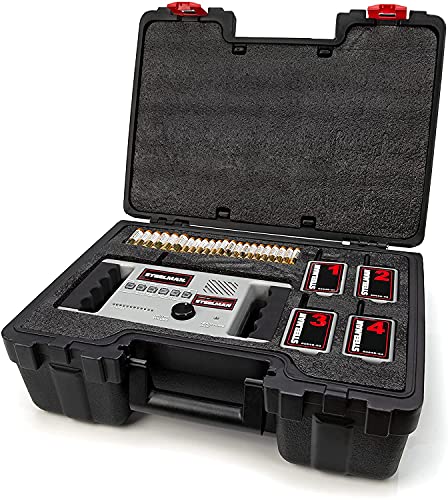
- Four wireless transmitters included (channels 1–4), expandable to six
- Microphone clamps on cable leads attach to bearings, brakes, differentials, transmissions, and suspension parts
- Receiver unit with built-in speaker and earphone jack, plus earphones included
- Runs on AAA cells in the transmitters and AA cells in the receiver; straps, location note pad, and blow-molded case included
The Steelman 97202 Wireless ChassisEAR exists for noises a probe cannot reach: ones that only happen at road speed, under load, or over bumps. Clamp the microphone sensors at the suspect corners, clip each to its wireless transmitter, and listen from the driver’s seat while switching channels to hear which location is loudest. With no long leads to route through door seals, setup is quick and the comparison happens in one drive. The manual recommends a separate driver if you listen through earphones: your attention should stay on the sounds, not the road. Straps, a note pad for recording clamp positions, and a molded case are included.
STEELMAN PRO ChassisEAR 2 Auto Diagnostic Noise Finder (60491)

Specs
- Six piezoelectric microphone clamps, color-coded, on 16-foot cable leads
- All-digital control unit with a USB-rechargeable battery rated for up to 8 hours of use
- Full-coverage over-ear headphones included to block surrounding sound
- Blow-molded ABS storage case with zip ties, hook-and-loop straps, and a dry erase pen for marking clamp locations
- The ChassisEAR 2 is Steelman’s current wired flagship, and its six color-coded piezo clamps let you instrument both sides of the front and rear suspension plus a differential or transmission in one setup. Long 16-foot leads reach every corner of most vehicles, and switching channels gives an immediate loudest-to-quietest ranking while a helper drives. The rechargeable battery removes the dead-battery problem that plagues older kits, and the over-ear headphones shut out road noise so faint bearing tones stay audible. A dry erase pen and straps are included for labeling and securing clamps, preventing the classic mistake of forgetting which clamp was where. For shops chasing NVH complaints, this is the most complete kit here.
Usage Notes
Work safely before you work cleverly. Keep the probe, tubing, cords, hair, and loose clothing away from spinning belts, fans, and pulleys, and never reach across a running engine with a lead trailing. On road tests, secure every clamp and transmitter so nothing falls into a wheel or driveline, route cables away from exhaust heat, and let someone else drive if you wear headphones.
Technique makes these tools accurate. Compare like with like: listen to left and right wheel bearings on the same stretch of road, or touch the probe to each injector in turn, and trust the comparison more than the absolute volume. Change one variable at a time, such as load, speed, or steering angle, and note when the noise appears and disappears. Sound travels through castings and chassis members, so the loudest point is a strong lead, not proof. Confirm with a wiggle test or practical inspection before ordering replacements.
FAQ
Can a mechanic’s stethoscope find a bad wheel bearing?
It can help, with limits. A probe scope works on a stationary bearing you can touch, such as an idler or alternator bearing, but a wheel bearing usually only growls under load at speed. That is a job for a chassis ear kit, with clamps near each hub compared side to side on the same road surface.
What is the difference between a mechanic’s stethoscope and chassis ears?
A mechanic’s stethoscope is a single probe you hold against one part at a time on a stationary vehicle. Chassis ears are electronic kits with several clamp-on microphones at different points, so you can compare locations during one road test and find which is loudest.
Can a stethoscope track down a vacuum leak?
Yes, with the right attachment. A plain probe only carries contact vibration, but a dual-purpose kit with a hose and funnel picks up the hiss of moving air, making vacuum leaks, small exhaust leaks, and wind leaks around seals much easier to locate.
Do electronic chassis ear kits work while driving?
Yes, that is their purpose. The clamps stay fixed to the components, and you listen through the receiver or headphones in the cabin, switching channels as conditions change. For safety, have a second person drive if you are wearing headphones.
Will a stethoscope tell me exactly which part to replace?
Not by itself. It tells you where a noise is loudest, which narrows the search dramatically, but sound conducts through metal and can mislead. Use the result to target your inspection, confirm the fault with further tests, then replace parts.
Conclusion
For most home garages, a mechanical scope such as the Lisle 52500 or GEARWRENCH 835D covers most noise hunts, and the Lisle 52750 adds leak tracing for little extra complexity. When the noise only exists on the road, the Steelman 97202 Wireless ChassisEAR and STEELMAN PRO ChassisEAR 2 turn a guessing game into a single comparative drive. Pick based on where your noises live, and confirm before you buy parts.
More from Amazon
Programs that pair well with the guide above. Offers and eligibility are set by Amazon and may change.
Free shipping on eligible items, Prime Video and more. Eligible new members can start with a free trial.
Start a Prime free trialAudiobooks and podcasts to listen to on the go. Eligible new members can start with a free trial.
Try Audible freeAd-free music streaming. Eligible new subscribers can start with a free trial.
Try Music Unlimited freeA free business account with business pricing and bulk-buying tools for work, shop or home office.
Create a business accountAs an Amazon Associate we earn from qualifying purchases.