Key takeaways
- Compare the best engine vacuum gauges and vacuum/fuel pump testers for reading manifold vacuum, spotting leaks and checking valves, rings and timing.
Disclosure: As an Amazon Associate, I earn from qualifying purchases.
A vacuum gauge is one of the oldest diagnostic tools in the garage, and it still earns its place. Teed into intake manifold vacuum on a running engine, it turns invisible things — a burnt valve, worn rings, late ignition timing, a restricted exhaust, a simple hose leak — into needle behavior you can watch in real time. It needs no batteries, no software and no vehicle-specific coverage, which is why it remains the first tool many mechanics reach for on carbureted engines and older classics, and a useful sanity check on any engine with a manifold vacuum port.
One honest warning before the picks: a vacuum gauge shows symptoms, not verdicts. A rhythmic needle drop tells you a cylinder is not sealing evenly; it does not tell you whether the cause is a burnt valve, a worn guide or a head gasket. The patterns narrow the search, and then compression or leak-down tests confirm the part. Every gauge below is the same basic instrument — a Bourdon-tube dial reading 0 to 28 or 30 inHg of vacuum with a small low-pressure scale for mechanical fuel pumps — so the real differences are dial size, adapters, hose quality and whether the kit includes a case.
How to Choose
Decide what you are testing. A plain gauge kit reads manifold vacuum patterns and mechanical fuel pump pressure and vacuum. That covers engine mechanical health on carbureted engines. If you also need to test vacuum-operated components off the engine — EGR valves, vacuum advance canisters, heater controls, brake boosters — you need a hand pump that applies vacuum, like the Mityvac pick below, instead of or as well as a gauge.
Respect the pressure limit. The pressure side of these gauges tops out at 10 to 15 psi because they are built for carburetor fuel pumps. They are not fuel injection testers and must never be plumbed into a fuel rail. On an injected engine the gauge is for manifold vacuum only.
Dial size and scales. A 3.5-inch or 4-inch face is much easier to read from the driver’s seat or across the engine bay than a small 2.5-inch dial, and needle behavior is the whole test, so resolution matters. Dual scales (inHg and cmHg for vacuum, psi and kg/cm² for pressure) help when a service manual quotes metric figures.
Hose and adapters. Most kits include about two feet of hose, a tee fitting, a tapered adapter and a universal fuel line adapter. Two feet is workable but short in a big engine bay; check that the tee lets you test inline without disabling a vacuum accessory. Brass fittings outlast the all-plastic sets.
Case and zeroing. A blow-molded case keeps the gauge face from being scratched in a toolbox, which matters because a scratched lens makes small needle movements hard to see. Better gauges can be re-zeroed if the needle drifts off zero after being dropped.
The 5 Best Engine Vacuum Gauges
1. Innova 3620 Vacuum and Carburetor Fuel Pressure Tester — Best All-Round Pick

The 3620 is the gauge most home mechanics end up owning. Its 3.5-inch dial is dual-calibrated and color-coded, so the normal, late-timing and low-vacuum zones are easy to separate at a glance while you work the throttle with one hand. The Bourdon tube movement is heavier duty than the no-name kits, and the included adapter selection covers the common carburetor fuel line and manifold port sizes.
Specs:
– Dial: 3.5-inch face, dual-calibrated, color-coded scales
– Vacuum range: 0–30 inHg
– Pressure range: 0–10 psi, for carbureted fuel systems
– Hose: 24-inch oil-resistant rubber hose
– Includes: universal fitting adapter, tapered adapter and tee connector
– Movement: heavy-duty Bourdon tube
2. Actron CP7803 Vacuum and Fuel Pressure Tester Kit — The Long-Running Benchmark

Actron has sold the CP7803 for decades, and its instruction sheet is still one of the best short courses in needle-pattern reading, with illustrated tests for cranking vacuum, exhaust restriction and PCV function. The gauge reads standard and metric scales, and the repair parts list is published, so a perished hose can be replaced with the exact part instead of retiring the kit.
Specs:
– Dial: 3.5-inch face with standard and metric scales
– Vacuum range: 0–30 inHg
– Pressure range: 0–10 psi, carbureted engines only
– Hose: 24-inch black rubber hose for air and fuel
– Includes: universal adapter, tee fitting, tapered hose adapter, 1/8 NPT barb fitting
– Documentation: detailed multilingual instructions with pattern charts
3. ABN Car Vacuum and Fuel Pump Tester Gauge Kit (ABN-2190) — Biggest Dial, Full Case

The ABN kit’s 4-inch color-coded gauge is the largest here, which makes small fluctuations — the one or two inHg wiggle of worn valve guides — the easiest to spot. The adapter set is mostly brass rather than plastic, and everything stores in a fitted blow-molded case. The gauge can be re-zeroed by removing the lens and turning the adjustment screw, a feature the cheapest kits omit.
Specs:
– Dial: 4-inch diameter, color-coded scales
– Vacuum range: 0–28 inHg (0–70 cmHg)
– Pressure range: 0–10 psi (0–0.7 kg/cm²)
– Hose: 2-foot rubber hose, rated to 40 psi working pressure
– Includes: brass cone adapter, tee adapter, three brass thread adapters, plastic connector
– Storage: blow-molded carrying case; total kit weight 1.65 lb
4. HFS(R) Fuel Pump and Vacuum Tester Gauge Kit — Budget Pick

The HFS kit covers the same four basic tests — fuel pump pressure, fuel pump vacuum, carburetor manifold vacuum and general vacuum checks — with a 3.5-inch gauge and brass-bodied fittings at an entry-level specification. One quirk the maker states openly: the needle may not sit exactly on zero out of the box after shipping, because air pressure changes in transit can shift it. Check zero before your first test and treat any small offset as part of every reading.
Specs:
– Dial: 3.5-inch diameter gauge
– Vacuum range: 0–28 inHg
– Pressure range: 0–10 psi, for carburetor engines with mechanical pumps
– Hose: 24-inch vacuum hose
– Includes: adapter set for most vehicles, storage box
– Weight: 1.5 lb; UPC 819300011902
5. Mityvac MV8000 Automotive Test Kit — For Testing Vacuum Components
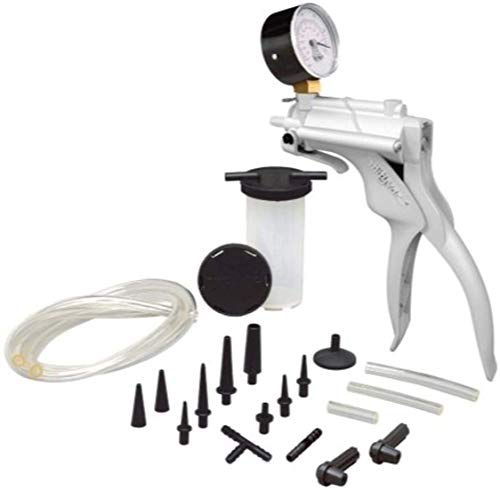
The MV8000 is a different tool: a hand pump that applies vacuum, with a gauge on top. Squeeze the handle and you can watch an EGR valve open, check whether a vacuum advance canister holds vacuum or a brake booster leaks down, and bleed brakes or a clutch one-handed thanks to the one-finger vacuum release. Teed into a manifold line it will also read engine vacuum, but pattern diagnosis is a side role — buy it for component testing, and pair it with a plain gauge above if manifold patterns are your main job.
Specs:
– Pump: Selectline hand pump (MV8010) with one-finger vacuum release
– Gauge: gearless diaphragm gauge, reads vacuum in inHg and kPa
– Reservoir: 4.5 oz fluid container for brake and clutch bleeding
– Includes: 4 tapered adapters, connection tubes and manifold plugs
– Weight: 1.7 lb
– Construction: ergonomic polymer pump body
Usage and Safety Notes
Warm the engine fully before testing, and connect to true manifold vacuum — a port below the throttle plate or the brake booster line with a tee — not a ported vacuum source that reads zero at idle. Readings are quoted at sea level: expect roughly 1 inHg less for every 1,000 feet of altitude, so a healthy engine in the mountains idles lower without anything being wrong.
Classic patterns, used as starting points rather than verdicts: a steady 17 to 22 inHg at idle is a healthy engine at sea level. Low but steady suggests late ignition timing or a vacuum leak. A regular rhythmic drop points to one cylinder’s valve not sealing. A slow float up and down suggests worn valve guides or an idle mixture problem. A needle that falls toward zero as revs are held suggests exhaust restriction. Confirm any of them with a compression or leak-down test before buying parts.
Work carefully around a running engine. Route the hose away from belts, pulleys and the fan, keep hands and loose clothing clear, and never lean over the engine bay while blipping the throttle. For fuel pump tests, work on a cool engine, catch spilled fuel, and keep ignition sources away.
FAQ
What is a normal manifold vacuum reading at idle?
On a healthy stock engine at sea level, expect a steady 17 to 22 inHg. Performance cams idle lower and less steadily by design, and altitude lowers the figure by about 1 inHg per 1,000 feet, so compare against your engine’s baseline, not just the chart.
Can a vacuum gauge find a vacuum leak?
It can tell you a leak is likely — low, steady vacuum with no other explanation — but it cannot locate the leak. Pinching off hoses one at a time while watching the needle, or using a smoke machine, finds the actual split hose or gasket.
Can I use one of these gauges on a fuel-injected engine?
Yes for manifold vacuum diagnosis, connected to a manifold port. No for fuel pressure: injected systems run far beyond the 10 to 15 psi pressure scale, and these kits are explicitly for carbureted systems on the pressure side.
Why does the needle vibrate instead of holding steady?
Small rapid vibration usually means the signal is real, not a faulty gauge: worn valve guides let vacuum pulse cylinder by cylinder. A gauge with some needle damping is easier to read, but heavy damping also hides the patterns you bought the tool to see.
Vacuum gauge or scan tool — which should I buy first?
They answer different questions. A scanner reports what the ECU sees, including calculated load and fuel trims, but it cannot see a burnt valve on an engine with no misfire counter — and it does nothing on a pre-OBD engine. For classic and carbureted cars the gauge comes first; for modern cars it is a cheap, honest cross-check.
Conclusion
For most home garages the Innova 3620 or Actron CP7803 covers everything a vacuum gauge needs to do, with the ABN kit worth choosing if you want the biggest dial and a proper case. The HFS kit is the low-commitment way to learn pattern reading, and the Mityvac MV8000 is the pick when the job is testing vacuum-operated parts rather than the engine itself. Whichever you choose, learn your own engine’s healthy baseline first — the gauge’s real value is showing you the day that number changes.
More from Amazon
Programs that pair well with the guide above. Offers and eligibility are set by Amazon and may change.
Free shipping on eligible items, Prime Video and more. Eligible new members can start with a free trial.
Start a Prime free trialAudiobooks and podcasts to listen to on the go. Eligible new members can start with a free trial.
Try Audible freeAd-free music streaming. Eligible new subscribers can start with a free trial.
Try Music Unlimited freeA free business account with business pricing and bulk-buying tools for work, shop or home office.
Create a business accountAs an Amazon Associate we earn from qualifying purchases.