Our Top Picks

The real decision when buying a battery tester for a family is not accuracy on paper; it is whether the result tells a non-expert what to do next. A household with two or three cars does not need workshop diagnostics. It needs one tool that moves from car to car, gives a plain verdict such as good, recharge or replace, and catches a weakening battery in October instead of on the coldest morning of January, at the school run, with everyone already late.
This guide is for families sharing one tester across several vehicles, drivers who check batteries before winter and before long road trips, and anyone who has been stranded once and would rather not repeat it. The four testers below were chosen from their Amazon titles and listed specifications, favouring clear on-screen verdicts, cranking and charging system tests alongside the basic battery test, and support for the battery types family cars actually use.
Quick Picks
As an Amazon Associate we earn from qualifying purchases.
| Product | Best for | Key spec from title |
|---|---|---|
| ANCEL BA101 | The clearest good-or-replace verdicts for beginners | 12V, 100-2000 CCA, battery, cranking and charging tests |
| TOPDON BT100 | A simple shared tester with traffic-light indicators | 12V, 100-2000 CCA, alternator and cranking tests |
| KONNWEI KW208 | Seeing cranking voltage as a waveform, not just a number | 12V, 100-2000 CCA, colour display with waveform |
| FOXWELL BT705 | Families with a truck, boat or 24V system as well as cars | 12V/24V, 100-2000 CCA, heavy-duty coverage |
How to Choose
Start with verdicts a non-expert can act on
A tester earns its place in a family garage when the screen ends the argument. Look for plain-language results such as good battery, charge and retest, or bad cell replace, backed by state of health and state of charge shown as percentages. Raw voltage alone is not a verdict, because a battery can show a healthy voltage at rest and still collapse under load. The ANCEL and TOPDON units below lead with exactly this kind of summary, which means any adult in the household can run the check and understand the answer without translating numbers.
Cranking and charging tests matter as much as the battery test
A battery rarely fails alone in the story. A weak alternator undercharges it for months, and a tired starter drags it down at every start. Testers that add cranking and charging system tests let you separate those causes at home: the cranking test records how far voltage falls while the engine turns over, and the charging test shows whether the alternator holds proper voltage with lights and blower running. For a family maintaining several cars, that extra information is the difference between replacing one failing part and replacing the wrong one twice.
Match the CCA range and battery types to your actual cars
Every tester here covers 100 to 2000 CCA, which spans small hatchbacks through large trucks, so range is rarely the limit. Battery chemistry is the detail to check instead. Most family cars use regular flooded batteries, but stop-start models often carry EFB or AGM batteries, and selecting the wrong type in the tester menu skews the result. Check that the models you shortlist name your battery types in their listings, and remember you must enter the battery’s rated CCA, printed on its label, before each test for the verdict to mean anything.
Know where basic testers cut corners
The simplest testers skip the charging test, use small monochrome screens that are hard to read in bright daylight, or have short cables that force you to hold the unit over the engine bay. Screens that store or review previous results help when you maintain several cars, because you can compare this autumn’s reading with last year’s. None of that makes a basic unit useless, but for one tester shared by a whole household, a readable colour screen and a results review function, like the KONNWEI below, reduce arguments about what the screen actually said.
Safety Notes
Testing is low-risk compared with charging, but the battery still deserves respect. Connect red to positive and black to negative, keep the clamps from touching each other, and keep sparks, flames and cigarettes away, because a lead-acid battery vents flammable hydrogen gas. Never test a battery that is frozen, swollen, leaking or cracked; a frozen battery must thaw indoors first, and a damaged one should be replaced, not tested. Wear eye protection, remove rings and watches, and avoid repeated cranking tests back to back, which overheats the starter and drains the battery you are trying to assess.
The 4 Best Options
ANCEL BA101

The BA101 is the easiest tester here for a non-expert to trust, because its results are written as decisions: good battery, charge and retest, or bad cell and replace. It tests 12-volt batteries across a 100 to 2000 CCA range and adds cranking and charging system tests, so one session covers the battery, the starter load and the alternator. The listing also names reverse polarity protection, which matters in a household where the least mechanical person may be the one holding the clamps. For families, that combination of plain verdicts and full system checks makes it the natural first choice.
Specs
- Voltage: 12V
- Test range: 100-2000 CCA
- Tests: battery test, cranking test and charging test
- Results shown: state of health, state of charge, voltage, measured CCA and internal resistance
- Battery types: regular flooded, AGM flat plate, AGM spiral, GEL and EFB, per the listing
- Protection: reverse polarity protection named in the listing
Best for: A first family tester that any driver in the house can use and understand.
Watch out for: It covers 12V systems only, so it cannot test a 24V truck system, and you must enter the battery’s rated CCA from its label for the verdict to be valid.
ASIN: B01M0ARG3X
TOPDON BT100
The BT100 takes a similar three-test approach and adds a shortcut the others lack: indicator lights that summarise the result as good, charge or bad before you read the numbers. That traffic-light summary suits a shared family tool, because whoever runs the pre-winter check gets the headline instantly, while the screen still provides health percentage, charge percentage, voltage and internal resistance for anyone who wants detail. It covers the same 100 to 2000 CCA range on 12-volt systems and is listed for cars, trucks, motorcycles, ATVs, SUVs and boats, which fits a household whose vehicles are not all cars.
Specs
- Voltage: 12V
- Test range: 100-2000 CCA
- Tests: battery test, cranking test and charging system test
- Results shown: health and charge percentages, voltage, measured CCA and internal resistance
- Summary: indicator lights for good, charge and bad results
- Listed for: car, truck, motorcycle, ATV, SUV, boat and yacht
Best for: Quick pass-or-fail checks across several family vehicles before winter.
Watch out for: It is a 12V-only tester, and like all conductance testers it gives its verdict relative to the rated CCA you enter, so a wrong entry produces a wrong verdict.
ASIN: B07Z67MMGC
KONNWEI KW208

The KW208 is the pick for the family member who wants to see what the starter actually does. Alongside battery, cranking and charging tests on 12-volt systems, it displays voltage as a live waveform, so a cranking dip is visible as a curve rather than a single minimum number. Its colour screen is the clearest here to read in a bright driveway, and a review function stores past results, which helps when you maintain three cars and want to spot the battery that is fading fastest. Battery, cranking and charging coverage matches the ANCEL, so the choice between them is about display and records.
Specs
- Voltage: 12V
- Test range: 100-2000 CCA
- Tests: battery test, cranking test and charging test
- Display: colour screen with voltage waveform view
- Results shown: state of health, state of charge, voltage, measured CCA and internal resistance
- Battery types: regular flooded, AGM flat plate, AGM spiral and GEL, per the listing
- Storage: review function for previous test results
Best for: The household’s designated checker who tests every car each autumn and tracks the trend.
Watch out for: The waveform and menus offer more than a casual user needs, and EFB batteries for stop-start cars are not in its listed types, so check your battery label before relying on it for those.
ASIN: B08MPXGSGN
FOXWELL BT705
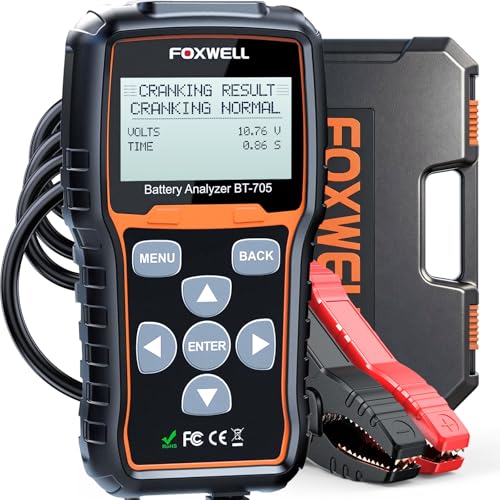
The BT705 is the heavy-duty option, and its headline difference is voltage coverage: it handles 12-volt and 24-volt cranking and charging systems as well as 12-volt battery testing across the same 100 to 2000 CCA range. That makes it the one tester here suited to a household that also runs a diesel truck, a boat or other equipment beyond ordinary cars. It tests the common battery types, regular flooded, AGM flat plate, AGM spiral and gel, and presents results with measured CCA against the rating you entered. Buy it for the breadth of vehicles it covers rather than for simplicity.
Specs
- Voltage: 12V batteries, with 12V and 24V cranking and charging system tests
- Test range: 100-2000 CCA
- Tests: battery test, cranking test and charging system test
- Battery types: regular flooded, AGM flat plate, AGM spiral and GEL, per the listing
- Listed for: heavy-duty trucks, boats, marine and shop use
Best for: Families whose vehicles include a truck, boat or 24V system alongside the cars.
Watch out for: It is the most workshop-oriented unit here, with a menu built for mechanics, so allow a few minutes to learn it; and confirm the current listing’s seller and terms before ordering.
ASIN: B01ANF1D7U
Which One Fits Your Situation
Checking every family car before the first freeze
Work through the cars in one session with the TOPDON BT100 or the ANCEL BA101. Both give an instant verdict per car, so a Saturday morning covers the whole household. Any car that reports charge and retest goes on the charger that day; any that reports replace gets a new battery before the cold makes the decision for you.
The night before a long family road trip
Test the trip car properly rather than glancing at the voltage. The ANCEL BA101’s charging test confirms the alternator will keep the battery up over hours of driving with lights, fans and devices running, and its cranking test shows how much reserve the battery really has. A marginal result the night before is an inconvenience; the same result at a motorway services is a breakdown.
A spare car or teen’s first car that sits for weeks
Infrequent use is what quietly kills batteries, so test this car monthly rather than seasonally. The KONNWEI KW208 suits the job because its stored results show whether the battery is holding steady or sliding month by month. A slow slide caught early means a recharge at home; caught late, it usually means a replacement.
Cars plus a truck, boat or RV in the family
Choose the FOXWELL BT705. It is the only tester here that also covers 24V cranking and charging systems, so the same tool checks the cars, the truck and the boat battery on one shelf. The broader coverage justifies its more professional layout if your household’s vehicles go beyond standard 12-volt cars.
Common Mistakes
- Testing straight after a drive, when surface charge inflates the voltage and the tester reports a healthier battery than you really have.
- Entering the wrong rated CCA, or the wrong battery type, and then trusting a verdict that was calculated against the wrong baseline.
- Running only the battery test and skipping the charging test, then replacing a battery that a failing alternator will ruin again within months.
- Treating a resting voltage reading as proof of health, when only a load-based test shows how the battery behaves during an actual start.
- Testing a frozen, swollen or leaking battery instead of replacing it, and repeatedly cranking during tests until the starter overheats.
Frequently Asked Questions
How often should a family test its car batteries?
Twice a year is a sensible rhythm: once in autumn before the cold arrives, and once in spring. Add a test before any long road trip and whenever a car starts sounding slow or laboured. Batteries in cars that sit unused need checking more often, roughly monthly, because inactivity drains them steadily even in mild weather.
Can these testers check the alternator as well?
Yes. All four testers here include a charging system test alongside the battery and cranking tests. With the engine running and electrical loads switched on, the tester measures the voltage the alternator delivers and flags charging as normal or faulty. That matters because a weak alternator is a common hidden cause behind a battery that keeps going flat.
Do I need to remove the battery from the car to test it?
No. These testers are designed to work with the battery in the vehicle, clamping straight onto the terminals, and the cranking and charging tests require it to stay connected anyway. Just make sure the terminals are clean enough for the clamps to grip bare metal, since a corroded connection can distort the readings and produce a misleading verdict.
What does state of health mean, and when should I replace the battery?
State of health compares the battery’s measured cranking ability with its original rated CCA, shown as a percentage. A battery near full health has most of its original strength; as the figure falls, cold starts become unreliable. When a tester reports bad cell or replace, or health drops low alongside slow cranking, plan a replacement soon rather than waiting for a no-start.
More from Amazon
Programs that pair well with the guide above. Offers and eligibility are set by Amazon and may change.
Free shipping on eligible items, Prime Video and more. Eligible new members can start with a free trial.
Start a Prime free trialAudiobooks and podcasts to listen to on the go. Eligible new members can start with a free trial.
Try Audible freeAd-free music streaming. Eligible new subscribers can start with a free trial.
Try Music Unlimited freeA free business account with business pricing and bulk-buying tools for work, shop or home office.
Create a business accountAs an Amazon Associate we earn from qualifying purchases.