Key takeaways
- Compare the best hex key sets for car and garage work: metric and SAE coverage, ball-end access, steels and cases, plus honest fit and torque advice.
Disclosure: As an Amazon Associate, I earn from qualifying purchases.
Hex socket screws are everywhere on a modern car: brake caliper brackets, interior trim, roof rack hardware, engine covers and brackets under the hood. A good hex key set turns those fasteners without drama. A poor one, or the wrong size, rounds the socket head and turns a ten-minute job into an extraction project. This guide compares five metric and SAE sets covering the sizes car owners actually meet.
How to Choose
Get both measurement systems. Cars sold in North America mix metric fasteners with SAE hardware on accessories, older models and aftermarket parts. A 5 mm key measures 0.197 inches and a 3/16 inch key measures 4.76 mm, so they look interchangeable on a bench. They are not. A metric key in an SAE socket, or the reverse, can feel almost snug while touching the socket walls at only a few points, and the first hard pull rounds those points off. Use the key that slides in with no wobble.
Ball end versus flat end. A ball end on the long arm lets the key enter the socket at an angle, typically up to about 25 degrees, reaching screws hidden behind hoses, brackets and trim. The cost is real: the ball’s narrow neck contacts less of the socket and handles far less torque than the straight short arm. Break fasteners loose and do final tightening with the short, flat end seated fully; use the ball end only to spin a fastener that already moves freely.
Arm length is a trade-off, not a bonus. The short arm is the torque arm: with the long arm in your hand, the short end delivers the turning force. The long arm is for reach and spinning. Extra-long keys flex more, and flexing under load twists cheap keys into spirals.
Steel and finish. Look for hardened alloy steel or chrome vanadium steel with a black oxide, phosphate or plated finish that slows rust. Size markings on every key matter: loose unmarked keys in a drawer invite the wrong-system guess.
Never cheat the length. Slipping a pipe or box wrench over a small key for more leverage is a reliable way to snap the key, round the socket, or both. A snapped 3 mm key leaves hardened steel stuck in the screw head, and removing that usually means drilling. If a fastener will not move with the correct key used properly, the answer is penetrating oil and patience, not a longer lever.
The 5 Best Hex Key Sets
Bondhus 20199 Balldriver L-Wrench Double Pack

Specs
- 22 pieces: 13 SAE keys (.050 to 3/8 inch) and 9 metric keys (1.5 to 10 mm)
- Ball end on the long arm, entry angles up to 25 degrees
- Protanium high-torque steel with ProGuard finish
- Bondhex color-coded case: yellow for inch, red for metric
- Made in the USA
The Bondhus 20199 is the classic two-system answer: one case holds the SAE set (Bondhus 10937), the other the metric set (10999). The ball end on each long arm is the spinning end, for running fasteners down at an angle once the short arm has broken them loose. Bondhus machines its keys to tight tolerances, the unglamorous detail that keeps sockets from rounding: a key that truly fills the hex leaves no room to rock and chew the corners. The ProGuard finish is a dry, rust-resistant coating rather than a slippery plating, so keys stay grippable with oily hands.
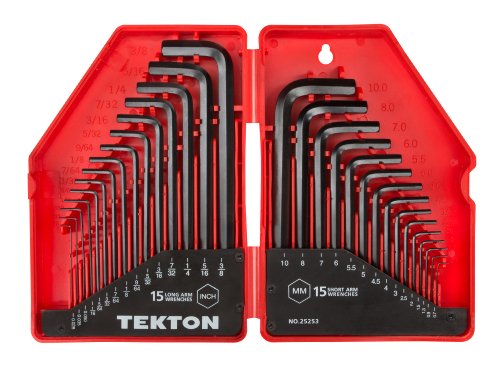
TEKTON Hex Key Wrench Set, 30-Piece (25253)
Specs
- 30 pieces: 15 long-pattern SAE keys (.028 to 3/8 inch), 15 short-pattern metric keys (0.7 to 10 mm)
- Flat hex ends on both arms, no ball end
- Heat-treated steel, manganese phosphate finish
- Includes small sizes many sets skip: 0.7, 0.9 and 1.3 mm
- Hinged storage case; weight about 1.86 pounds
The TEKTON 25253 takes the opposite approach from the ball-end sets: plain flat ends, in exchange for the widest size coverage here. Long-pattern inch keys give reach and leverage on SAE hardware, while short-pattern metric keys include the tiny sizes found on electronics, sensors and small brackets. Flat ends seat fully and take full torque on both arms, making this the set for stubborn caliper and bracket bolts where a ball end would be the wrong tool anyway. The trade-off is access: every screw must be approached straight on.
TEKTON Ball End Hex Key Wrench Set, 26-Piece (25282)

Specs
- 26 pieces: 13 SAE keys (3/64 to 3/8 inch) and 13 metric keys (1.27 to 10 mm)
- Ball end on the long arm, up to a 25-degree entry angle
- Heat-treated chrome vanadium steel, black oxide finish
- Metric run includes half sizes: 3.5, 4.5 and 5.5 mm
- Weight about 0.9 pounds
Where the 25253 is the torque specialist, the TEKTON 25282 is the access specialist, and the most car-friendly single set here. The metric half sizes matter: 3.5, 4.5 and 5.5 mm fasteners appear on European and Japanese hardware often enough that sets skipping them leave a real gap. Ball ends on every long arm mean trim screws and brackets tucked behind obstructions can be spun out without removing half the engine bay first. Keep the discipline above: the ball end spins, the short flat end breaks loose and snugs.
Amazon Basics 26-Piece Long-Arm Hex Key Set (AMZ1715)

Specs
- 26 pieces: 13 SAE and 13 metric long-arm keys
- Ball end tips, stated entry angle up to 25 degrees
- Chrome vanadium steel construction
- Two hinged storage cases with size markings
- Limited 1-year warranty
The Amazon Basics AMZ1715 is the budget route to full two-system coverage. Long arms give decent reach, ball ends handle angled access, and two hinged cases keep inch and metric separated. The honest caveats concern precision and support: tolerances on budget keys tend to run looser than on the Bondhus or TEKTON sets, and a loose key is exactly the kind that rounds a socket under real torque, so check each key’s fit in a known fastener before leaning on it. The one-year warranty is also the shortest here. As a glove-box or second set for light work it makes sense; for daily heavy use, the tighter-made sets are better.
Bondhus 20399 Ball End L-Wrench Double Pack

Specs
- 22 pieces: 13 SAE keys (.050 to 3/8 inch) and 9 metric keys (1.5 to 10 mm)
- Ball end on the long arm, up to 25-degree working angle
- BriteGuard plated finish on inch keys, GoldGuard on metric keys
- Weight about 1.2 pounds; Bondhus lifetime warranty
The 20399 covers the same 22 sizes as the 20199 but swaps the ProGuard coating for plated BriteGuard and GoldGuard finishes. That matters in a garage that sees coolant, brake cleaner and winter slush: plated keys shrug off moisture, wipe clean more easily, and the bright finish makes a dropped key easier to spot. The finishes double as a visual code, so gold-toned metric keys are hard to confuse with the bright inch keys. The same rules apply: ball end for spinning, short arm for torque, no cheater bars.
Usage and Buying Notes
Match the key to the fastener before applying force. The correct key seats fully with no rocking; if it wobbles, it is the wrong size or the wrong system, and pulling anyway will round the socket. Clean dirt and grit out of the socket head first, because debris stops the key seating to full depth and loads the socket’s rim.
Seat the short arm fully when breaking a fastener loose, push the key in as you turn, and keep your other hand clear of the swing path in case it lets go suddenly. Once the fastener moves, switch to the ball end to spin it out. Reverse the process on installation, and remember that small hex screws in aluminum and plastic strip the part, not the screw, when over-tightened; a published torque specification beats feel.
Store keys in their case, in size order. A set missing its 5 mm key invites the 3/16 inch substitution that rounds sockets, so replace lost keys instead of improvising. Corroded fasteners are a known trap: wire-brush the socket, soak it, and reach for a screw extractor rather than escalating force on a key never designed as a breaker bar.
FAQ
Can I use a metric hex key in an SAE fastener if it feels close?
No. Close sizes such as 5 mm and 3/16 inch differ by about a quarter of a millimeter, leaving the key touching only the socket’s corners. Under torque those corners round off and the fastener becomes an extraction job. Use the exact size from the correct system.
Why does the ball end keep slipping out under hard turning?
Because it is not meant for hard turning. The ball’s neck is narrower than the socket and contacts less surface, so it cams out or snaps under high torque. Break fasteners loose and do final tightening with the short flat end; use the ball end only to spin fasteners that already move freely.
Is it safe to extend a hex key with a pipe for more leverage?
No. A pipe multiplies force past what key and socket can take. The usual outcomes are a snapped key with hardened steel lodged in the screw head, a rounded socket, or both. Penetrating oil, time and proper extraction tools are the answer to a seized fastener.
Which sizes do I actually need for car work?
Most car hex hardware falls between 3 mm and 10 mm, with 4, 5 and 6 mm doing the bulk of the work on brackets, covers and accessories. SAE coverage from 1/8 to 3/8 inch handles older domestic hardware and aftermarket parts.
What should I do when a hex socket is already rounded?
Stop before it gets worse. Escalate in order: a fresh, exact-fit key seated fully with downward pressure, a Torx bit tapped into the damaged socket for bite, then a dedicated screw extractor. Drilling is the last resort.
Conclusion
For most car owners, one good two-system set is enough: the Bondhus 20199 for tight tolerances, the TEKTON 25282 if angled access matters most, or the TEKTON 25253 when flat-end torque and odd small sizes are the priority. The Amazon Basics set covers light duty, and the Bondhus 20399 adds plated finishes for damp storage. Whichever you choose, the habits decide the outcome: exact size, correct system, short arm for torque, ball end only for spinning, never a pipe on one.
More from Amazon
Programs that pair well with the guide above. Offers and eligibility are set by Amazon and may change.
Free shipping on eligible items, Prime Video and more. Eligible new members can start with a free trial.
Start a Prime free trialAudiobooks and podcasts to listen to on the go. Eligible new members can start with a free trial.
Try Audible freeAd-free music streaming. Eligible new subscribers can start with a free trial.
Try Music Unlimited freeA free business account with business pricing and bulk-buying tools for work, shop or home office.
Create a business accountAs an Amazon Associate we earn from qualifying purchases.