Key takeaways
- Compare the best hydraulic shop presses for home garages, from a compact 10-ton H-frame to a 20-ton pneumatic floor press for bearings and bushings.
Disclosure: As an Amazon Associate, I earn from qualifying purchases.
A hydraulic shop press is the tool that turns jobs you used to farm out — pressed-in wheel bearings, control arm bushings, ball joints, U-joints, pulleys and bent brackets — into work you can do on your own schedule. Instead of hammering on a bearing race and hoping, you support the part squarely, apply force in a straight line, and watch it move. For a home garage, the realistic choice is an H-frame press between 10 and 20 tons, and the differences that matter are frame size, working height, stroke and pump style rather than the headline tonnage alone.
The five presses below span that range, from a compact 10-ton starter model to a pneumatic-assisted 20-ton floor press.
How to Choose
Start with the tonnage your jobs actually need
Twelve tons handles the overwhelming majority of passenger-car work: wheel bearings and hubs, ball joints, bushings, small U-joints, pulleys and gears. Twenty tons buys headroom for full-size truck hubs, large U-joints and press-fits that have been corroding in place for a decade. Ten tons is enough for lighter bearing, bushing and straightening work on smaller cars. Whatever you buy, treat the rating as a ceiling, not a cruising speed — never exceed the press’s rated tonnage, and be suspicious of any job that needs maximum force to move.
Frame size, daylight and stroke decide what fits
Tonnage is useless if the part does not fit in the frame. Check the width between the uprights, the adjustable working height (daylight) between the ram and the bed, and the ram stroke, typically around 5 to 6 inches in this class. A hub with a dust shield or a long control arm needs width; a tall knuckle with a driver stacked on top needs daylight. More bed positions mean less wasted ram travel and fewer mid-job resets.
Pump style and a pressure gauge
Most home-garage presses use a hand pump or a bottle jack. Pneumatic-assisted models add an air motor so the ram advances without constant pumping, while keeping a hand pump for fine control. A pressure gauge is worth having: it tells you when force is climbing with no movement — the classic sign that a part is cocked or seized — and it lets you repeat a known, gentle force on fragile aluminum housings.
Plates and support are not optional extras
A press is only as good as what the part rests on. Use proper press plates and arbor plates rated for the load, sized to support the workpiece close to where the force is applied. Improvised spacers — stacked sockets, wood blocks, random scrap steel — can shatter or kick out under load. If a press ships with stamping plates or V-blocks, that saves a separate purchase, but confirm the plates are rated for the press’s full capacity.
The Picks
VEVOR Hydraulic Shop Press, 20 T H-Frame Pneumatic Shop Press

Specs:
– Capacity: 20 tons
– Operation: manual hand pump or pneumatic (air-assisted)
– Working height: 9 adjustable settings, 2.56 to 40.5 inches
– Ram stroke: about 5.5 inches
– Frame: H-frame steel with triangular support base
– Includes: press plate and 20-ton pressure gauge
– Weight: about 190 lb
This is the most capable press here for a busy home shop. The dual manual/pneumatic drive runs the ram down quickly on air and finishes by hand, and the included gauge helps you spot a seized bearing before you lean on it. Nine bed positions and over 40 inches of working height swallow tall knuckles and strut assemblies, and the triangular base keeps the tall frame steady under off-center loads. It is big and heavy, so plan the floor space and recruit help for assembly.
BIG RED ATY20011R Torin 20-Ton H-Frame Shop Press

Specs:
– Capacity: 20 tons (40,000 lb)
– Drive: removable 20-ton bottle jack
– Working range: 0 to 28 inches
– Frame: steel H-frame, floor standing
– Includes: stamping plates with V-blocks
– Weight: about 159 lb
The BIG RED is the traditional take on the 20-ton home press: a steel H-frame powered by a removable bottle jack that can be serviced or replaced on its own, and doubles as a standalone jack in a pinch. The included stamping plates with V-blocks support round shafts and give you basic bending and stamping capability out of the box. Its 28-inch working range covers bearings, bushings, U-joints and truck press-fits without the cost or complexity of air assist.
VEVOR Hydraulic 12 Ton H-Frame Garage Floor Shop Press

Specs:
– Capacity: 12 tons (26,000 lb)
– Working height: adjustable, 1.6 to 27.8 inches
– Frame: 0.2-inch carbon steel H-frame, powder-coated
– Base: triangular reinforced design
– Safety: built-in relief valve
– Includes: 2 movable stamping plates
– Weight: about 86 lb
For car and crossover work, this 12-ton VEVOR is the sweet spot of capacity, footprint and weight. The frame is thick carbon steel with a triangular base that resists rocking, the relief valve vents pressure if you exceed the rating, and at roughly 86 pounds one person can shift it around the garage. The 27.8-inch maximum working height handles most hub and knuckle jobs, and the movable stamping plates are included. Rust-belt truck hubs at the ragged edge of 12 tons are the main reason to step up to a 20-ton model.
JoanKaren 12 Ton Hydraulic Shop Press, H-Frame Bench Top

Specs:
– Capacity: 12 tons
– Frame: carbon steel H-frame
– Working distance: 3.74 to 24.8 inches
– Bed adjustment: 8-hole adjustable worktable
– Overall height: 51.18 inches
– Includes: movable press plates
This compact 12-ton press suits a smaller garage where a full-height floor press will not fit. The 8-hole adjustable bed sets working height in fine steps, and the roughly 51-inch overall height keeps the top of the frame below most shelving. Capacity matches the bigger 12-ton floor models — the trade-off is daylight: at 24.8 inches of maximum working distance, tall assemblies with a driver stacked on top get tight sooner. Make sure the bench or stand you mount it on can take the reaction load of a full 12-ton press.
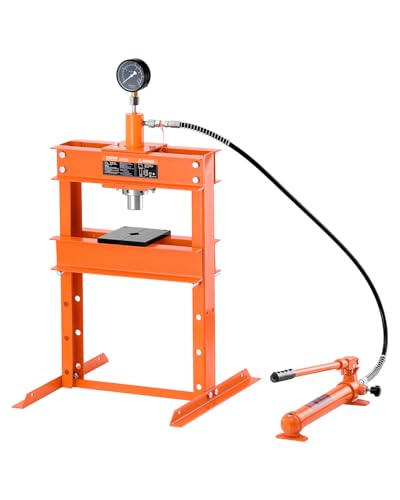
VEVOR Hydraulic Shop Press, 10 T H-Frame
Specs:
– Capacity: 10 tons
– Model: ZX0901 10T
– Frame: H-frame steel with H-shaped base
– Safety: built-in relief valve
– Includes: press plate
– Operation: manual hand pump
The 10-ton VEVOR is the entry point for lighter work: small-car bearings and bushings, pulleys, gears, and bending or straightening brackets and flat stock. The H-shaped base keeps the compact frame planted, the relief valve guards against over-pressuring, and a press plate is included so you can work straight away. Be honest about your workload, though — if you regularly press truck hubs or fight corroded press-fits, start with a 12- or 20-ton press instead.
Usage Notes
Set the part up square before you pump. The workpiece should sit flat on rated press plates, supported close to the bore or race you are pressing, with the ram centered on the driver. Force applied at an angle cocks the part in its bore, galls the surfaces, and can launch the workpiece sideways.
Work up to force gradually. Apply penetrating oil to corroded press-fits and let it soak first; heat, where the part tolerates it, helps more than extra tonnage. If the gauge climbs and nothing moves, stop and re-check the setup — a press does not make a stuck bearing safe to force indefinitely, and the fix is better support, penetrant, or a bearing separator, not more pumps.
Protect yourself every time. Wear eye protection, keep hands out of the pressing path and off the workpiece while it is under load, and stand to the side of the ram rather than in line with it. A heavy blanket or shield draped over the work contains fragments if a hardened race lets go suddenly. Bolt tall floor presses to the slab or brace them, and store the press with the ram retracted.
FAQ
Is a 12-ton press enough for wheel bearings?
For most passenger cars and crossovers, yes. Pressed-in wheel bearings usually come out and go in well within 12 tons when the knuckle is supported properly and corrosion is not severe. Heavy-duty truck hubs and badly rusted assemblies are the cases where a 20-ton press earns its floor space.
What is the difference between a bottle-jack press and a pneumatic press?
A bottle-jack press uses a removable hydraulic jack as its power unit, which is simple and easy to service. A pneumatic-assisted press adds an air motor that advances the ram quickly, usually with a hand pump retained for the final, controlled part of the press. The pneumatic version mainly saves time and effort on frequent work.
Can I use wood blocks or stacked sockets as press spacers?
No. Only use press plates and arbor plates rated for the load. Wood crushes unevenly and can split, and stacked sockets or scrap steel can shatter or shoot out under load. Rated steel plates support the part evenly and are the single cheapest safety upgrade for any press.
Do I need a pressure gauge on a shop press?
It is not mandatory, but it is genuinely useful. A gauge shows force building with no movement, which warns you a part is cocked or seized before something breaks, and it lets you apply a consistent, limited force when pressing bearings into aluminum housings that can crack if over-pressed.
Should I bolt my shop press to the floor?
For tall 20-ton floor presses, yes — anchoring or bracing removes any tipping risk under off-center loads and keeps the frame from walking as you pump. Smaller 10- and 12-ton presses on wide, triangular or H-shaped bases are steadier, but they still belong on a flat, level surface, and benchtop models need a bench rated for the full pressing load.
Conclusion
For most home garages, the VEVOR 12-ton H-frame is the balanced buy: real capacity for car bearings and bushings in a stable frame that does not dominate the shop. If you work on full-size trucks or rusty hardware, step up to the pneumatic VEVOR 20-ton or the bottle-jack BIG RED 20-ton. Tight on space, the compact JoanKaren 12-ton keeps full 12-ton capacity in a shorter frame, and the VEVOR 10-ton covers lighter work at the lowest commitment. Match the frame to your biggest part, use rated plates, and any of these will pay for itself the first time a bearing job stays in your garage instead of going to a shop.
More from Amazon
Programs that pair well with the guide above. Offers and eligibility are set by Amazon and may change.
Free shipping on eligible items, Prime Video and more. Eligible new members can start with a free trial.
Start a Prime free trialAudiobooks and podcasts to listen to on the go. Eligible new members can start with a free trial.
Try Audible freeAd-free music streaming. Eligible new subscribers can start with a free trial.
Try Music Unlimited freeA free business account with business pricing and bulk-buying tools for work, shop or home office.
Create a business accountAs an Amazon Associate we earn from qualifying purchases.