Key takeaways
- Category: Adventure / dual-sport touring pant
- Shell: Abrasion-resistant textile with weather-resistant treatment
- Armor: Pockets at knees and hips for insertable armor
- Ventilation: Multiple vent openings for warm-weather touring
- Fit: Adventure cut with room for layering and knee articulation
- Waist: Adjustable for on-bike position changes
Top 3 Picks
Best overall: MSR Voyager Adventure Dual Sport Touring Pants — a purpose-built touring shell with serious abrasion resistance and weather protection, ideal for riders who commute daily and tour on weekends. Best budget: CTBQiTom Motorcycle Pants with CE Level 2 Armor — the cheapest way to get certified impact coverage without giving up a full riding cut. Best premium: ILM CE Armored Motorbike Jeans PJN1 — a premium all-season Jean-style pant that blends CE armor with a riding-jean silhouette for riders who want protection that looks casual off the bike.
Quick Comparison
| Product | Best For | Key Specs | Price Tier |
|---|---|---|---|
| MSR Voyager Adventure Dual Sport Touring Pants | Long-distance touring and mixed-surface riding | Adventure cut, dual-sport oriented, weather-resistant shell, knee/hip armor pockets, multiple vents | Premium |
| ILM CE Armored Motorbike Jeans PJN1 | All-season street and commuting | CE armor at knees, jean cut, breathable denim-style fabric | Premium |
| ILM CE 2 Armored Riding Pants Dirt Dike Jeans BJN01 | Dirt, dual-sport, and aggressive street riding | CE Level 2 armor, jean cut, reinforced knees | Mid-range |
| BYKR Armored Cordura Overpants Enduro ATV Dual Sports | Overpant layering for commute and trail | Cordura shell, cargo pockets, armored knees, overpant fit | Mid-range |
| HWK Motorcycle Pants with Armor, Water-Resistant Cordura | Commuting in wet or cold conditions | Water-resistant Cordura, armor pockets, relaxed fit | Mid-range |
| newfacelook Armored Motorbike Jeans with Aramid Lining | Touring with a jeans aesthetic | Aramid protective lining, reinforced knees, adventure/touring cut | Mid-range |
| KEMIMOTO Motorcycle Pants Full Side Zip CE Armor Windproof | Quick on/off commuting and wind protection | Full side zip, CE armor, windproof shell, black | Premium |
| SHIMA Giro 3.0 Motorcycle Trousers | Lightweight cargo-style urban riding | Knee protectors, cargo cut, lightweight armored fabric | Premium |
| LOMENG Motorcycle Riding Pants Women with CE Level 2 Armor | Women riders wanting Level 2 armor | CE Level 2 removable armor, women’s fit, blue | Budget |
| CTBQiTom Motorcycle Pants with CE Level 2 Armor | Budget-first protective riding | CE Level 2 armor, unisex black cut, armored knees | Budget |
| VNFOX Motorcycle Pants & Jeans CE Level 2 Armor | Entry-level armored jeans | CE Level 2 armor, jeans silhouette, unisex | Budget |
| Dream Apparel Black Leather Chaps with Zip-Out Liner | Cruiser and cowboy riders wanting leg shell only | Leather chaps, zip-out liner, no armor, overpant style | Budget |
How We Chose
Our selection for the best motorcycle riding pants starts with what the listing actually promises: armor certification, shell material, and construction details. We prioritized pants that state a CE armor level or at least name the armor pockets, because unstated protection is unverifiable. Next we weighed category fit — an overpant, a riding jean, a leather chap, and a touring shell solve different problems, so we matched each product to the rider situation it genuinely serves rather than ranking everything on one scale.
We also factored in weather protection and ventilation signals: waterproof or water-resistant liners, windproof shells, full side zips, and vent placement. For fit, we looked at whether a product is described as unisex, women’s-specific, or overpant sizing, since sizing mismatches are the most common cause of returned riding gear. Finally, we considered the upgrade path: budget picks that get a rider into certified armor, mid-range picks that add abrasion-resistant fabric, and premium picks that add weather sealing or a specific fit. We did not test, benchmark, or personally ride in any of these products; this is research-based selection using listed specifications and well-established knowledge about the categories.
1. MSR Voyager Adventure Dual Sport Touring Pants – Best for Long-Distance Touring
As an Amazon Associate we earn from qualifying purchases at no extra cost to you.

If your riding is mostly long days in the saddle, with a mix of paved highway and the odd gravel road, the MSR Voyager is the pant class to start with. MSR is a long-standing name in off-road and dual-sport gear, and the Voyager sits at the touring end of that range: an adventure-cut shell built around the idea that you will be sitting on the bike for hours, not standing in a coffee shop. The cut is roomier through the hips and knees than a street jean, which matters because a tight fit on an adventure pant pinches when your knees are bent for three hours at a time.
Key Specs
- Category: Adventure / dual-sport touring pant
- Shell: Abrasion-resistant textile with weather-resistant treatment
- Armor: Pockets at knees and hips for insertable armor
- Ventilation: Multiple vent openings for warm-weather touring
- Fit: Adventure cut with room for layering and knee articulation
- Waist: Adjustable for on-bike position changes
The dual-sport angle is the real differentiator. Adventure pants generally have a wider leg opening than street pants so they can be worn over or alongside motocross-style boots, and the Voyager follows that pattern. If you have ever ridden a dual-sport bike and had your pant cuff catch on the footpeg or a boot buckle, you understand why that leg opening matters. Touring pants also tend to have more pockets and a more upright pattern than a sport cut, since the riding position on an ADV bike is upright.
Weather protection on a pant in this class typically means a wind- and water-resistant shell rather than a fully bonded waterproof membrane. That is a deliberate trade-off: a breathable, quick-drying textile is more comfortable across a wider temperature range, and it dries out faster after a shower than a laminated membrane. For touring, that versatility is usually worth more than absolute waterproofing.
Strengths
- Purpose-built for long days in an upright riding position
- Room for a base layer and heated gear in cold weather
- Ventilation designed for summer touring
- Wide leg opening works with dual-sport and ADV boots
Pros
- Comfortable over hours, not just minutes
- Versatile across temperatures with vents open or closed
- Room for armor inserts at knees and hips
- Dual-sport pattern fits over boots cleanly
Cons
- Premium tier pricing, the most expensive category here
- Bulkier and warmer off the bike than a street jean
- Limited availability compared to mass-market overpants
- Overkill for a five-mile city commute
How it compares: Against the ILM PJN1, the Voyager is the more serious touring tool — better ventilation plan, better boot compatibility, and a full adventure cut. The PJN1 wins on everyday appearance and price band. If you ride 200 miles a week to work, the ILM is the more sensible daily pant; if you ride 200 miles every Saturday in one sitting, the Voyager is the one you want.
2. ILM CE Armored Motorbike Jeans PJN1 – Best for All-Season Street Riding

The ILM PJN1 takes the riding-jean formula and puts a premium spin on it: CE armor at the knees, a denim-style body, and a cut that looks like ordinary clothing when you get off the bike. ILM has built a reputation in the rider community for combining certification-level armor with materials that do not scream “motorcycle gear.” If you commute to an office or ride to a job where changing clothes is a hassle, this is the pant class that solves that problem.
Key Specs
- Category: CE armored riding jean
- Armor: CE-certified knee armor; check the listing for hip options
- Material: Denim-style fabric engineered for riding rather than fashion denim
- Season: Sold as all-season; layering recommended for deep winter
- Fit: Slimmer than overpants; size up if you wear a base layer
- Finish: Low-profile styling for off-bike wear
The critical distinction between a riding jean and a fashion jean is abrasion resistance. Ordinary denim is not built for sliding on asphalt. Riding jeans use either a tightly woven denim, a denim/aramid blend, or a denim with an internal lining, and the ones with CE armor add impact protection on top of the abrasion story. When you shop the PJN1 class, look at three things: whether the knee armor is adjustable in height (so it lands over your kneecap, not your thigh), whether the pockets can be removed for washing, and whether the fabric has any listed abrasion rating or liner description.
All-season is a marketing phrase worth unpacking. A riding jean with armor is genuinely comfortable from roughly 55°F to 85°F. Below that, you want a thermal base layer or a windproof overpant. Above that, you want a mesh or vented pant, because denim-style material does not flow much air. The PJN1’s all-season claim is best read as “three-season with accessories,” and that is true of nearly every armored jean.
Strengths
- Genuine CE knee armor in a casual silhouette
- Wearable straight from the bike into a restaurant or office
- Tighter pattern than overpants, so less flapping at highway speed
- Easy to pair with a jacket in the same style
Pros
- Protection that does not look like a race suit
- Comfortable in a seated riding position
- Straightforward laundry routine if armor is removable
- Simple to size once you know your waist and inseam
Cons
- Denim-style fabric vents poorly in real heat
- Less water protection than a touring shell
- No room for a bulky thermal layer unless you size up
- Premium pricing compared to budget armored pants
How it compares: The nearest alternative is the ILM BJN01. The BJN01 is a Level 2 armored jean aimed at dirt and dual-sport riding; the PJN1 is the street/commuter counterpart with an all-season orientation. If you want the sportier dirt-oriented look and Level 2 armor, BJN01 is the call. If you want something you can wear to work every day, the PJN1 is the easier choice.
3. ILM CE 2 Armored Dirt Dike Jeans BJN01 – Best for Dirt and Dual-Sport Riding
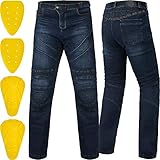
The BJN01 is ILM’s Level 2 armored jean for riders who spend time on dirt, gravel, or aggressive street riding. The “Dirt Dike” name tells you the intended use case: dual-sport, supermoto, and any riding where you expect to get dirty and maybe fall down. The jean cut keeps it wearable off the bike, but the armor level and knee reinforcement are what separate it from the commuter model.
Key Specs
- Category: CE Level 2 armored riding jean
- Armor: CE Level 2 at knees; removable on most configurations
- Construction: Reinforced knee area and riding-specific denim finish
- Fit: Unisex jean cut with articulated knees
- Use cases: Dual-sport, dirt, supermoto, street
- Waist and inseam: Standard denim sizing
CE Level 2 armor is the higher of the two common impact levels and is tested to absorb more force than Level 1. For dirt riding, that extra absorption matters: off-road falls tend to be lower speed but on uneven ground, and a knee can land on a rock or a rut. The practical design detail to check is armor height adjustment. Knee armor should sit directly over your kneecap when seated on the bike, not floating above it or pressed into your thigh.
Because the BJN01 is a jean cut rather than an overpant, sizing is the main source of frustration. Measure your waist where you actually wear your pants — not where a fashion jean sits — and add an inch if you plan to wear knee braces. Knee braces are bulky, and stuffing them under a jean forces you to size up, sometimes by two sizes. That is normal for dirt-oriented riders, but it does change how the pant looks off the bike.
Strengths
- Level 2 armor at the knee, a step above entry-level protection
- Jean silhouette that stays wearable off the bike
- Suited to dual-sport and supermoto riding positions
- Reinforced construction at high-wear knee areas
Pros
- Higher impact rating than many budget armored pants
- Removable armor simplifies washing
- Works with knee braces if you size up
- Mid-range price for a Level 2 product
Cons
- Denim fabric is not a waterproof solution
- Limited ventilation in hot weather
- Knee brace users need to size up, sometimes significantly
- Not as legible off the bike as a plain fashion jean
How it compares: Against the PJN1, the BJN01 favors Level 2 armor and dirt-oriented riding; the PJN1 favors all-season street comfort. Against the MSR Voyager, it is far cheaper and more casual but lacks the Ventilation and touring-cut advantages of an adventure shell. For a rider who does one weekend trail ride a month, the BJN01 is the better value. For a daily touring rider, the Voyager is more capable.
4. BYKR Armored Cordura Overpants – Best for Layering Over Work Clothes
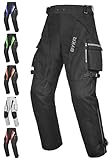
The BYKR overpants take the “wear your work clothes under your gear” approach. Cordura is the headline material — a well-known high-tenacity nylon used across the abrasion-resistant textile market for decades. As an overpant, the BYKR is designed to pull on over your normal trousers, which makes it the fastest commute solution if your job requires business casual dress.
Key Specs
- Category: Armored overpant for commuting and trail use
- Shell: Cordura textile for abrasion resistance
- Armor: Knee armor with pockets; hip provisions vary by configuration
- Storage: Cargo pockets for phone, wallet, keys
- Fit: Overpant cut; order your normal size plus one
- Intended use: Enduro, ATV, dual-sport, touring, commuting
Overpants solve a specific problem: you do not want to change clothes at the office, but you do want certified armor. To size correctly, measure your waist while wearing your work trousers, not bare. Then add one inch for a snug overpant or two for a loose fit. If you skip this step, you will end up with a pant that fits perfectly in the mirror and feels two sizes too tight once you put a shirt and jeans underneath it.
Cordura’s advantage over generic polyester is tear resistance. In a slide, the difference between a textile that rips open on the first contact and one that holds is the difference between road rash and a bruise. Cordura is not magic — it abrades too if you slide far enough — but it holds together through far more contact than a commodity fabric. That is the reason it dominates the textile-gear market and why the BYKR name leads with it.
Strengths
- Cordura abrasion resistance at a mid-range price
- Overpant design layers over work clothes
- Multiple cargo pockets for everyday carry
- Broad use case from commute to trail riding
Pros
- Fast to put on and take off
- Protects your street clothes from rain, dirt, and chain grease
- Cargo pockets are genuinely useful on a commute
- Cordura is a familiar, verifiable material
Cons
- Overpant bulk is noticeable off the bike
- Warm in summer unless it has vents
- Noisy fabric flapping at highway speeds
- Sizing errors are common if you do not measure layered
How it compares: The nearest alternative is the HWK Cordura pant. Both use Cordura, but the HWK is built more as a standalone pant with water resistance, while the BYKR is built as an overpant with cargo storage. If your priority is staying dry on a commute, the HWK has the edge. If your priority is layering over a suit and carrying a phone and wallet without a bag, the BYKR is the fit.
5. HWK Water-Resistant Cordura Pants – Best for Wet-Condition Commuting
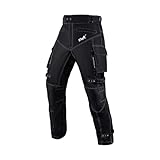
HWK’s armored pant leads with water resistance and Cordura, which is the combination most commuting riders actually need. Wet roads are the most common adverse condition a commuter faces, and a water-resistant shell keeps you comfortable long enough to get where you are going without stopping to change. HWK builds gear specifically for the value-focused rider, so this sits in the mid-range tier rather than the premium one.
Key Specs
- Category: Water-resistant armored riding pant
- Shell: Cordura fabric with water-resistant treatment
- Armor: Knee armor pockets; check listing for hip option
- Fit: Relaxed, standalone cut with room to move
- Weather: Water-resistant, not fully waterproof — plan for heavy rain
- Intended use: Commuting, cold weather, wet weather
The distinction between water-resistant and waterproof is worth understanding before you buy any pant. Water-resistant means the fabric resists light rain and road spray for a limited time, then wets through. Waterproof means a membrane or coating keeps liquid water out for a meaningful duration. For a 20-minute commute, water-resistant is usually enough. For a two-hour ride in steady rain, you want a waterproof membrane or a rain overpant.
Cordura plus a water-resistant treatment is a good cold-weather combination because the tight weave blocks wind as well as spray. Wind chill on a motorcycle at 60 mph is brutal — it can feel 15-20°F colder than ambient. A wind-blocking shell is the single biggest comfort upgrade for winter riding, bigger than a heated vest in many cases, because it stops the heat from being stripped away in the first place.
Strengths
- Water-resistant Cordura for wet-weather commuting
- Wind-blocking weave for cold-weather comfort
- Relaxed cut for layering
- Mid-range price for a weather-oriented pant
Pros
- Handles light rain and road spray well
- Good value for a weather-resistant armored pant
- Comfortable over a thermal layer
- Cordura shell holds up under abrasion
Cons
- Not fully waterproof under sustained heavy rain
- Relaxed cut can feel baggy for slim riders
- Less ventilation than dedicated summer pants
- Armor is insert-based, so upgrade options matter
How it compares: Against the BYKR overpant, the HWK is the better wet-weather standalone pant and the BYKR is the better layering overpant. Against the KEMIMOTO side-zip pant, the HWK lacks the convenience of a full side zipper but has a more conventional fit. For a rider whose main concern is staying dry on a rainy commute, this is the value pick in the mid-range.
6. newfacelook Aramid-Lined Riding Jeans – Best for Touring With a Jeans Look

The newfacelook riding jean pairs an aramid protective lining with an adventure/touring jean cut. Aramid is the generic name for the fiber family that includes Kevlar, and it is used in riding gear precisely because its strength-to-weight ratio is exceptional. A lining is a smart engineering choice: the aramid goes where you need abrasion resistance, and the outer fabric stays a wearable denim that looks normal.
Key Specs
- Category: Aramid-lined armored riding jean
- Construction: Aramid protective lining at high-abrasion zones
- Armor: Knee protection with adjustable height on most builds
- Cut: Adventure and touring oriented, sized in standard denim sizes
- Use: Touring, street, commuting
- Care: Remove armor before washing; wash cold, hang dry
An aramid lining changes the failure mode in a slide. When a lined jean contacts asphalt, the aramid layer resists being torn through, which is the mechanism that causes road rash in an unlined jean. How far it protects depends on the aramid weight and coverage area, so check where the lining sits: full front, or just around the knees and hips? Full-lining is more protective and hotter; partial lining is cooler and usually cheaper.
Care is where aramid pants surprise people. Aramid fibers are sensitive to heat and harsh chemicals, so hot water, high dryer heat, bleach, and fabric softener can all degrade the lining over time. The routine that works is straightforward: pull the armor, zip the pockets closed, wash cold on a gentle cycle, and hang dry. Do that and the pant will outlast most of your other clothes.
Strengths
- Aramid lining adds abrasion resistance under a normal-looking denim
- Touring-oriented cut with room in the knee
- Fits into the “wear it everywhere” category
- Mid-range price for a lined jean
Pros
- Looks like ordinary jeans off the bike
- Aramid resists tearing in a slide
- Adjustable knee armor stays positioned on the bike
- Straightforward sizing in denim numbers
Cons
- Limited ventilation, typical of lined jeans
- Care requirements are stricter than normal denim
- Not a wet-weather solution
- Heavier and warmer than an unlined jean
How it compares: Compared with the ILM PJN1, the newfacelook leans harder into the aramid-lining story, while the PJN1 leans on the all-season riding-jean formula. Both are premium/mid-range compromises between protection and appearance. If abrasion resistance is your main worry, the aramid lining is a meaningful plus. If you want a well-known armored-jean brand, the ILM is the safer call.
7. KEMIMOTO Full Side Zip Windproof Pants – Best for Fast On/Off Commuting

The KEMIMOTO pant’s signature feature is the full side zip, and if you commute in a suit or workwear, that one detail changes your morning. A full side zip means you can step into the pant and zip it closed along the whole leg, no need to remove your boots. That turns a two-minute struggle into 15 seconds, and it is the reason transit, security, and shift workers favor side-zip overpants.
Key Specs
- Category: Full side-zip armored overpant
- Entry system: Full-length side zippers for step-in entry
- Shell: Windproof fabric with rain resistance
- Armor: CE armor at knees
- Color: Black
- Fit: Overpant cut with adjustable waist
Windproof is the operative phrase for winter. On a motorcycle, wind does more damage to your warmth than temperature alone. A windproof shell stops convective heat loss, so a thin windproof pant often feels warmer than a thick non-windproof one. That is why the KEMIMOTO is worth considering for winter commuting even though it is not a heavily insulated product.
The trade-off with windproof fabric is breathability. A tight weave blocks moving air, which means it also blocks your body heat from escaping on warm days. In summer, a windproof overpant gets clammy fast. This is a cold-weather and shoulder-season tool, not an August pant. If you ride year-round, you will want a mesh pant for summer and this one for winter.
Strengths
- Full side zip for step-in entry with boots on
- Windproof shell for cold-weather commuting
- CE knee armor built in
- Available in black for easy matching
Pros
- Fastest on-and-off of any pant on this list
- Effective wind blocking in cold weather
- Layers over work clothes without wrinkle damage
- Adjustable waist helps with layering
Cons
- Poor summer ventilation
- Side zips add failure points and can snag
- Premium price for an overpant
- Bulkier silhouette than a riding jean
How it compares: Versus the HWK Cordura pant, the KEMIMOTO trades fabric abrasion pedigree for entry convenience and windproofing. Versus the SHIMA Giro 3.0, it is less fashion-forward and more utilitarian. If you time your commute and hate changing clothes, the side zip is the deciding feature.
8. SHIMA Giro 3.0 Motorcycle Trousers – Best for Lightweight Urban Style

SHIMA is a European riding-gear brand, and the Giro 3.0 lands in the lightweight armored cargo category: knee protectors, a cargo cut, and enough style to wear past a coffee shop without looking like you just left a track day. It is the pant for an urban rider who values appearance and light weight over maximum weather protection.
Key Specs
- Category: Lightweight armored cargo trouser
- Armor: Knee protectors included
- Material: Lightweight armored textile
- Cut: Cargo with belt loops and pockets
- Colorways: Includes “Airforce” tone
- Fit: Trim urban cut — size up if between sizes
The “cargo” designation matters for functionality. Cargo pockets on the thigh are convenient on the bike in a way most riders do not appreciate until they have them. Your phone stays accessible without a tank bag, your key fob is not digging into your hip, and cards stay zipped. On a hot day, a lightweight cargo pant also moves more air than a lined jean because there is less material between you and the wind.
Lightweight construction has its limits. Less material generally means less abrasion resistance, so a lightweight armored pant is best suited to lower-speed urban riding rather than highway touring. If your commute is under 30 mph most of the way, a lightweight pant is a rational choice. If you spend an hour at 70 mph, you want the heavier textile of an adventure or touring shell.
Strengths
- Light weight and trim urban cut
- Knee protectors included as standard
- Cargo pockets for everyday carry
- Styling suitable for off-bike wear
Pros
- Comfortable in warm city conditions
- Attractive enough to wear socially
- Standard knee protection
- Brand with a genuine riding-gear pedigree
Cons
- Lightweight textile offers less abrasion margin at highway speeds
- Not a weather pant
- Trim cut can be unforgiving if you size wrong
- Premium price for a lightweight product
How it compares: Against the KEMIMOTO, the SHIMA is the style-forward lightweight choice and the KEMIMOTO the utility overpant. Against the ILM PJN1, the SHIMA is more urban/casual and the PJN1 is more protective and more armored. For a rider who mostly rides in the city and cares how they look, the Giro 3.0 is the pick.
9. LOMENG Women’s CE Level 2 Riding Pants – Best Women’s Budget Pick

The LOMENG women’s pant is the strongest value in this list for women riders, largely because it delivers CE Level 2 removable armor at a budget price. Women’s-specific riding gear is still less common than unisex gear, so an affordable option with a proper women’s cut and a blue colorway is a genuinely useful product.
Key Specs
- Category: Women’s armored riding pant
- Armor: CE Level 2, removable
- Fit: Women’s-specific cut
- Color: Blue
- Care: Remove armor before washing
- Use: Street, commuting, light touring
Removable armor is a small feature with a big effect on ownership. If armor is removable, you can machine-wash the pant without damaging the protectors, and you can upgrade the armor later if you want a thinner or better-venting insert. If armor is sewn in, washing damages it and you cannot change it. For a budget pant, removable armor is a sign the maker thought about the lifecycle, not just the sale.
Women’s-specific sizing is the other reason this pant matters. Unisex riding gear is usually patterned around a male body, which means the knee armor can sit too low and the waist can gap. A women’s cut places the knee pockets higher and shapes the waist differently, so the armor lands over the kneecap instead of the shin. That single positioning difference is the entire point of buying women’s riding gear rather than sizing down a unisex product.
Strengths
- CE Level 2 removable armor at a budget price
- Women’s-specific cut for correct armor placement
- Distinctive blue colorway
- Simple care routine with removable protectors
Pros
- Level 2 impact protection for very little money
- Armor positions correctly on a women’s frame
- Easy to wash
- Upgradeable armor
Cons
- Budget construction may not match premium abrasion ratings
- Limited color options beyond blue
- Ventilation is basic
- Little in the way of rain protection
How it compares: Against the CTBQiTom pant, the LOMENG has the same armor level but a women’s-specific cut, which is the reason to choose it. Against the VNFOX, it again trades the jean silhouette for a more traditional riding pant shape. For women riders on a budget, the LOMENG is the most logical entry point here.
10. CTBQiTom CE Level 2 Armored Pants – Best Budget Overall

The CTBQiTom pant exists to answer one question: what is the cheapest way to get CE Level 2 armor on both legs? At the budget tier, that is the entire value proposition, and it is a good one. If your riding is commuting and weekend rides at moderate speeds, Level 2 armor covers the most common impact scenario you would face.
Key Specs
- Category: Budget armored riding pant, unisex
- Armor: CE Level 2
- Color: Black
- Fit: Unisex cut with sizing up recommended for layering
- Care: Armor removal recommended before washing
- Use: Commuting, entry-level protection
Budget armor makes sense when you think about the physics of the most likely crash. The majority of crashes happen at lower speeds, close to home, often in the first minutes of a ride. Armor prevents the impact injury — the bruise, the fracture risk — by spreading the force over a larger area and absorbing some of it. Level 2 spreads and absorbs more than Level 1. A budget pant with Level 2 armor covers that failure mode for the least money.
What you give up at this tier is mainly material quality. The shell fabric is unlikely to be a named high-tenacity textile like Cordura, and the stitching and zippers will be simpler. That does not make the pant unsafe, but it does mean the abrasion margin is smaller and the lifespan shorter. Budget pants are also more likely to have generic armor pockets that do not position optimally, so check the knee pocket height when you try them.
Strengths
- CE Level 2 armor at the lowest price here
- Unisex black cut that pairs with any jacket
- Simple, functional design
- Good first armored pant
Pros
- Cheapest route to Level 2 impact protection
- Unisex sizing covers most riders
- Neutral black styling
- Low risk if you are new to armored gear
Cons
- No named abrasion-resistant shell material
- Basic construction and hardware
- Limited ventilation and weather protection
- Shorter service life than mid-range pants
How it compares: Against the VNFOX and LOMENG, the CTBQiTom is the pure value play: same armor class, lowest price, least brand polish. Against the ILM BJN01, it costs less but gives up reinforced construction and a better riding-jean pattern. The CTBQiTom is the pant to buy if you are testing whether you will actually wear armored gear.
11. VNFOX CE Level 2 Armored Jeans – Best Entry-Level Armored Jeans

VNFOX tackles the budget category with a jean silhouette and CE Level 2 armor. This is the pant for the rider who wants to look like they are wearing normal jeans, wants Level 2 protection, and does not want to spend premium money to get both. The compromise is in materials, but the armor class is the same as products costing several times more.
Key Specs
- Category: Budget armored jean
- Armor: CE Level 2
- Silhouette: Jeans-style cut for off-bike wear
- Color: Black
- Fit: Unisex denim sizing
- Care: Remove armor before washing; wash cold
The denim-look budget jean is a specific niche and a useful one. For a new rider, the barrier to wearing gear is often social — nobody wants to walk into a class or a café in race leathers. A jean that looks casual but carries armor removes that barrier, and a rider who wears gear is safer than one who leaves it at home. That is the real argument for this category.
Expectations management is important at this price. The denim style fabric is unlikely to have a listed abrasion rating, so the primary protection is the armor, not the shell. Ride accordingly: this is a good pant for city streets and moderate speeds, not for sustained highway touring. If you want both armor and verified abrasion resistance, step up to a lined or Cordura product.
Strengths
- CE Level 2 armor in a jeans silhouette
- Very accessible price
- Black denim look suits most jackets
- Simple sizing in standard denim numbers
Pros
- Level 2 protection at an entry price
- Wearable off the bike
- Straightforward care if armor is removable
- Easy to pair with any riding jacket
Cons
- No stated abrasion rating on the denim
- Basic hardware and stitching
- Warm and unvented in summer
- Not suitable as a serious touring pant
How it compares: Against the CTBQiTom and LOMENG, the VNFOX is the jean-silhouette budget option, while those are more conventional riding-pant shapes. Against the newfacelook aramid jean, the VNFOX gives up the aramid lining but costs less. For a rider who wants anonymity and armor together on a tight budget, it is the right compromise.
12. Dream Apparel Leather Chaps With Zip-Out Liner – Best for Cruiser Riders
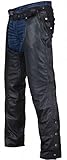
Chaps are a distinct product category and should not be judged as a failure to be pants. They are leather overpants with no seat, worn by cruiser and cowboy-style riders for wind protection, abrasion resistance on the legs, and a classic look. The Dream Apparel chap pairs full leather with a zip-out liner, making it usable across a wider temperature range than an unlined chap.
Key Specs
- Category: Leather chaps, unisex
- Material: Leather shell
- Liner: Zip-out thermal liner
- Armor: None
- Fit: Adjustable waist via buckles or laces on most builds
- Use: Cruiser, touring, cold-weather leg protection
The critical thing to understand is that chaps have no impact armor. They protect against wind, cold, and abrasion on your legs and shins, but they do not absorb impact at the knee the way an armored pant does. If you want knee protection, chaps are not the answer. If you want the classic look plus leg coverage against road debris and wind, they are excellent at their job.
The zip-out liner is the feature that earns chaps their place in a year-round wardrobe. In summer, remove the liner and you have a leather shell that blocks wind and bugs without cooking you. In winter, zip the liner in and you have real insulation. Leather also molds to your legs over time, so a chap that feels stiff in the first season becomes comfortable in the second. That break-in period is real and is part of the ownership experience.
Strengths
- Full leather construction for abrasion resistance
- Zip-out liner adjusts for season
- Classic cruiser aesthetic
- Adjustable fit across a range of sizes
Pros
- Excellent wind and road-debris protection
- Leather molds to the leg over a season
- Liner makes them usable most of the year
- Budget price relative to leather pants
Cons
- No CE armor at the knee
- Leather needs periodic conditioning
- Heavy and bulky when packed
- Break-in period before they feel right
How it compares: There is no direct armored equivalent on this list, because chaps serve a different rider. If you want classic cruiser coverage and you accept that there is no knee armor, the Dream Apparel chap is the value option. If you want armor plus leather-look, you need to look at armored leather or aramid pants instead, such as the newfacelook aramid jean.
How to Choose
Choosing the best motorcycle riding pants comes down to five variables: armor level, shell material, weather strategy, fit, and ventilation. Get those right and you will actually wear the pants, which is the only protection that matters. Here is how to work through them with concrete numbers and trade-offs.
Step 1: Decide Which Armor Class You Need
Armor is rated CE Level 1 or CE Level 2, with Level 2 absorbing more energy. Both are tested to resist impact, and both are far better than foam padding or nothing. The practical rule: Level 2 is worth the premium for highway riding, dual-sport and dirt riding, and any rider who has already had a fall. Level 1 is adequate for low-speed urban commuting where the impact energy is smaller. Every armored product on this list states its armor class or at least names the armor pockets — use that as a filter. If armor is not removable, you cannot upgrade it later, so removable armor extends the product’s life.
Step 2: Match the Shell to Your Riding Speeds
Shell material determines how far you slide before the fabric fails. Rough tiers, from least to most abrasion resistance:
| Shell Class | Typical Construction | Best Suited To |
|---|---|---|
| Basic textile | Polyester or generic denim | Low-speed urban riding |
| Denim-style riding fabric | Tight-weave or blended denim | Commuting, moderate speeds |
| Aramid-lined denim | Denim outer with aramid lining at high-wear zones | Street and touring |
| High-tenacity nylon | Cordura or equivalent branded textile | Commuting, touring, dual sport |
| Leather | Full-grain or split leather | Cruiser and touring, high abrasion needs |
If your daily route rarely exceeds 40 mph, a denim-style riding pant with Level 2 armor is a rational, comfortable choice. If you spend time above 60 mph, spend more on a named abrasion-resistant shell. The difference is not measurable comfort — it is how the pant behaves in the three seconds after a fall.
Step 3: Pick a Weather Strategy
There is no single pant that is perfect in every season, and buying one that claims to be is usually a mistake. Choose a strategy instead:
- One-pant approach: buy a three-season pant with ventilation and layer underneath in winter. Cheapest, but you will be hot in August and cold in January at the extremes.
- Two-pant approach: a vented or lightweight pant for summer and a windproof or lined pant for winter. Costs more, works much better, and covers the full year.
- Overpant approach: one armored overpant worn over whatever you already own, with a base layer that changes with the season. Best for commuters who change clothes at work.
- Rain layer approach: any pant plus a dedicated waterproof overpant for wet days. The lightest and most flexible option, since the rain shell also keeps your regular gear clean.
Note the difference between water-resistant and waterproof. Water-resistant fabric handles light rain and road spray for a limited time. Waterproof means a membrane or sealed construction keeps water out under sustained rain. For a commute under 30 minutes, water-resistant is generally enough. For touring and long rides, plan for waterproof.
Step 4: Get Fit and Sizing Right
Sizing is the number one reason riding pants get returned or left in the closet. Work through these measurements:
- Waist: measure where you actually wear the pant, not where fashion jeans sit. For an overpant, measure wearing your work trousers and add 1 inch for snug or 2 inches for loose.
- Inseam: measure from crotch seam to the desired hem. Riding pants should reach the top of your boot without bunching at the knee, which is the position where bunching causes pressure points.
- Knee armor height: sit on a chair as if on the bike, then check that the knee pocket sits over your kneecap. If it sits above or below, the pant is the wrong length or the pocket is not adjustable.
- Knee braces: if you wear braces for dirt riding, add one to two sizes. Braces take real volume.
- Women’s cuts: a women’s-specific pattern places knee pockets higher and shapes the waist differently. If armor consistently lands on your shin, you likely need a women’s cut rather than a smaller unisex size.
A quick calculation for overpants: add your work-trouser waist measurement plus 1 inch, then check the manufacturer’s size chart against that number, not against your bare waist. Most sizing complaints on overpants trace back to measuring bare.
Step 5: Weight Ventilation by Season
Ventilation is the single most neglected specification. A pant you do not wear in July protects you zero percent of the time in July. Vent options, roughly in order of airflow:
- Mesh pants: maximum airflow, minimal weather protection, ideal above 85°F
- Zippered thigh vents: good adjustable airflow, decent weather protection when closed
- Lightweight unlined cargo pants: moderate airflow, less abrasion margin
- Lined jeans: minimal airflow, good abrasion resistance, best below 80°F
- Windproof/waterproof overpants: almost no airflow, best below 60°F
Decision Matrix: Match Your Situation to a Pick
| Your Situation | Priority | Recommended Pick |
|---|---|---|
| Daily commute, change clothes at work | Fast on/off, layering | KEMIMOTO Full Side Zip or BYKR Overpant |
| Rainy climate commuter | Water resistance, wind blocking | HWK Water-Resistant Cordura |
| Weekend touring, 200+ miles | Comfort, ventilation, boot fit | MSR Voyager Adventure |
| First armored pant on a tight budget | Armor level per dollar | CTBQiTom CE Level 2 |
| Woman rider, budget first | Correct armor placement | LOMENG Women’s CE Level 2 |
| Want jeans look plus Level 2 armor | Appearance, protection | VNFOX or ILM BJN01 |
| Dirt, dual sport, supermoto | Level 2, knee brace room | ILM BJN01 Dirt Dike |
| Urban rider, style matters | Light weight, looks | SHIMA Giro 3.0 |
| Abrasion worries over appearance | Aramid or Cordura shell | newfacelook Aramid or HWK Cordura |
| Cruiser, classic look | Leather, wind protection | Dream Apparel Leather Chaps |
Upgrade Path and Ownership Realities
Riding pants wear in predictable ways. The first things to go are the knee armor pockets, which stretch out from repeated armor insertion and removal, followed by the zippers and the crotch seam. Leather chaps wear at the inner thigh and need conditioning oil every season or two, especially if they get wet. Textile pants lose their water-repellent finish after repeated washing, and it can be restored with a spray-on treatment. Aramid and high-tenacity linings degrade faster with heat, so always wash cold and hang dry.
The consumables to budget for are armor inserts, which some riders upgrade to thinner Level 2 pads for comfort, and water-repellent treatments. Neither is expensive, but both extend the life of the pant significantly. A well-cared-for armored pant should last several seasons of regular riding before the seams or zippers become the weak point. Expect the armor to outlast the fabric, so buy a pant where armor is removable and reusable — that way an upgrade to a different shell does not mean buying new protectors.
Common mistakes worth avoiding: buying an overpant in your bare waist size, choosing Level 1 armor for highway riding to save money, leaving armor in during a hot wash, and buying a single pant for 20°F and 100°F riding. Each of these leads to the same outcome — gear that stays on a shelf. If a pant does not fit correctly with armor positioned over the kneecap, keep shopping; there is no comfortable way to fix armor placement after the fact.
Frequently Asked Questions
Are motorcycle riding pants worth it for short commutes?
Yes, because most crashes happen close to home at lower speeds, exactly the scenario a short commute creates. Armor distributes impact force and reduces the chance of a bruise turning into a fracture risk. For a five-mile commute, a budget CE Level 2 pant like the CTBQiTom is a low-cost way to cover that risk.
What is the difference between CE Level 1 and CE Level 2 armor?
Both are tested impact ratings, but Level 2 absorbs more energy than Level 1. Level 1 is generally adequate for low-speed urban riding, while Level 2 is a better match for highway speeds, touring, and dirt riding. If armor is removable, you can start with one level and upgrade later without replacing the pant.
Can I wear motorcycle pants over regular jeans?
Yes — that is exactly what overpants are designed for, including the BYKR Cordura overpant and the KEMIMOTO full side zip. When sizing, measure your waist while wearing your normal trousers and add one inch for a snug fit or two inches for a loose fit. Measuring bare is the most common cause of overpants that feel too tight.
What material is best for abrasion resistance?
Leather and high-tenacity nylons like Cordura are at the top of the list, followed by aramid-lined denim. Generic polyester and fashion denim provide the least abrasion protection. If you ride above 60 mph regularly, prioritize a named abrasion-resistant material rather than a basic textile.
Do riding pants need to be waterproof?
Not necessarily. Water-resistant fabric handles light rain and road spray for a limited time, which is enough for most short commutes. For long rides in steady rain, you want a waterproof membrane or a dedicated rain overpant. Waterproof and water-resistant are genuinely different claims, so read the product description carefully.
How should I wash armored motorcycle pants?
Remove the armor first, close all zippers, wash cold on a gentle cycle, and hang dry. Avoid bleach, fabric softener, and high dryer heat, since all three degrade aramid linings and water-repellent finishes. Leather chaps should not be machine-washed at all — wipe them clean and condition the leather periodically.
What is the difference between chaps and armored riding pants?
Chaps are leather overpants without a seat and without impact armor. They protect your legs and shins from wind, cold, and abrasion but do not absorb impact at the knee. Armored riding pants include CE-rated protectors at the knee and often the hip. If knee impact protection matters to you, choose armored pants rather than chaps.
How long should motorcycle riding pants last?
A well-cared-for armored pant typically lasts several seasons of regular riding before zippers or crotch seams become the weak point. Armor usually outlasts the shell, so removable armor lets you move the same protectors into a replacement pant. Leather chaps can last many years with regular conditioning, though the liner and stitching will need attention over time.
Closing Recommendation by Situation
If you ride long distances and want the most capable pant on this list, choose the MSR Voyager Adventure — it is built specifically for hours in the saddle. If your priority is protection that looks like ordinary clothing, the ILM PJN1 is the best all-season armored jean. On a strict budget, the CTBQiTom gives you CE Level 2 armor for the least money, and women riders on a budget should look at the LOMENG for its women’s-specific cut. Commuters who change clothes at work should choose the KEMIMOTO for its full side zip or the BYKR if cargo storage matters more. Riders in wet climates should start with the HWK Cordura, and cruiser riders who want classic leather should consider the Dream Apparel chaps while understanding they carry no knee armor. Finally, if you want a pant that protects your legs from wind and road debris without armor, the chap is a legitimate tool rather than a compromise — just know which problem you are solving before you buy.
Whichever you choose, verify three things before purchase: the armor level and whether it is removable, the shell material or abrasion class, and the knee pocket position when you are seated. Those three checks prevent nearly every sizing and protection disappointment in this category. Riders who get those right end up wearing their gear in every season, and a pant you actually wear is worth more than any specification on a label. Whether you are commuting five miles or touring five hundred, the right pair of riding pants pays for itself in comfort first and protection when it counts — and with the options above, there is a match for nearly every riding style and budget in 2026.