Key takeaways
- Side cutter for separating parts from the plastic runner
- Hobby knife with a fine blade for trimming nubs and flash
- Tweezers for decals and small parts placement
- Sanding or filing tool for flattening the cut point
- Compact organizer case that keeps blades and cutters separate
Top 3 Picks
Best overall: The Rustark 21Pcs Modeler Basic Tools Craft Set is the most sensible single purchase for most builders because it pairs a proper side cutter and hobby knife with a sanding and filing assortment at a mid-range price. It covers the three jobs that actually matter on a first model — cutting parts from the runner, trimming nubs, and smoothing the cut — without padding the box with tools you will never touch.
Best budget: The Rustark 9Pcs Model Tools Kit strips the kit down to the essentials and costs very little, which makes it the right starting point for anyone who is not yet sure how deep they want to go. It is also the smart choice as a second kit to keep at a second workspace.
Best premium: The Fippy 101PCS Model Tools Kit is the most complete set here, and it suits builders who work across multiple model types — car models, miniatures, mecha — and want sanding sticks, polishing cloths, tweezers, and spare blades in one case. The Tamiya RC Tool Kit is the premium alternative if you specifically work on radio-controlled cars rather than static display models.
Quick Comparison
| Product | Best for | Key specs | Price tier |
|---|---|---|---|
| Fippy 11PCS Model Kit Tools | Beginners building a car model | 11 pieces; compact organizer case; cutter, knife, tweezers, sanding stick core | Budget |
| Fippy 29PCS Model Tools Kit | Basic model assembly with room to grow | 29 pieces; storage case; broader cutter/file/tweezer assortment | Premium |
| Fippy 101PCS Model Tools Kit | Multi-discipline builders wanting one box | 101 pieces; layered case; sanding sticks, polishing cloths, tweezers, spare blades | Premium |
| Rustark 21Pcs Modeler Basic Tools Craft Set | Overall best value for most hobbyists | 21 pieces; side cutter, hobby knife, files, tweezers, sanding tools | Mid-range |
| HIJIRH Model Tools Kit 108PCS | Gunpla and mecha builders | 108 pieces; large case; nippers, files, sanding and finishing accessories | Premium |
| Rustark 9Pcs Model Tools Kit | Tight budgets and starter kits | 9 pieces; cutter, knife, tweezers, basic finishing tools | Budget |
| IQIANS 15PCS Basic Hobby Model Tool Kit | Gunpla and 3D printing cleanup | 15 pieces; precision nippers and hobby clips; compact case | Budget |
| Rustark 10Pcs Model Tools Craft Set | Assembly plus repair work | 10 pieces; cutter, knife, tweezers, small files | Budget |
| JUNYAOHSU Gundam Model Tool Kit | Mecha builders stepping up | 28 pieces; mid-size case; nippers, files, tweezers, sanding tools | Mid-range |
| Mandala Crafts 13 Model Building Hobby Tools Kit | 3D-printed miniatures and plastic kits | 13 pieces; sculpting and cleanup tools for small plastic parts | Mid-range |
| Tamiya RC Tool Kit 8 Pieces | Radio-controlled car maintenance | 8 pieces; tuning and assembly tools sized for RC hardware | Premium |
| BXQINLENX Professional 8 PCS Model Tools Kit | Minimalist buyers who own tools already | 8 pieces; core cutting and trimming tools; compact case | Budget |
How We Chose
This roundup is built from what the manufacturer listings state about each set, combined with how model-building tools are categorized and used in practice: what a cutter actually has to do to a plastic runner, why a flat and a round file solve different problems, and which tools go dull or break first. We did not test, benchmark, or buy these kits, and we make no hands-on claims about any of them. Everything below describes spec class, category, and the kind of job each tool is built for.
Four criteria drove the selection. First, specification fit — whether the listed contents line up with the work the kit claims to support. A “Gundam kit” that omits nippers is a weaker pick than one that includes them. Second, category fit — static plastic models, mecha, miniatures, and radio-controlled cars each have a different hardware profile, so a kit tuned for RC screws and turnbuckles is not a substitute for a hobby knife set. Third, use case — a beginner needs cutting, trimming, and smoothing; a returning builder often needs refinishing and precision tweezers more than another knife. Fourth, upgrade path — whether the set leaves room to add a better cutter or a proper sanding system without duplicating half the box. Kits that fit a clear job at a clear price tier made the list; kits that padded a piece count with items no builder reaches for did not.
1. Fippy 11PCS Model Kit Tools – Best for First Car Model Builds
As an Amazon Associate we earn from qualifying purchases at no extra cost to you.

The Fippy 11PCS set is aimed squarely at someone opening their first car model box. Eleven pieces is deliberately small — it forces the kit to be about the three tasks that dominate a first build: separating parts from the runner, trimming the leftover nub flush, and light surface cleanup before paint or decals. If you have never built a model before and do not want to spend an evening researching tool names, this is the shape of kit that gets you building the same day.
What is in it
- Side cutter for separating parts from the plastic runner
- Hobby knife with a fine blade for trimming nubs and flash
- Tweezers for decals and small parts placement
- Sanding or filing tool for flattening the cut point
- Compact organizer case that keeps blades and cutters separate
The piece count is the honest headline. A car model — body, interior, wheels, chassis — typically has a few hundred parts on the sprue, but the tool variety needed is narrow. You cut, you trim, you smooth, you place. Eleven pieces covers that loop with a couple of spares, and the case keeps the whole thing flat enough to store on a shelf instead of a workbench.
Strengths
The main strength is decision relief. A kit this small has nothing to learn and nothing to configure: the cutter cuts, the knife trims, the sanding tool finishes. For a first car model, where the goal is to finish the build and see whether you enjoy the hobby, that matters more than having twelve grades of sanding film you do not know how to sequence. The storage case also matters more than beginners expect — loose blades in a drawer rust and get lost, and a case with dedicated slots keeps a hobby knife from becoming a household hazard.
Price tier is budget, which fits the intent. If the hobby does not stick, the loss is small. If it does stick, the case becomes your travel kit and the tools become your backups once you upgrade the cutter and knife.
Pros
- Very low entry cost relative to the number of useful tools
- Small, shelf-friendly case for cramped workspaces
- Covers the full cut-trim-smooth loop needed for a first car model
- Nothing in the box requires prior tool knowledge to use
Cons
- No spare blades, so a dulled knife blade needs a separate purchase
- No precision tweezers beyond basic type, which limits fine decal work
- Not enough finishing grits for serious surface prep before a glossy paint job
How it compares
The nearest alternative in this list is the Rustark 9Pcs Model Tools Kit. Both are budget kits with a similar core — cutter, knife, tweezers, finishing tool. The Fippy offers two more pieces and leans explicitly toward car model assembly, while the Rustark is positioned as a general basic set. If you want a slightly wider net at the same tier, the IQIANS 15PCS kit adds precision nippers and hobby clips, which helps more on mecha and 3D-printed parts than on a car body. For a first car model specifically, the Fippy’s focus is an advantage; for a mixed bench, the wider kits win.
2. Fippy 29PCS Model Tools Kit – Best for Growing a Bench Gradually

The Fippy 29PCS kit sits a tier above the 11-piece version and is aimed at builders who have done a model or two and started noticing the gaps. Twenty-nine pieces is enough to add real variety — more than one cutting tool, more than one file profile, a fuller tweezer selection — while still fitting in a single organized case. It is the pick for someone who wants a complete basic bench without jumping straight to a hundred-piece set.
What is in it
- Cutting tools for runner separation and close trimming
- Hobby knife with replacement blade provisions
- Multiple file or sanding profiles for flat and curved surfaces
- Assorted tweezers for decals and small part handling
- Layout case with separated compartments
Strengths
The value of a 29-piece set over an 11-piece set is not “more tools” as an abstract — it is fewer interruptions. When you only own one file, you stop working to make that file do a job it was not shaped for. Multiple file profiles means flat surfaces get a flat file and curved edges get a rounded one, which is the difference between a clean seam and a gouged one. That is a real workflow gain on painted surfaces where sanding marks show through the finish.
The extra tweezers matter too. Straight tweezers handle decals; angled or curved ones handle parts in tight interior spaces — a car cockpit or a mecha joint. Having both means you stop improvising with whatever is closest.
Storage is the other strength. A mid-size case with compartments keeps like tools together, which cuts the time spent hunting for the cutter you set down two minutes ago. On longer builds this is not a small thing.
Pros
- Broad enough to avoid mid-build tool substitutions
- Multiple file profiles for flat and curved cleanup
- Case layout keeps a growing tool set organized
- Good middle step before committing to a large premium set
Cons
- Piece count includes items you may use rarely, so effective value is lower than 29 suggests
- Premium tier pricing for a set that still lacks some specialty finishing tools
- Blade and cutter quality is not described in the listing, so expectations should stay modest
How it compares
Versus the Rustark 21Pcs set, the Fippy 29PCS is the larger and more expensive option, and the difference is mostly breadth — more tools, more compartments. The Rustark 21Pcs, however, is the better value per useful tool and is easier to recommend as a first purchase. Where the Fippy 29PCS makes more sense is when you already know you will keep building and want the case to grow into rather than replace. Against the Fippy 101PCS, the 29-piece set is the more disciplined purchase — the 101-piece set wins only if you genuinely work in multiple model categories.
3. Fippy 101PCS Model Tools Kit – Best for Multi-Category Builders

The Fippy 101PCS kit is the largest Fippy set in this roundup and is designed for builders who move between model types — a car model one month, miniatures the next, a mecha kit after that. At 101 pieces, the set covers cutting, trimming, sanding, polishing, and handling in one box. It is the right purchase for someone who has decided the hobby is permanent and wants to stop buying tools piecemeal.
What is in it
- Cutting and trimming tools including knife and blade provisions
- An expanded range of files and sanding sticks across multiple grits
- Polishing cloths and finishing accessories
- Multiple tweezer types for decals and fine part placement
- Layered or compartmented storage case
Strengths
The headline strength is grit coverage. Finishing plastic is a progression problem: you remove material with a coarser abrasive, then refine the scratch pattern with progressively finer ones until the surface is uniform. A set with multiple grits lets you complete that progression without stopping to order the next grade. That is the single biggest practical difference between a small kit and a large one, and it shows up directly in paint and clear-coat quality.
Polishing cloths are the second real addition. After the finest abrasive, a polish step brings plastic or painted surfaces to a consistent sheen, particularly around seams and cut points that caught light badly before. Builders who skip this step often cannot explain why one panel looks different from the next.
The case is the third. At 101 pieces, organization is not a convenience, it is a requirement — without dedicated compartments, loose files and blades turn into a tangle. The layered case keeps tools separated and searchable, which is what makes a set this large actually usable rather than intimidating.
Pros
- Broad grit progression supports high-quality surface finishing
- Polishing accessories included rather than sold separately
- Large organized case handles a genuinely complete bench
- Covers car models, miniatures, and mecha without repurchasing
Cons
- Premium pricing for a set where many pieces will see occasional use only
- Large case consumes noticeably more bench or shelf space
- Overkill for someone building one or two models a year
How it compares
Against the HIJIRH 108PCS kit, the two are near-twins on scale. The HIJIRH set is positioned explicitly toward Gunpla and model kits, with nippers as the anchor tool; the Fippy 101PCS is positioned more generally across basic model assembly. If your shelf is mostly mecha, the HIJIRH naming and tool emphasis is a better match. If your builds are mixed, the Fippy’s broader framing fits better. Versus the Fippy 29PCS, the jump is justified only by finishing work — if you never sand past a nub trim, the 29-piece set is enough.
4. Rustark 21Pcs Modeler Basic Tools Craft Set – Best Overall Value
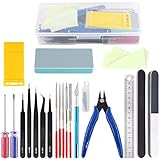
The Rustark 21Pcs Modeler Basic Tools Craft Set is the best single purchase for most hobbyists. It is a mid-range set that hits the sweet spot on contents per dollar: a side cutter, a hobby knife, files, tweezers, and sanding tools, arranged in a case. It serves beginners well because everything essential is present, and it serves experienced builders as a well-stocked travel or secondary kit.
What is in it
- Side cutter for runner separation
- Hobby knife for trimming and detail cutting
- Assorted files for flat and curved edge cleanup
- Tweezers for decals and small parts
- Sanding tools for surface preparation
- Storage case with tool slots
Strengths
Twenty-one pieces is close to the actual number of tools an average builder reaches for. That makes it efficient — there is very little dead weight. The cutter and knife handle the structural work; the files and sanding tools handle finishing; the tweezers handle placement. Each category is represented by at least one usable tool, which is the definition of a complete basic kit.
Being mid-range rather than budget also means you are not immediately shopping for replacements. A budget nine-piece kit often ends up as a nine-piece kit plus a separate cutter plus separate sanding film, and that math rarely beats buying the twenty-one-piece set once. Ownership reality matters here: cutters dull first, knife blades second, files third. A mid-range set with a spare blade or two buys you real time before the first consumable purchase.
The listing also covers repair and fixing alongside assembly, which reflects how these tools are actually used. Models get knocked, seams open, decals lift. Having trimming and smoothing tools on hand for repair is worth more than it sounds.
Pros
- Contents map closely to the tools builders actually use
- Mid-range price avoids the replace-everything problem of budget kits
- Supports both assembly and later repair work
- Case keeps blades and files organized between sessions
Cons
- Not enough grit variety for advanced finishing before a high-gloss paint job
- Tweezer selection is basic, limiting very fine decal work
- Specialty needs like scribing or rivet tools are not addressed
How it compares
Versus the Fippy 29PCS kit, this is the leaner and cheaper option that covers the same core jobs — the Fippy adds breadth, Rustark adds efficiency. Versus the Rustark 9Pcs and Rustark 10Pcs kits in this list, the 21-piece set is the clear upgrade: it keeps the same brand and approach but removes the immediate need to buy finishing tools separately. Versus the JUNYAOHSU 28-piece set, the Rustark is the more general-purpose kit; the JUNYAOHSU leans toward mecha and comes with more pieces at a similar tier.
5. HIJIRH Model Tools Kit 108PCS – Best for Gunpla Builders

The HIJIRH 108-piece kit is positioned explicitly for model kits and Gundam-style builds, which in practice means it is tuned for plastic mecha: tight part fit, lots of panel lines, small polycaps and joints, and a lot of surface that will be seen up close. At 108 pieces it is one of the two largest sets here.
What is in it
- Nippers or cutters sized for plastic runners
- Files across multiple profiles for joint and edge cleanup
- Sanding accessories for panel and surface finishing
- Tweezers for decals and small joint components
- Large compartmented case
Strengths
Mecha building rewards surface consistency more than car building does. A Gundam-style kit has many flat armor panels where a scratched nub or a sanding mark sits in plain view, and panel lines that catch any unevenness. That is exactly the job a large file-and-sanding assortment is built for. A 108-piece set gives you enough profiles and grits to work each panel through to a uniform surface instead of settling for “good enough.”
The part handling side matters too. Mecha kits are full of small joint pieces, polycaps, and tiny decals. Having a range of tweezers rather than one pair is the difference between placing a decal correctly on the first try and chasing it across the bench.
The case is sized for the tool count, which keeps a set this large from becoming a drawer of loose files.
Pros
- Tool range matches the finishing demands of mecha panel work
- Large organized case for a big tool count
- Tweezer variety supports fine decal and joint work
- Broad finishing coverage reduces mid-build purchases
Cons
- Premium pricing, and the set assumes you will do a lot of sanding
- Very large footprint for small workspaces
- If you build mainly cars, much of the finishing range goes unused
How it compares
The closest competitor is the Fippy 101PCS set. Both offer roughly a hundred pieces and a large case; the difference is positioning. HIJIRH names Gundam and model kits directly, so the implied tool mix favors mecha finishing. Fippy frames itself as a general basic-model kit. If you build mecha almost exclusively, the HIJIRH is the more targeted pick; for a mixed shelf, the Fippy is the safer general choice. Versus the JUNYAOHSU 28-piece set, the HIJIRH is the same direction at three to four times the tool count — worth it only if you finish surfaces seriously.
6. Rustark 9Pcs Model Tools Kit – Best Budget Starter
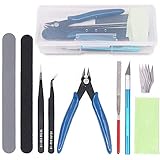
The Rustark 9Pcs kit is the leanest Rustark option here and the right answer for anyone who wants to start building today at minimal cost. Nine pieces covers cutting, trimming, handling, and basic finishing — the irreducible core of model work.
What is in it
- Cutter for separating parts from runners
- Hobby knife for nub and flash trimming
- Tweezers for small part placement
- Basic files or sanding tool for cleanup
- Compact storage case
Strengths
Nine pieces is enough to complete a model. It is not enough to complete one beautifully, and that is a fair trade at budget pricing. The kit’s real strength is that it lets a new builder answer the important question — do I enjoy this? — without a meaningful financial commitment. If the answer is yes, the tools become backups when you upgrade; if no, the loss is trivial.
Its second strength is portability. A compact nine-piece case fits in a bag, which makes it a good travel kit or a second set for a kitchen table workspace. Builders who already own a full bench often keep a small kit like this for exactly that reason.
Pros
- Lowest practical entry cost for a usable set
- Compact and easy to store or carry
- Covers the essential cut-trim-place loop
- Makes a sensible second kit for a second workspace
Cons
- No grit progression, so finishing quality is capped
- Limited tweezers for fine decal work
- You will likely upgrade the cutter and knife before long
- Spare blades typically require a separate purchase
How it compares
The nearest alternative is the Rustark 10Pcs set, which adds a piece and positions itself for assembly and repair — essentially the same kit with a slightly wider claim. The Fippy 11PCS is the other direct competitor at this tier and leans toward car models. Between the three, differences are small; the practical choice is whichever case layout and stated focus matches your first build. If you can stretch slightly, the Rustark 21Pcs set removes the immediate need for a second purchase and is the better long-run value.
7. IQIANS 15PCS Basic Hobby Model Tool Kit – Best for Gunpla and 3D Print Cleanup

The IQIANS 15-piece kit is aimed at two jobs that share a surprising amount of tooling: plastic model kits, especially Gunpla, and 3D-printed parts cleanup. Both require precision cutting and trimming of small plastic features, which is why the listing leads with precision nippers and hobby clips rather than a broad file assortment.
What is in it
- Precision nippers for close trimming on runners and supports
- Hobby clips for holding and positioning small parts
- Trimming tools for nubs and print artifacts
- Basic tweezers and finishing tools
- Compact case
Strengths
Precision nippers are the anchor here, and they are the right anchor. On a Gunpla runner, a flush cut close to the part means less material to remove afterward, which means less sanding and a lower risk of gouging the surface. On 3D prints, the same tool removes support material and stringing close to the model, which is the cleanup step that separates a rough print from a presentable one.
Hobby clips are an underrated inclusion. Small parts are hard to hold steady while trimming, and clips make it possible to secure a piece and work on it with two hands. That reduces slips, and slips are what cause the majority of damage during cleanup.
At 15 pieces and budget pricing, the set stays lean. It does not try to be a full finishing bench; it tries to be a good cutting and trimming kit, and it succeeds at that framing.
Pros
- Precision nippers suit both runner work and 3D print cleanup
- Hobby clips improve control on small parts
- Budget tier keeps entry cost low
- Compact case fits small workspaces
Cons
- Thin on sanding and polishing, which limits paint preparation
- Fewer file profiles than mid-range sets
- Not aimed at car model interior or detail work
How it compares
Against the JUNYAOHSU 28-piece Gundam kit, the IQIANS is the leaner, cheaper option with a strong cutting focus but far less finishing coverage. Against the BXQINLENX 8-piece set, the IQIANS offers roughly twice the tools for a similar budget position, and the nippers make it the more capable choice for plastic cleanup. If your work is mostly cutting and trimming, the IQIANS is efficient; if you plan to sand and paint, step up to a mid-range set.
8. Rustark 10Pcs Model Tools Craft Set – Best for Assembly and Repair

The Rustark 10-piece set is a basic assembly kit that explicitly includes repair and fixing in its stated purpose. That framing matters: it acknowledges that model tools are used twice — once to build, and later to fix what gets knocked off a shelf or dropped.
What is in it
- Cutter for part separation
- Hobby knife for trimming
- Tweezers for small parts
- Small files for edge cleanup
- Compact case
Strengths
For repair work, the tools that matter are trimming and smoothing — you need to clean up a broken joint, remove a burr, or re-flatten a mating surface before re-gluing. A cutter, knife, and small files cover exactly that. Builders who already own a full bench often keep a small kit like this in a drawer precisely for repair duty, because it is faster than sorting through a large case for three tools.
The compact case supports that role. A repair kit needs to be findable and quick to open, not comprehensive. Ten pieces in a small case does that.
Pros
- Good fit for repair and touch-up as well as assembly
- Very low cost at budget tier
- Compact and quick to access
- Simple tool set with nothing to learn
Cons
- Minimal finishing capability
- No grit progression for paint preparation
- Limited tweezer precision for decals
- Very close in contents to the Rustark 9Pcs, so buying both makes little sense
How it compares
Compared with the Rustark 9Pcs kit, the difference is essentially framing rather than contents — one extra piece and an explicit repair emphasis. If you are choosing between them, pick based on price and case layout, not capability; they are the same class of kit. Against the BXQINLENX 8-piece set, the Rustark offers slightly more for a similar budget position. Against the Rustark 21Pcs, this is the stripped-down version: same approach, fewer tools, lower cost.
9. JUNYAOHSU Gundam Model Tool Kit – Best Mid-Range Mecha Set
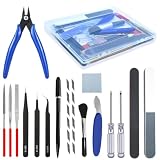
The JUNYAOHSU 28-piece Gundam tool set sits between the small budget kits and the hundred-piece premium sets. It is aimed at builders who work on mecha kits and want more than a starter set but do not need or want a full finishing bench with polishing compounds and dozens of accessories.
What is in it
- Nippers or cutters for runner work
- Files for edge and joint cleanup
- Tweezers for decals and small components
- Sanding tools for surface preparation
- Mid-size compartmented case
Strengths
Twenty-eight pieces is a comfortable middle. It is enough to include multiple file profiles and a real sanding capability, which is the threshold where finishing starts to look intentional rather than improvised. On mecha kits, where flat armor panels dominate, that threshold shows up quickly in the final look.
The mid-range tier also means the case is sized properly for the tool count. A 28-piece set in a well-laid-out case is faster to use than a 108-piece set in a case that requires searching, and for builders who work on one kit at a time, speed of access is a real advantage.
Pros
- Balanced tool count without premium pricing
- Enough file and sanding variety for visible surface improvement
- Case size is manageable on a small bench
- Clear focus on mecha-style builds
Cons
- Not enough grits or polishing tools for high-end finishing
- Fewer specialty tools than the 100-piece class
- Less useful if your builds are mainly cars or miniatures
How it compares
Against the HIJIRH 108PCS, the JUNYAOHSU is the same design intent at a fraction of the tool count and a lower price. If you finish surfaces seriously, the HIJIRH’s extra range is worth it; if you build and display without heavy sanding, the JUNYAOHSU is the better buy. Against the Rustark 21Pcs set, the JUNYAOHSU offers more pieces and a mecha focus, while the Rustark is more general-purpose and slightly cheaper. Against the IQIANS 15PCS, the JUNYAOHSU is the clear step up in finishing capability.
10. Mandala Crafts 13 Model Building Hobby Tools Kit – Best for Miniatures and 3D Plastic Parts

The Mandala Crafts 13-piece kit is aimed at 3D plastic miniatures — a category that shares tools with model kits but stresses them differently. Miniatures involve small, irregular shapes, mold lines on cast or printed surfaces, and detail that is easy to damage with an oversized tool.
What is in it
- Cutting and trimming tools sized for small parts
- Files or shaping tools for mold line and artifact removal
- Tweezers for small components
- Compact case
Strengths
Miniature work is about control, not force. The parts are small enough that a heavy-handed cut removes detail rather than flash, so the useful tools are the fine ones: a sharp trimming blade, a small file, and tweezers that can place a component without crushing it. A 13-piece kit with that focus is more appropriate than a large set built around bigger plastic surfaces.
The mid-range tier reflects that these tools are being selected for precision rather than volume. For builders who also print their own parts, the same kit handles support removal and surface cleanup, which is where 3D-printed miniatures need the most attention.
Pros
- Sized appropriately for small, detailed parts
- Covers mold line and print artifact cleanup
- Compact case suits a small dedicated workspace
- Useful for both cast and 3D-printed miniatures
Cons
- Not enough tools for large-scale model assembly
- No sanding grit progression
- Limited use if you do not work on miniatures
How it compares
Against the IQIANS 15PCS kit, the Mandala Crafts set is aimed more at miniature detail work while the IQIANS leans toward Gunpla and print cleanup with nippers as the lead tool. If your parts are small and irregular, the Mandala Crafts focus fits better; if your parts come off runners, the IQIANS nippers are more useful. Against the Rustark 21Pcs set, the Mandala Crafts kit is narrower and more specialized — the Rustark covers more ground for general model building.
11. Tamiya RC Tool Kit 8 Pieces – Best for Radio-Controlled Cars

The Tamiya RC Tool Kit is a different species from the rest of this list. It is an eight-piece set built for radio-controlled car work — assembly, tuning, and track-side maintenance — rather than static display models. Tamiya is a long-established name in the hobby, and an RC-specific kit reflects the different hardware involved: small screws, turnbuckles, wheel nuts, and adjustments that need to be made repeatedly.
What is in it
- Tools sized for RC hardware rather than plastic runners
- Assembly and adjustment tools for chassis and suspension work
- Compact case intended for transport to a track or bash spot
Strengths
RC cars are maintained, not built once. A car that runs gets dirty, loosens, and breaks; the tools you need are the ones that let you adjust and repair quickly, often away from a workbench. An eight-piece kit designed for that scenario is more useful than a hundred-piece model kit, because the tool types are different — you need drivers and wrenches for hardware, not files for seam cleanup.
Portability is the second strength. A compact eight-piece case goes in a pit box or backpack, which matches how RC work actually happens. Buying a large model-building set for RC maintenance would give you the wrong tools in an awkward container.
Pros
- Tool types match RC hardware rather than static model work
- Compact and portable for track or field use
- Tamiya is a well-established name in the hobby
- Premium build expectation for a small, focused set
Cons
- Premium tier for only eight pieces
- Not suitable for static model building or miniature cleanup
- Specialized enough that it is a poor choice unless you run RC cars
How it compares
There is no direct competitor in this list — every other kit is aimed at static plastic models or miniatures. The closest in spirit is the BXQINLENX 8-piece set, but that is a modeler’s kit with cutting and trimming tools, not RC hardware tools. If you work on radio-controlled cars, this is the only appropriate pick here. If you build static models, skip it and choose a Rustark or Fippy set instead.
12. BXQINLENX Professional 8 PCS Model Tools Kit – Best Minimalist Set for Existing Tool Owners

The BXQINLENX 8-piece set is a compact modeler’s kit for Gundam and general model work, and it suits a specific buyer: someone who already owns tools and wants a small, tidy set of the core cutting and trimming pieces rather than a full bench in a box.
What is in it
- Core cutting tool for runner separation
- Hobby knife for trimming and detail
- Basic tweezers
- Small finishing tool
- Compact case
Strengths
Eight pieces means almost no redundancy. If you already have a sanding system, files, and a good cutter, adding another large kit mostly duplicates what is on your bench. This set fills specific gaps — a spare cutting tool, a second knife, a compact case for travel — without adding clutter.
It is also a reasonable absolute-minimum kit for someone who wants to try the hobby with the smallest possible commitment, provided they accept that finishing quality will be limited.
Pros
- Minimal footprint and minimal cost
- Useful as a travel or secondary kit
- No redundant tools for someone with an existing bench
- Simple, uncomplicated contents
Cons
- Too few tools to serve as a primary kit for a new builder
- No grit progression for surface preparation
- Limited tweezer and file options
- Positioned at budget tier with corresponding expectations
How it compares
Against the Rustark 9Pcs and Rustark 10Pcs kits, the BXQINLENX offers one or two fewer pieces at a similar budget position, so the Rustark options are generally stronger primary kits. Against the IQIANS 15PCS, the BXQINLENX is leaner and lacks the precision nippers that make the IQIANS useful for Gunpla and print cleanup. Choose the BXQINLENX only if you want the smallest possible case, or if you already own most of what you need.
How to Choose
The right model tool set is determined by four variables: what you build, how often you build, how much space you have, and how far you intend to take surface finish. Price follows from those, not the other way around.
Start with the material you are cutting
Polystyrene model kits — cars, aircraft, armor — come on runners and need a side cutter that leaves a clean cut, plus a knife for the remaining nub. The nub is the leftover stub where the part met the runner; if you cut too close with the cutter, you stress the plastic and get a white stretch mark that will not take paint evenly. A cutter that cuts slightly away from the part, followed by knife trimming, is the standard approach, and it is why both tools appear in nearly every kit on this list.
Resin and 3D-printed parts behave differently. They are more brittle, they have support structures or mold lines rather than runners, and they respond better to a fine saw or sharp blade than to a compression cutter. If your work is mostly printed or cast, prioritize kits with fine trimming tools — the Mandala Crafts and IQIANS sets fit this better than the large sanding-heavy kits.
Radio-controlled cars are a separate case entirely. The hardware is metal, the adjustments are mechanical, and the tools are drivers and wrenches. Among the products here, only the Tamiya RC Tool Kit is built for that. If you run both static models and RC cars, you need two kits; no single set on this list covers both.
Match the kit size to how often you build
Build frequency drives tool count more than skill does. A rough guide:
- One or two models per year: a nine- to eleven-piece budget kit is sufficient. Rustark 9Pcs, Rustark 10Pcs, Fippy 11PCS, and BXQINLENX 8PCS all sit here.
- One model every month or two: a fifteen- to twenty-one-piece set pays for itself by removing mid-build purchases. IQIANS 15PCS, Rustark 21Pcs, and Mandala Crafts 13 are the range.
- Continuous building, multiple kits in progress: a twenty-eight-piece set or larger. JUNYAOHSU 28, Fippy 29PCS, Fippy 101PCS, HIJIRH 108PCS.
The reason is consumables. Cutters dull, blades break, sanding sticks wear out. If you build rarely, you may never wear out a budget cutter. If you build constantly, a cheap cutter that dulls in a few months is a recurring cost, and a mid-range or premium set that includes spares and better steel is cheaper over two years. The break-even point is usually somewhere around a dozen models.
Look at the cutter and knife before the piece count
Piece count is the most advertised number and the least useful one. A 108-piece set with a mediocre cutter and one knife is worse than a 21-piece set with a good cutter and a knife that holds an edge. When comparing sets, check these in order:
- Cutter or nipper type: flush-cut nippers are better than general-purpose side cutters for model work because they leave a flatter cut. Precision nippers, as on the IQIANS set, are better still for close trimming.
- Knife blade shape: a fine pointed blade handles nub trimming and detail; a wider blade handles heavier cuts. Most kits supply one; spares are what you actually want.
- File profiles: flat files for flat surfaces, round or half-round for curved edges and interior corners. A kit with one file profile forces you to make it do both jobs, and the result shows.
- Sanding grits: coarse to fine progression matters more than the number of sanding tools. Three grades used in sequence beat ten grades used randomly.
- Tweezer type: straight for decals, angled for confined interiors. Two types is ideal; one is workable.
Decide how much finishing you actually do
This is the biggest fork in the road, and it explains most of the price gap between budget and premium sets. Finishing is the progression after cutting: trimming the nub, filing the cut point flat, then sanding through progressively finer grits until the surface is uniform, then optionally polishing. If you paint your models, finishing is not optional — every scratch and uneven surface shows through paint, sometimes more than it did on bare plastic.
If you do not paint, and you are happy with bare plastic, you need far less. A budget kit plus one sanding stick handles most nub cleanup. If you paint, you want multiple grits and probably a polish step, which is why the Fippy 101PCS and HIJIRH 108PCS sets exist. Buying a hundred-piece finishing set when you never sand past the nub is money spent on a case you have to store.
Consider the workspace and storage reality
A 108-piece set in a layered case requires somewhere to put it. If your workspace is a kitchen table that gets cleared every night, a large case is a genuine inconvenience and a compact kit is the better choice — Rustark 9Pcs, IQIANS 15PCS, BXQINLENX 8PCS, and Fippy 11PCS all fit that constraint. Conversely, a large case with dedicated slots reduces the time you spend looking for tools, which matters if you build in short sessions. Builders who work twenty minutes at a time benefit more from organization than from tool count.
Plan the upgrade path deliberately
Most builders end up replacing the cutter and knife first — they are the highest-wear tools, and a better one makes every cut easier. That means the smart first purchase is not the biggest kit, it is the kit whose non-wear tools you will keep. A 21-piece mid-range set whose files and tweezers you keep while swapping in a better cutter is more efficient than a 108-piece set you replace wholesale. Conversely, if you know you want to finish surfaces well from day one, buying the finishing tools once in a large set avoids paying for them twice.
A practical sequence for many builders: start with a budget kit to confirm the hobby sticks; add a mid-range set as the primary bench once it does; keep the budget kit as the travel or repair set. That sequence costs more than buying one big set up front, but only if the hobby sticks. If it does not, it costs far less.
Quick decision matrix by situation
| Your situation | Tool count that fits | Best pick here |
|---|---|---|
| First model ever, tight budget | 8–11 pieces | Rustark 9Pcs or Fippy 11PCS |
| First model, car subject | 11 pieces | Fippy 11PCS |
| Mostly Gunpla, want precision cutting | 15 pieces | IQIANS 15PCS |
| Gunpla, want mid-range finishing | 28 pieces | JUNYAOHSU Gundam Model Tool Kit |
| General builder, best value | 21 pieces | Rustark 21Pcs |
| Mecha, serious about surface finish | 100+ pieces | HIJIRH 108PCS |
| Mixed model types, want one box | 100+ pieces | Fippy 101PCS |
| Miniatures and 3D prints | 13 pieces | Mandala Crafts 13 |
| 3D print cleanup and trimming | 15 pieces | IQIANS 15PCS |
| Radio-controlled cars | 8 pieces | Tamiya RC Tool Kit |
| Small workspace, nightly cleanup | 8–15 pieces | BXQINLENX 8PCS or IQIANS 15PCS |
| Already own tools, want a travel set | 8–10 pieces | BXQINLENX 8PCS or Rustark 10Pcs |
Frequently Asked Questions
What is the difference between a side cutter and a flush-cut nipper?
A side cutter has blades that meet at an angle, which is efficient for cutting through thick plastic but leaves a small angled stub at the cut. A flush-cut nipper has blades that meet flat against the part surface, leaving a much smaller and flatter remnant. For model work, flush-cut nippers reduce the amount of knife trimming and sanding needed afterward. Precision nippers, as included in the IQIANS 15PCS set, take this further with a thinner profile for cutting close to small parts.
Do I need a hobby knife if my kit includes a cutter?
Yes, for anything beyond the most basic build. A cutter separates the part from the runner, but it always leaves some material behind, and that leftover nub has to be trimmed flush. A hobby knife with a fine blade does that cleanly. Trying to remove the nub with the cutter alone risks gouging the part surface or stressing the plastic, which produces a white mark that will not take paint evenly. Most kits on this list include both for that reason.
How many pieces do I actually need?
Most builders complete a model with eight to twelve tools: a cutter, a knife, one or two files, one or two sanding grits, and tweezers. Beyond roughly twenty-one pieces, the additions are mostly about surface finishing — more grits, more file profiles, polishing accessories. A 21-piece set like the Rustark is close to the practical ceiling for general building; sets with a hundred pieces make sense when you paint and finish seriously, or when you work across several model categories.
What wears out first in a model tool kit?
The cutter is the first component to degrade, because it does the most work and cuts the most abrasive material. Knife blades go next — they dull and snap at the tip with use. Files wear more slowly, and tweezers and cases typically outlast several sets of blades. That order matters when budgeting: a mid-range kit that includes spare blades often costs less over two years than a budget kit plus repeated separate blade purchases.
Are premium 100-piece kits worth it for beginners?
Generally no. The extra tools in large sets are mostly finishing and polishing items that only matter if you sand through a grit progression and then polish. A beginner who has not yet built a model cannot know whether they will paint and finish, and buying a hundred-piece set to find out means storing a large case you may not use. A budget kit first, then a mid-range set once the hobby sticks, is the more efficient path for most people.
Can I use these tools on 3D-printed parts?
Yes, with adjustments. 3D-printed plastic is often more brittle than polystyrene and has support structures or stringing rather than runners. Precision nippers and fine trimming blades work well for removing supports, and small files handle layer lines. Compression cutting on brittle prints can cause cracking, so a sharper, lighter cut is safer. The IQIANS 15PCS and Mandala Crafts 13 sets are the best fits here, since both lean toward fine trimming of small plastic features.
Do I need a separate kit for radio-controlled cars?
Yes, if you work on RC cars at all. RC maintenance involves metal hardware — small screws, turnbuckles, wheel nuts — that requires drivers and wrenches, not files and hobby knives. The Tamiya RC Tool Kit is built for that hardware and is compact enough to carry to a track. A static model kit would give you the wrong tool types for RC work even if it contained more pieces.
How should I store model tools to keep them usable?
Keep blades and cutters separated from each other so edges do not contact and dull, and keep everything dry to prevent rust — this is the main reason a case with individual slots is worth having over a loose drawer. Wipe sanding sticks after use to remove plastic dust, which clogs the abrasive and shortens its life. Replace knife blades as soon as cutting requires noticeably more pressure; a dull blade is more likely to slip and damage a part than a sharp one.
Final Recommendation by Situation
If you are buying your first model tool set and want the single best answer, choose the Rustark 21Pcs Modeler Basic Tools Craft Set. Its contents map closely to the tools builders actually use, the mid-range price avoids the replace-everything problem of budget kits, and it serves as a secondary kit later rather than becoming obsolete.
If cost is the deciding factor, take the Rustark 9Pcs Model Tools Kit — it completes a model, lets you test the hobby with minimal outlay, and stays useful as a travel or repair set. If you build cars specifically, the Fippy 11PCS kit’s stated focus makes it the more natural starting point at the same tier.
If you build Gunpla and 3D-printed parts, start with the IQIANS 15PCS kit for its precision nippers, then move to the JUNYAOHSU 28-piece set when you want real finishing capability. If you build mecha and finish surfaces seriously, the HIJIRH 108PCS set targets that work directly; for a mixed shelf of car models, miniatures, and mecha, the Fippy 101PCS set is the more general choice. Builders working on miniatures should take the Mandala Crafts 13 kit, and anyone maintaining radio-controlled cars needs the Tamiya RC Tool Kit, which is a different tool category entirely from everything else here.