Key takeaways
- Compare the best idler pulleys for serpentine drives: smooth vs grooved, steel vs plastic, key sizes, and how to find the pulley that is making noise.
Disclosure: As an Amazon Associate, I earn from qualifying purchases.
An idler pulley does one simple job: it guides the serpentine belt around the accessories and keeps the routing on track. It has no spring and no adjustment — it is a sealed bearing pressed into a steel or molded pulley, bolted to a fixed bracket. Because that bearing works every second the engine runs, it is one of the most common sources of belt-area noise as a car ages: when the grease dries out or the races wear, the pulley starts to chirp, squeal, growl or wobble.
This roundup covers five proven replacement idler pulleys from the brands mechanics reach for first. Because idler pulleys are application-specific — diameter, width, bore, bolt hardware and belt face all have to match your engine — each pick below lists the dimensions and OE cross-reference numbers that matter, so you can match them against the pulley that came off your car.
How to Choose
Find the noisy pulley before you buy anything. A squeal or chirp has many possible sources: a glazed belt, a misaligned accessory, a weak tensioner, or a failing bearing in any pulley — idler, tensioner, alternator, water pump or A/C compressor. Swapping parts until the noise stops gets expensive fast. Localize it first: with the engine off and the belt removed, spin each pulley by hand. A healthy pulley spins smoothly and silently; a dying one feels gritty, notchy, loose or whirs dryly. A mechanic’s stethoscope on the pulley bolt with the engine idling works too, but keep hands, hair and clothing clear of the moving belt.
Smooth and grooved pulleys are not interchangeable. A grooved (ribbed) pulley runs against the ribbed inside face of the belt, usually wrapping an accessory. A smooth pulley runs against the flat back of the belt. Fitting the wrong type shreds the belt in short order, so match the face exactly, along with the outside diameter, width and center bore.
Steel vs. molded plastic. Original pulleys come in both. Steel tolerates heat and bolt torque better; quality molded pulleys run quieter and resist corrosion. Either is fine when it matches the OE specification — what matters most is the bearing inside, which is why OE-supplier brands dominate this list.
The bearing is sealed and not serviceable. There is no grease fitting and no practical way to repack the bearing; some owners press in a generic bearing, but the pulley, hub and dust shields are designed as one unit. Plan on replacing the whole pulley.
Think in systems at high mileage. The belt, tensioner and idlers all live the same life. If one pulley bearing is failing past roughly 100,000 miles, the others are usually not far behind, and the labor overlaps almost completely — replacing them together is often the cheaper total job.
The 5 Best Idler Pulleys
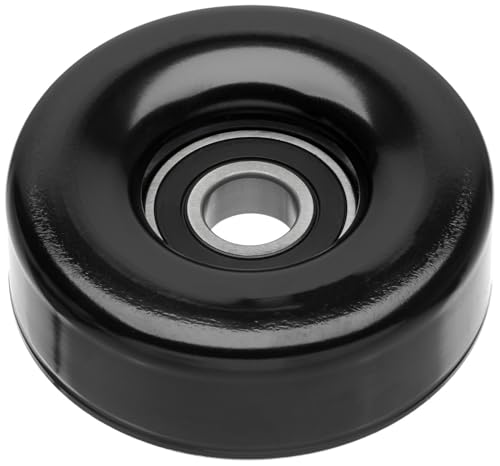
1. ACDelco Gold 38001 Idler Pulley
Specs:
– Part number: ACDelco Gold 38001 (GM 88909582)
– Outside diameter: 90 mm class (3.6 in), smooth backside contact
– Dimensions: 3.6 x 3.6 x 2 in; weight 10.2 oz
– Exterior: machined steel; sealed bearing
– Fitment: one of the widest GM/Chrysler/Ford idler applications in the catalog (crosses Gates 38001)
The 38001 pattern is the workhorse smooth idler found across years of GM trucks and SUVs and many other applications, making this ACDelco Gold version the default first look for a noisy pulley on a domestic V6 or V8. The machined steel body shrugs off underhood heat that can distort cheaper molded pulleys. Verify your old pulley measures about 90 mm across with a smooth face before ordering — the same engines often carry a second, smaller idler in a different position.
2. Gates DriveAlign 36336 Idler/Tensioner Pulley

Specs:
– Part number: Gates DriveAlign 36336
– OE cross references: Nissan 11927-4P100, 11927-4P101, 11927-AL500
– Weight: 1 lb
– Construction: steel pulley with sealed bearing, OE-exact DriveAlign line
– Fitment: Nissan and Infiniti accessory drives using the 11927-AL500 idler
Gates is the OE belt-drive supplier to much of the industry, and its DriveAlign pulleys are built to the original dimensions rather than a universal approximation. The 36336 serves the Nissan/Infiniti applications that call for the 11927-AL500 idler, a common failure point on higher-mileage VQ-engine cars where the pulley sits high on the drive and is easy to reach. If your Nissan chirps on cold starts and the noise tracks engine speed, this is the pulley to hand-spin first once the belt is off.
3. Gates DriveAlign 38028 Idler/Tensioner Pulley

Specs:
– Part number: Gates DriveAlign 38028
– OE cross references: Honda 31180-PNA-003, 31180-PNA-J01, 31180-RAA-A01; Jaguar C2C22758; Ford 2W9Z-8678-BA
– Construction: DriveAlign OE-spec pulley with sealed bearing
– Fitment: Honda/Acura four-cylinder accessory drives and related applications
Honda’s K-series and related four-cylinders route the belt over an idler that tends to announce itself with a cold-start chirp long before it fails outright. The Gates 38028 matches the Honda 31180-PNA-003 family exactly, so belt tracking stays where the factory put it — important here, where a slightly off-diameter pulley changes belt wrap and can add a new noise while fixing the old one. Cross-check the OE number in your service records before ordering.
4. ACDelco Gold 36320 Flanged Idler Pulley

Specs:
– Part number: ACDelco Gold 36320 (GM 19253841)
– Type: flanged idler pulley — raised edges help keep the belt tracked
– Dimensions: 3.6 x 3.6 x 2 in; weight 13 oz
– Construction: steel with sealed bearing, ACDelco Gold (Professional) line
– Fitment: GM applications specifying the 19253841 flanged idler
Some belt drives use a flanged pulley — one with raised lips on both edges — where the routing needs extra help keeping the belt from walking. Substituting a plain smooth pulley in a flanged position invites the belt to wander and chew its edges, so if the pulley that came off your engine has flanges, replace it with a flanged one like this ACDelco Gold 36320. It is a direct OE-pattern replacement for the GM 19253841, built to the same dimensions and bearing specification as the part fitted at the factory.
5. Dorman 419-620 Idler Pulley

Specs:
– Part number: Dorman 419-620 (pulley only)
– OE cross references: 36229, 49151, 89166, SK89166, K8051594XA
– Dimensions: 4.6 x 1.8 x 4.6 in; weight 8.8 oz
– Exterior: machined; sealed bearing
– Fitment: Mazda applications using the K8051594XA idler
Dorman’s 419-620 covers Mazda applications where the dealer part can be hard to source. It is a pulley-only replacement — you reuse your existing bolt and bracket hardware, so keep them in order during removal. As with every pick here, compare the old pulley’s diameter, width and face against the new one side by side on the bench before installation; that thirty-second check prevents the most common wrong-part mistake in this category.
Usage and Buying Notes
Photograph the belt routing before you remove anything. Most cars have a routing diagram on a sticker under the hood, but a phone photo of your exact engine is better. A misrouted belt is not just an inconvenience — routed wrongly, it can spin an accessory such as the water pump backwards, and the engine will overheat with a brand-new belt fitted perfectly tight.
Never run the engine with a pulley you can wobble by hand. A bearing that is loose today can seize tomorrow, and a seized idler shreds the serpentine belt within seconds. Losing the belt means losing the alternator, power steering and — on many engines — the water pump all at once. Treat new pulley noise as a schedule-it-this-week repair, not background music to live with.
Torque the center bolt to the maker’s specification. Idler bolts thread into brackets that are often aluminum; an over-torqued bolt strips the bracket and turns a cheap job into a helicoil repair, while an under-torqued one backs out. Also note that a few applications use a left-hand-thread bolt — if the bolt will not budge the normal way, check the service information before reaching for a longer bar.
Reuse nothing questionable. If the belt shows cracks, glazing or frayed edges, replace it while the drive is apart, and spin every remaining pulley by hand before the new belt goes on. Finding a second gritty bearing now costs minutes; finding it next month costs the whole job again.
FAQ
How do I know the idler pulley is the noisy one and not the belt or tensioner?
Remove the belt with the engine off and spin each pulley by hand. A failing idler feels gritty or notchy, wobbles, or whirs dryly, while good pulleys spin smoothly and quietly. A glazed belt alone usually chirps in a steady rhythm and quiets briefly with a light mist of water on the ribs; a bad bearing keeps grinding regardless.
Can I just replace the bearing inside my idler pulley?
The bearing is sealed and the pulley is built as a single unit with its hub and dust shields. Pressing in a generic bearing is possible on some steel pulleys but rarely economical and easy to get wrong; a complete replacement pulley is the standard, reliable repair.
Are smooth and grooved idler pulleys interchangeable?
No. Grooved pulleys run on the ribbed face of the belt and smooth pulleys run on the flat back. Swapping them misaligns the ribs and destroys the belt quickly. Match the face, diameter, width and bore of the pulley that came off.
Should I replace the tensioner and belt at the same time?
At higher mileage, yes, it is usually the smart money. The parts share the same service life and the labor overlaps almost entirely, so doing the belt, tensioner and idlers together costs little more than the single-pulley job and resets the whole drive.
What happens if I keep driving with a noisy idler pulley?
The bearing wears until it either wobbles enough to throw the belt or seizes and shreds it. Either way you lose the alternator, power steering and often the water pump without warning, which can leave you stranded or, if the water pump stops, facing an overheated engine.
Conclusion
An idler pulley is a small part with an outsized voice: when its sealed bearing dries out, the whole belt drive gets loud, and the fix only satisfies if you replace the pulley that is actually failing. Confirm the culprit by hand-spinning each pulley with the belt off, match the replacement by diameter, width, face type and OE cross-reference, and consider renewing the belt and tensioner while the drive is apart. The five pulleys above are the OE-pattern replacements that fit right and run quiet.
More from Amazon
Programs that pair well with the guide above. Offers and eligibility are set by Amazon and may change.
Free shipping on eligible items, Prime Video and more. Eligible new members can start with a free trial.
Start a Prime free trialAudiobooks and podcasts to listen to on the go. Eligible new members can start with a free trial.
Try Audible freeAd-free music streaming. Eligible new subscribers can start with a free trial.
Try Music Unlimited freeA free business account with business pricing and bulk-buying tools for work, shop or home office.
Create a business accountAs an Amazon Associate we earn from qualifying purchases.