Key takeaways
- Compare the best fan clutches for trucks and SUVs: thermal heavy-duty and standard picks, fitment checks, and the spin test to run before you buy.
On a truck or SUV with a belt-driven fan, the fan clutch decides how much air the fan pulls through the radiator. When it fails, it fails in one of two directions: it stops engaging, so the engine runs hot at idle while the air conditioning fades, or it locks up and roars like a turboprop from startup to shutdown. Both modes get misdiagnosed constantly, because a tired radiator, a weak water pump and a sticking thermostat produce overlapping symptoms.
Disclosure: As an Amazon Associate, I earn from qualifying purchases.
The five clutches below cover the most common replacement situations: a heavy-duty thermal unit for classic GM iron, a standard-duty thermal for lighter fans, a widely cross-referenced parts-store staple, a catalog OE-style replacement, and an OE-supplier unit for older Toyotas. All five are application-specific parts, so treat the listings as examples of each type and confirm the exact part number for your year, engine and fan before ordering.
How to Choose
Thermal vs non-thermal. A thermal clutch has a bimetal spring on its front face that reacts to the temperature of air leaving the radiator. Cool air keeps it disengaged, so the fan freewheels at a small fraction of shaft speed; hot air winds the spring, moves silicone fluid into the drive area, and the fan locks up to somewhere between roughly 60 and 90 percent of shaft speed. A non-thermal clutch has no spring and engages based on rpm alone. Non-thermal units are cheaper and belong mostly on older vehicles that came with them; a thermal clutch is the right replacement for almost everything else.
Duty rating is about lock-up, not strength. Standard-duty clutches are built for fans with a blade pitch under about 2.5 inches. Heavy-duty clutches have a larger working surface and lock up harder, around 70 to 90 percent, for deeper-pitch fans. Severe-duty units use a much thicker body with far more fluid surface and lock up around 80 to 90 percent. Severe duty is for towing, plowing and hot-climate work. On a light truck that mostly commutes, it mostly buys you noise: a severe-duty clutch roars more at startup and after every hot soak, and it is not automatically the better part.
Rotation and mounting come first. Serpentine systems come in both rotations. If the grooved side of the belt rides the water pump pulley, rotation is standard (clockwise); if the flat back of the belt drives the pulley, it is reverse. A wrong-rotation clutch overheats the engine no matter how good it is. Then check the mounting style — four-bolt flange or thread-on — the fan bolt circle, and the overall height, which sets how far the fan sits into the shroud.
Test before you buy. With the engine cold and off, spin the fan by hand: it should turn with smooth, even resistance and no wobble or grinding. A fan that free-spins with almost no resistance when the engine is hot, or one you cannot turn at all, points at the clutch. Listen on a warm-up drive too: a healthy thermal clutch roars briefly at startup, quiets down, then roars again when the air through the radiator gets hot. A roar that never fades means it has locked; silence on a hot day in traffic means it never engages. Even then, confirm the radiator is clean inside and out, the thermostat opens, and the water pump shaft has no play — a wobbling pump mimics a bad clutch, and a wobbling clutch will kill a good pump bearing.
The 5 Products
1. Hayden 2747 Premium Fan Clutch

Specs:
– Type: Thermal, heavy duty
– Rotation: Standard (clockwise)
– Mounting: 4-bolt flange
– Maximum diameter: 7.2 in
– Overall height: 3.34 in
– Material: Aluminum; weight 3.2 lb
The 2747 is the default answer for a long list of classic GM cars and trucks, and its fitment stretches across decades of Buick, Chevrolet, GMC and Cadillac V8 applications. It is a flange-mount, standard-rotation unit, which makes it the pattern to compare against if your truck still runs a V-belt or a standard-rotation serpentine setup. The heavy-duty internals suit the deeper-pitch steel fans those vehicles carry, and the aluminum body keeps weight close to the original part. If your application calls for a heavy-duty standard-rotation clutch, this is the benchmark.
2. Hayden 2794 Premium Fan Clutch

Specs:
– Type: Thermal, bimetal spring control
– Faceplate: Smooth steel, the standard-duty design
– Fan pairing: Lighter-pitch fans
– Exterior: Machined
– Listing dimensions: 7.5 x 7.3 x 5.1 in
Hayden describes this design plainly: it is used with lighter-pitched fans and identified by the smooth steel faceplate and thermal spring on the front. That makes the 2794 the honest choice for vehicles whose original clutch was a standard-duty unit — lighter-duty trucks, vans and cars where a heavy or severe-duty replacement would just add startup roar without moving meaningfully more air. Matching the original duty rating matters more than upgrading it, and this is the pick for buyers who want the factory behavior back.
3. Four Seasons 36700 Fan Clutch

Specs:
– Brand line: Four Seasons (SMP Temperature Control)
– Model: FOR36700
– Exterior: Machined
– Listing dimensions: 7.94 x 8.06 x 4.06 in
– Design: OE-style replacement fan clutch
Four Seasons is the temperature-control division of Standard Motor Products, and the 36700 is its kind of part: a catalog replacement sold through nearly every parts channel and cross-referenced against a wide range of OE numbers. Four Seasons also publishes genuinely useful diagnostic guidance — its own tech material warns that overheating is often blamed on the clutch when the real fault sits elsewhere, which is the right mindset for this repair. Choose the 36700 when your application cross-references to it and you want a mainstream, easy-to-source replacement.
4. Hayden 2906 Fan Clutch

Specs:
– Model: 2906
– UPC: 036752029068
– Design: Built to meet or exceed OE performance, fit and appearance
– Type: Engine cooling fan clutch, application-specific
The 2906 represents the other common buying situation: your vehicle has one correct clutch in the catalog and no meaningful standard/heavy/severe choice to make. Hayden’s documentation states it is engineered to meet or exceed original equipment performance, fit and appearance — exactly what you want from a like-for-like swap. On application-specific clutches, the interchange number on your old unit and the catalog listing for your exact year and engine matter more than brand preference.
5. AISIN FCT-001 Engine Cooling Fan Clutch
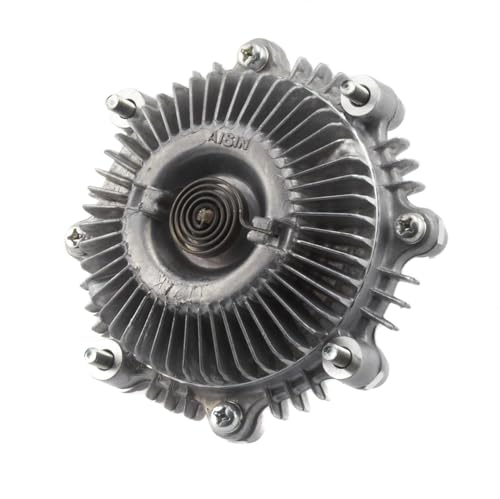
Specs:
– Brand: AISIN, the OE supplier for Toyota applications
– Model: FCT-001
– UPC: 792088066541
– Fitment: Toyota Pickup 1979-1992, Celica 1978-1985, Corona 1976-1982
For older Toyotas, AISIN is the company that made the original clutch, and the FCT-001 covers the long-running Toyota Pickup with the 2.2L and 2.4L fours plus period Celica and Corona models. An OE-supplier part is worth choosing on vehicles this age because the aftermarket coverage is uneven and the engagement feel of a cheap clutch — too loose when hot, or dragging when cold — is hard to judge until it is installed. If you are keeping an old Toyota truck on the road, this is the low-drama option.
Usage and Buying Notes
Store a viscous fan clutch upright, the way it sits in the engine bay, and keep it that way on the shelf. The silicone fluid inside migrates when the clutch lies flat for long periods, which is why a brand-new clutch sometimes roars for the first several minutes of running — the fluid needs run time to redistribute. That startup roar is normal; a roar that never stops is not.
Before forcing any fastener, confirm the thread direction. Many thread-on clutches use a left-hand (reverse) thread, and the fan turns the opposite way from what your hands expect. A proper fan clutch wrench set — one wrench holds the water pump pulley while the other turns the nut — makes removal a short job instead of a fight. While the clutch is off, spin the water pump by hand and feel for roughness or play, and inspect the fan itself for cracked blades and a bent rim; a damaged fan destroys a new clutch.
One rule overrides every tip here: never reach near a cooling fan on a running or hot engine. A thermal clutch can engage without warning as underhood air heats up, and an electric fan on a modern vehicle can start with the engine off entirely. Do every hand test cold, with the engine off and the key out.
FAQ
1. What are the signs of a failing fan clutch?
Overheating at idle that improves at highway speed, air conditioning that fades in traffic, a fan that free-spins with no resistance when hot, or a constant roar that never fades after warm-up. Silicone fluid leaking from the front of the clutch is a visual confirmation.
2. Is a severe-duty clutch a good upgrade for a daily driver?
Usually not. It locks up harder and roars more, which suits towing and plowing but adds noise and drag to a commute. Match the duty rating to your fan’s blade pitch and how the vehicle is actually used.
3. Can I test the clutch before replacing it?
Yes. Cold and off, spin the fan by hand and feel for smooth resistance and wobble. Then listen through a warm-up and a hot idle. Also rule out a clogged radiator, a thermostat that is not opening, and water pump play first.
4. Does the fan clutch affect air conditioning?
Directly. The condenser sits in front of the radiator and depends on the same airflow at low speed. A clutch that never engages is a common cause of air conditioning that works on the highway and goes warm at stoplights.
5. Why does my new fan clutch roar at startup?
Briefly, that is normal. Fluid settles while the clutch sits in its box, so it starts partially engaged and quiets as the fluid redistributes. If the roar lasts the whole drive, check you bought the right duty rating and rotation.
Conclusion
Most fan clutch purchases are diagnosis purchases: confirm the failure with the cold spin test and warm-up roar check, rule out the radiator, thermostat and water pump, then match the replacement on rotation, mounting, bolt circle and duty rating. The Hayden 2747 covers classic GM heavy-duty applications, the 2794 restores standard-duty behavior for lighter fans, the Four Seasons 36700 and Hayden 2906 handle catalog OE-style swaps, and the AISIN FCT-001 keeps older Toyotas running their original supplier’s part. Buy the clutch your fan and engine actually call for, and store it upright until it goes on.
More from Amazon
Programs that pair well with the guide above. Offers and eligibility are set by Amazon and may change.
Free shipping on eligible items, Prime Video and more. Eligible new members can start with a free trial.
Start a Prime free trialAudiobooks and podcasts to listen to on the go. Eligible new members can start with a free trial.
Try Audible freeAd-free music streaming. Eligible new subscribers can start with a free trial.
Try Music Unlimited freeA free business account with business pricing and bulk-buying tools for work, shop or home office.
Create a business accountAs an Amazon Associate we earn from qualifying purchases.