Our Short List of 3
- Voltage: 12 volts, battery powered, lithium ion
- Speed: 2,000–4,500 RPM, six settings
- Orbit: 3 mm and 12 mm, rotary and dual action
- Backing plates: 1 inch, 2 inch, and 3 inch

- Voltage: 12 volts, battery powered
- Batteries: two 2,000 mAh lithium ion batteries included, fast charger included
- Speed: low band 0–2,800 RPM for polishing, high band up to 8,300 RPM
- Motion: rotary and dual action via adapter

- Voltage: 24 volts, battery powered, brushless
- Motion: free-spinning random orbital
- Output: up to 4,350 RPM and 8,700 OPM, constant speed under load
- Speed control: 11-speed dial with variable speed trigger
All 4 Picks at a Glance
| Product | Specs | Action |
|---|---|---|
| 1. SPTA Cordless Mini Polisher, 12V — B0B7WMFW4L |
| Check price on Amazon |
| 2. SPTA 12V Cordless Car Rotary Polisher Tool Set — B0C7BX4FGZ |
| Check price on Amazon |
| 3. FLEX 24V Brushless Cordless Random Orbital Polisher Kit — B0DQK91VC9 |
| Check price on Amazon |
 4. DEWALT 20V MAX XR Cordless Polisher, Rotary, 7-Inch — B07YQJLYNR |
| Check price on Amazon |
Key takeaways
- Compare the best cordless car polisher options by orbit, speed range, battery platform and pad size, with four verified picks for detailing and waxing.
As an Amazon Associate we earn from qualifying purchases.
A cordless car polisher removes the one thing that makes machine polishing awkward in a driveway or a rented garage bay: the cord. Without a cable dragging across a fender, catching on a tire, or forcing you to plan every pass around the nearest outlet, you can work panel by panel and stop exactly where the light is best. The trade-off is that the battery platform, the orbit, and the speed range now matter more, because the tool has to deliver steady motion from a pack that is also part of the weight in your hands.
This guide compares four cordless car polishers that cover the main ways people actually use these tools. Two are compact 12-volt machines built around small pads for pillars, bumpers, and mirrors. One is a full-size 24-volt random orbital kit with two large batteries and both 5-inch and 6-inch backing plates for whole-car work. The fourth is a 20-volt rotary polisher sold as a bare tool for people who already own batteries on that platform and want direct rotary action for heavier correction. Every pick is a cordless car polisher, every specification is taken from its Amazon US product page, and each section links to that page so you can confirm the details before you buy.
Disclosure: This article contains affiliate links. If you buy through these links, we may earn a commission at no additional cost to you.
How to Choose a Cordless Car Polisher
Rotary, dual action, and random orbital motion
The motion of the pad decides how the machine behaves on paint. A rotary polisher spins the pad on a single axis. That direct drive cuts quickly, which is useful on hard, heavily oxidized paint, but it also concentrates heat and demands a steady, practiced hand, because pausing in one spot can damage clear coat. A dual action or random orbital polisher moves the pad in small orbits as well as spinning it, which spreads the work over a wider pattern, runs cooler, and is far more forgiving for owners polishing their own car. For most readers, a random orbital or dual action machine is the sensible default, and a rotary is a deliberate choice for experienced users.
Orbit size and backing plate size
Orbit describes how far the pad travels in its small circular path. A short orbit suits small pads and tight areas, while a longer orbit covers flat doors, hoods, and roofs faster. Backing plate size works with it: 1-inch, 2-inch, and 3-inch plates reach into the narrow painted strips around windows and lights, 5-inch plates are the all-round choice for most panels, and 6-inch or 7-inch plates cover large flat surfaces but become clumsy around mirrors and badges. A kit that includes more than one plate size gives you more of the car within reach without buying a second machine.
Speed range and speed control
Polishing is done at different speeds for different jobs. Low speeds spread wax and sealant evenly, medium speeds handle light polishing and cleaning, and higher speeds do the correction work on swirls and oxidation. Look for a wide, clearly divided speed range and a control you can adjust without stopping, whether that is a dial, a rotating switch, or a variable speed trigger. A machine whose lowest setting is still fast will feel grabby when you are applying wax, and a machine with no real top end will take a long time on neglected paint.
Battery platform, capacity, and runtime planning
With a cordless polisher, the battery is part of the tool. Voltage tells you the platform family, and amp-hour capacity tells you roughly how much work a pack holds. Two batteries in a kit matter more than a slightly larger single pack, because one can charge while the other works. Bare tools only make sense when you already own compatible batteries and a charger.
Weight, grip, and vibration
You hold a polisher at arm’s length, often at odd angles on vertical panels. Published weight, a grip you can hold in more than one position, and reduced vibration all show up in how accurate your last panel is compared with your first. Smaller machines are easier to guide one-handed around pillars and mirrors. Larger machines with a long body let you use two hands on big panels, which keeps the pad flat and the pressure even.
Pads and accessories in the box
Pads do the actual work, and kits differ a lot here. Foam pads in several grades, wool pads, and microfiber bonnets let you move from correction to finishing to waxing without a separate order. Check whether the pads match the backing plates included, whether the attachment is hook and loop for fast changes, and whether a charger is in the box.
The Four Cordless Car Polishers Compared
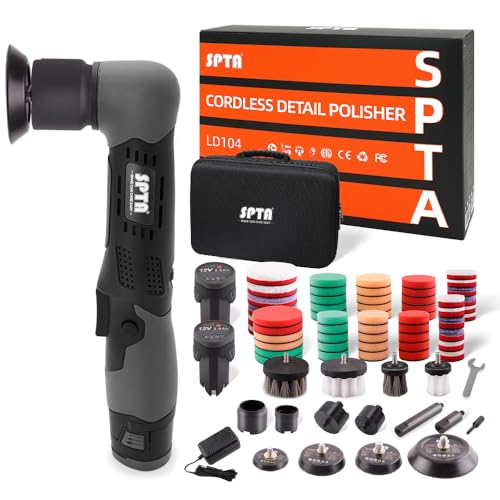
1. SPTA Cordless Mini Polisher, 12V — B0B7WMFW4L
- Voltage: 12 volts, battery powered, lithium ion
- Speed: 2,000–4,500 RPM, six settings
- Orbit: 3 mm and 12 mm, rotary and dual action
- Backing plates: 1 inch, 2 inch, and 3 inch
The SPTA Cordless Mini Polisher is the small-area specialist in this group. It is a 12-volt machine, model LD104US, that works as both a rotary and a dual action polisher, with two eccentric blocks giving 3 mm and 12 mm orbits. That dual personality is rare at this size and is the main reason to choose it: rotary mode for a stubborn spot, dual action mode for safer finishing, in one compact tool that weighs 4.29 pounds.
The backing plate set is the other headline. The kit covers 1-inch, 2-inch, and 3-inch plates, which are the sizes that actually fit the painted surfaces full-size polishers cannot reach: A-pillars, the strip above a windshield, mirror housings, door handle surrounds, and the narrow sections of bumpers. Speed runs from 2,000 to 4,500 RPM across six settings adjusted by a rotating switch, and the page lists the machine at 12 inches long, which keeps it easy to guide one-handed.
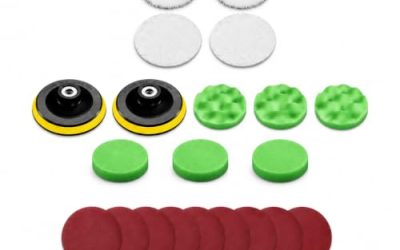
Two 12-volt lithium ion batteries are included, along with the charger, so one pack can charge while the other works. The pad assortment covers three cutting grades in the small sizes, plus microfiber and wool pads, and the hook and loop backing is described as heat resistant with a firm hold at speed. A self-locking switch lets the machine keep running without constant finger pressure, which helps on longer passes. If your car is already in good shape and your real problem areas are the tight, curved, and narrow ones, this is the most precisely matched tool in the guide.
Specifications from the Amazon US page:
View it on Amazon: https://www.amazon.com/dp/B0B7WMFW4L
2. SPTA 12V Cordless Car Rotary Polisher Tool Set — B0C7BX4FGZ
- Voltage: 12 volts, battery powered
- Batteries: two 2,000 mAh lithium ion batteries included, fast charger included
- Speed: low band 0–2,800 RPM for polishing, high band up to 8,300 RPM
- Motion: rotary and dual action via adapter
The second SPTA machine, model LD302US, takes a different approach to the same 12-volt idea. Instead of mini plates, it is a variable speed polisher and buffer set built around a dual action adapter that lets you switch between spin and double action movement, with a small wrench used to change the adapter over. The set is aimed at owners who want one compact machine that can polish, buff, and handle light grinding tasks as well as paint work.
Its speed range is split into two bands. The low band runs from 0 to 2,800 RPM and is identified for polishing, while the high band runs from 0 to 8,300 for grinding, with the technical details listing a top speed of 8,330 RPM. That split is useful as long as you respect it: paint work belongs in the low band, and the high band exists for other surfaces the page names, including metal, wood, marble, and glass. Used with that discipline, the low band covers the same ground as most compact polishers.
The kit content is generous. Two 2,000 mAh lithium ion batteries and a fast charger are included, along with 24 sponge, wool, and microfiber pads in five grades from hard to soft, and 13 detail cleaning brushes. The pads use a hook and loop backing made from heat resistant material. The machine weighs 6.84 pounds in its package listing, so it is a heavier tool than the mini model above, and its spindle lock and release lock are listed as safety features for adapter changes. Choose this one if you want a single 12-volt set that arrives with a deep pad and brush inventory for a whole detailing routine.
Specifications from the Amazon US page:
View it on Amazon: https://www.amazon.com/dp/B0C7BX4FGZ
3. FLEX 24V Brushless Cordless Random Orbital Polisher Kit — B0DQK91VC9
- Voltage: 24 volts, battery powered, brushless
- Motion: free-spinning random orbital
- Output: up to 4,350 RPM and 8,700 OPM, constant speed under load
- Speed control: 11-speed dial with variable speed trigger
The FLEX kit, model FX3321-2C, is the full-size machine in this guide and the one aimed at polishing entire cars rather than selected areas. It is a 24-volt brushless random orbital polisher with constant speed technology, which the page describes as maintaining speed under pressure, delivering up to 4,350 RPM and 8,700 OPM. That combination of a high orbit rate and speed held under load is what separates a full correction tool from a wax spreader.
Control is handled by an 11-speed dial together with a variable speed trigger, giving finer steps than the six-setting machines above, which helps when you are matching pad speed to a specific compound and panel. The kit includes both a 5-inch and a 6-inch backing plate, so the same machine can work a door with the larger plate and then switch down for tighter sections. The page also notes an optimized gear head for reduced high-frequency noise and vibration control for reduced fatigue, and the tool weighs 6.3 pounds.
The battery side is the strongest here: two 5.0 Ah lithium batteries and a 160 W fast charger are in the box, which makes a full day of intermittent polishing realistic without planning around a single pack. An Allen key for plate changes is also included. This is the pick for larger vehicles and for paint that needs real correction across every panel. It is also the least suited to very tight areas, where the SPTA mini model above remains the better instrument.
Specifications from the Amazon US page:
View it on Amazon: https://www.amazon.com/dp/B0DQK91VC9
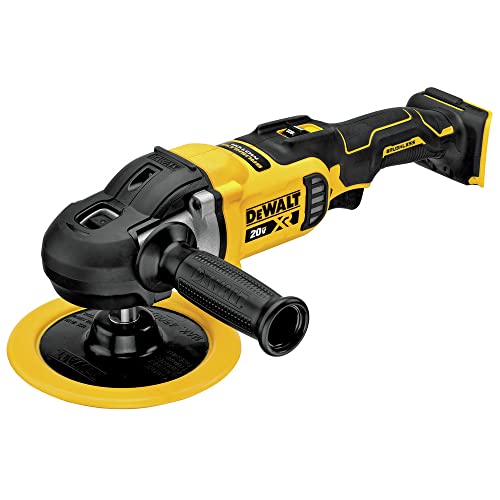
4. DEWALT 20V MAX XR Cordless Polisher, Rotary, 7-Inch — B07YQJLYNR
- Voltage: 20 volts, battery powered
- Motion: rotary
- Pad size: 7 inch (180 mm)
- Speed: 2,200 RPM as listed
The DEWALT DCM849B is the rotary option, and it is included for a specific reader: someone who already owns 20V MAX batteries and wants direct rotary action for heavier correction. It is a brushless-style XR platform tool sold as tool only, with no battery included and batteries required, so its value depends entirely on the batteries already in your garage. Bought on its own without that platform behind it, it is an incomplete purchase.
As a rotary, it spins its 7-inch pad on a single axis. The page lists a speed of 2,200 RPM and a voltage of 20 volts, with the tool weighing 4.8 pounds and measuring 17.1 by 7.3 by 6 inches. That long body is typical of rotary machines and gives you the two-handed leverage that rotary work needs, since keeping a rotary pad flat and moving is the whole skill. In return, a 7-inch rotary covers flat panels quickly, which is why this format remains popular for large, flat, heavily oxidized surfaces.
Be honest about the experience rotary requires before choosing it. The same direct drive that cuts fast can also burn through an edge or leave holograms in the hands of a first-time user, and none of the forgiveness of the random orbital machines above is built in. If you are new to machine polishing, the FLEX or either SPTA will serve you better. If you have rotary experience and the batteries on the shelf, this is a well-matched bare tool from a major platform.
Specifications from the Amazon US page:
View it on Amazon: https://www.amazon.com/dp/B07YQJLYNR
Comparison Table
| Product | Motion | Voltage | Speed | Plates or pad size | Batteries in box | Weight |
|---|---|---|---|---|---|---|
| SPTA Cordless Mini Polisher B0B7WMFW4L | Rotary and dual action | 12V | 2,000–4,500 RPM | 1, 2, and 3 inch | Two, with charger | 4.29 lb |
| SPTA 12V Rotary Polisher Set B0C7BX4FGZ | Rotary and dual action | 12V | 0–2,800 RPM polishing band | Pad set with 24 pads | Two 2,000 mAh, with fast charger | 6.84 lb |
| FLEX 24V Random Orbital Kit B0DQK91VC9 | Random orbital | 24V | Up to 4,350 RPM, 8,700 OPM | 5 and 6 inch | Two 5.0 Ah, with 160 W fast charger | 6.3 lb |
| DEWALT 20V MAX XR Rotary B07YQJLYNR | Rotary | 20V | 2,200 RPM as listed | 7 inch | None, tool only | 4.8 lb |
Frequently Asked Questions
Is a cordless polisher powerful enough for a whole car?
Yes, provided the kit is built for it. A full-size random orbital machine with two higher-capacity batteries, like the FLEX 24-volt kit in this guide, is designed for whole-car sessions, and the second battery removes the waiting that stops work. Compact 12-volt machines can also cover a car, but their small pads make large flat panels slow, so they are better matched to selected areas and maintenance polishing.
Which motion is safest for a beginner?
Random orbital and dual action machines are the safest starting point, because the orbiting pad movement spreads heat and keeps the tool from concentrating its work in one spot. Both SPTA models offer dual action movement and the FLEX is a random orbital. A rotary such as the DEWALT cuts faster but punishes a pause or a tilted pad, so it belongs with experienced users.
What pad sizes do I actually need?
Most owners need two sizes: a 5-inch or 6-inch plate for doors, hoods, and roofs, and a small 1-inch to 3-inch plate for pillars, mirrors, and bumper details. The FLEX kit covers the large end with both 5-inch and 6-inch plates, while the SPTA mini polisher covers the small end with three plates. Choosing a machine is partly choosing which end of that range matters more for your car.
Does a bare tool make sense to buy?
Only when you already own the matching batteries and charger. The DEWALT rotary in this guide is sold as tool only, so it is a sensible addition to an existing 20-volt collection and an incomplete purchase without one. The other three picks include batteries and a charger, so they work out of the box.
Can these polishers be used for waxing as well as correction?
Yes. Waxing is a low-speed job, so use the lower settings, a soft foam pad or a bonnet, and light pressure. The variable speed ranges on all four machines include settings low enough for that work.
How do I avoid damaging paint with a cordless polisher?
Keep the pad flat, keep the machine moving, work in small sections, and start with the least aggressive pad and speed combination that does the job. Match the motion to your experience, check your work often under good light, and never let a rotary sit spinning in one place. Battery power does not change these fundamentals; it only removes the cord from the list of things to manage.
Conclusion
The best cordless car polisher for most owners is the one whose size matches the work. Choose the FLEX 24V random orbital kit for one machine for full-car correction and finishing, with two large batteries and both working plate sizes in the box. Choose the SPTA Cordless Mini Polisher if your paint is generally sound and your problem areas are the small, curved panels that big machines cannot reach. Choose the SPTA 12V rotary tool set for a compact kit with a deep inventory of pads and brushes. Choose the DEWALT rotary only if you already run that battery platform and have the experience rotary polishing requires.
More from Amazon
Programs that pair well with the guide above. Offers and eligibility are set by Amazon and may change.
Free shipping on eligible items, Prime Video and more. Eligible new members can start with a free trial.
Start a Prime free trialAudiobooks and podcasts to listen to on the go. Eligible new members can start with a free trial.
Try Audible freeAd-free music streaming. Eligible new subscribers can start with a free trial.
Try Music Unlimited freeA free business account with business pricing and bulk-buying tools for work, shop or home office.
Create a business accountAs an Amazon Associate we earn from qualifying purchases.