Key takeaways
- Compare the best brake line flaring tools for 45-degree double and ISO bubble flares, from compact on-car hand tools to turret and bench kits.
Disclosure: As an Amazon Associate, I earn from qualifying purchases.
Replacing a rusted brake line or building a fuel line from scratch comes down to one skill: forming a flare that seals perfectly the first time you press the pedal. A good flaring tool makes that flare repeatable. A poor one makes cracked, off-center flares that weep fluid under pressure — and brake hydraulics run at very high pressure. The five tools below cover the main styles worth owning: a turret-style professional set, a bench tool that handles stainless steel, two compact handheld tools that work on the vehicle, and a metric bubble flare kit for European and many Asian cars.
How to Choose
Match the flare type to the fitting. Most domestic and older vehicles use a 45-degree SAE double flare (also called an inverted flare). Many European and Asian vehicles use an ISO bubble flare, which looks like a small rounded mushroom instead of a folded cone. The two are not interchangeable, and forcing the wrong flare into a seat will leak. Check your car’s fittings before buying a tool.
Never substitute a single flare or a compression fitting on brake lines. Where a double flare is specified, a single flare is not an acceptable shortcut — the folded double wall gives the joint its strength and sealing surface. Compression fittings are likewise not approved for brake lines in most jurisdictions. A single-flare-only tool belongs on low-pressure lines, not brakes.
Decide where you will flare. Bench and turret tools give the most consistent results when building complete lines on the workbench. Compact handheld tools earn their keep on repairs: they fit under the car and let you flare the existing line in place, without removing the whole run.
Consider your tubing material. Steel line is cheap and strong but hard to flare and quick to rust. Stainless resists corrosion but is the hardest to form and defeats light-duty tools. Copper-nickel line is the DIY favorite for good reason: it flares easily, bends by hand, and resists rust far better than plain steel. If you are new to flaring, copper-nickel plus a decent tool makes learning much less frustrating.
Practice first, always. Make your first several flares on scrap tubing. Cut each practice flare apart and inspect it: the folds should be even, concentric, and free of cracks. Then pressure-test the finished line and bleed the system carefully, checking every new joint for seepage after repeated firm pedal applications. If any part of the job feels beyond you, have a shop fabricate the lines — brakes are the wrong system for learning by consequence.
The 5 Best Brake Line Flaring Tools
1. Titan 51534 Professional Single, Double, and Bubble Flaring Tool Set

Specs:
– Flare types: 45-degree single, double, and bubble flares
– Tube sizes: 3/16 in., 1/4 in., 5/16 in., 3/8 in., 1/2 in., and 4.75 mm retaining dies
– Design: turret-style indexed head keeps all forming dies ready to use
– Clamp: quick-release T-handle screw clamp holds the tube-retaining dies
– Use: brake lines, transmission cooler lines, and fuel lines
The Titan 51534 is the closest thing to a shop tool in this roundup. Instead of a loose bag of adapters swapped in and out of a flaring bar, its turret head indexes each forming die into position, so switching between single, double, and bubble flares is fast and the dies cannot get lost. The quick-release T-handle clamp locks the tubing dies down with far less fumbling than wing nuts. For someone building a full set of lines for a project car — a mix of SAE double flares and metric bubble flares — this tool makes the job feel routine instead of fiddly.
2. ARES 18012 Professional Brake Line Flaring Tool

Specs:
– Flare types: 45-degree double flares
– Tube sizes: 3/16 in., 1/4 in., 5/16 in., and 3/8 in.
– Tubing materials: steel, stainless steel, copper, and aluminum
– Design: bench tool that mounts in a vise for leverage; 6-piece set
– Includes: storage case; package dimensions 14 x 11 x 4 inches
Most budget flaring tools quietly exclude stainless steel, because forming it takes real force and cheap bars flex or slip. The ARES 18012 is rated for stainless as well as steel, copper, and aluminum, and its vise-mount design lets you use the bench for leverage instead of grip strength. That makes it a strong pick for restorations with stainless lines, or for anyone who wants one sturdy bench tool for double flare work across the four common tube sizes. It is a dedicated double flare tool, so bubble flare jobs will need a second kit.
3. Titan 51515 1/4-Inch Double Flaring Tool

Specs:
– Flare type: inverted 45-degree SAE double flare, 1/4 in. tubing only
– Tubing materials: steel and nickel-copper (not recommended for stainless steel)
– Design: compact handheld tool for on-vehicle use in tight under-car spaces
– Includes: double-ended OP1/OP2 punch, die lubricant, and positioning bolt
– Handle: removable, so the tool can be mounted in a bench vise; weight 7.2 ounces
The Titan 51515 is a single-purpose repair tool, and that focus is its strength. When a 1/4-inch line rusts through at one fitting, this compact tool lets you cut back to sound metal and form a fresh double flare right there under the vehicle, with no room needed for a flaring bar and yoke. The included punch and die lubricant cover both steps of the double flare process. It handles one size only, so it is not a fabrication tool — but as a repair tool for the most common larger line size, it is hard to beat.
4. Capri Tools 3/16 in. Double Flaring Tool (CP21110-316)

Specs:
– Flare type: 45-degree SAE double flare, 3/16 in. tubing only
– Tubing materials: steel, nickel, and copper (non-stainless)
– Design: compact low-profile tool for use on or off the vehicle
– Handle: removable for bench vise use
– Weight: 12.8 ounces; part number CP21110-316
Three-sixteenths-inch line is the most common brake line size on cars and light trucks, and the Capri CP21110-316 is built specifically for it. Like the Titan above, it trades size coverage for access: the compact body works in wheel wells and along frame rails where a bar-style kit cannot swing. It produces proper 45-degree double flares on steel and copper-nickel tubing, and the handle comes off if you prefer to clamp it in a vise. If most of your brake work is repairing individual 3/16-inch lines rather than plumbing whole cars, this is the sensible specialist to own.
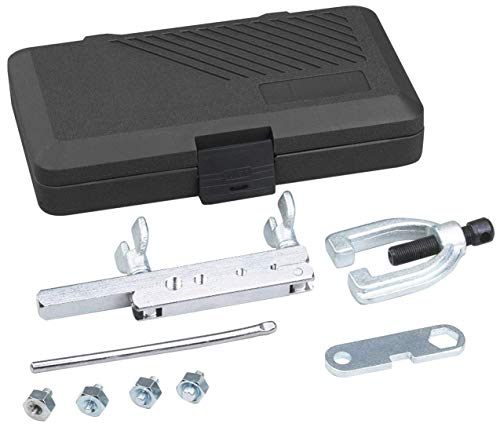
5. OTC 4504 Stinger ISO Bubble Flaring Tool Kit
Specs:
– Flare type: ISO bubble flares
– Tube sizes: metric 4.75 mm, 6 mm, 8 mm, and 10 mm
– Tubing materials: copper, aluminum, soft steel, and brass
– Design: traditional flaring bar and yoke with wing-nut clamp
– Use: metric brake lines on European and many Asian vehicles
If your car uses bubble flares, none of the double flare tools above will seal correctly — you need a dedicated ISO bubble kit like the OTC 4504 Stinger. It uses the classic bar-and-yoke layout, with adapters covering the four standard metric sizes. The wing-nut design demands more patience than a turret tool, and getting the tube height exactly right matters, so practice flares are essential. But it does the one job it is built for, and for owners of metric-flare cars it is the difference between making your own lines and paying shop rates for every repair.
Usage Notes
Cut tubing with a proper tubing cutter, never a hacksaw, and deburr inside and out before flaring — a leftover burr becomes a crack in the finished flare. Slide the tube nut onto the line before you flare, every time; everyone forgets once. A drop of brake fluid or die lubricant on the punch reduces galling and improves the fold. Set the tube height in the bar using the adapter shoulder as the gauge, as your tool’s instructions describe.
After assembly, fill and bleed the system, then have a helper hold firm pedal pressure while you inspect each new flare with a flashlight and a dry fingertip. Any dampness means the flare comes apart and gets remade — there is no tightening your way out of a bad flare. Recheck the joints after the first few drives.
FAQ
Can I use a single flare on a brake line if my tool only makes single flares?
No. Where the fitting is designed for a double flare, a single flare lacks the folded sealing surface and strength the joint needs, and it can crack or leak under pedal pressure. Use a tool that makes proper double flares, or have a shop make the line.
What is the difference between a double flare and a bubble flare?
A double flare folds the tube wall back on itself into a 45-degree cone for SAE inverted-flare fittings. A bubble flare forms a rounded, mushroom-shaped end for ISO metric fittings. They fit different seats and are not interchangeable.
Why do my flares keep cracking or coming out off-center?
Usually the tube was not deburred, the tube height was wrong, or the tubing is corroded. Cut back to clean tubing, set the height with the adapter gauge, lubricate the punch, and practice on scrap until the folds come out even.
Is copper-nickel line really easier to flare than steel?
Yes. Copper-nickel tubing is softer, so it folds with less force, resists cracking, and bends by hand without kinking as easily. It costs more than plain steel but resists rust far better, which is why many restorers use it for full line sets.
Can I flare a line while it is still on the car?
Yes, with a compact handheld tool like the Titan 51515 or Capri CP21110-316, as long as you can cut the line square, deburr it, and seat the tool fully. Bench tools give more consistent results for complete lines, so on-car flaring is best for section repairs.
Conclusion
For most home mechanics, the choice comes down to where and how often you flare. The Titan 51534 turret set is the best all-round fabrication tool, covering single, double, and bubble flares across common sizes. The ARES 18012 is the pick for bench work in stainless steel. The Titan 51515 and Capri CP21110-316 are compact repair tools that flare lines in place, and the OTC 4504 covers the metric bubble flare cars the others cannot. Whichever you choose, practice on scrap, inspect every flare, and pressure-test before the car moves — your whole stopping distance depends on that small piece of folded metal.
More from Amazon
Programs that pair well with the guide above. Offers and eligibility are set by Amazon and may change.
Free shipping on eligible items, Prime Video and more. Eligible new members can start with a free trial.
Start a Prime free trialAudiobooks and podcasts to listen to on the go. Eligible new members can start with a free trial.
Try Audible freeAd-free music streaming. Eligible new subscribers can start with a free trial.
Try Music Unlimited freeA free business account with business pricing and bulk-buying tools for work, shop or home office.
Create a business accountAs an Amazon Associate we earn from qualifying purchases.