Key takeaways
- Compare the best brake caliper tools, from 24-piece wind-back kits to ratcheting presses, and learn when pistons must be wound back, never forced in.
Disclosure: As an Amazon Associate, I earn from qualifying purchases.
New pads are thicker than worn ones, so before a caliper fits back over the rotor, its piston has to go back into the bore. That single step is where pad changes go wrong. Some pistons simply press straight in. Others — most rear calipers with an integrated parking brake — must be rotated as they retract, and forcing those in with a clamp can destroy the caliper. A dedicated brake caliper tool matches the piston you actually have, applies force evenly, and keeps the dust boot from tearing.
The five tools below cover both jobs: full wind-back kits with adapters for screw-in pistons, and faster presses and spreaders for straightforward push-back pistons. Which type you need is decided by your car, not by preference, so the buying guide comes first.
How to Choose
Identify your piston type first. Front calipers almost always use push-back pistons. Rear calipers vary: if the parking brake acts on the caliper itself, the piston usually winds back on a threaded mechanism. Check your service manual or look at the piston face — two pin holes or slots in the face are the classic sign of a wind-back piston.
Match the tool to the job. A wind-back kit uses a thrust bolt and a vehicle-specific adapter plate to rotate and press the piston at the same time. Kits include both right-hand and left-hand thrust bolts because some pistons wind clockwise and others counter-clockwise. A press or spreader only pushes, which is correct for front pistons and wrong for screw-in ones.
Count pistons, not just axles. Performance and truck calipers may have two or four pistons. Those need a tool that pushes all pistons evenly and in parallel, or one piston pops back out as you press its neighbor.
Check the extras. Caliper hangers in a kit matter more than they look: they hold the caliper up while you work so it never dangles from its rubber brake hose, which the caliper’s weight can damage internally.
Respect the fluid. Pushing a piston back sends brake fluid up into the reservoir. Open the cap and check the level before you start, and draw some fluid out if it is near the top, because overflow will strip paint on contact.
The 5 Best Brake Caliper Tools
Orion Motor Tech Brake Caliper Wind Back Tool Kit, 24-Piece

Specs
- 24 pieces: 18 disc adapters, 2 thrust bolt assemblies, 2 retaining plates, 2 caliper hangers
- Left-hand and right-hand thrust bolts for both wind-back directions
- 45# carbon steel construction with a sandblasted finish
- Universal fit for most domestic and import disc brake calipers
- Blow-molded storage case and a pair of work gloves included
- Manufacturer warranty: 1 year
This is the complete answer for anyone whose rear calipers wind back. The two thrust bolt assemblies turn in opposite directions, and the 18 adapters cover the pin patterns used across American, Japanese, and European cars, so the odds are good the plate you need is already in the case. Magnetic drive keys help hold the adapter on the bolt while you line it up inside the caliper. Because it also presses straight-in pistons with the adapter plates, this one kit can handle a full four-wheel pad change on most cars.
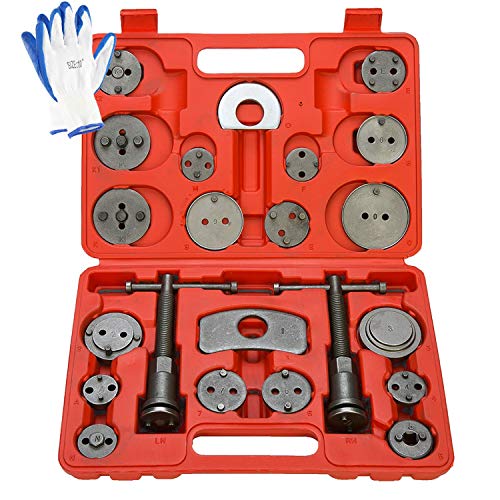
8MILELAKE Disc Brake Caliper Compressor Wind Back Tool, 24-Piece
Specs
- 24 pieces with 18 disc adapters and 2 retainer plates
- Left-handed and right-handed thrust bolt assemblies
- Designed for cars and trucks, including 4-wheel-drive vehicles
- Manufacturer part number DE9630, sold by Freebird Trading
- Pair of work gloves included
- Storage case included
The 8MILELAKE kit follows the same layout as the Orion set: pick the adapter that matches your piston’s pin pattern, choose the thrust bolt that turns the correct way, and wind the piston in while the retainer plate braces against the caliper bridge. It suits owners of several vehicles, or trucks with larger rear calipers, who want full adapter coverage for less than a professional shop kit. As with any universal kit, confirm the adapter chart against your make before the car is apart, and keep the threads lightly oiled so the thrust bolts stay smooth.
Lang Tools 279 Brake Caliper Press (279-5420)

Specs
- Works on twin and quad piston fixed calipers, plus single and twin piston floating calipers
- Centrally located ratchet spreads the plates in parallel
- Ratchet handle swings a full 360 degrees for awkward angles
- Carbon steel with chrome and black oxide finish
- Made in the USA; item weight 1.1 pounds
The Lang 279 solves a problem wind-back kits and C-clamps handle badly: fixed calipers with pistons on both sides. Its central ratchet drives both plates outward evenly, so opposing pistons retract together instead of seesawing. The 360-degree ratchet swing lets you work around suspension parts without repositioning the tool. Be clear about its limit, though — this is a press only. It cannot rotate a screw-in rear piston, and using it on one would be exactly the forcing mistake this guide warns against. For front brakes and multi-piston performance calipers, it is the professional-grade pick.
Lisle 24300 Speedy Brake Pad Spreader

Specs
- Squeeze-handle design with a fast-acting plunger
- Compresses disc brake pistons straight back for pad replacement
- Model 24300, covered by US Patent 6,874,217
- Item weight 1.5 pounds
- Single tool, no adapters or case
For plain push-back pistons, the Lisle 24300 is about speed. You place it against the piston, squeeze the handle, and the plunger drives the piston in with controlled, parallel force — far tidier than walking a C-clamp back and forth inside a mounted caliper. There are no adapters to lose and nothing to assemble. The trade-off is scope: it only presses, so it belongs on front calipers and any rear caliper confirmed to be a push-back design. It will not wind back a parking-brake piston, and no amount of handle pressure makes that safe to try.
Lisle 25750 Dual Piston Brake Caliper Compressor

Specs
- Purpose-built for dual piston calipers on cars and light trucks
- Compresses both pistons simultaneously and evenly
- Squeeze-action plates spread in parallel inside the caliper
- Model 25750, UPC 083045257509
- Steel construction from Lisle, a US brake tool specialist
Twin-piston floating calipers have a quiet trap: press one piston in and the other, sharing the same fluid, pushes back out. The Lisle 25750 exists for exactly that caliper. Its paired plates sit against both piston faces and spread together, so the two pistons retract at the same rate and stay retracted while you fit the new pads. It is a single-purpose tool — it does not wind pistons back and it is not shaped for quad-piston fixed calipers — but for trucks and SUVs running dual-piston front calipers, it removes the most frustrating part of the job.
Usage and Safety Notes
Brakes are safety-critical, so treat the last ten minutes of the job as carefully as the first. After reassembly, pump the brake pedal slowly until it feels firm before moving the car — the first pedal application after a pad change can go nearly to the floor while the pistons seat against the new pads. Then test the brakes at low speed in a safe place before normal driving.
Rear calipers with an integrated parking brake must be wound back with the correct adapter, never pressed. On many modern cars the electronic parking brake also has to be put into service mode with a scan tool or the manufacturer’s procedure before the piston will move at all; forcing an electronic parking brake caliper can break its actuator. Check the procedure for your exact model first.
Support the caliper with a hanger, hook, or bungee the entire time it is unbolted — never let it hang by its brake hose. Clean brake dust by wetting it down or with brake cleaner; do not blow it out with compressed air, because dust from older pads may contain asbestos. Watch the reservoir as pistons retract so displaced fluid does not overflow, remember that brake fluid is hygroscopic and damages paint, and torque caliper bracket and guide pin bolts to the vehicle maker’s specification, not by feel.
FAQ
1. How do I know if my pistons press in or wind back?
Look at the piston face and check a service manual for your model. Pistons with pin holes or notches in the face almost always wind back, and rear calipers with a built-in parking brake mechanism are usually wind-back designs. Front calipers are nearly always simple push-back pistons.
2. Can I just use a C-clamp instead of a caliper tool?
On a single front push-back piston, a C-clamp often works, though it is slower and can cock the piston if it is not centered. On a wind-back rear piston, a clamp is the wrong tool entirely — it cannot rotate the piston, and forcing it can ruin the caliper’s internal parking brake mechanism.
3. What should I do before compressing a piston?
Open the brake fluid reservoir cap and check the level, since retracting pistons pushes fluid back up and a full reservoir will overflow. Support the caliper so it never hangs from its hose, and confirm whether the parking brake needs a service mode procedure before anything moves.
4. Why did the pedal feel soft right after my pad change?
The pistons were still retracted, so the first pedal strokes are spent pushing them back out against the pads. Pump the pedal until it is firm before driving. If it stays spongy after several firm pumps, suspect air in the system or a fluid problem and do not drive the car until it is diagnosed.
5. Does a wind-back kit also work on front calipers?
Yes. With a flat adapter plate, the thrust bolt in a wind-back kit presses a front piston straight in without rotating it. That versatility is why a full kit is often the better buy if you maintain a whole car, not just one axle.
Conclusion
Start by identifying your pistons. If your rear calipers wind back, the Orion Motor Tech or 8MILELAKE 24-piece kits give you both rotation directions and the adapter range to match, plus hangers to protect your brake hoses. If your work is push-back pistons only, the Lang 279 press handles multi-piston fixed calipers with real control, the Lisle 24300 is the fast single-piston option, and the Lisle 25750 is the specialist for dual-piston calipers. Whichever you choose, wind what must be wound, press only what is meant to be pressed, and pump the pedal firm before the car moves.
More from Amazon
Programs that pair well with the guide above. Offers and eligibility are set by Amazon and may change.
Free shipping on eligible items, Prime Video and more. Eligible new members can start with a free trial.
Start a Prime free trialAudiobooks and podcasts to listen to on the go. Eligible new members can start with a free trial.
Try Audible freeAd-free music streaming. Eligible new subscribers can start with a free trial.
Try Music Unlimited freeA free business account with business pricing and bulk-buying tools for work, shop or home office.
Create a business accountAs an Amazon Associate we earn from qualifying purchases.