Key takeaways
- Compare the best component speakers for a clearer front soundstage, with honest notes on tweeter placement, crossovers, sensitivity and factory power.
Disclosure: As an Amazon Associate, I earn from qualifying purchases.

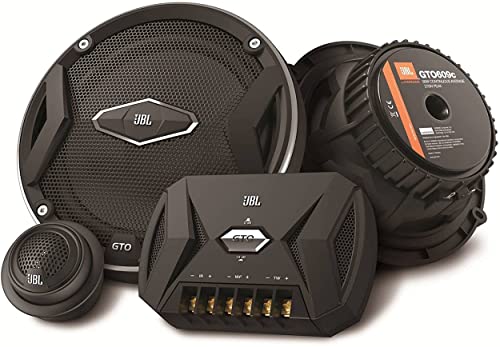
A coaxial speaker puts the tweeter in the middle of the woofer, down in the door, firing at your shins. A component system separates the two: the woofer stays in the door, but the tweeter moves up to the sail panel, A-pillar, or dash corner, and a crossover splits the signal before it reaches either driver. That separation is the entire point. Vocals stop sounding like they come from the footwell, and the image lifts to dashboard height — what a front soundstage actually means.
This site already covers coaxial speakers and 6×9 speakers as their own product classes. Components are different hardware with a different install, rewarding buyers willing to mount tweeters, hide crossovers, and think about power. The five systems below are all 6.5-inch two-way sets, but they differ in sensitivity, impedance, crossover design, and how much amplifier they really want.
How to Choose
Tweeter placement is the real benefit, so plan it first. The component advantage is not a magic woofer. It is the freedom to put the tweeter near ear level and aim it at the listeners. If your plan buries the tweeter in a low factory door spot behind a grille, you have paid for components and kept the coaxial problem. Decide before buying where the tweeters will live: sail panels, dash-corner pods, or A-pillar flush mounts.
Be honest about the install effort. A component install means running tweeter wire, finding a home for two crossover boxes, and often cutting for tweeter mounts. Budget half a day for a first attempt, not the hour a coaxial swap takes.
Sensitivity decides how the set plays on factory power. Sensitivity, quoted in decibels at 2.83 volts, tells you how loud a speaker plays on a head unit’s modest output. A 93 dB set sounds noticeably livelier on stock power than an 88 dB set, and 3-ohm designs draw a little more from factory wiring. Without an amplifier, sensitivity matters more than the peak power number on the box.
Power needs are real, but so is the thin-sound trap. Some sets sound lean and quiet on a factory radio because they are designed around an amplifier’s stronger signal. If a set’s recommended power starts well above head-unit output, plan on a small amplifier from day one; if you will never add one, pick a high-sensitivity set designed for factory power.
Deaden the door before climbing the price ladder. A rattling, hollow door panel colors any woofer mounted in it. Deadening and a sealed mounting surface usually improve midbass more than stepping up one tier in speaker price. Between a premium set in a bare door and a midrange set in a treated door, the treated door wins almost every time.
Match the crossover style to your patience. Outboard boxes offer steeper slopes and sometimes tweeter-level adjustment, but need mounting space and wiring. Inline crossovers in the leads install far faster and hide easily, at the cost of simpler filtering. Neither is automatically better; the question is whether you will use the adjustability.
The Picks
1. Infinity Reference REF-6530cx — Best for Factory Power
Specs
- Woofer: 6.5-inch Plus One polypropylene cone
- Tweeter: edge-driven textile dome, separate mount
- Power handling: 90 watts RMS, 270 watts peak
- Sensitivity: 93 dB at 2.83 volts
- Impedance: 3 ohms
- Frequency response: 53 Hz to 21 kHz
- Crossover: external; Starfish tweeter mounts included
The REF-6530cx is built for the most common component upgrade: keeping the factory radio. Its 93 dB sensitivity and 3-ohm design squeeze more volume from a stock system’s limited power and thin wiring, so the set sounds awake at head-unit wattage. The Plus One cone’s extra surface area helps midbass, and the included Starfish brackets adapt the tweeters to many factory locations without fabrication. Choose it for the soundstage lift without committing to an amplifier.
2. JBL GTO609C — Best All-Round Component Set
Specs
- Woofer: 6.5-inch Plus One carbon-injected cone
- Tweeter: edge-driven Mylar-titanium (My-Ti) dome
- Power handling: 75 watts RMS, 270 watts peak
- Sensitivity: 92 dB at 2.83 volts
- Impedance: 3 ohms
- Frequency response: 53 Hz to 21 kHz
- Crossover: outboard passive network
The GTO609C balances this class’s competing demands well. Sensitivity suits factory power, the 3-ohm impedance is friendly to stock wiring, and the outboard crossover gives a cleaner woofer-to-tweeter handoff than cheaper sets’ inline filters. The My-Ti tweeter leans bright and detailed, cutting through road noise — the one caveat, since reflective cabins can make the top end feel forward. Pick it for a set that works now on the factory radio and keeps headroom for a later amplifier.
3. Alpine S2-S65C — Best Detail and Build Quality
Specs
- Woofer: 6.5-inch polypropylene, glass fiber, and mica cone with HAMR surround
- Tweeter: 1-inch silk dome, separate component mount
- Power handling: 80 watts RMS, 240 watts peak
- Impedance: 4 ohms
- Frequency response: 70 Hz to 40 kHz, Hi-Res Audio certified
- Crossover: external network
The S2-S65C suits listeners who hear tweeter character first. The silk dome is smoother and less fatiguing than metal domes on long drives, and the extended response suits high-resolution sources. The stiff, light cone keeps midrange clean at volume, and the HAMR surround allows generous movement without distortion. The honest trade-off is efficiency: not the loudest set on weak factory power, with shallower rated bass extension than the Infinity or JBL, so it pairs best with an amplifier. Buy it for refinement, not volume per watt.
4. JL Audio C1-650 — Best Easy Install
Specs
- Woofer: 6.5-inch mineral-filled polypropylene cone, rubber surround
- Tweeter: 0.75-inch aluminum edge-driven dome
- Power handling: 50 watts RMS, 225 watts peak; 10 to 75 watts recommended
- Sensitivity: 93 dB at 2.83 volts (90.5 dB at 1 watt)
- Impedance: 4 ohms
- Frequency response: 48 Hz to 24 kHz
- Crossover: inline filters rather than separate boxes; woofer top-mount depth 2-1/16 inches
JL Audio took the opposite approach to crossover design: inline filters on the leads instead of boxes to mount, removing the fiddliest part of a component install. Shallow mounting depth helps in doors with tight window clearance, and a recommended range starting at just 10 watts RMS signals a set happy on factory power. The aluminum tweeter is clear and precise, if less forgiving of harsh recordings than silk. Choose it for a first component install.
5. Focal ASE 165 — Best Soundstage Character

Specs
- Woofer: 6.5-inch (165 mm) polypropylene cone, butyl surround
- Tweeter: inverted dome Mylar tweeter, adjustable positioning
- Power handling: 60 watts RMS, 120 watts peak
- Sensitivity: 91.5 dB at 2.83 volts
- Impedance: 4 ohms
- Frequency response: 60 Hz to 21 kHz
- Crossover: prewired external crossover, 12 dB per octave; woofer mounting depth 2-1/2 inches
Focal’s inverted dome tweeter is the company’s signature, spreading high frequencies widely so the stage stays stable for both front seats rather than beaming at one listener. Adjustable positioning lets you fine-tune aim after mounting, and small A-pillar angle changes are clearly audible. The prewired crossover keeps wiring tidy with a proper 12 dB per octave slope. Power handling is the most modest here, suiting factory-power and small-amplifier builds. Pick it if imaging and a wide, even stage matter more than output.
Install Notes
Start with the doors. Test window clearance against the woofer’s mounting depth before drilling anything, and mount woofers on a firm adapter or ring rather than a flexing factory bracket. Seal gaps around the adapter with foam tape so the woofer’s back wave does not leak forward and cancel bass.
Place crossovers where water cannot reach them. The bottom of a door is a wet zone; boxes belong high in the door, in the kick panel, or under the dash, secured against rattles. Route tweeter wire away from window mechanisms.
Aim tweeters before final mounting. Temporary positioning with removable adhesive and a familiar track teaches more than any diagram: small angle changes shift stage height and the center image noticeably. Set any tweeter-level switch before the panels go back on. With an amplifier, set gains at the head unit’s clean maximum, not by ear at full volume. A component set also reveals the rest of the chain: a noisy source or rattling door becomes more obvious once tweeters sit at ear level.
FAQ
Can I run component speakers on a factory radio with no amplifier?
Yes, if you choose for it. High-sensitivity sets around 92 to 93 dB with 3-ohm designs, like the Infinity and JBL above, are built for exactly that. Lower-sensitivity, amplifier-oriented sets will play, but quietly and with thinner bass.
Where is the best place to mount the tweeters?
Sail panels and A-pillars are the usual answers: near ear level and roughly equidistant from the listener. Dash corners work in some cars. Height and aim matter more than the exact panel.
Do I need to replace the rear speakers too?
Not for a front soundstage. Rear speakers provide fill for rear passengers and contribute little to the driver’s image. Many builds leave the factory rears in place, faded slightly down, and spend the budget on the fronts instead.
Are components always better than coaxials?
No. A component set with tweeters mounted low in the door gives up most of its advantage, and a good coaxial installed well can beat a careless component install. Components win when you use the placement freedom they provide.
How much power do I need if I do add an amplifier?
Match the set’s RMS rating, not its peak number. Most of these systems are fully served by roughly 50 to 90 watts RMS per channel. More power than the rating buys distortion and risk, not quality.
Conclusion
A component system earns its extra install effort in one place: the tweeter’s freedom to live at ear level. For a factory-radio upgrade, the Infinity REF-6530cx and JBL GTO609C make that lift with the least compromise. The Alpine S2-S65C rewards amplifier power with the smoothest top end, the JL Audio C1-650 makes the install as painless as the format allows, and the Focal ASE 165 stages music with real width. Treat the doors and place the tweeters with care; those decisions shape the result more than the badge on the box.
More from Amazon
Programs that pair well with the guide above. Offers and eligibility are set by Amazon and may change.
Free shipping on eligible items, Prime Video and more. Eligible new members can start with a free trial.
Start a Prime free trialAudiobooks and podcasts to listen to on the go. Eligible new members can start with a free trial.
Try Audible freeAd-free music streaming. Eligible new subscribers can start with a free trial.
Try Music Unlimited freeA free business account with business pricing and bulk-buying tools for work, shop or home office.
Create a business accountAs an Amazon Associate we earn from qualifying purchases.