Key takeaways
- Compare the best car battery monitors with Bluetooth alerts, cranking tests and shunt-based tracking. Find the right monitor for your car, truck or RV.
A dead battery rarely gives fair warning. One morning the starter turns slowly, the next it does nothing at all, and the jump pack is in the garage. A car battery monitor watches voltage around the clock and warns you while there is still time to charge, replace, or investigate a drain. It is a different tool from a handheld battery tester, which gives a one-off reading when you ask for it. A monitor stays connected, logs what happens between drives, and turns a phone into a battery dashboard.
As an Amazon Associate, we earn from qualifying purchases.
Quick answer
For most daily drivers, the ANCEL BM200 is the simplest fit: it bolts to the battery posts, checks cranking and charging, and keeps 70 days of voltage history on a phone. Drivers with 6-volt or 24-volt systems should look at the ANCEL BM300 Pro instead. For RV and dual-battery setups, the shunt-based Renogy 500A and Victron SmartShunt IP65 track state of charge far more precisely.
ANCEL BM200 Bluetooth Battery Monitor, 12V
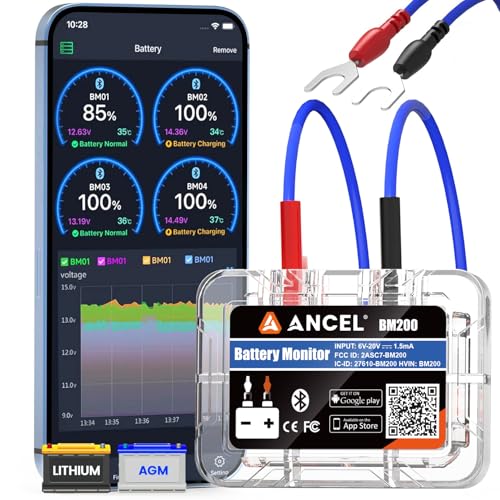
The ANCEL BM200 is a terminal-mounted monitor that bolts directly to the battery posts, so installation needs no wiring loom work and no display on the dash. It connects over Bluetooth 4.2 to a phone app for iOS and Android, where it shows live voltage, temperature, and charge level. The app runs a cranking test and a charging system test, and it can sound an alarm when voltage drops below a set point, which is the early warning that matters most for a daily driver.
The monitor records voltage every two minutes and keeps 70 days of history, so a slow drain over a long weekend shows up as a trend rather than a single number. One app can watch up to four devices at once, which suits a household with more than one vehicle. The listing states compatibility with 12-volt lead-acid batteries and lithium iron phosphate batteries, and a cranking range of 100 to 2000 cold cranking amps. Bluetooth range is stated at 15 to 30 feet, and idle draw is listed at about 1.5 milliamps.
What the BM200 does not do is count current. With no shunt, it infers battery condition from voltage behaviour, which is enough for a starter battery but not for tracking how much charge an auxiliary bank has left.
Quicklynks BM2 Bluetooth Battery Monitor
The Quicklynks BM2 follows the same terminal-mounted idea as the BM200 but in a simpler package aimed squarely at 12-volt lead-acid starter batteries. It connects over Bluetooth 4.0 to a phone app for iPhone and Android, showing live voltage and storing a history of readings so a gradual decline is visible before it becomes a no-start morning. The app includes a cranking test and a charging test, plus a LowVolt alarm that warns when voltage falls to a level that needs attention.
Installation is the strong point: the unit mounts at the battery and needs no separate display, no cable run into the cabin, and no shunt in the negative line. That keeps the job short for anyone who is comfortable with a wrench but not with vehicle wiring.
The trade-offs are the same as any voltage-only monitor. Without a shunt it cannot measure current flow or state of charge in amp-hours, so it cannot tell you how much usable energy remains in a deep-cycle bank. It also covers 12-volt lead-acid systems only, with no stated support for 6-volt or 24-volt setups or for lithium batteries.
ANCEL BM300 Pro Bluetooth Battery Monitor
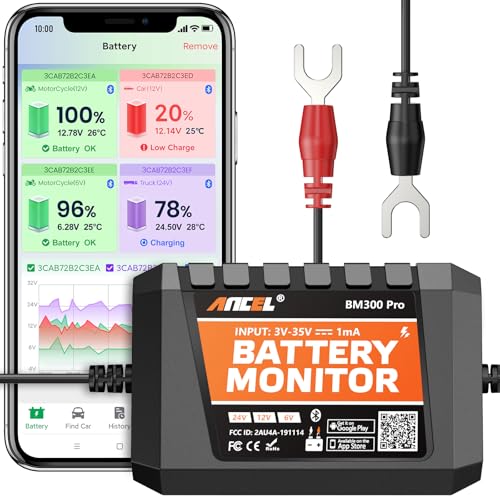
The ANCEL BM300 Pro is the wider-ranging sibling in this roundup, and it serves a different job from the BM200 even though both come from ANCEL. Where the BM200 covers 12-volt systems only, the BM300 Pro covers 6-volt, 12-volt, and 24-volt batteries, which makes it the pick for owners of classic cars, motorcycles, trucks, and boats with mixed voltages. It connects over Bluetooth 5.3, carries an IP67 waterproof rating, and the listing states an operating temperature range of minus 30 to 85 degrees Celsius.
Like the BM200, it runs cranking and charging tests and sends real-time alerts to the phone app when something drifts out of range. It stores 72 days of history and can watch up to four batteries in one app. Idle draw is listed at about 1 milliamp, which is low enough to leave connected through a long storage period without meaningfully draining the battery it watches. The model number is BM300PRO.
The BM300 Pro is still a voltage-based monitor, so it does not count current or report state of charge in amp-hours the way a shunt monitor does. What it adds over the BM200 is voltage range, a newer Bluetooth version, and weather sealing, which matters for a battery mounted outside the cabin or in an engine bay that sees rain and road spray.
Renogy 500A Battery Monitor with Shunt
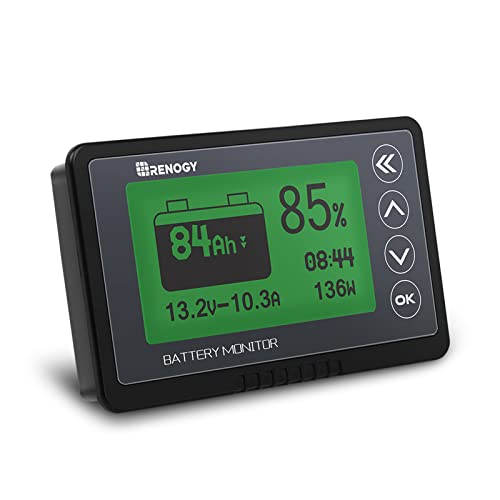
The Renogy 500A is the first shunt-based monitor in this roundup, and the shunt is what sets it apart. A shunt sits in the negative cable and measures actual current flowing in and out, so the monitor can report voltage, current, power, state of charge, and remaining capacity rather than inferring condition from voltage alone. That makes it the right class of device for an RV, a boat, or a dual-battery setup where knowing how much energy is left matters more than a simple good-or-bad reading.
The listing states a voltage range of 10 to 120 volts and a current rating up to 500 amps, with programmable high and low voltage alarms that warn before a bank is over-discharged. A wired display shows readings at the bank, connected by a 20-foot shielded cable, so the numbers are visible without opening a phone app. The listing states compatibility with 12-volt lithium, sealed, gel, and flooded batteries, and the model number is RBM500-G1.
Installation is more involved than a terminal clamp, since the shunt must be wired into the negative line and the display cable routed to a readable spot. That extra work is the price of accurate current counting, and it is worth paying only if you actually need bank-level tracking.
Victron Energy SmartShunt IP65 500A Battery Monitor

The Victron Energy SmartShunt IP65 500A is the most polished shunt monitor in this roundup, and it comes from a maker whose battery equipment is a familiar sight in RV and marine electrical systems. The shunt measures current directly, so the companion VictronConnect phone app can show voltage, current, state of charge, time remaining, and historical data with the accuracy that only current counting provides. The listing states a voltage range of 6.5 to 70 volts and a current rating of 500 amps.
The IP65 rating means the housing resists dust and water jets, which matters for a shunt mounted in an engine bay, a locker, or an exposed battery compartment. The model number is SHU065500BT. There is no built-in display, so readings live entirely in the phone app, which keeps the install clean but means there is nothing to glance at without the phone in hand.
The SmartShunt suits owners who already run Victron equipment or who want the most refined app experience in this class. It costs more than a terminal-mounted voltage monitor, and it asks for a shunt install, but for a house bank, a camper, or a boat, the state-of-charge figures it returns are the ones that actually answer the question of how much power is left.
How to choose
Start with the design. A terminal-mounted monitor tracks voltage and is enough for a starter battery in a daily driver. A shunt monitor counts current and is the right choice for an RV, a boat, or any auxiliary bank where state of charge matters. Next, match the voltage range: 12-volt-only monitors are fine for most cars, but 6-volt and 24-volt systems need a monitor that states support for those voltages, such as the BM300 Pro. Check the Bluetooth version and the history length, since a monitor that keeps two months of readings is far more useful for spotting a slow drain than one that shows only live voltage. Decide whether you want a display or are happy with a phone app. Two of the five picks here come from ANCEL, but they serve different jobs, one for 12-volt cars and one for mixed-voltage fleets.
Who should skip
A battery monitor is not for everyone. If the battery is new, the car is driven daily, and starting has never been a problem, a monitor adds little beyond curiosity. Drivers who only want a one-off health check should use a handheld battery tester instead, which gives a reading on demand without a permanent install. Shunt monitors are also the wrong pick for anyone unwilling to wire a shunt into the negative cable, since the install is the whole point of the device. Owners of vehicles with complex battery management systems should check the vehicle manual first, since some systems need a dealer procedure after a battery is disturbed. And if the goal is simply to keep a stored car charged, a battery maintainer is the better tool, because a monitor watches the battery but does nothing to charge it.
FAQ
Will a battery monitor drain the battery it watches?
A monitor draws a very small current, and the listings here state idle draw of about 1 to 1.5 milliamps. At that rate a healthy car battery loses well under one amp-hour in a month. A monitor is safe to leave connected through storage, but if the battery is already weak or the vehicle sits for many months, a maintainer is still the safer move.
Can one monitor watch more than one battery?
It depends on the design. The two ANCEL monitors in this roundup can each watch up to four batteries through a single app, with one unit fitted to each battery. A shunt monitor watches the single bank its shunt is wired into, so a second bank needs a second shunt. Check the listing for the number of devices the app supports before buying.
Do I need a shunt monitor or a terminal clamp monitor?
Choose a terminal clamp monitor for a starter battery in a car or truck, where the question is whether the vehicle will start. Choose a shunt monitor for an RV, a boat, or a dual-battery setup, where the question is how much energy remains in the bank. Only a shunt measures current flow, so only a shunt can report state of charge in amp-hours.
Will a battery monitor work with a lithium battery?
Some will and some will not, so check the listing rather than assuming. The ANCEL BM200 states support for lithium iron phosphate batteries alongside lead-acid, and the Renogy 500A states compatibility with 12-volt lithium, sealed, gel, and flooded batteries. The Quicklynks BM2 is listed for 12-volt lead-acid systems only. Match the monitor to the battery chemistry in the vehicle.
Final verdict
For most drivers, the ANCEL BM200 is the right starting point: simple to fit, clear on the phone, and honest about what voltage can and cannot tell you. Owners with 6-volt or 24-volt systems, or with several vehicles to watch, should step up to the ANCEL BM300 Pro for its wider range and weather sealing. The Quicklynks BM2 is the plainest option here and suits a single 12-volt car with no complications. For RV and marine banks, the Renogy 500A gives accurate state-of-charge tracking with a readable display, while the Victron SmartShunt IP65 offers the most polished app and the toughest housing.
Product and ASIN Reference
| Product | ASIN |
|---|---|
| ANCEL BM200 Bluetooth Battery Monitor, 12V | B0DTDWZQJQ |
| Quicklynks BM2 Bluetooth Battery Monitor | B01MT4583U |
| ANCEL BM300 Pro Bluetooth Battery Monitor | B0CXP8RRNR |
| Renogy 500A Battery Monitor with Shunt | B07RP5B5P7 |
| Victron Energy SmartShunt IP65 500A Battery Monitor | B0BF636VBX |
More from Amazon
Programs that pair well with the guide above. Offers and eligibility are set by Amazon and may change.
Free shipping on eligible items, Prime Video and more. Eligible new members can start with a free trial.
Start a Prime free trialAudiobooks and podcasts to listen to on the go. Eligible new members can start with a free trial.
Try Audible freeAd-free music streaming. Eligible new subscribers can start with a free trial.
Try Music Unlimited freeA free business account with business pricing and bulk-buying tools for work, shop or home office.
Create a business accountAs an Amazon Associate we earn from qualifying purchases.