Key takeaways
- Compare LED vs halogen reverse light bulbs on brightness, socket fit, CANbus errors and lifespan, with five verified picks for 921, 7440 and 3157 sockets.
Disclosure: As an Amazon Associate, I earn from qualifying purchases.
Factory reverse lights are the weakest lights on most cars. The small halogen bulb behind you was chosen to signal your intent to back up, not to actually light the driveway. That is why the LED vs halogen question matters more here than in any other socket on the car.
This guide covers reverse bulbs in the 921, 7440 and 3157 socket families — small wedge-base bulbs, a different family from the LED headlight and fog light bulbs covered elsewhere on this site, with different fitment and error concerns. Below we compare how LED retrofits and halogen bulbs behave in a reverse housing, then list five real bulbs — three LED, two halogen.
The Core Difference
A halogen reverse bulb makes light by heating a tungsten filament inside a glass envelope. It is simple, cheap and tolerant of voltage swings. Its weaknesses are output and lifespan: a typical 921 halogen is rated at roughly 265 lumens, and the filament degrades a little every time it cycles.
An LED retrofit makes light from diodes on a small circuit board. A good LED is noticeably brighter and whiter, switches on instantly, and draws far less current — often a third or less of the halogen it replaces. Its weaknesses are fit and compatibility. The diode board is bulkier than a glass bulb, so tight housings can be a problem, and because it draws so little current, vehicles with bulb-out monitoring may flag an error or flicker unless the bulb has a built-in decoder or you add load resistors.
One honest warning: lumen figures for LED retrofits are rarely measured the same way across brands — some quote per bulb, some per pair, some quote theoretical chip output rather than what leaves the housing. Halogen ratings follow established standards. Treat any LED figure several times higher than a competitor’s as marketing until proven otherwise.
How to Choose
Confirm the socket first. Reverse bulbs are not interchangeable across families. The 921 is a small T-5 wedge common in sedans and crossovers; the 7440/7443 is a larger T-20 wedge used on many trucks, SUVs and Japanese models; the 3157 is a plastic wedge base, often dual-filament, common on domestic vehicles. Your owner’s manual or the number printed on the old bulb is the authority — online fitment filters are wrong too often to rely on alone.
Decide what you actually want from the swap. If you only need to be noticed backing out of a parking space, a fresh halogen does that well. If you back down a long, unlit driveway or hitch a trailer at night, LED output genuinely helps you see, not just be seen.
Think about CANbus and bulb monitoring. Cars that monitor bulb health by current draw may warn or flicker with LEDs. Bulbs advertised as CANbus-ready carry built-in decoding, which solves most cases but adds heat. If your car does not monitor the reverse circuit — many do not — a plain LED is simpler and runs cooler.
Check the physical space. Eyeball the depth behind your reverse lens. Long LED bulbs with large heat sinks can foul the housing or sit too close to the lens. A bulb that does not fit is useless regardless of its specs.
Pick a color temperature you can live with. Most LED reverse bulbs are 6000K to 6500K, a crisp white that makes obstacles pop in a backup camera image. Halogens sit near 2700K to 3000K, warmer and matching an older car’s other lighting. Neither is wrong; it only matters if the mismatch bothers you.
The Bulbs Compared
AUXITO 912 921 LED Bulb (LED, 921 Socket)

Specs
- Socket: T15 wedge base, fits 912, 921, 906, 904, 902, 922 and W16W applications
- Light source: 15 high-power 2835 SMD chips per bulb
- Color temperature: 6000K white
- Power: 6W per bulb, 12–16V, non-polarity (installs either way)
- Sold as a pack of 2
The straightforward LED answer for cars using a 921 reverse bulb. Its near-stock sizing fits housings that reject bulkier designs, and the non-polarity base removes installation guesswork. At 6W it draws about a third of the halogen’s power — which is why a monitored car may complain. AUXITO rates it error-free for most vehicles; treat that as “usually,” not “always.”
SYLVANIA 921 Long Life Miniature Bulb (Halogen, 921 Socket)

Specs
- Socket: 921, T-5 glass wedge base (W2.1×9.5d)
- Voltage and draw: 12.8V, 1.4A (about 18W)
- Rated output: 265 lumens
- Rated life: 2,000 hours, roughly double the standard 921 rating
- Sold as a pack of 2 (part 921LL.BP2)
The halogen benchmark for this socket. Output is modest on paper, but the light goes exactly where the reflector expects it — no error messages, no flicker, no fitment surprises. The Long Life version is the one to buy. This is the pick for a five-minute, zero-drama replacement.
LASFIT 7443 7440 LED Bulbs (LED, 7440/7443 Socket)

Specs
- Socket: T20 wedge base, fits 7440, 7443, 7444, W21W and WY21W applications
- Color temperature: 6000K white
- Plug-and-play design, no wiring modification required
- Sold as a pack of 2
For the T-20 family, LASFIT’s bulb is the mainstream LED option. The 7443 version is dual-function, covering sockets that handle more than one duty. Brightness is a clear step up from the stock halogen, and the white output improves what a backup camera shows at night. Check housing depth before ordering, since T-20 LED bodies run longer than the glass original.
D-Lumina 7440 7443 LED Backup Bulbs (LED, 7440/7443 Socket)

Specs
- Socket: T20 wedge base, fits 7440, 7441, 7443 and W21W applications
- Light source: 2 high-output CSP chips per bulb
- Maker-rated output: 5,600 lumens per pair, 21W (brand claim, unverified)
- Electronics: built-in CANbus decoding for error-free operation on monitored vehicles
- Color temperature: 6000K white; sold as a pack of 2
The high-output end of the comparison, for trucks and SUVs reversing in dark places. The CSP chips concentrate light where a filament would sit, helping the reflector do its job. Read the headline lumen figure with the skepticism described above — but even discounted heavily, this class of bulb is far brighter than stock. Built-in decoding addresses bulb-out warnings on most monitored vehicles, at the cost of extra heat that matters little in a socket that runs briefly.
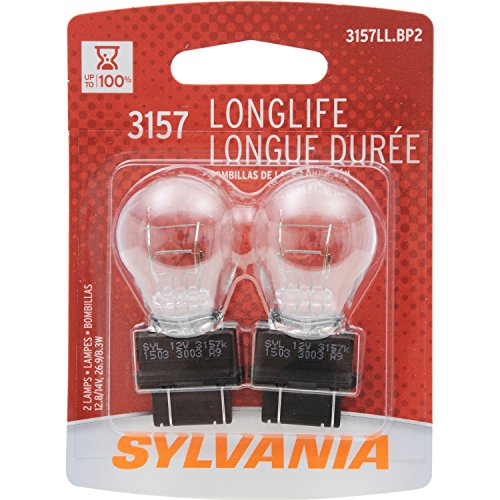
SYLVANIA 3157 Long Life Miniature Bulb (Halogen, 3157 Socket)
Specs
- Socket: 3157, plastic wedge base, dual filament
- Voltage: 12.8V; major filament 2.1A, minor filament 0.59A
- Standard-specification incandescent, direct factory replacement
- Long Life series, extended service rating versus basic bulbs
- Sold as a pack of 2 (part 3157LL.BP2)
The 3157 appears in the reverse position on many domestic trucks and SUVs, and this is its default replacement. On some vehicles one filament serves reverse while the other handles a second duty. An LED swap can be worthwhile, but the halogen’s virtues are real: perfect electrical behavior, correct light distribution, and no surprises with the bulb monitors common on these trucks.
Install Notes
Most reverse bulbs are reached through the trunk behind a trim panel, or by removing the tail lamp housing. The job takes minutes per side. A few practical points:
- Test before you reassemble. Put the car in reverse (engine off, ignition on, parking brake set, wheels chocked) or have a helper confirm both bulbs light.
- A polarized LED inserted backwards will not light; flip it 180 degrees before assuming it is defective. Non-polarity designs like the AUXITO avoid this.
- If an LED triggers a warning or flickers, the fix is built-in decoding or a load resistor wired in parallel. Resistors get hot, so mount them to metal, away from plastic and wiring.
- Handle halogen bulbs by the base, not the glass; skin oils create hot spots that shorten filament life.
- Replace in pairs. The other side is the same age, and matched output makes judging distance easier.
A legal note: some jurisdictions restrict modifications to required vehicle lighting. Reverse lamps are less scrutinized than headlights, but check local rules before fitting unusually powerful auxiliary lighting — and remember a brighter bulb never replaces a camera, mirrors, or looking.
FAQ
Is LED actually brighter than halogen in a reverse light?
Yes, in practice. A standard 921 halogen is rated around 265 lumens, while even mid-range LED retrofits produce several times the usable light. Just do not compare raw lumen claims between LED brands literally — there is no single enforced measuring standard for retrofit bulbs.
Will LED reverse bulbs cause an error message on my dashboard?
They can, on vehicles that monitor the reverse circuit by current draw, because LEDs use far less power than expected. Many cars do not monitor reverse bulbs at all. If yours does, choose a bulb with built-in CANbus decoding or add load resistors.
Do I need resistors for reverse lights specifically?
Only if you see flicker, a warning light, or bulbs staying dimly lit when off. Reverse lights are not turn signals, so hyper-flash is not an issue; the resistor is purely to satisfy bulb monitoring.
Which socket does my car use?
Check the owner’s manual bulb chart or read the number stamped on the bulb you remove. The common reverse sizes are 921, 7440/7443 and 3157, and none fit each other’s sockets.
How long do LED reverse bulbs last compared to halogen?
LED chips are rated for tens of thousands of hours versus roughly 1,000 to 2,000 for a halogen, though the small driver electronics are the real-world weak point. In a socket running seconds per trip, either will likely outlast your ownership.
Conclusion
The honest answer is split. If your reverse lights work and you want reliability, fresh Long Life halogens — the SYLVANIA 921 or 3157 — restore factory performance with zero risk. If you regularly back up in real darkness, an LED retrofit in the correct socket, from the AUXITO 921 to the high-output D-Lumina 7440, is a noticeably effective small upgrade, provided you confirm fitment in the manual first and accept the possibility of a bulb-monitor warning. Either way, brighter bulbs remain an aid, not a substitute for mirrors, a camera, and a look over your shoulder.
More from Amazon
Programs that pair well with the guide above. Offers and eligibility are set by Amazon and may change.
Free shipping on eligible items, Prime Video and more. Eligible new members can start with a free trial.
Start a Prime free trialAudiobooks and podcasts to listen to on the go. Eligible new members can start with a free trial.
Try Audible freeAd-free music streaming. Eligible new subscribers can start with a free trial.
Try Music Unlimited freeA free business account with business pricing and bulk-buying tools for work, shop or home office.
Create a business accountAs an Amazon Associate we earn from qualifying purchases.