Key takeaways
- Compare the best car air quality monitors for PM2.5, CO2 and VOC readings, with honest notes on sensor accuracy, battery life and what the numbers can fix.
Disclosure: As an Amazon Associate, I earn from qualifying purchases.


A car cabin is a small, sealed box, and its air changes faster than most drivers expect. Carbon dioxide from the passengers themselves can climb high enough on a long, recirculated-air drive to leave everyone drowsy. Traffic fumes push particle counts up in tunnels and queues, and a new car’s plastics give off volatile organic compounds (VOCs) for months. A portable monitor will not fix any of that — it cleans nothing — but it tells you when to crack a window, switch to fresh air, or replace the cabin filter.
The five monitors below are compact, battery-capable units that work as well on a dashboard as on a desk. They cover the three readings that matter most in a cabin — PM2.5, CO2, and VOCs — plus temperature and humidity. Treat every number as an estimate from a consumer sensor, not a laboratory measurement: the trends are what you act on.
How to Choose
Decide which reading you actually need. PM2.5 is the traffic and wildfire-smoke number: it spikes behind a diesel truck or in haze. CO2 is the stuffiness number: it comes from the people in the car and tells you when recirculation has gone on too long. VOC is the chemical smell number: it rises with new-car off-gassing and air fresheners. No cheap sensor does all three equally well, so pick the monitor whose strength matches your main concern.
Understand what kind of sensor is inside. Particle counts come from a small laser scattering sensor, reasonably consistent from unit to unit. Real CO2 comes from an NDIR (non-dispersive infrared) sensor; some budget devices instead estimate “equivalent CO2” from a VOC sensor, and that estimate drifts and misleads. VOC readings on every consumer monitor are a relative index — useful for “better or worse than before,” meaningless as an exact chemical concentration. Formaldehyde sensors in this class are electrochemical and can react to alcohol vapors, so read them as a rough guide.
Battery life decides whether it lives in the car. Particle sensors use a tiny fan and drain batteries quickly, so PM monitors run only a few hours per charge and are best plugged into USB while driving. CO2-only units with e-ink screens sip power and can run for months or years. Decide whether you want a plug-in fixture or a grab-and-check tool before you buy.
A monitor is not a safety alarm. None of these devices is a carbon monoxide alarm, and none should ever substitute for one. They do not certify air as safe or unsafe. What they do well is show change: before and after a filter swap, windows up versus down.
The 5 Best Car Air Quality Monitors
1. Temtop M10 Air Quality Monitor — Best for Particles and Formaldehyde Checks
Specs
- Measures: PM2.5, TVOC, formaldehyde (HCHO), and a calculated AQI
- PM2.5 range: 0–999 µg/m3, laser particle sensor
- HCHO range: 0–2 mg/m3, Dart electrochemical sensor
- TVOC range: 0–5 mg/m3
- Battery: 2,200 mAh rechargeable, roughly 6 hours per charge
- Size and weight: about 3.2 × 3.2 × 1.2 in, 7 oz
- No CO2 measurement and no app connection
The M10 is the classic spot-checker: a small cube with a bright screen and three indicator lights that show green, yellow, or red before you read a single digit. In a car it is useful after a cabin filter change, on smoky days, or when a musty smell makes you suspect a spill. Hold its formaldehyde reading loosely, because electrochemical HCHO sensors also respond to alcohol-based cleaners. The short battery life means it works best plugged into the car’s USB port, and it has no CO2 sensor, so it cannot warn you about stuffy air on a long drive.
2. Temtop M10+ 6-in-1 CO2 Meter — Best All-Rounder for Cabin Use
Specs
- Measures: CO2, PM2.5, TVOC, temperature, humidity, and AQI (6-in-1)
- CO2 range: 400–5,000 ppm, stated accuracy of ±40 ppm plus 5% of the reading
- Display: e-ink screen, readable in bright cabin light
- Connectivity: Bluetooth with the Temtop app for history and data export
- Battery: rechargeable, rated up to 60 days per charge
- Model number: US-M10+
The M10+ fixes the original M10’s biggest gap by adding a real CO2 reading, the single most actionable number in a car: when it climbs in a full, recirculating cabin, you know fresh air will help everyone feel more alert. The e-ink display is the other car-friendly feature — readable in sunlight, no glare at night, and a big part of why the battery lasts weeks instead of hours. It drops the older model’s formaldehyde sensor. For most drivers who want one device covering stuffiness and smoke, this is the balanced pick.
3. AQItech 16-in-1 Portable Air Quality Monitor — Best for Alarms and Big Screens
Specs
- Measures: PM1.0, PM2.5, PM10, CO2, TVOC, HCHO, temperature, humidity
- Alarms: 7 configurable AQI alert buzzers, silenced with a double press
- Display: large HD color screen, readings refreshed every 3 seconds
- Battery: rechargeable lithium, about 4–5 hours per charge, USB-C charging
This generic-but-capable handheld is the kitchen-sink option: it reports the widest spread of numbers, including PM1.0 and PM10 alongside PM2.5, and it can beep when air quality crosses thresholds you set — handy if you want an audible cue in traffic. The trade-offs are familiar for this class: the battery lasts only a few hours because of the big color display and particle fan, so it is effectively a plug-in device in the car, and the “16-in-1” count includes derived values like AQI rather than 16 separate sensors. Read the CO2, PM2.5, and humidity; treat the rest as context.
4. SAF Aranet4 HOME — Best CO2 Accuracy and Battery Life
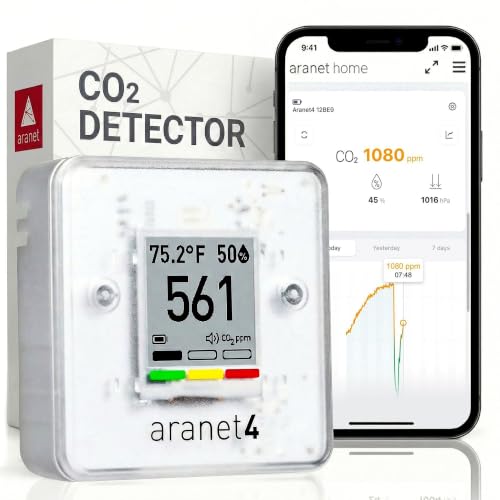
Specs
- Measures: CO2, temperature, relative humidity, and atmospheric pressure
- CO2 sensor: NDIR, range 0–9,999 ppm, accuracy ±(30 ppm + 3% of reading) from 0–5,000 ppm
- Display: e-ink screen with color indication for CO2 level
- Battery: 2 AA batteries, up to several years depending on settings
- Connectivity: Bluetooth with the Aranet Home app for history
- Model number: TDSPC003.001
- No particle or VOC measurement
If your one question is “is the air in here getting stale,” the Aranet4 answers it better than anything else on this list. Its NDIR CO2 sensor is factory calibrated, the e-ink screen is glanceable, and a set of AA batteries can last years, so it can live in a door pocket without a cable. It is also the narrowest device here: no PM2.5 for smoke days, no VOC index for chemical smells — the money buys precision on one gas rather than breadth. Commuters and rideshare drivers who run recirculation for hours will get the most from watching that one number climb.
5. Qingping Air Monitor Lite — Best with Smart Features and Fast Response

Specs
- Measures: CO2, PM2.5, PM10, temperature, and humidity (5 factors)
- CO2 range: 400–9,999 ppm; PM2.5/PM10 range: 0–500 µg/m3
- Display: OLED, all readings refreshed every second
- Battery: 2,000 mAh rechargeable, up to about 7 hours, USB-C charging
- Connectivity: 2.4 GHz Wi-Fi, Apple HomeKit compatible, Qingping+ app
- Size and weight: about 2.5 × 2.2 × 1.8 in, 142 g
- Model number: CGDN1
The Qingping Lite reacts fast — readings update every second, so you can watch particle counts fall in real time after closing the windows and switching to recirculation with a fresh filter, making it the most satisfying monitor here for testing whether your ventilation settings actually work. It also performed unusually well for its class in independent field comparisons of its PM2.5 sensor. The compromises: Qingping does not publish its CO2 sensor type or accuracy, so treat that number as a trend, and the battery lasts a few hours, so plan on USB power in the car.
Usage and Safety Notes
Place the monitor where air circulates — a console, dash corner, or seat pocket — not in a closed glovebox, and keep it out of hours of direct sun, which overheats the sensors and battery. Give it a few minutes after startup before trusting the numbers, and watch the direction, not individual spikes.
Most importantly, know what to do with a bad reading. The fixes are mechanical, not electronic: open windows or switch to fresh-air mode for high CO2, replace a clogged cabin air filter for persistent particles, and remove the source — a leaking fuel container, a strong air freshener, wet mats — for VOC spikes. And repeat the warning: these monitors do not detect carbon monoxide reliably and are not safety alarms. Worried about exhaust leaks or CO? That is a job for a certified CO alarm and a mechanic.
FAQ
Can an air quality monitor clean the air in my car?
No. A monitor only measures and displays. Cleaning is done by your cabin air filter, ventilation settings, and removing whatever is polluting the air. The monitor’s value is showing whether those fixes worked.
Why does the CO2 reading climb so fast with passengers?
People exhale CO2 constantly, and a car cabin is a very small volume. With recirculation on and several passengers aboard, CO2 can rise well past outdoor levels within half an hour. A few minutes of fresh-air mode brings it back down.
Are the VOC numbers exact?
No. Consumer VOC sensors report a relative index of total volatile compounds, not an exact concentration of a specific chemical. Use them to compare situations, not as precise measurements.
Do I need a monitor if my car already has an air quality sensor?
Some cars have a basic sensor that only switches ventilation to recirculation automatically. A standalone monitor shows the actual numbers, works in any car, and can also be used at home.
Will leaving a monitor plugged in drain my car battery?
These units draw little power, but a USB port that stays live with the ignition off will slowly drain the 12V battery over many days. Unplug it when the car will sit unused.
Conclusion
For most drivers, the Temtop M10+ is the sweet spot: real CO2, PM2.5, and VOC readings on a sunlight-readable e-ink screen with a battery measured in weeks. Choose the Aranet4 if CO2 accuracy and battery life matter more than breadth, the Qingping Lite for fast particle readings, the original Temtop M10 for formaldehyde spot checks, and the AQItech for audible alarms and a big color screen. Whichever you pick, the monitor is the messenger — fresh air, a clean cabin filter, and removing the source are what actually improve the air.
More from Amazon
Programs that pair well with the guide above. Offers and eligibility are set by Amazon and may change.
Free shipping on eligible items, Prime Video and more. Eligible new members can start with a free trial.
Start a Prime free trialAudiobooks and podcasts to listen to on the go. Eligible new members can start with a free trial.
Try Audible freeAd-free music streaming. Eligible new subscribers can start with a free trial.
Try Music Unlimited freeA free business account with business pricing and bulk-buying tools for work, shop or home office.
Create a business accountAs an Amazon Associate we earn from qualifying purchases.