Key takeaways
- Compare the best car battery heaters and warmers, from 80W thermal wraps to silicone pads, and learn how to size, fit, and safely plug one in.
Disclosure: As an Amazon Associate, I earn from qualifying purchases.
A lead-acid battery loses much of its cranking power as temperatures fall, while a cold engine needs more power than usual to turn over. That double squeeze is why a car that started fine in October can barely crank in January. A battery heater closes the gap from the battery side: a low-wattage electric wrap or pad that plugs into a household outlet and keeps the battery case, and the electrolyte inside, closer to room temperature overnight.
Be clear about what a warmer can and cannot do. It restores cranking power the cold temporarily took from a healthy battery. It does not revive a worn-out, sulfated, or damaged battery: if yours fails a load test in mild weather, replacement is the fix, and the warmer belongs on the new battery. For a sound battery in a cold climate, the five heaters below cover the main designs: full wraps, shorter wraps for small batteries, and a flat silicone pad.
How to Choose
Start with fit, because a heater only works when it sits snugly against the case. Measure your battery’s perimeter, around all four sides at mid-height, and compare it with the wrap length. A 36-inch wrap suits most full-size car and truck batteries, including Group 24, 27, and 31 sizes; a 28-inch wrap fits smaller batteries in compact cars, UTVs, and lawn tractors. One too long overlaps itself and creates a hot spot; one too short leaves a cold gap and can slip loose. Under-battery pads avoid the perimeter question, but the pad must be smaller than the battery’s footprint.
Next, match wattage to climate. Most warmers draw 50 to 80 watts, deliberately: the goal is gentle, even warmth held for hours, not a fast blast of heat. An 80-watt wrap is the safer pick for sustained subzero nights; 50 or 60 watts is enough for the teens and twenties. More wattage is not automatically better, because excess heat ages a battery too.
Then decide on a thermostat. Most blankets have none: they heat whenever plugged in, so you manage the schedule with an outdoor timer or by plugging in only on cold nights. Some silicone pads include a thermostat that switches off once the battery is warm, suiting a vehicle left plugged in for days. Either way, plan the cord run first: it must reach an outlet without crossing belts, fans, or the hood hinge line, and never be pinched by the hood. Finally, a vinyl cover resists under-hood oil and acid mist, and a thermal lining holds heat in rather than warming the engine bay.
The Best Car Battery Heaters and Warmers
Kat’s 22200 80 Watt 36-Inch Battery Thermal Wrap

Specs
- Type: Wrap-around thermal blanket
- Power: 80 watts
- Voltage: 120V AC plug-in
- Length: 36 inches; fits batteries up to a 36-inch perimeter
- Thermostat: None; use a timer or plug in as needed
- Cover: Vinyl, resistant to oil and battery acid
The 22200 is the classic full-size wrap and the default pick for trucks and larger cars. Its 36-inch band covers Group 24, 27, and similar batteries, and the 80-watt element spreads low, even heat around all four sides instead of concentrating it in one spot. The vinyl jacket shrugs off engine-bay grime and wipes clean. Installation: wrap snugly, secure with ties, route the cord forward. With no thermostat, treat it like a block heater: plug in a few hours before you need the vehicle, or use a timer on cold nights.
Zerostart 2800063 Electric Battery Blanket, 36-Inch

Specs
- Type: Wrap-around insulated blanket
- Power: 80 watts
- Voltage: 120V AC plug-in
- Size: 36 x 5 inches, about 0.5 inch thick
- Insulation: Thinsulate thermal lining
- Fits: Battery groups 24, 27, 31, 34, and 35
- Certification: CSA approved; 30-inch ground cord
The Zerostart pairs its 80-watt element with a Thinsulate lining, so more heat stays against the case instead of leaking into the engine bay. It is rated to hold the battery core well above ambient on subzero nights, the margin that turns a labored crank into a normal start. At half an inch thick it fits between battery and hold-down without forcing the tray. The short 30-inch cord is the one compromise: most owners need a heavy-duty outdoor extension cord. Like the Kat’s wrap, it has no thermostat, so plug-in time is yours to manage.
Kat’s 22100 60 Watt 28-Inch Battery Thermal Wrap
Specs
- Type: Wrap-around thermal blanket
- Power: 60 watts
- Voltage: 120V AC plug-in
- Length: 28 inches, for smaller batteries
- Thermostat: None; use a timer or plug in as needed
- Cover: Vinyl, resistant to oil and battery acid
The 22100 is the smaller sibling of the 22200, built for batteries a 36-inch wrap would swallow. Its 28-inch band and 60-watt output suit compact cars and the smaller batteries in UTVs, garden tractors, and standby equipment. The shorter wrap matters: a full-size blanket bunched or overlapped on a small battery heats unevenly and can damage its own cover. Construction mirrors the bigger model, same vinyl jacket and tie-on fitting. If your battery measures well under a 36-inch perimeter, this wrap sits snug against the case, and snug contact is what makes any heater work.
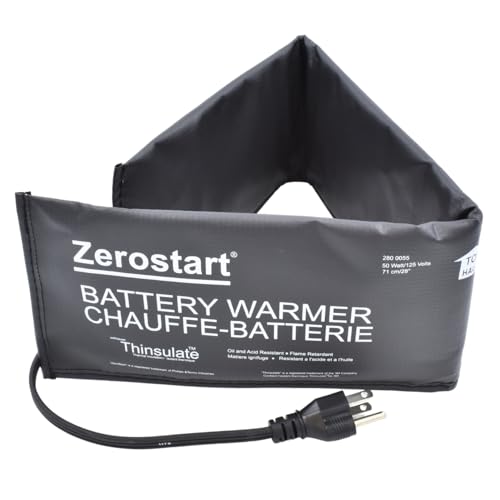
Zerostart 2800055 Electric Battery Blanket, 28-Inch
Specs
- Type: Wrap-around insulated blanket
- Power: 50 watts
- Voltage: 120V AC plug-in
- Size: 28 x 5 inches
- Insulation: Thinsulate thermal lining
- Certification: CSA approved; 30-inch ground cord
This is the small-battery Zerostart, same Thinsulate lining and slim profile in a 28-inch, 50-watt package. It fits compact cars and small equipment where tray space is tight, and the lower wattage matches a smaller battery’s thermal mass. Fifty watts will not overwhelm a mild climate either, suiting winters of teens and twenties rather than deep subzero. As with the larger Zerostart, plan on an extension cord, keep it clear of moving parts, and unplug once temperatures moderate: there is no thermostat to cycle it off.
Kat’s 22400 60 Watt Battery Pad Heater, 5.5 x 8.5 Inches

Specs
- Type: Silicone heating pad, sits under the battery
- Power: 60 watts
- Voltage: 120V AC plug-in
- Pad size: 5.5 x 8.5 inches
- Thermostat: None; manage plug-in time yourself
- Fit: Must be smaller than the battery footprint
The 22400 takes the opposite approach: the flat silicone pad sits in the tray underneath the battery and warms the case from below, solving the fit problem in cramped bays with no room for a blanket around the sides. The trade-off is coverage: heat enters through the bottom only, so it works best in moderate cold or paired with an insulation-only blanket over the top. Note insulation’s honest limit: an unheated blanket slows heat loss but adds no heat, so on the coldest nights a powered pad or wrap does the real work. The pad must sit flat, fully under the battery, its cord routed where the battery’s weight cannot pinch it.
Usage and Buying Notes
Inspect the heater before every season: look for cracks, melted spots, frayed insulation, or a brittle cover, and check the cord and plug end to end. A damaged electric blanket against a battery, amid acid residue and fuel vapor, is a fire risk. Retire a damaged unit rather than taping it.
Plug into a GFCI-protected outlet, ideally the same circuit as a block heater. If you need an extension cord, use only a heavy-duty outdoor one, and keep the connection out of standing water and snow. Route cords away from belts, fans, and sharp brackets, secure them so they cannot migrate, and never close the hood on one: a pinched cord is damaged insulation waiting to short.
Set realistic expectations. A warmer helps a healthy battery deliver near-normal cranking power in deep cold, and warm electrolyte accepts a charge better from the alternator. It will not fix slow cranking from corroded terminals, a failing starter, or thick oil, nor rescue a worn-out battery.
When spring comes, unplug the heater and leave it off: running a non-thermostat wrap in warm weather cooks the battery and shortens its life.
FAQ
How long should a battery heater stay plugged in?
For a wrap or pad without a thermostat, a few hours before starting usually warms the battery through; many owners use an outdoor timer set for the early morning. In extreme cold, leaving it plugged in overnight is common. Unplug once temperatures stay above freezing: continuous heat in mild weather ages the battery.
Will a battery warmer save a weak battery?
No. A warmer restores power the cold temporarily removes from a healthy battery. A sulfated, internally shorted, or worn-out battery will still fail, warm or not. If slow cranking happens in mild weather too, have the battery load tested and replace it if it fails; then fit the heater to the new battery.
Can I drive with a battery blanket installed?
Yes, the wrap or pad stays on the battery; only the cord is for stationary use. Before driving, unplug and secure the loose end so it cannot fall into the belt path or onto a hot exhaust part. Never drive with the heater connected to an extension cord, and never close the hood on the cord.
What size battery heater do I need?
Measure your battery’s perimeter at mid-height. A 36-inch wrap fits most full-size car and truck batteries, including many Group 24, 27, and 31 batteries. A 28-inch wrap fits smaller car, UTV, and lawn tractor batteries. An under-battery pad just needs to be smaller than the battery’s footprint and sit flat in the tray.
Is a battery heater the same as an engine block heater?
No. A block heater warms the engine’s coolant or oil so the engine turns over more easily. A battery heater warms the battery so it can deliver full cranking power. They solve different halves of the cold-start problem, and in very cold regions many owners use both on one timer circuit.
Conclusion
For most cars and trucks, a full-size 80-watt wrap such as the Kat’s 22200 or the insulated Zerostart 2800063 is the dependable choice, the Zerostart’s lining earning its keep on the coldest nights. Smaller batteries are better served by the 28-inch Kat’s 22100 or Zerostart 2800055, and the Kat’s 22400 pad covers tight bays where no wrap fits. Whichever you pick, measure first, route the cord with care, inspect it every season, and remember: a warmer supports a healthy battery rather than substituting for one.
More from Amazon
Programs that pair well with the guide above. Offers and eligibility are set by Amazon and may change.
Free shipping on eligible items, Prime Video and more. Eligible new members can start with a free trial.
Start a Prime free trialAudiobooks and podcasts to listen to on the go. Eligible new members can start with a free trial.
Try Audible freeAd-free music streaming. Eligible new subscribers can start with a free trial.
Try Music Unlimited freeA free business account with business pricing and bulk-buying tools for work, shop or home office.
Create a business accountAs an Amazon Associate we earn from qualifying purchases.