Key takeaways
- Compare the best radiator pressure tester kits for finding coolant leaks at home, with adapter coverage, gauge ranges, cap testing and safety tips.
Disclosure: As an Amazon Associate, I earn from qualifying purchases.
A cooling system can lose coolant for weeks before the cause shows itself. The level drops a little at a time, a faint sweet smell hangs around the engine bay, and the leak never drips where you can see it while the engine runs. A radiator pressure tester kit solves that by pressurizing the system with a hand pump while the engine sits cold and off. At normal operating pressure, weak hose connections, tired radiator seams, a weeping water pump and a cap that no longer holds its rating reveal themselves as drips or a slowly falling gauge needle.
Every kit here pairs a pump and gauge with adapters that seal against the radiator filler neck or expansion tank, and most can test the cap itself. One rule applies before anything else: pressure testing is a cold-engine job, full stop.
How to Choose a Radiator Pressure Tester Kit
Adapter coverage matters more than anything else. Older cars use bayonet-style radiator caps in two common sizes, while many modern vehicles have no radiator cap at all and are tested through a threaded or bayonet expansion tank neck. European makes lean heavily on threaded tank adapters. A wide spread of color-coded caps and threaded adapters will fit the next car you own, not just the current one.
Match the gauge range to real system pressures. Most passenger car caps are rated in the 13 to 18 psi neighborhood, and testers typically read 0 to 30 or 0 to 35 psi. What matters is a legible gauge face and a pump that builds pressure smoothly, because you will stop at the rating printed on your cap and never above it.
Cap testing is worth having. A weak cap is one of the cheapest causes of coolant loss and overheating, yet a system test cannot catch it, because the cap is removed to fit the tester. Cap test adapters let you confirm the cap opens at its stamped rating.
Vacuum refill tools are a bonus, not the core job. Many larger kits add a vacuum purge and refill tool that uses shop air to draw coolant in without air pockets. Useful after a repair, but it needs a compressor and does not replace the hand pump.
Build and storage count. Look for clean molding, sound seals and a blow-molded case that keeps two dozen small pieces organized.
The 5 Best Radiator Pressure Tester Kits
Mityvac MV4560 Cooling System Pressure Test Kit

Specs:
– Selectline hand pressure pump with 2-inch (50 mm) diameter gauge
– Four cooling system adapters: small bayonet deep, small bayonet shallow, large bayonet, and GM/Ford
– Two dual-function cap test adapters for US and Asian caps
– Fits most US and Asian cars and light trucks, plus many European vehicles
The MV4560 is the compact, focused option. Instead of burying you in adapters, Mityvac includes the four system adapters covering the vast majority of US and Asian filler necks, shaped to seat the way the original cap does. The pump is the same Selectline design used across the Mityvac line, and service parts are available separately. If your vehicles are mainstream domestic or Japanese models and you do not need threaded European tank adapters, this is the tidy kit to own.
MotoRad 12270 Cooling System Pressure Tester

Specs:
– Tests cooling systems and pressure caps up to 30 psi
– Gauge includes marked cap-testing ranges, including 17 to 19 lb and 20 lb bands
– Adapter for standard A-size caps plus a spacer for deep filler necks
– Pressure release bar for controlled venting after a test
This is the classic American shop tester, sold for years as the Stant 12270 and now carrying the MotoRad brand. Where universal kits chase coverage with a box of caps, the 12270 takes the opposite approach: one well-made tester body, an adapter for the standard A-size cap fitting found on generations of domestic and import radiators, and a spacer for deep filler necks. The gauge face is printed with common cap pressure ranges, making cap tests quick to read. It will not fit every threaded expansion tank on a late-model European car, but for standard necks it is the durable, no-drama tool found in professional toolboxes for decades.
Astro Tools 78585 Universal Radiator Pressure Tester and Vacuum Type Cooling System Kit
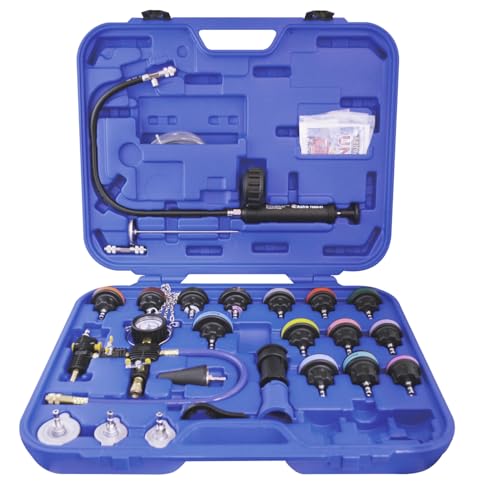
Specs:
– Gauge reads 0 to 35 psi for higher-pressure systems
– Includes a temperature gauge for checking thermostat behavior during our research
– Steel and nylon radiator caps plus R123/R124 and R123/R125 cap test connectors
– Vacuum purge and refill tool and universal rubber radiator adapter included
The 78585 is the master-kit route: a hand pump and gauge, a stack of numbered steel and nylon caps for domestic, Asian and European filler necks, cap test connectors, and a vacuum tool for air-free refills. The thermometer helps separate a leak from a thermostat problem, and the universal rubber adapter covers odd filler necks no hard cap matches. It is more kit than a single-car household needs, but if you work on a rotating cast of vehicles, the right adapter is almost always in the case.
FOUR UNCLES Radiator Pressure Tester and Vacuum Refill Kit, 28-Piece

Specs:
– 28-piece universal kit, model FU-T001-BLK
– Dual-scale gauge reads 0 to 35 psi for pressure testing
– Color-coded test caps covering a wide range of radiator and expansion tank necks
– Vacuum refill tool included for air-free coolant refilling
FOUR UNCLES packages the master-kit formula at the budget end of the category: a hand pump with a clear dual-scale gauge, color-coded caps, cap test adapters, and a vacuum refiller in one case. The color coding speeds things up when matching an unfamiliar filler neck by eye. As with most value kits, the adapters are molded nylon rather than machined metal, so treat the threads with care. For a home garage that sees several makes, it delivers the broadest function checklist here.
OEMTOOLS 27069 Cooling System Pressure Test Pump

Specs:
– Test range of 4 to 30 psi, suited to most domestic and import vehicles
– Heavy-duty steel pump construction
– Lever-style pressure relief valve for controlled venting
– Blow-mold case with extra room for adapters; pump only, adapters sold separately
The 27069 is the odd one out, and it earns its place for a specific buyer: someone who already owns a drawer of Stant-style adapters, or who only tests one or two vehicles and wants a serious pump to pair with the single adapter those cars need. The steel pump body and lever-style relief valve feel a step up from all-plastic budget pumps, and the 4 to 30 psi range covers any passenger car system. Go in with clear expectations: the case has room for adapters precisely because none are in the box. Price in the adapter you need, and this is a strong buy for a one-make household.
Using a Pressure Tester Safely
Start with a stone-cold engine. Park the car for several hours or overnight. Never remove a radiator cap, and never attach a tester, on a warm engine: a hot system holds scalding coolant under pressure, and cracking the cap open can spray it violently.
Pressurize to the cap rating, and not one psi past it. The number stamped on your vehicle’s own cap is the ceiling. Pump slowly up to that figure and stop. Over-pressurizing can split an old plastic radiator tank or burst a weak heater core, creating the very repair you were trying to avoid.
Watch the gauge, then look and listen. A healthy system holds its pressure steady. A falling needle with drips points straight at the leak: check hose ends, radiator seams and end tanks, the water pump weep hole and the thermostat housing.
Respect the coolant itself. Most antifreeze is ethylene glycol, which is toxic and tastes sweet, making spills a real danger to pets and children. Wipe up every drip, keep containers sealed and out of reach, and take used coolant to a recycling or hazardous waste point rather than a drain or the ground.
Know what a pass does and does not mean. A system that holds pressure cold has no significant external leak at that moment, but it does not prove the head gasket is sound: some gasket failures only open up at full operating temperature, and combustion gas in the coolant needs a different test, such as a chemical block tester.
FAQ
What pressure should I set when testing my cooling system?
Pump up to the rating printed on your own radiator or expansion tank cap, commonly 13 to 18 psi, and never exceed it. If the cap marking is gone, look up the specification for your exact vehicle rather than guessing.
Can I test through the expansion tank instead of a radiator cap?
Yes. Many modern cars have no radiator cap at all, and kits include threaded or bayonet adapters that seal on the expansion tank neck in place of its cap. The test works the same way, since the tank is part of the pressurized system.
The gauge drops but I cannot see any leak. What is going on?
Coolant may be leaking internally, for example past a head gasket into a cylinder or the oil, or the leak may be at the tester adapter itself. Re-seat the adapter and test the cap separately first. If pressure still falls with no drips, check the oil for a milky appearance.
How long should a healthy system hold pressure?
A sound system holds the needle steady. Watch it for several minutes; a slow, continuous fall means a leak somewhere, even a small one. Slight initial settling can come from seepage at the adapter seal, so re-seat the adapter first.
Is a pressure tester the same thing as a vacuum refill kit?
No. A pressure tester pushes air in to expose leaks. A vacuum refill tool pulls the system into vacuum, checks that it holds, then draws fresh coolant in without trapped air. Larger kits bundle both, but they do different jobs.
Conclusion
The right kit is the one whose adapters match the filler necks in your driveway. The Mityvac MV4560 covers mainstream US and Asian cars in a compact tray, the MotoRad 12270 remains the durable classic for standard necks, and the Astro 78585 and FOUR UNCLES kits trade up to near-universal coverage with vacuum refill tools. The OEMTOOLS 27069 suits anyone who already owns adapters and wants a better pump. Whichever you choose, test cold, stop at the cap rating, and let the gauge turn a coolant mystery into a visible drip.
More from Amazon
Programs that pair well with the guide above. Offers and eligibility are set by Amazon and may change.
Free shipping on eligible items, Prime Video and more. Eligible new members can start with a free trial.
Start a Prime free trialAudiobooks and podcasts to listen to on the go. Eligible new members can start with a free trial.
Try Audible freeAd-free music streaming. Eligible new subscribers can start with a free trial.
Try Music Unlimited freeA free business account with business pricing and bulk-buying tools for work, shop or home office.
Create a business accountAs an Amazon Associate we earn from qualifying purchases.