Key takeaways
- Compare the best valve spring compressors for on-head seal swaps and bench rebuilds, with jaw sizes, adapter ranges and the safety steps that matter most.
Disclosure: As an Amazon Associate, I earn from qualifying purchases.
A valve spring compressor squeezes a valve spring down far enough that the two small keepers (collets) can be lifted off the valve stem, freeing the retainer and spring. The spring fights you the whole time: a stock spring holds well over 100 pounds of seat pressure, performance springs far more, and that energy sits inches from your face. The right tool depends mostly on where the cylinder head is while you work: still on the engine calls for an on-head tool; on a workbench, a C-clamp style compressor gives more control and leverage.
How to Choose
Decide on-head or bench first. On-head work means changing valve stem seals or swapping springs without pulling the head. That saves hours, but something must hold each valve up while its keepers are off. Bench work means the head is already off for a rebuild or valve job, where a C-clamp compressor is usually the better choice.
Check jaw opening and throat depth. The jaw opening must span your spring and retainer, and the throat must reach springs sitting in a pocket on overhead cam heads. Lever tools in this class commonly offer a jaw opening around 1-3/8 to 5-5/8 inches with roughly 5-7/8 inches of throat clearance.
Match the adapter to your retainer diameter. Adapters are sized to the retainer, commonly 1 inch (25 mm) and 1-3/16 inch (30 mm) on universal lever tools, or a stepped pusher set on C-clamp kits. Too small a cup can slip off the retainer edge; too large can hang up on the casting.
Consider spring pressure honestly. Light stock springs are forgiving. Stiff aftermarket, dual, and beehive springs punish flexy tools: jaws spread, screws bind, and the tool can walk off the retainer. For high-pressure springs, a heavy steel tool with a rigid frame is the safe option, not a luxury.
Think about keeper handling. Keepers are tiny and love to drop into oil drain-back holes. A magnetic keeper tool, or open access around the retainer, makes the fiddly part far less miserable.
The 5 Best Valve Spring Compressors
1. Lisle 36050 Valve Keeper Remover and Installer Kit

Specs:
– Fits valve stems from 4.5 to 7.5 mm and 5/16 to 3/8 inch
– Magnetic body captures keepers as they release
– Two tool sizes, incl. a smaller one for Toyota four-cylinder and Chrysler engines
– Item weight: 2.23 pounds
The Lisle 36050 takes a different approach. Instead of clamping the spring with a screw or lever, you center it over the retainer and push down, or tap it with a hammer. The spring compresses, the keepers pop free, and a magnet inside grabs them. Installation reverses the process: set the keepers in the retainer and push until they seat. The honest limits: it demands a firm, controlled push and a steady hand, works best on stock-pressure springs, and does not hold the valve up, so on-head work needs shop air or the rope method below.
2. ARES 15017 Valve Spring Compressor

Specs:
– Direct-action lever; clear view of the retainer
– Jaw opening: 1-3/8 to 5-5/8 inches (35 to 142 mm)
– Throat clearance: 5-7/8 inches (150 mm)
– Two adapters for retainers up to 1 inch (25 mm) and 1-3/16 inch (30 mm)
– Item weight: 5.24 pounds; made in Taiwan; limited lifetime warranty
The ARES 15017 is the classic lever-style compressor, refined. Instead of an over-center linkage swinging through a long arc, its lever drives the spring straight down, keeping the retainer in plain sight while you work the keepers out. At over five pounds, it has the rigid frame stiffer springs demand, and the two adapters cover most retainers. It works with the head installed or on the bench, given room to swing the lever. A light tap on the retainer first helps break stubborn keepers loose.
3. Orion Motor Tech 10-Piece Valve Spring Compressor Kit

Specs:
– C-clamp style compressor for bench work with the head removed
– AISI 1045 carbon steel with black oxide finish
– Five collet pusher adapters: 16, 19, 23, 25, and 30 mm
– Three extension rods plus a hand lever
– For cars, motorcycles, ATVs, small engines; molded case
With the head already off the engine, this C-clamp kit is the straightforward way to strip it down. The clamp reaches around the head casting, one end bears on the valve face, and the pusher adapter presses the retainer down as you turn the lever, with steady control across all sixteen valves. The five adapter sizes span most retainers, and the extension rods help on deep castings. On the bench there is no valve-dropping risk and no air hose to manage; support the head so valves clear the bench and work over a tray. It cannot be used with the head installed, so it is a rebuild tool, not a seal-swap shortcut.
4. Orion Motor Tech Universal Overhead Valve Spring Remover and Installer

Specs:
– Model FBA_SCS0002BL; on-head design for OHV and OHC engines
– Manual screw operation for controlled compression
– Item weight: 8.8 pounds; storage case included
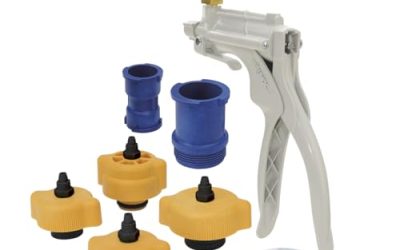
This kit targets the most common on-head job: valve stem seals or springs with the head still on the engine. It clamps over the valve, compresses the spring with a screw drive you can ease down gradually, and includes the valve holder fitting that connects to shop air through the spark plug hole to keep the valve from dropping. The screw drive is slower than a lever, but that slowness is a feature with stiff springs or poor access: the spring stays where you leave it while both hands deal with the keepers. Seat the jaws fully before applying load, and reset if anything slips.
5. 3mirrors 67605 LS Valve Spring Compressor Tool

Specs:
– Fits GM LS engines: 4.8, 5.3, 5.7, 6.0, and 6.2 liter (LS1, LS2, LS3, LS6)
– OE cross-references: 26906-16, 5462, 67605, HM1885
– Compresses both springs on one cylinder at a time
– T-shaped body marked “TOP” for correct orientation
– Item weight: 11.8 ounces
LS engines are common enough that they earned their own tool pattern, and this is it. The flat steel body bolts to the cylinder head in place of the rocker arms, using the head’s own bolt holes, and a central screw presses a plate down over both springs of one cylinder at once. There is no jaw to slip and no lever to swing, making it one of the most secure-feeling ways to swap springs or seals on an LS, heads installed or on the bench. It fits nothing else, so confirm your engine code, not just the vehicle model. You still need air or rope to hold the valves up on-head, and two springs at once means four keepers per cylinder.
Usage and Safety Notes
Valve spring work deserves respect. A compressed spring stores real energy, and if a compressor slips off the retainer, the retainer and keepers can launch hard enough to cause a serious eye injury. Wear eye protection every time, keep your face out of the spring’s line of fire, and never lean over a loaded spring. Compress slowly, confirm the tool is seated squarely, and release the pressure before removing the tool.
For on-head work, the valve itself is the trap. The keepers are the only thing holding it up, so once they come off, an unsupported valve drops into the cylinder, and retrieving it means pulling the head. Two proven methods prevent that. Shop air through a spark plug hole fitting (around 90 to 120 psi) holds the valve closed; set the transmission in park or neutral with the brake on first, since air pressure can rotate the crank. The rope method needs no compressor: feed soft rope into the cylinder, then turn the crank by hand until the piston squeezes the rope against the valves.
Keepers are the easiest part to lose. Before you start, stuff rags into the oil drain-back holes and ports so a dropped keeper cannot fall into the engine, and fish keepers out with a magnetic pickup tool, not your fingertips.
Finally: never use a suspension coil spring compressor on valve springs, or a valve spring compressor on a strut spring. They are different tools built for different loads, and mixing them up is genuinely dangerous. If a spring feels beyond your tool, stop and get the right compressor.
FAQ
Can I change valve springs without removing the cylinder head?
Yes, with an on-head tool such as a lever compressor, a keeper tool, or an engine-specific bolt-down tool. Each valve must be held up while its keepers are removed, using shop air or the rope method, or it will drop into the cylinder.
How do I stop a valve from falling into the cylinder?
Pressurize the cylinder with shop air through a spark plug hole fitting, or feed soft rope into the cylinder and rotate the piston up by hand to trap the rope against the valve. Either holds the valve against its seat while the keepers are off.
What size valve spring compressor do I need?
Match three things: the jaw opening must span your spring and retainer, the throat must reach the spring where it sits in the head, and the adapter must fit your retainer diameter, commonly 1 inch or 1-3/16 inch.
Can I use a coil spring compressor meant for suspension on valve springs?
No. They are different tools designed for different springs, loads, and access, and using one in place of the other is unsafe.
Why do the keepers keep falling, and how do I avoid losing them?
Keepers are tiny, oily, and under tension as they release, so they bounce. Work slowly, use a magnetic pickup or keeper tool, stuff rags into the oil drain-back holes first, and work over a tray.
Conclusion
The best valve spring compressor matches where your cylinder head will be during the job. For fast on-head seal work, the Lisle 36050 is hard to beat, and the Orion Motor Tech overhead kit adds a controlled screw drive plus the air holder fitting. The ARES 15017 is the versatile middle ground, on the car or on the bench. If the head is already off, the Orion Motor Tech C-clamp kit strips it down methodically, and LS owners get the secure bolt-down 3mirrors 67605. Whichever you choose, respect the stored energy in every spring: eye protection on, face out of the line, valves supported, keepers accounted for.
More from Amazon
Programs that pair well with the guide above. Offers and eligibility are set by Amazon and may change.
Free shipping on eligible items, Prime Video and more. Eligible new members can start with a free trial.
Start a Prime free trialAudiobooks and podcasts to listen to on the go. Eligible new members can start with a free trial.
Try Audible freeAd-free music streaming. Eligible new subscribers can start with a free trial.
Try Music Unlimited freeA free business account with business pricing and bulk-buying tools for work, shop or home office.
Create a business accountAs an Amazon Associate we earn from qualifying purchases.