Key takeaways
- Pro: Multi-driver design spreads sound to driver and passenger.
- Pro: Marine rating handles rain and washdowns.
- Pro: Often paired with Wet Sounds amplifiers for tuned results.
- Con: Premium price tier.
- Con: Tube-diameter compatibility must be confirmed.
The best UTV and ATV speakers are marine-rated (IP65 or better), UV-resistant, high-efficiency units that mount to a roll cage, dash or soundbar and run from a small marine-rated amplifier. In 2026 the names that come up most in side-by-side buyer guides are Wet Sounds, Rockford Fosgate, Kicker, SSV Works and JL Audio, in three formats: roll-cage soundbars for RZR and Can-Am builds, round 6.5-inch or 8-inch cage or tower speakers, and dash or kick-panel pods. Pick the format first, then pick the brand.
The comparisons below rely on published specs and published reviews, not on our own bench work. Models are refreshed often, so confirm the exact part number, cage-tube diameter and vehicle fit with the manufacturer before ordering.
Our top picks



As an Amazon Associate we earn from qualifying purchases at no extra cost to you.
Why UTV speakers are not just car speakers
A side-by-side has no cabin to hide a speaker. Wind noise at 30-40 mph, engine and exhaust sound, and tire noise raise the background to 80 to 90 dB at the driver’s ear. A speaker needs high sensitivity (typically 90 dB or more), real power handling, and a waterproof build. A paper-cone car speaker will fail quickly from water, mud and UV. Look for polypropylene or similar cones, rubber or butyl surrounds, stainless or coated hardware, and a stated ingress rating.
Power budget is the second difference. Most buyers run a compact marine amplifier or a powered head unit from the vehicle’s 12 V system. A typical four- to six-speaker setup draws 20 to 40 A at loud volume, which matters because UTV charging systems have limited spare capacity, especially at idle.
Format comparison
| Format | Example brands | Typical speaker count | Best for | Trade-off | Price tier |
|---|---|---|---|---|---|
| Roll-cage soundbar | Wet Sounds Stealth, SSV Works, Kicker PowerBar class | 2 to 6 drivers in one bar | RZR, Can-Am, Talon builds | Cage tube diameter must match | Mid to premium |
| Round cage/tower speakers | Kicker KMT class, Rockford Fosgate M2, Wet Sounds Rev | 2 | Bigger sound, upgrade path | Needs clamps and an amp | Mid to premium |
| Dash or kick pods | Rockford Fosgate, Kicker, JL Audio class | 2 to 4 | Stock-looking installs | Fit differs by model | Entry to mid |
| Full vehicle kit | Rockford Fosgate vehicle kits | 4 to 6 plus subs | Plug-and-play on popular models | Highest cost | Premium |
Best UTV speakers by use
Best roll-cage soundbar overall: Wet Sounds Stealth series
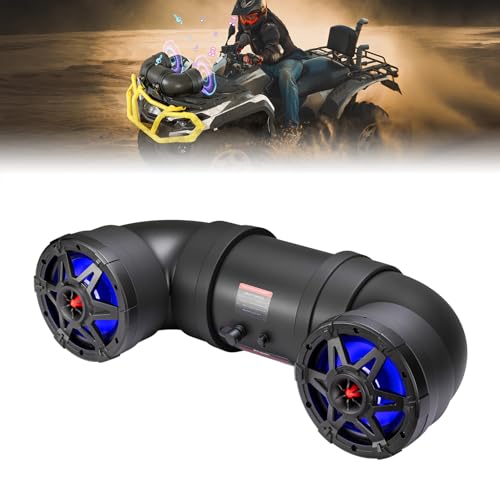
Spec line: Marine-rated soundbars sized for UTV roll cages, in versions with multiple speakers and tweeters, designed for full coverage across the cabin; clamp-on mounting.
Best for / Skip if: Best for RZR and Can-Am drivers who want complete overhead coverage with one install. Skip if you need to keep the cage open for a sunroof or accessory mounts.
- Pro: Multi-driver design spreads sound to driver and passenger.
- Pro: Marine rating handles rain and washdowns.
- Pro: Often paired with Wet Sounds amplifiers for tuned results.
- Con: Premium price tier.
- Con: Tube-diameter compatibility must be confirmed.
Best plug-and-play fit: SSV Works soundbars and kits
Spec line: Soundbars and kits tailored to specific models, with brackets cut to match the cage tubing of the vehicle.
Best for / Skip if: Best for owners who want guaranteed cage fit without drilling. Skip if you want to mix and match speakers from different brands.
- Pro: Model-specific brackets reduce fitment risk.
- Pro: Fully matched kits simplify wiring.
- Pro: Often offers remote and Bluetooth options.
- Con: Less flexibility to upgrade individual drivers.
- Con: Fit is tied to specific vehicle models.
Best loud option: Kicker PowerBar class
Spec line: Powered soundbar with an integrated amplifier in the roughly 300 W class per Kicker’s published figures; designed for roll-cage mounting.
Best for / Skip if: Best for highway-speed volume and a simple one-bar install. Skip if you prefer separate speakers and an external amp for finer tuning.
- Pro: Built-in amplifier means less wiring.
- Pro: Strong output for open vehicles.
- Pro: Reviewers frequently cite loudness at speed.
- Con: Fewer upgrade paths than component-style setups.
- Con: Higher current draw at full volume.
Best brand-matched option: Rockford Fosgate for UTV
Spec line: Rockford Fosgate offers UTV-specific speakers, soundbars and full vehicle kits (for example Stage 5 and Stage 6 style kits for popular RZR and Maverick X3 models), with some kits including 10-inch subwoofers.
Best for / Skip if: Best for people who want a complete, tested-by-brand package for a popular model. Skip if budget is limited; full kits sit in the premium tier.
- Pro: Kits are built around specific vehicles.
- Pro: Wide range from speakers to subs and amps.
- Pro: Strong brand support and warranty channels.
- Con: Premium cost for full kits.
- Con: More wiring and more load on the electrical system.
Best round cage speaker: Kicker KMT class and Rockford Fosgate M2 class
Spec line: Marine 6.5-inch round speakers with clamp-on mounting, available as coaxial pairs; Kicker’s KMTC65 and Rockford Fosgate’s M2 6.5-inch speakers are examples frequently cited in UTV buyer lists.
Best for / Skip if: Best for owners who want to mount speakers on the cage and use a separate marine amplifier. Skip if you want a single-bar solution.
- Pro: Flexible mounting and easy replacement.
- Pro: 6.5-inch size fits common clamps and pods.
- Pro: Pairs well with a compact 4-channel marine amp.
- Con: Needs clamps and wiring that you assemble.
- Con: Output depends heavily on amplifier quality.
Best for a bigger voice: Wet Sounds Rev 8 class
Spec line: Marine 8-inch coaxial speakers designed for towers and cages; larger cone for stronger midbass.
Best for / Skip if: Best for large side-by-sides with wide cabs. Skip if your cage tubing or space will not take the larger diameter.
- Pro: Larger cone gives better midbass than 6.5-inch units.
- Pro: Durable construction.
- Pro: Popular marine option with broad dealer support.
- Con: Larger and heavier on the cage.
- Con: Higher price tier.
Best ATV and four-wheeler speakers
ATVs and four-wheelers have no roll cage, so options are smaller: handlebar or rack-mounted Bluetooth speaker pods, fairing mounts, and compact waterproof speakers with their own battery or a switched 12 V feed. Choose speakers rated at IPX6 or higher, use rubber or silicone mounting, and keep wiring away from the exhaust and moving parts. Expect lower volume than a UTV system; wind exposure is high and the speakers are small. For rider-focused listening, a compact 2.5- to 4-inch pod pair mounted near the handlebars gives better clarity than a larger rear speaker.
Bluetooth versus wired: what works in a UTV
Bluetooth soundbars and powered pods are convenient because the phone connection removes a head unit. The trade-offs are range (usually 30 to 100 feet in free air, less in a metal cab), occasional dropouts when a phone is in a pocket, and reliance on phone streaming data. A wired head unit with a USB or auxiliary input avoids dropouts, but it adds another weather-rated part to mount. Many owners choose a Bluetooth bar for simplicity and a marine receiver for high-end builds.
How to choose: power, current and cage size
1. Measure the cage tube
Roll cage tubes vary: 1.5, 1.75, 2.0 inches and above are common. Most universal clamps accept a range, so measure the outside diameter and compare. Soundbars sold for a specific model are cut to fit.
2. Decide your power source
For 100 to 200 W of total audio power, a typical current draw at full volume is about 10 to 20 A (power divided by 12 V, adjusted for amplifier efficiency of roughly 70 percent). A 300 W bar can pull about 25 A, which is significant at idle. If you add a subwoofer or a larger amplifier, check the battery, stator output and wiring gauge; thick power wire and an inline fuse near the battery are essential.
3. Match speakers and amplifier
Pair speakers rated at or above the amp’s per-channel RMS output. A 75 W RMS speaker is well matched with an amplifier delivering 50 to 100 W per channel. Avoid running a small amp at full gain to chase volume: distortion is the usual cause of blown UTV speakers.
4. Choose a waterproof rating
Marine-rated speakers are usually the baseline. Look for IP65 or higher on the driver and for sealed, conformal-coated amplifier boards. Soundbars and amplifiers should be mounted where they cannot collect standing water.
Worked example: a two-seat side-by-side with a 1.75-inch cage
A driver wants clear sound at about 35 mph. A roll-cage soundbar with four drivers and a 200 W amplifier gives a reasonable baseline. At 70 percent efficiency, full-volume current draw is about 200 W divided by 12 V and 0.7, or roughly 24 A. A typical UTV charging system leaves about 15 to 25 A spare at mid-RPM, so the bar should be run at moderate volume at idle and the stator should be checked. If the driver wants more, adding a separate 6.5-inch pair with a marine amplifier and fusing it with a 30 A inline fuse keeps wiring safe and avoids stressing the harness.
Power, fuse and wire sizing at a glance
| Total amplifier power | Approx. current at full volume | Suggested fuse | Minimum power wire (short run) |
|---|---|---|---|
| 100 W | About 12 A | 15-20 A | 12-14 AWG |
| 200 W | About 24 A | 30 A | 10-12 AWG |
| 300 W | About 36 A | 40 A | 8-10 AWG |
| 500 W | About 60 A | 60-70 A | 6-8 AWG |
Current is estimated as power divided by 12 V and an assumed efficiency of about 70 percent; real amplifiers vary, so follow the manufacturer’s fuse and wire instructions. Put the fuse within about 18 inches of the battery terminal.
Step-by-step: installing a roll-cage soundbar
- Confirm the cage tube diameter and the bar’s clamp range, then dry-fit the bar to see that it clears the helmet and any roof or doors.
- Run power from the battery through an inline fuse, using grommets wherever the wire passes through the firewall or panels, so the insulation does not chafe.
- Connect a switched 12 V turn-on wire to an accessory circuit, not constant power, so the amplifier shuts off with the key and does not drain the battery.
- Route the speaker wire or the bar’s harness along the cage with zip ties spaced about every 8 to 12 inches, keeping clear of heat and moving parts.
- Tighten clamps evenly; over-tightening can dent thin tubing, while under-tightening lets the bar shift on rough trails.
- Set amplifier gain with the head unit at about 75 percent volume, then lower it if you hear distortion. This keeps clean output and prevents blown drivers.
Dash, kick-panel and pod speakers
Not every build suits an overhead bar. Dash and kick-panel pods, available from Rockford Fosgate, Kicker and others for specific models, use 5.25- to 6.5-inch drivers to give front-facing sound without cage clamps. They keep the stock look, leave overhead space for lighting or a roof, and are usually easier to protect from branches. The trade-off is that sound is aimed at your knees or chest, so clarity at speed is lower than an overhead bar. They work best for slower trail use and as a front fill alongside a rear subwoofer.
Common mistakes
- Choosing by wattage alone: a 400 W peak rating tells you little. Compare RMS and sensitivity.
- Using constant power for the amplifier turn-on wire, which drains the battery overnight.
- Skipping the fuse or using one too large for the wire.
- Mounting the amplifier where water pools underneath it.
- Running speaker wire across sharp frame edges without a grommet or loom.
Ownership and durability
- Rinse speakers with fresh water after muddy rides and dry the connectors.
- Use dielectric grease on speaker and power connectors.
- Re-torque cage clamps after the first few rides, since vibration loosens them.
- Check wire routing near heat sources and moving suspension parts.
- Remove or cover speakers during long storage in direct sun to extend UV life.
- Fit and cage compatibility must be checked on each vehicle; a bar that fits one model may not fit another.
Frequently Asked Questions
What are the best speakers for a RZR?
Roll-cage soundbars from Wet Sounds, SSV Works and Kicker, along with Rockford Fosgate kits for popular RZR models, appear most often in buyer guides. Choose based on cage fit, speaker count and whether you want a built-in amplifier.
Do UTV speakers need to be waterproof?
Yes. Rain, mud and washdowns will damage standard car speakers quickly. Use marine-rated or UTV-specific products with sealed construction and UV-resistant materials.
Can I use Bluetooth speakers on a UTV?
You can, and many soundbars include Bluetooth. Pick a rugged, waterproof unit and expect some dropouts in metal cabs. For consistent reliability, a wired marine receiver is more stable.
How loud should UTV speakers be?
Background noise is often 80 to 90 dB at the driver’s ear, so you need systems that can reach 95 to 100 dB at the seat. That generally means 90 dB or higher sensitivity, an amplifier of 100 W or more, and speakers placed close to the listener.
Will UTV audio drain my battery?
It can if used with the engine off. At idle, a loud system can exceed the charging capacity. Use a fuse, keep volume moderate at idle, and consider a battery with enough capacity if you play audio for long periods at camp.
What speakers work for a four-wheeler?
Waterproof Bluetooth pods or compact marine speakers mounted on the handlebars or rack work best. Choose IPX6 or higher and expect lower volume than a UTV system.
More from Amazon
Programs that pair well with the guide above. Offers and eligibility are set by Amazon and may change.
Free shipping on eligible items, Prime Video and more. Eligible new members can start with a free trial.
Start a Prime free trialAudiobooks and podcasts to listen to on the go. Eligible new members can start with a free trial.
Try Audible freeAd-free music streaming. Eligible new subscribers can start with a free trial.
Try Music Unlimited freeA free business account with business pricing and bulk-buying tools for work, shop or home office.
Create a business accountAs an Amazon Associate we earn from qualifying purchases.