Key takeaways
- Pro: High sensitivity makes it the easiest component upgrade on stock power.
- Pro: Shallow woofer fits many standard doors.
- Pro: Frequently cited by retailers as an entry component recommendation.
- Con: Limited headroom if you later upgrade your amplifier.
- Con: Tweeter can sound bright on harsh recordings.
For most cars, the best component car speakers in 2026 are a 6.5-inch set from Alpine (S-Series), JL Audio (C2 or C3), Kicker (KS or CS component), JBL (Club 64C class) or Rockford Fosgate (Prime or Punch), chosen by how much amplifier power you have. If you are running the factory radio, choose a high-sensitivity set around 92 dB. If you are adding an amp, choose a set rated for at least that amp’s per-channel power. Components cost more than coaxials, and the gain is imaging: the tweeter can be aimed at your ears.
Everything below comes from published manufacturer specs and professional reviews. Series are refreshed regularly, so confirm the model number, mounting depth and vehicle fit with the retailer’s fit guide before ordering.
Our top picks



As an Amazon Associate we earn from qualifying purchases at no extra cost to you.
What a component set changes (and what it does not)
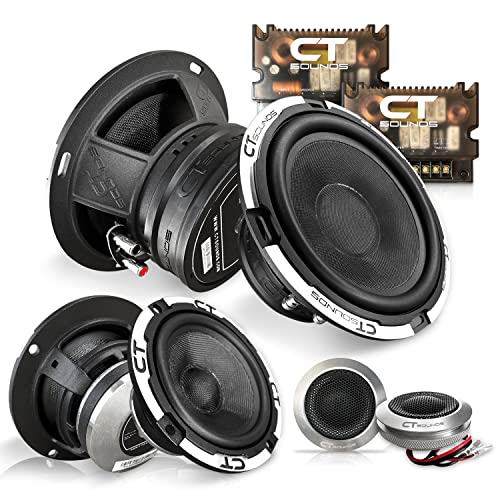
A component set separates the woofer, the tweeter and an external crossover. The crossover sends only treble to the tweeter and only mids and bass to the woofer, which lowers distortion in both. Because the tweeter is a separate part, it can be mounted on the door sail, the A-pillar or the dash, closer to ear height than a woofer in a lower door. That produces a wider, more centered stage.
What components do not do is add deep bass. A 6.5-inch woofer in a door still stops near 50-60 Hz on a good day. Many people buy a component set and are surprised the bass has not grown; the upgrade is clarity and placement, not low-end output.
Comparison table: 6.5-inch component sets
| Set | Tweeter | Power (RMS) | Sensitivity | Best for | Price tier |
|---|---|---|---|---|---|
| Rockford Fosgate Prime R165-S | About 1/2-inch Mylar | 40 W | About 92 dB | Factory radio, no amp | Entry |
| Kicker KS / CS component (such as KSS650) | Dome, class-dependent | About 75-100 W | About 90 dB | Value with amp | Entry to mid |
| Alpine S2-S65C | 1-inch silk dome | 80 W | 88 dB | Smooth vocals | Mid |
| JBL Club 64C class | Dome, class-dependent | About 60-100 W | About 92 dB | Lively sound | Mid |
| Pioneer TS-A series component | Dome, class-dependent | About 50-80 W | About 88-91 dB | Budget-minded upgrade | Entry |
| JL Audio C2 / C3 component | Dome, class-dependent | About 60-100 W | About 90 dB | Natural tone | Mid to upper |
| Focal Auditor / Integration component | Inverted-dome class | About 60-80 W | About 90-92 dB | Premium clarity | Premium |
Power and sensitivity are class ranges from manufacturer sheets; individual diameters vary within each series.
Best 6.5 component speakers by situation
Best without an amp: Rockford Fosgate Prime R165-S
Spec line: 6.5-inch component set, roughly 40 W RMS, sensitivity near 92 dB, frequency response starting around 60 Hz, mounting depth about 2 inches for the woofer.
Best for / Skip if: Best for factory head units that only supply 10-20 W per channel. Skip if you plan to pair the set with a high-power amplifier, since the ceiling is low.
- Pro: High sensitivity makes it the easiest component upgrade on stock power.
- Pro: Shallow woofer fits many standard doors.
- Pro: Frequently cited by retailers as an entry component recommendation.
- Con: Limited headroom if you later upgrade your amplifier.
- Con: Tweeter can sound bright on harsh recordings.
Best value with an amplifier: Kicker component sets
Spec line: Kicker’s component lines (the KS series and the CS series, including models such as the KSS650) offer 6.5-inch woofers with external crossovers; power handling is in the roughly 75-100 W RMS class; sensitivity about 90 dB.
Best for / Skip if: Best for a small four-channel amp at about 50-75 W per channel. Skip if you want a mellow tone.
- Pro: Strong power handling for the price tier.
- Pro: Crossover includes tweeter level options on many models.
- Pro: Widely stocked, so replacement parts are easy to find.
- Con: Tonal balance is lively, sometimes forward.
- Con: Tweeter mounting hardware varies by series; check the box contents.
Best smooth vocals: Alpine S2-S65C
Spec line: 6.5-inch component set, 80 W RMS (240 W peak), 1-inch silk dome tweeter, 88 dB sensitivity, 55 Hz to 40 kHz response, rubber surround.
Best for / Skip if: Best for listeners who want a polished presentation with an amp. Skip if you run the factory head unit, because 88 dB is on the lower side.
- Pro: Silk dome tweeter is gentle on long listening sessions.
- Pro: Rubber surround adds long-term durability.
- Pro: Frequently appears in sub-200 component roundups.
- Con: Needs more power to reach the same volume as 92 dB rivals.
- Con: Mid-bass is controlled rather than punchy.
Best for energetic music: JBL Club 64C class
Spec line: 6.5-inch component set, roughly 92 dB sensitivity class, power handling in the 60-100 W RMS range depending on revision.
Best for / Skip if: Best for rock, pop and electronic music on a moderate amp. Skip if you prefer a warm, relaxed signature.
- Pro: High sensitivity helps with low-powered systems.
- Pro: Good dynamics in the midrange.
- Pro: Listed regularly in value roundups for components.
- Con: Tweeters can sound hot.
- Con: Check mounting depth in thin doors.
Best natural tone: JL Audio C2 and C3 component
Spec line: 6.5-inch component sets in the C2 Evolution and C3 lines; around 60-100 W RMS; sensitivity roughly 90 dB.
Best for / Skip if: Best for listeners who want a neutral, refined sound and are adding an amplifier. Skip if you need the loudest output per dollar.
- Pro: Smooth tweeter and natural midrange.
- Pro: Quality crossovers and hardware.
- Pro: Many mounting options including low-profile fits.
- Con: Costs more than entry-tier alternatives.
- Con: Sounds polite on weak power.
Best budget alternative: Pioneer TS-A series components
Spec line: 6.5-inch sets with power handling in the 50-80 W RMS class and sensitivity around 88-91 dB, depending on model.
Best for / Skip if: Best for an inexpensive first component upgrade. Skip if you care about tweeter refinement.
- Pro: Entry-tier price.
- Pro: Wide availability and mounting adapters.
- Pro: Reasonable output on aftermarket head units.
- Con: Tweeters are less refined than mid-tier sets.
- Con: Fewer premium material choices.
Best premium: Focal Auditor and Integration
Spec line: 6.5-inch component sets with inverted-dome tweeters in the higher-end lines; 60-80 W RMS class; sensitivity around 90-92 dB.
Best for / Skip if: Best for detailed listening and wide imaging. Skip if the budget cannot also cover an amp and sound deadening.
- Pro: Open, detailed treble.
- Pro: Efficient with modest amplifiers.
- Pro: Vehicle-specific kits simplify fitment.
- Con: Premium price tier.
- Con: Bass remains limited by door-speaker physics.
Best component speakers under 200
For a budget of 200 or less, three practical choices stand out in published roundups: the Alpine S2-S65C for smooth sound with an amp, a Kicker component set for power handling, and the Rockford Fosgate Prime R165-S for factory radios. The deciding question is not brand but power source. If you do not have an amp, spend the money on a high-sensitivity set and sound deadening. If you have a 50-75 W per channel amp, a mid-tier set will deliver more clarity.
Component speakers without an amp: what to expect
Component speakers will work from a factory radio, but results depend on sensitivity. A 92 dB set on 15 W per channel reaches about the same level as an 88 dB set on 30 W. That is why the Prime and JBL Club classes are recommended for stock systems. The external crossover also removes a small amount of power, so expect a modest volume drop compared with the coaxial version of the same series. An amplifier is not mandatory, but even a compact 4-channel amp noticeably improves dynamics and lets you raise volume without distortion.
Installation: where the tweeter goes
- Start by temporarily taping the tweeter in place and listening to a familiar track; change location until vocals sit at dash height.
- For A-pillar mounts, aim the tweeter toward the opposite side of the cabin to widen the stage.
- For door sail mounts, check that the tweeter is not blocked by the mirror triangle.
- Use the crossover’s tweeter attenuation switch if treble sounds sharp; a 3 dB reduction fixes many bright setups.
- Seal the door and add sound deadening on the outer panel so the 6.5-inch woofer has a stiff mounting surface.
How to choose: quick decision matrix
| Your situation | Pick this class | Why |
|---|---|---|
| Factory radio, entry budget | Rockford Fosgate Prime or JBL Club | 92 dB sensitivity |
| Small amp, 50-75 W per channel | Kicker or Alpine S | RMS 75-80 W |
| Amp plus sound deadening, sound quality focus | JL Audio C2 / C3 | Smooth, natural tonality |
| Premium budget, imaging priority | Focal Auditor / Integration | Tweeter detail |
| Older car with odd door sizes | Pioneer TS-A or vehicle-specific kit | Adapter availability |
Fit checks before you buy
Measure the woofer’s mounting depth against the available door cavity, and check that the window glass does not touch the magnet when lowered. Confirm the screw pattern or buy adapter rings. Verify that your factory speaker wiring has a quick connector adapter, so you do not need to cut wires. Vehicle fit must be verified for each car; the generic size on the box is not a guarantee.
Durability and ownership
Component sets last many years if kept dry. Crossovers are the most overlooked part: mount them where they will not get wet and secure them so they do not rattle. Tweeter surfaces collect dust and should be wiped with a dry cloth. Foam surrounds degrade faster than rubber, so rubber-surround models like the Alpine S-Series are better for hot climates.
Reading a component spec sheet
Four numbers decide most of the outcome, and they are worth reading in this order.
Sensitivity and the volume it buys
Sensitivity tells you how loud a speaker plays at 1 watt measured at 1 meter. Each 3 dB step equals a doubling of amplifier power. A 92 dB set on a 15 W factory head unit plays about as loud as an 89 dB set on 30 W and an 86 dB set on 60 W. If your power source is weak, sensitivity is the cheapest source of volume.
RMS rating and amp matching
RMS is the continuous power a speaker handles. Pair it with an amplifier that delivers roughly 75 to 150 percent of that figure per channel. For an 80 W RMS set such as the Alpine S2-S65C, that means an amp of about 60-120 W per channel. Peak ratings, such as 240 W for the same set, describe short bursts and are not a matching target.
Frequency response and crossover point
A response starting near 55-60 Hz is typical for a 6.5-inch woofer in a door. The crossover usually splits the signal around 3 to 4 kHz. If a set lets you choose between two tweeter levels or two crossover positions, use the lower-output position first and move up only if treble sounds dull.
Mounting depth and magnet size
Shallow doors limit what you can fit. A woofer that needs about 2 inches of depth is acceptable in many doors, while some premium woofers need 2.5 inches or more. The magnet diameter matters as well; oversized magnets can hit door-panel ribs or window tracks. Vehicle fit must be checked on a car-by-car basis.
Worked example: a four-door sedan with a small amp
Suppose a sedan has 6.5-inch front doors with 2.25 inches of clearance and a compact four-channel amp that delivers 50 W RMS per channel. An 80 W RMS set matches that amp comfortably because the amp covers about 62 percent of the speaker’s rating, well inside the safe range. A 40 W RMS set would be driven beyond its rating at full output, so you would have to keep the volume lower. For the rear doors, a less expensive pair of 6.5-inch coaxials is a sensible use of the budget, because the front stage does most of the work in a component setup. That leaves money for 10 to 15 square feet of sound-deadening sheet across the front doors, which improves midbass response more than a speaker step-up would.
Common mistakes with component sets
- Mounting the tweeter on the door panel low down, which pulls the stage to the floor. Move it higher when you can.
- Skipping the crossover or using the wrong terminals, which can damage the tweeter.
- Ignoring phase: reversing the polarity on one speaker thins the bass and blurs the center image. Match positive and negative terminals carefully.
- Buying on peak power. A set listed at 240 W peak and 80 W RMS should be judged by the 80 W number.
- Leaving the factory door speaker baffle loose, which leaks bass from the door cavity into the cabin.
Frequently Asked Questions
Are component speakers better than coaxial?
For sound quality and imaging, usually yes. Separating the tweeter lets you mount it at ear level and lets the crossover filter frequencies cleanly. Coaxials are easier to install and cost less, so they remain the practical choice for many daily drivers.
Can I run component speakers without an amplifier?
Yes, but choose a high-sensitivity set, around 90-92 dB. A set rated at 88 dB will play quietly on a factory radio. Adding a compact amplifier later gives a clear improvement.
Which component speaker brand is best for sound quality?
JL Audio, Focal and Alpine are often cited for refined sound, while JBL, Kicker and Rockford Fosgate are often cited for value and energy. Your music taste and amplifier power matter more than the label.
Do I need a crossover with component speakers?
Yes. Component sets come with passive crossovers that split frequencies between the woofer and tweeter. Never wire a tweeter directly without it, as bass frequencies can damage the tweeter.
What size component speakers fit my car?
Many cars use 6.5-inch front door openings, but some use 5.25-inch, 6×8 or 6×9. Look up your vehicle in a manufacturer or retailer fit guide and verify mounting depth before ordering.
Will component speakers give me more bass?
Slightly better midbass is possible, especially with sound deadening, but a door-mounted 6.5-inch woofer will not reproduce deep bass. A subwoofer is the right tool for low notes.
More from Amazon
Programs that pair well with the guide above. Offers and eligibility are set by Amazon and may change.
Free shipping on eligible items, Prime Video and more. Eligible new members can start with a free trial.
Start a Prime free trialAudiobooks and podcasts to listen to on the go. Eligible new members can start with a free trial.
Try Audible freeAd-free music streaming. Eligible new subscribers can start with a free trial.
Try Music Unlimited freeA free business account with business pricing and bulk-buying tools for work, shop or home office.
Create a business accountAs an Amazon Associate we earn from qualifying purchases.