Key takeaways
- Match your trailer hitch ball to the coupler the first time. Five chrome and tri-ball picks compared by diameter, shank, and weight ratings.
Disclosure: As an Amazon Associate, I earn from qualifying purchases.
A trailer hitch ball looks like the simplest part of a towing setup, a polished steel sphere on a threaded shank, yet it carries the whole connection between tow vehicle and trailer. When the diameter matches the coupler, the shank fits the mount, and the weight rating clears the loaded trailer, a good ball simply does its job for years. When any of those three is wrong, the result ranges from a loose coupling to a trailer that comes off the ball on the road.
How to Choose
Match the ball diameter to the coupler exactly. Trailer couplers come in three common sizes: 1-7/8 inch, 2 inch, and 2-5/16 inch. The ball must be the same size as the coupler, with no exceptions and no close-enough substitutions. A 2-inch ball in a 2-5/16-inch coupler will not seat properly and can pop off under load, while a 2-5/16-inch ball will not fit into a 2-inch coupler at all. Read the size stamped on the coupler before ordering; if the stamping is worn away, measure the socket.
Check the shank diameter and length. The shank is the threaded stem that passes through the hole in the ball mount, and it must match that hole. Common shank diameters are 3/4 inch and 1 inch. A shank that is too large will not pass through the hole, and one that is too small will have play in the mount. The shank also needs enough thread for the nut and lock washer to seat fully.
Buy a weight rating above your loaded trailer weight. Every ball carries a gross trailer weight rating, and that rating must exceed the weight of your trailer when fully loaded, not when empty. A 3,500-pound ball is fine for a small utility trailer and wrong for a loaded car hauler. Remember that the lowest-rated component in the chain sets the real limit: a 10,000-pound ball on a 3,500-pound mount is still a 3,500-pound setup.
Consider the finish and the hardware. Chrome plating resists rust and makes the ball easy to grease and wipe down, which matters for a part that lives outside in rain and road salt. A ball should come with a zinc-plated hex nut and a helical lock washer, torqued to the figure in the instructions. An under-torqued nut can work loose, and an over-torqued one can stretch the threads.
Know what a ball cannot fix. A new ball cannot fix a worn coupler, a bent drawbar, or a cracked ball mount. If the coupler jaws are worn, the latch does not close firmly, or the mount shows cracks or bent steel, replace the worn part first. Retire any ball with flat spots, pitting, or visible wear.
1. CURT 40003 Chrome Trailer Hitch Ball
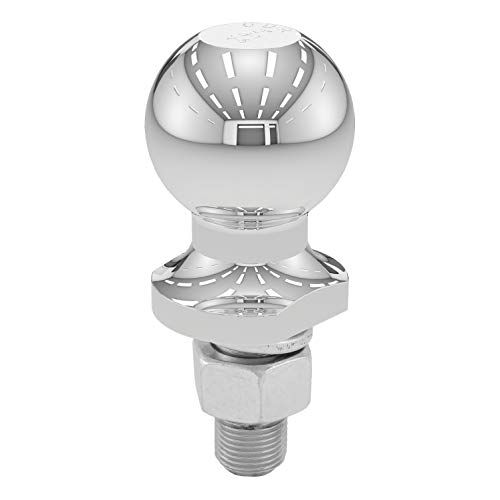
Specs
- Ball diameter: 2 inches
- Gross trailer weight rating: 3,500 pounds
- Shank: 3/4-inch diameter, 1-3/4 inches long
- Material: hot-forged steel
- Finish: chrome plating
- Fit: most 2-inch couplers
The CURT 40003 is the straightforward 2-inch ball for light to medium duty towing. Its diameter fits the most common coupler size on utility trailers, small boat trailers, and popup campers, while the 3,500-pound rating covers those trailers with room to spare. The 3/4-inch shank suits standard ball mounts with a 3/4-inch hole, the most common size on light-duty mounts. Hot-forged steel gives the ball its strength, and the chrome finish resists corrosion and wipes clean after a dusty trip. This is the pick for an owner who tows one trailer with a 2-inch coupler and wants a simple replacement ball.
2. CURT 40004 Chrome Trailer Hitch Ball

Specs
- Ball diameter: 2 inches
- Gross trailer weight rating: 6,000 pounds
- Shank: 1-inch diameter, 2-1/8 inches long
- Material: hot-forged steel
- Finish: chrome plating
- Hardware: zinc-plated hex nut and helical lock washer
- Nut torque: 250 lb-ft
The CURT 40004 is the heavier 2-inch ball for owners whose trailer outgrew the light-duty rating. It keeps the same 2-inch diameter, so it fits the same couplers, but the 1-inch shank and the 6,000-pound rating move it into the range of larger utility trailers, car haulers, and flatbeds. The longer 2-1/8-inch shank fits mounts with a 1-inch ball hole and thicker plates, and the included zinc-plated hex nut and helical lock washer are the hardware the ball is designed to be installed with. CURT lists 250 lb-ft for the nut, so a torque wrench is part of the job. Choose this ball when your trailer is too heavy for a 3,500-pound ball but still uses a 2-inch coupler, and check that your mount has a 1-inch hole before ordering.
3. CURT 40007 Chrome Trailer Hitch Ball

Specs
- Ball diameter: 2-5/16 inches
- Gross trailer weight rating: 10,000 pounds
- Shank: 1-inch diameter, 2-1/4 inches long
- Material: hot-forged steel
- Finish: chrome plating
The CURT 40007 is the heavy-duty ball for trailers with a 2-5/16-inch coupler, the size found on large campers, heavy equipment trailers, and tandem-axle haulers. The 10,000-pound rating matches the loads those trailers carry, and the 1-inch shank with a 2-1/4-inch length fits heavy-duty mounts with a 1-inch ball hole. Like the other CURT balls here, it is hot-forged steel with a chrome finish, so it resists corrosion in the weather a heavy trailer sees. This ball is not interchangeable with the 2-inch balls above: it only fits a 2-5/16-inch coupler.
4. MaxxHaul 70270 Triple Ball Mount

Specs
- Ball sizes: 1-7/8 inch, 2 inch, and 2-5/16 inch
- Gross trailer weight ratings: 2,000, 5,000, and 7,500 pounds by ball size
- Receiver: 2-inch square
- Length: 10 inches
- Shaft: hollow steel shaft
- Finish: black powder coat with black balls
The MaxxHaul 70270 is the pick for an owner who tows more than one trailer with different coupler sizes. It carries all three common ball sizes on a single mount, so switching trailers means rotating the mount in the receiver instead of swapping balls with a wrench. The ratings step up with the ball size: 2,000 pounds on the 1-7/8-inch ball, 5,000 pounds on the 2-inch ball, and 7,500 pounds on the 2-5/16-inch ball. The hollow shaft keeps the weight down, and the 10-inch length gives room to clear a spare tire or a tailgate. Note the ratings carefully: this mount suits mixed light and medium trailers, not a heavy hauler, because its largest ball is rated at 7,500 pounds.
5. Reese 21536 Trailer Hitch Ball Mount Starter Kit

Specs
- Ball diameter: 2 inches
- Gross trailer weight rating: 6,000 pounds
- Drop: 2 inches
- Shank: 2 inches
- Receiver: 2-inch square
- Construction: all-welded steel
- Included: 2-inch trailer ball, pin, and clip
The Reese 21536 kit is the ready-to-tow option for someone setting up a 2-inch receiver for the first time. It bundles a pre-attached 2-inch ball on an all-welded steel mount with a 2-inch drop, plus the pin and clip, so there is nothing else to buy before the first tow. The 6,000-pound rating covers most utility trailers, boat trailers, and small campers with a 2-inch coupler, and the 2-inch drop helps level a trailer that sits high behind the tow vehicle. Because the ball comes factory-attached, there is no shank sizing or torquing to get wrong. It is the simplest path to a working setup, and the right choice when an old mount is bent or rusted and the whole assembly needs replacing at once.
Usage and Buying Notes
Measure the coupler before you buy anything, and buy the ball to match the coupler. The size is stamped on most couplers near the latch; if it is not legible, measure the socket opening with calipers. Grease the ball lightly before coupling and wipe it down after towing in rain or dust, since a dry ball wears faster and a dirty one grinds grit into the coupler. Torque the nut to the figure given for that ball and recheck it after the first tow, because a nut can settle as the lock washer beds in. Inspect the ball before every trip for flat spots, pitting, or a nut that has moved from its marked position, and replace a ball that shows any of these. When towing more than one trailer, a tri-ball mount is convenient, but keep the per-ball ratings in mind, since the smallest ball carries the lowest rating. Finally, the ball, the mount, the coupler, and the receiver each have their own rating, and the lowest of the four is the rating of the whole setup.
FAQ
Q: What size trailer hitch ball do I need?
A: Match the ball to the size stamped on your trailer coupler: 1-7/8 inch, 2 inch, or 2-5/16 inch. There is no safe substitute size.
Q: Can I use a 2-inch ball on a 2-5/16-inch coupler?
A: No. A smaller ball will not seat fully in a larger coupler and can come off under load. Use a ball that matches the coupler size exactly.
Q: What does the shank size on a hitch ball mean?
A: The shank is the threaded stem that passes through the hole in the ball mount. Its diameter must match the mount hole, and it must be long enough for the nut and lock washer to seat fully.
Q: How much weight can a trailer hitch ball carry?
A: Each ball has a gross trailer weight rating, such as 3,500, 6,000, or 10,000 pounds. It must exceed your trailer weight when fully loaded, and the lowest-rated part of the setup sets the real limit.
Q: How often should I replace a trailer hitch ball?
A: Replace a ball when you see flat spots, pitting, or wear on the sphere, or when the nut will not stay torqued. With regular greasing and inspection, a chrome ball lasts for years.
Conclusion
The right trailer hitch ball matches your coupler size, fits your ball mount, and clears your loaded trailer weight with margin. The CURT 40003 covers light 2-inch towing, the CURT 40004 steps the same diameter up to 6,000 pounds, and the CURT 40007 handles heavy 2-5/16-inch couplers. The MaxxHaul 70270 suits owners who tow several trailers with different couplers, and the Reese 21536 kit is the simplest complete setup for a 2-inch receiver. Measure the coupler, check the shank, respect the lowest rating in the chain, and inspect the ball before every trip.
More from Amazon
Programs that pair well with the guide above. Offers and eligibility are set by Amazon and may change.
Free shipping on eligible items, Prime Video and more. Eligible new members can start with a free trial.
Start a Prime free trialAudiobooks and podcasts to listen to on the go. Eligible new members can start with a free trial.
Try Audible freeAd-free music streaming. Eligible new subscribers can start with a free trial.
Try Music Unlimited freeA free business account with business pricing and bulk-buying tools for work, shop or home office.
Create a business accountAs an Amazon Associate we earn from qualifying purchases.