Key takeaways
- A wiring harness runs new circuits to your trailer; an adapter only changes the plug shape. Compare three harnesses and two adapters and pick one.
Disclosure: As an Amazon Associate, I earn from qualifying purchases.
A trailer with dead lights is invisible after dark, and working trailer lights are a legal requirement. The fix is either a wiring harness or an adapter, and the two are not interchangeable. A harness is a complete wire kit that runs circuits from your tow vehicle to the trailer, while an adapter is a plug converter that lets a mismatched vehicle socket and trailer plug mate. This guide explains the difference, then compares three harnesses against two adapters.
The Core Difference
A harness adds wiring your vehicle does not have yet. T-connector harnesses plug into the factory tail light connectors, universal kits splice or plug into the vehicle’s lighting circuits, and both end in a standard trailer connector. A replacement harness plug rebuilds the trailer end itself, swapping a corroded plug for fresh wire.
An adapter adds no wiring at all. It reshapes the connector your vehicle already has so it fits the trailer’s plug: a 7-way RV blade socket becomes a 4-way flat. It cannot add a brake circuit, a 12-volt charge line, or reverse lights the vehicle socket does not already supply, and it cannot fix a dead circuit. If your vehicle has no trailer wiring socket at all, an adapter is useless and a harness is the only answer.
Buy a harness when your vehicle has no trailer connector, when the existing connector is damaged, or when you are changing connector types permanently. Buy an adapter when your vehicle already has a working socket and you only need to tow a trailer with a different plug for a weekend or a borrowed trailer.
How to Choose
Match the connector type to both ends before ordering. A 4-way flat carries ground, running lights, and left and right turn and brake signals, and that is all. A 5-way flat adds a reverse or surge-brake lockout wire. A 6-way round adds a brake or charge circuit, and a 7-way RV blade adds electric brakes, a 12-volt charge line, and reverse lights. Count the pins on both ends.
A harness cannot fix corroded grounds or a blown tow-vehicle fuse. If the trailer lights worked last season and now do not, test the circuit first. Check the tow vehicle’s trailer fuse and clean the ground point on the trailer frame. A new harness plugged into a corroded ground will behave exactly like the old one.
Secure wiring away from the hitch and exhaust heat. Trailer wiring fails most often where it rubs or melts. Route the harness with slack for turns and keep it off the hitch ball and the exhaust pipe.
Use dielectric grease on exposed connections. A dab inside each plug keeps moisture and road salt out of the contacts. It does not conduct electricity itself, so it belongs on the mating surfaces and the seal.
Check LED compatibility. LED trailer lights draw far less current than incandescent bulbs, and some tow vehicles read that low draw as a burned-out bulb and hyperflash the indicators.
The 5 Best Picks: 3 Harnesses vs 2 Adapters
1. CURT 55336 Custom 4-Pin Trailer Wiring Harness

Specs
- Output: standard 4-pin flat connector for tail, brake and turn signals
- Fitment: select Honda Accord, CR-V, Odyssey and Pilot, plus Acura Integra, CL, RL, TL and MDX
- Install: plugs into the factory tail light wiring, no cutting or splicing
- Circuitry: surface mount technology for less heat and steady light intensity
- Included: rubber dust cover to keep the connector clean when not in use
- Size and weight: 9 x 4 x 2 inches, 9.6 ounces
The CURT 55336 is the harness-side answer for a common question: how do I add trailer wiring to a Honda or Acura that never had it? The kit plugs into the factory wiring behind the tail lights and ends in a standard 4-pin flat at the rear, so installation is unplug, insert, plug back in, with no cut insulation and nothing to solder. One crawl showed no featured offers available for this listing, so availability may vary.
2. CURT 56621 Replacement 7-Pin RV Blade Wiring Harness Plug

Specs
- Output: 7-way RV blade plug for tail lights, turn signals, electric brakes, 12-volt battery, reverse lights and ground
- Wire: 6-foot blunt-cut wires, color-coded for splicing into the trailer wiring
- Protection: protective plastic sleeve over the cable
- Purpose: replaces an existing 7-way plug on the trailer end
- Size and weight: 9 x 9 x 5 inches, 1.04 kilograms
The CURT 56621 covers the other end of the system. Most harness talk is about the tow vehicle, but the trailer-side plug takes just as much abuse, and a corroded 7-way plug is a common reason trailer brakes and lights quit together. This replacement harness gives you a fresh plug with six feet of color-coded wire to splice into the trailer’s wiring, protected by a plastic sleeve. Splice it in with heat-shrink connectors rather than twist caps, which corrode in a season.
3. Hopkins 11143325 Plug-In Simple Vehicle to Trailer Wiring Kit

Specs
- Type: plug-in simple vehicle to trailer wiring kit, universal fit
- Connectors: exact OEM matching connectors for a weather-tight fit
- Install: plugs into the vehicle’s factory wiring, no splicing onto the factory harness
- Included: 4 pieces, including wiring and a dust cover plus a grease packet
- Voltage: 12 volts
- Weight: 12 ounces
The Hopkins 11143325 is the universal plug-in option for drivers whose vehicle has factory connectors but no dedicated T-connector listed for their exact model. Hopkins designs its kits around OEM matching connectors, so the plugs seal against weather instead of relying on snap splices, and the kit includes a dust cover and a grease packet.
4. CURT 57004 LED-Compatible 7-Way RV Blade to 4-Way Flat Adapter

Specs
- Adapts: 7-way RV blade vehicle socket to a 4-way or 5-way flat trailer plug
- Compatibility: LED trailer lights, with built-in resistors
- Install: plugs in, no splicing required
- Construction: quality plastic housing
- Size: 9 x 4 x 2 inches
The CURT 57004 is the adapter-side answer for the most common mismatch on the road: a truck with a 7-way socket and a small trailer with a 4-way flat plug. It plugs straight in, needs no splicing, and its built-in resistors recognize LED trailer lights, so the tow vehicle does not misread the low LED draw as a burned-out bulb. Remember what it cannot do: it only passes through the four lighting circuits, so it will not run electric brakes or charge a trailer battery. One crawl showed no featured offers available, so check availability before counting on it for a trip.
5. Oyviny 7 to 4 and 5 Pin Trailer Adapter
Specs
- Adapts: 7-way RV blade vehicle socket to 4-way and 5-way flat trailer plugs
- Design: 2-in-1 adapter with both a 4-way and a 5-way flat output
- Model: S70-45-001
- UPC: 769894715529
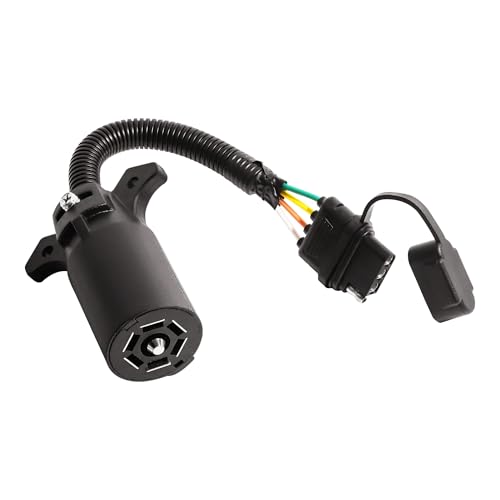
The Oyviny is the budget generic pick on the adapter side, and it earns its place by doing one thing the name-brand adapters do not: it carries both a 4-way and a 5-way flat output in a single 2-in-1 body, so the same adapter serves a standard utility trailer and a boat trailer with a surge-brake lockout wire. It is a generic brand rather than a CURT or Hopkins, so expect simpler packaging, and inspect the pins before first use to make sure none arrived bent.
Usage Notes
Test every circuit before the first tow: running lights, left turn, right turn, brake lights, and, on a 7-way, the brake controller output and the charge line.
When you use an adapter, plug it in fully and check that the dust cover or latch holds it seated. A half-seated adapter is the classic cause of trailer lights that work in the driveway and fail on the highway.
For a 4-way to 7-way adapter that must also feed trailer brakes, remember that the brake circuit needs its own wiring run from the cab brake controller to the rear socket. A plain plug adapter does not supply it.
Store plugs with their dust covers on and grease the contacts each spring.
FAQ
Q: Do I need a wiring harness or an adapter for my trailer?
A harness if your tow vehicle has no trailer connector at all, or if the existing connector is damaged. An adapter if your vehicle already has a working socket and the trailer plug simply does not match it.
Q: Can an adapter run my trailer brakes?
No, not by itself. An adapter only reshapes the connector, so it can only pass through the circuits the vehicle socket already supplies. To run electric brakes you need a 7-way socket, a brake controller in the cab, and wiring between them.
Q: Will a 4-way flat harness work with a 7-way trailer plug?
Not directly. A 4-way flat carries lighting only, while a 7-way adds brakes, a charge line and reverse lights. You can adapt the shapes with a plug adapter, but the extra circuits will stay dead unless the vehicle wiring supplies them.
Q: Why do my trailer lights work in the driveway but fail on the road?
Usually a loose ground, a half-seated adapter, or a wire that rubs when the trailer turns. Check the ground point on the trailer frame first, then seat the adapter fully and secure the wiring. Corrosion inside a plug can also pass a test light at rest and fail under vibration.
Q: Do I need a special harness for LED trailer lights?
Often yes. LED lights draw far less current than incandescent bulbs, and some tow vehicles read that as a burned-out bulb and hyperflash the indicators. Use an LED-compatible adapter or a harness with a converter module.
Conclusion
A harness and an adapter solve different problems. If your tow vehicle has no trailer wiring, buy a harness: a vehicle-specific T-connector like the CURT 55336 when one exists for your model, a universal plug-in kit like the Hopkins 11143325 when it does not, or a replacement plug like the CURT 56621 when the trailer end is the worn part. If your vehicle already has a working socket and only the plug shapes disagree, buy an adapter: the CURT 57004 for LED trailers, or the Oyviny 2-in-1 when you tow both 4-way and 5-way trailers.
More from Amazon
Programs that pair well with the guide above. Offers and eligibility are set by Amazon and may change.
Free shipping on eligible items, Prime Video and more. Eligible new members can start with a free trial.
Start a Prime free trialAudiobooks and podcasts to listen to on the go. Eligible new members can start with a free trial.
Try Audible freeAd-free music streaming. Eligible new subscribers can start with a free trial.
Try Music Unlimited freeA free business account with business pricing and bulk-buying tools for work, shop or home office.
Create a business accountAs an Amazon Associate we earn from qualifying purchases.