Key takeaways
- Five trailer leveling blocks for side-to-side leveling, from interlocking stack blocks to drive-on ramps, with capacities and setup notes for each.
Disclosure: As an Amazon Associate, I earn from qualifying purchases.
A trailer that sits low on one side is more than an annoyance. Doors swing shut on their own, the refrigerator in an absorption unit works poorly off level, and water pools on one side of the shower tray. Leveling blocks fix the side-to-side tilt: you build a small ramp or platform under the low-side tires and drive onto it until the bubble level reads true. That job is different from steadying a trailer that is already level, which is what stabilizer jacks do. Blocks level; jacks steady. This roundup covers blocks and drive-on ramps only.
The five picks span the two main designs. Interlocking stack blocks work like oversized building bricks: you lay them in a stepped ramp and drive up as far as you need. Curved drive-on levelers are a single crescent-shaped ramp per wheel, so you roll forward until the trailer is level and wedge the chock in place. Three of the five picks are Camco, which reflects how much of this niche that brand covers; the other two come from Tri-Lynx and Andersen.
How to Choose
Match the rated capacity to your trailer. Every pick below lists its published capacity in the Specs. A set rated for a light single-axle camper is not the right tool under a heavy tandem-axle trailer, and capacity figures are per wheel or per axle depending on the brand, so read the figure the way the maker states it. When in doubt, size up.
Count the lift you need. Stack blocks add about one inch per layer, with most brands warning against stacking more than four high. Curved ramps give up to four or five inches in one smooth climb. For slightly uneven sites a ten-pack is plenty; for sloped ground a drive-on ramp reaches the height you need with less fiddling.
Check the footprint against your tires. Standard stack blocks measure about 8.5 inches square, which suits most trailer tires. Dual-wheel setups need the wider 4-by-2 blocks, and curved levelers fit tires up to about 32 inches in diameter, so measure a large off-road tire before ordering.
Think about the surface. Blocks grip best on firm, flat ground. On soft dirt or wet grass, a solid-bottom block resists sinking better than an open-grid one, and a rubber grip mat under a curved leveler keeps it from sliding on smooth concrete. Blocks are for firm ground, not soft mud or steep grades; on a soft site, lay a plywood pad under the stack first.
Chock the wheels before and after leveling. Leveling blocks hold the trailer at height, but they do not stop it rolling. Chock the downhill side before you drive onto the blocks, and chock again once the trailer is level. A block stack cannot fix a bent axle or a failed jack, so inspect the running gear first if the trailer will not sit level even with a full stack.
The Picks
1. Camco 44510 Heavy Duty Leveling Blocks, 10-Pack
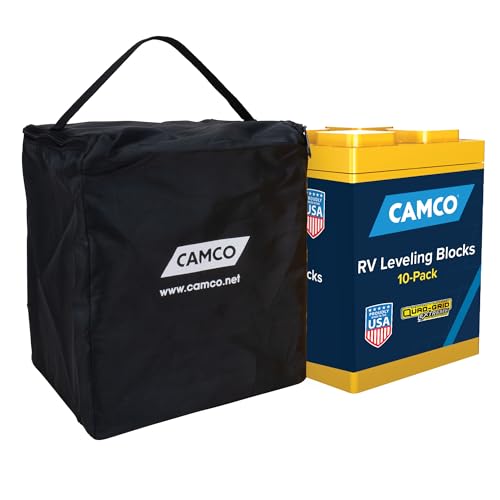
The Camco 44510 is the standard stack-block set in this category. Ten interlocking blocks nest for storage and build into a stepped ramp under the low-side tire, and the bright yellow color is easy to spot at dusk when packing up.
Specs
- Pack size: 10 interlocking blocks
- Block size: 8.5 x 8.5 x 1 inches
- Material: UV-stabilized resin
- Design: Interlocking nested blocks with a solid bottom
- Works with: Single wheels, dual wheels, tandem axles, tongue jacks, and hydraulic jacks
- Storage: Zippered storage bag included
One honest note: roundups disagree on this set’s rated capacity, with figures from 10,000 to 40,000 pounds appearing in different guides, so check the capacity printed on the current listing and match it to your trailer before you buy. Keep the stack to four blocks high or less, as taller stacks get unstable under load.
2. Tri-Lynx 00015 Lynx Levelers, 10-Pack

Tri-Lynx has sold the Lynx Leveler since 1992. Each block has a curved ramp face instead of a flat top, so the tire climbs a gentle curve and self-centers as you drive on, where a flat-topped stack can slide out from under an off-center tire.
Specs
- Pack size: 10 interlocking blocks
- Block size: 8.5 x 8.5 inches
- Material: Heavy-duty plastic, orange finish
- Capacity: 40,000 pounds (distributed)
- Design: Curved ramp face for self-centering drive-on
- Warranty: 10-year manufacturer warranty
- Storage: Nylon carry bag included
- Origin: Made in USA
Brand guidance tops out at four stacked blocks, so treat that as the safe maximum. Register the set online within 21 days of purchase to validate the warranty claim, per the included user guide.
3. Andersen 3604 Camper Leveler, 2-Pack

The Andersen 3604 skips stacking entirely. Each leveler is a single curved ramp you drive onto, stopping anywhere along the curve for an exact height from half an inch to four inches. Roll forward until the bubble level reads true, then slide the chock in behind the tire. The two-pack covers both wheels on one side of a tandem-axle trailer.
Specs
- Pack size: 2 curved levelers with 2 rubber grip mats
- Capacity: 30,000 pounds
- Lift range: 0.5 to 4 inches
- Tire fit: Up to 32 inches in diameter
- Design: Single-piece curved drive-on ramp with infinite adjustment
- Material: Heavy-duty polymer
The rubber mats matter more than they look: they sit under the leveler and stop it sliding on smooth concrete or hard-packed dirt while the tire climbs. This listing is the levelers-and-mats set; a version with a carrying bag is sold under a separate listing.
4. Camco FasTen 21025 4×2 Leveling Blocks, 10-Pack

Dual-wheel trailers need a wider platform than a standard 8.5-inch block, and that is the job of the FasTen 4×2. Each block measures 17 by 8.5 inches, so one block spans a dually pair where two standard blocks would be needed. A T-handle twists through the stack to lock the set together for carrying.
Specs
- Pack size: 10 interlocking blocks
- Block size: 17 x 8.5 x 1 inches
- Material: Durable resin
- Design: Quad-grid interlocking pattern, stackable to the desired height
- Carrying system: T-handle twists to secure the stack
- Works with: Dual tires, single wheels, and stabilizer jacks
The quad-grid pattern gives the blocks their grip on the tire and on each other, and the wider footprint spreads the load so the stack is less likely to sink into soft ground. This is the pick for dually and wide-tire trailers. As with the other stack blocks here, keep the stack to four high.
5. Camco Super Tri-Leveler 21028

The Super Tri-Leveler is a single-piece step ramp with three fixed heights: two, three and a half, and five inches. Set it in front of the tire, drive up to the step you need, and you are done. There is nothing to assemble or count, which makes it the simplest pick here, and the built-in handle makes it easy to carry one-handed.
Specs
- Leveling heights: 2, 3.5, and 5 inches
- Load capacity: 12,500 pounds
- Dimensions: 27.75 x 10.13 x 5.13 inches
- Material: UV-stabilized resin
- Design: Three-step drive-on ramp with built-in carry handle
Do not confuse this model with the smaller Camco 44573 Tri-Leveler, which tops out at 3.9 inches and carries a much lower per-wheel rating. The Super Tri-Leveler is the heavier-duty of the two, and its 12,500-pound capacity suits most single-axle travel trailers and lighter tandem rigs. The fixed steps mean no fine-tuning: a site needing three inches forces a choice between the 2-inch and 3.5-inch steps.
Usage Notes
Leveling works best as a short routine done the same way every time. Park where you intend to stay, set the parking brake, and check the bubble level side to side first. Chock the wheels on the downhill side first, then build your ramp or place your leveler on the low side. Drive slowly onto the blocks while a spotter watches the level, and stop the moment the bubble centers. Chock the raised wheels again before you unhitch or deploy the stabilizer jacks. The jacks come last: level first with the blocks, then steady the trailer with the jacks.
On soft ground, put a flat board or plywood pad under the stack so the blocks do not sink as the tire climbs. On gravel, sweep the loose stones clear first, since a block can crack if it bridges a sharp stone under load. After a trip, hose the blocks off and let them dry before bagging them; grit trapped between interlocking blocks grinds the mating surfaces and makes the stack harder to separate next time.
FAQ
Q: How many leveling blocks do I need for one trailer?
A ten-pack covers most single-axle trailers, since you usually need three or four blocks under one wheel. Tandem-axle trailers often need two sets, one per axle on the low side.
Q: Can leveling blocks replace stabilizer jacks?
No. Blocks level the trailer side to side by raising the low-side tires. Stabilizer jacks steady a trailer that is already level by bracing the frame against rocking. Use blocks first, then deploy the jacks.
Q: How high can I safely stack leveling blocks?
Most brands, including Tri-Lynx, advise a maximum of four blocks in one stack. Taller stacks get unstable and can crack or kick out under the tire. If four blocks are not enough, the site is too steep for blocks.
Q: Do leveling blocks work on soft ground?
They work if you give them a firm base. Lay a plywood pad under the stack so the weight spreads instead of sinking, and prefer solid-bottom blocks on grass or wet soil. Avoid leveling on mud entirely when you can.
Q: What is the difference between a leveling block and a wheel chock?
A leveling block raises the tire to level the trailer. A wheel chock wedges against the tire to stop it rolling. You need both, and never rely on a leveling block alone to keep a trailer from moving.
Conclusion
The Camco 44510 ten-pack is the safe default for most trailers, and the Tri-Lynx 00015 adds a curved face that forgives an imperfect approach. The Andersen 3604 is the fastest setup for frequent leveling, the Camco FasTen 4×2 is the pick for dual wheels, and the Super Tri-Leveler is the simplest tool for lighter trailers. Whichever you choose, match the capacity to your trailer, keep stacks to four high, chock the wheels, and level with blocks before touching the stabilizer jacks.
More from Amazon
Programs that pair well with the guide above. Offers and eligibility are set by Amazon and may change.
Free shipping on eligible items, Prime Video and more. Eligible new members can start with a free trial.
Start a Prime free trialAudiobooks and podcasts to listen to on the go. Eligible new members can start with a free trial.
Try Audible freeAd-free music streaming. Eligible new subscribers can start with a free trial.
Try Music Unlimited freeA free business account with business pricing and bulk-buying tools for work, shop or home office.
Create a business accountAs an Amazon Associate we earn from qualifying purchases.