Best Baseball Hitting Nets for Practice: Which One Fits Your Space?
The best baseball hitting nets for most players are 7-by-7-foot portable nets with a bow-style or fiberglass frame: they provide enough target area for tee work and front-toss practice, set up in roughly two to five minutes, and fit in a garage or backyard without becoming a permanent installation.
The right choice changes with your priorities. A youth player using a net twice a week can save money with a basic steel-frame model, while a team that moves equipment frequently should prioritize a reinforced frame, thicker knotless netting, replaceable parts, and a carry bag that will survive repeated transport.
Our top picks
 GoSports 7 ft x 7 ft Baseball
- New exclusive black version of our top selling…
- Perfect for baseball and softball players of all…
- Features a bow type frame that sets up…
 PowerNet Baseball & Softball Practice Net 7x7
- This 7x7 foot practice net is a portable…
- The PowerNet batting net offers easy assembly, allowing…
- The collapsible training nets assemble quickly and easily…
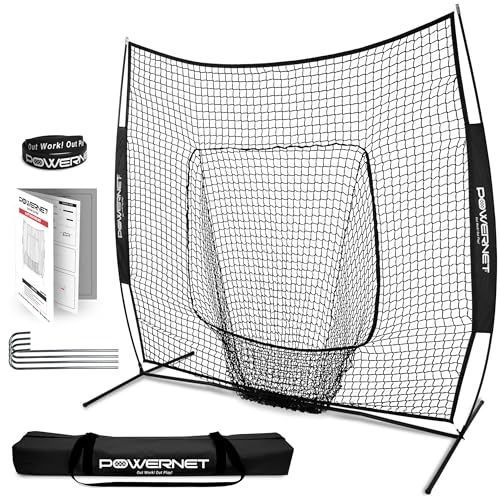 PowerNet Baseball & Softball Practice Net 7x7
- This 7x7 foot practice net is a portable…
- The PowerNet batting net offers easy assembly, allowing…
- The collapsible training nets assemble quickly and easily…
| Product | Key specs | |
|---|---|---|
| GoSports 7 ft x 7 ft Baseball | New exclusive black version of our top selling… Perfect for baseball and softball players of all… Features a bow type frame that sets up… | Check price |
| PowerNet Baseball & Softball Practice Net 7x7 | This 7x7 foot practice net is a portable… The PowerNet batting net offers easy assembly, allowing… The collapsible training nets assemble quickly and easily… | Check price |
| PowerNet Baseball & Softball Practice Net 7x7 | This 7x7 foot practice net is a portable… The PowerNet batting net offers easy assembly, allowing… The collapsible training nets assemble quickly and easily… | Check price |
 7x7FT Baseball Net for Any Skill Level 7x7FT Baseball Net for Any Skill Level | [STURDY CONSTRUCTION] The frame of this baseball pitching… [QUICK SETUP] No tools required, baseball net can… [ACCURACY TRAINING AID] This baseball net is perfect… | Check price |
As an Amazon Associate we earn from qualifying purchases at no extra cost to you.
Best Baseball Hitting Nets by Situation
| Practice situation | Best net type | Recommended size | What matters most | Typical market range |
|---|---|---|---|---|
| Small garage or basement area | Compact pop-up hitting net | 5 x 5 or 7 x 7 ft | Low rear clearance, quick folding, weighted base | $60–$150 |
| Backyard tee and front-toss practice | Bow-frame baseball net | 7 x 7 ft | Large pocket, stability, simple setup | $100–$250 |
| Older youth or adult hard-hit balls | Reinforced training net | 7 x 7 or 8 x 8 ft | Thick knotless net, strong frame joints, replaceable net | $180–$400 |
| Team practice and frequent transport | Commercial-style frame net | 7 x 7 or 8 x 8 ft | Frame durability, spare parts, carrying case | $250–$600+ |
Head-to-Head: The Main Net Designs
Bow-frame nets: the best all-around option
Bow-frame nets use flexible fiberglass or composite poles that curve around the target. The Bownet Big Mouth X is a well-known example of this design, with a 7-by-7-foot target and a broad mouth that helps catch balls during tee work. Comparable 7-by-7-foot nets from GoSports and other established training-equipment brands follow the same basic approach.
Their main advantage is speed. Many can be assembled in about two to five minutes without tools. The frame spreads force through the curved poles instead of relying on several rigid metal joints, and the deep pocket reduces rebounds when the ball enters near the center.
The trade-off is that fiberglass poles can eventually splinter, bend, or lose their original tension. They also need enough open space behind the net for the frame to flex. A bow-frame net is usually the strongest choice for a backyard or garage when portability matters.
Rigid steel-frame nets: stable but less convenient
Steel-frame nets generally feel more planted, especially when used with hard baseballs or repeated front toss. They are a sensible option for a team facility or a dedicated practice corner. Some use steel tubes with corner fittings; others combine steel legs with fiberglass uprights.
Rigid frames take longer to assemble, often five to fifteen minutes, and may require more floor space. Their connection points are potential failure points: loose bolts, cracked plastic fittings, or bent tubes can make the net lean even when the mesh is still usable. Choose one with separately available poles and connectors rather than a frame that must be discarded as a complete unit.
Portable rebounder nets: useful, but not a substitute for a full hitting net
Small rebounders are excellent for fielding drills and controlled throwing, but their narrow surface is less forgiving for batting practice. They can supplement a hitting net, not replace a 7-by-7-foot target. A mis-hit line drive that misses a small rebounder may travel into a wall, fence, or another person.
Dimension and Stability Comparison
| Configuration | Target area | Approximate packed length | Typical setup time | Suitable ball speed | Portability |
|---|---|---|---|---|---|
| Compact garage net | 5 x 5 ft | 30–36 in | 2–4 minutes | Tee work and controlled toss | Very high |
| Standard bow-frame net | 7 x 7 ft | 36–48 in | 3–6 minutes | Baseball and softball practice | High |
| Large training net | 8 x 8 ft | 42–60 in | 5–10 minutes | Hard-hit adult or team practice | Moderate |
| Rigid facility net | 7 x 7 or 8 x 8 ft | 48–72 in | 8–15 minutes | Frequent high-volume practice | Low to moderate |
Allow more room than the listed target dimensions. A 7-by-7-foot net commonly needs about 10 feet of width and at least 8 to 10 feet of depth once the frame, batter, and ball flight are considered. In a garage, measure around lights, shelves, vehicles, and the door track. The net should not be placed directly against a wall: a gap of 12 to 24 inches allows the frame to flex and prevents balls from striking the wall through loose mesh.
What to Look for in the Net and Frame
- Mesh construction: Knotless polyethylene or nylon netting is less abrasive on baseball covers than rough, poorly finished mesh. For frequent adult use, look for a heavier training net rather than a thin recreational net.
- Deep center pocket: A pocket of roughly 12 to 24 inches absorbs energy better than a flat sheet and reduces bounce-back.
- Frame feet: Wide feet and a low center of gravity matter more on concrete than on grass. A net that is light enough to carry may need ground stakes or sandbags outdoors.
- Protective sleeves: Sleeves over the upper frame reduce direct contact between the poles and the ball. They also make assembly easier.
- Replacement availability: Check whether the manufacturer sells the net, poles, corner fittings, ground stakes, and carry bag separately. This can extend ownership by several seasons.
- Weather resistance: Weather-resistant does not mean weatherproof. UV exposure, rain, and freezing temperatures shorten the life of both mesh and fiberglass.
Setup, Anchoring, and Maintenance
Set up the net on level ground with the opening facing away from windows, vehicles, and people. Assemble the frame loosely first, then seat each pole fully into its sleeve or connector. If the mesh looks twisted, stop and correct it before hitting; uneven tension places excessive force on one corner.
- Lay out the frame parts and identify the feet, poles, and connectors.
- Build the base before attaching the upper arch.
- Install the net without dragging it across rough concrete.
- Center the pocket and confirm that all four lower corners touch the ground.
- Stake each foot outdoors, or place a 20- to 30-pound sandbag over the rear base when stakes are unsuitable.
- Begin with soft tosses and inspect movement before using full-speed hits.
After practice, shake out dirt and grass, then dry the net completely before storage. Do not leave a wet net packed in its bag: mildew and trapped moisture can weaken fibers and corrode metal connectors. Inspect the center pocket, lower corners, pole ends, and frame sleeves every few sessions. These areas wear first because they receive the most ball impact or ground friction.
Worked Ownership Calculation
Suppose a $120 net lasts two years and is used three times per week for 40 weeks each year. That is approximately 240 sessions, or about $0.50 per session before replacement parts. A $300 reinforced net lasting five years with the same schedule costs about $0.50 per session as well. The more expensive model becomes the better value when its heavier mesh and replaceable frame parts prevent an early replacement.
For occasional practice, the calculation changes. At one session per week for 20 weeks per year, the $120 net costs roughly $1.20 per session over two years. In that case, paying extra for a commercial frame may not make sense unless the larger target or better stability solves a specific space or safety problem.
Final Buying Recommendations
Choose a 7-by-7-foot bow-frame net such as the Bownet Big Mouth X or a comparable GoSports-style training net for the broadest mix of portability, coverage, and quick setup. Choose a 5-by-5-foot model only when space is genuinely limited and the hitter is using controlled tee work. For older players, high-volume practice, or team use, move up to reinforced mesh, a heavier base, and a manufacturer with replacement poles and netting.
The most important purchase is not the largest net. It is the net that fits your available depth, stays stable under your hardest normal contact, and can be repaired rather than replaced when one pole, connector, or section of mesh eventually wears out.