Key takeaways
- Looking for the best 12 car subwoofer? Compare four 12-inch models by power handling, voice-coil setup, enclosure size and sensitivity before you buy.
A 12-inch subwoofer sits in the middle of the car bass world, large enough to move real air and small enough to fit a normal trunk or a compact enclosure. The real decision is not the diameter on the box but how much clean power the driver can take, which voice-coil layout matches your amplifier, and how much box volume your vehicle can spare. Get those three choices wrong and even a well-built sub sounds muddy, strained, or disappointingly quiet.

This guide is for drivers adding a first subwoofer to a factory or aftermarket system, for owners upgrading a tired 10-inch or 8-inch driver, and for builders planning a sealed or ported enclosure from scratch. Every product below was chosen from the name and specifications shown on its Amazon product page, so the power ratings, coil layouts, and mounting dimensions come straight from the listing rather than from guesswork. The four models here cover modest single-sub systems through high-output daily builds.
Quick Picks
As an Amazon Associate we earn from qualifying purchases
| Product | Best for | Key spec from title |
|---|---|---|
| Skar Audio SDR-12 D2 | High-output daily bass | 600W RMS, dual 2-ohm |
| Rockford Fosgate P3D4-12 | Sealed or ported builds | 600W RMS, dual 4-ohm |
| JL Audio 12W0v3-4 | Modest-power systems | 300W RMS, single 4-ohm |
| Pioneer TS-W312D4 | Loud output on moderate power | 500W RMS, 92 dB sensitivity |
How to Choose
Match RMS power to your amplifier
RMS power is the number that decides whether a subwoofer survives daily use. Peak ratings look impressive on a box, yet the amplifier spends its whole life near the RMS figure, so the sub must handle that level for hours without overheating its coil. A driver rated at 600 watts RMS pairs naturally with an amplifier that delivers roughly that amount at the wired impedance. Running a much larger amplifier invites clipping and heat, while a far smaller one leaves output on the table. Check the RMS figure first, then confirm the amplifier can deliver it cleanly at the final load. Matching RMS power keeps the system cool and clean at normal volumes.
Pick the voice-coil layout
Dual voice coils give you wiring flexibility that a single coil cannot match. A dual 2-ohm driver wires to 1 ohm in parallel or 4 ohms in series, while a dual 4-ohm driver wires to 2 ohms or 8 ohms, so the coil layout decides which amplifiers make sense. Single 4-ohm drivers suit simple single-sub setups on common monoblock amplifiers. Before buying, sketch the wiring you plan to use and confirm the final impedance sits inside your amplifier’s stable range. A mismatch here either wastes power or risks shutting the amplifier down. Write the final impedance on a note before ordering, since a quick sketch now prevents a costly rewiring job later.
Size the enclosure before buying
Every 12-inch subwoofer expects a certain air volume, and the listing usually states sealed and ported figures separately. Measure the space in your trunk or cargo area, then compare it with the recommended volume and the mounting depth. A driver that needs a deep box will not fit a shallow spare-tire well, and a ported design always needs more room than a sealed one. Cutout diameter matters too, since the mounting hole must match the basket. Choose the enclosure type first, then buy a driver whose volume and depth figures fit it. A tape measure and the listing’s dimensions settle the question in minutes.
Read sensitivity and frequency range
Sensitivity tells you how much sound a subwoofer makes from one watt, so a higher figure means more output from the same amplifier. A driver rated near 92 dB plays noticeably louder than one rated near 85 dB on identical power, which matters in modest systems. Frequency range shows how low the driver reaches; a bottom end near 22 Hz covers the deep notes in modern music, while a higher floor leaves the lowest octave thin. Treat these two numbers together, since loudness without low extension sounds hollow and depth without sensitivity needs a bigger amplifier. Listen for balance rather than chasing one number, since a well-matched pair of figures beats an impressive rating.
The 4 Best Options
Skar Audio SDR-12 D2
The Skar Audio SDR-12 D2 is built for drivers who want strong daily bass without stepping up to a competition-grade amplifier. Its dual 2-ohm coils wire down to a 1-ohm load, which suits the many monoblock amplifiers that make their full output at that impedance. The motor uses a large voice coil and a heavy ferrite magnet, so the driver keeps control when the volume climbs. With 600 watts of RMS handling, it covers the middle of the power range where most aftermarket systems live. The heavy ferrite magnet and large coil give it the thermal headroom for long sessions at volume.
Specs
- 600 watts RMS power handling, 1200 watts peak power
- Dual 2-ohm voice coils
- 2.5-inch 4-layer copper voice coil
- Frequency response 22 Hz to 300 Hz
- Sensitivity 84.7 dB
- Weight 18.6 pounds
- 2-year warranty
Best for: Drivers who want high-output daily bass from a 1-ohm monoblock amplifier.
Watch out for: The 84.7 dB sensitivity is modest, so it needs real power to reach its full output.
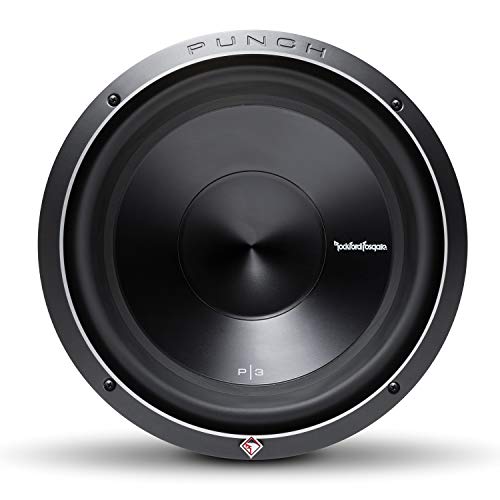
Rockford Fosgate P3D4-12
The Rockford Fosgate P3D4-12 is the flexible pick in this group, because its dual 4-ohm coils and published enclosure figures suit both sealed and ported builds. Rockford’s VAST surround increases the cone area, and the FlexFit basket uses slots rather than fixed holes, which makes mounting easier in boxes drilled for other drivers. At 600 watts RMS it handles the same power class as the Skar, yet its sensitivity and enclosure data make it the easier driver to plan a build around. The slotted basket also forgives boxes drilled for other drivers, which saves time during installation.
Specs
- 600 watts RMS power handling, 1200 watts peak power
- Dual 4-ohm voice coils
- Mounting depth 6.66 inches
- Cutout diameter 11.25 inches
- Sealed enclosure volume 1.02 cubic feet
- Vented enclosure volume 1.79 cubic feet
- VAST surround and FlexFit basket
Best for: Builders who want one driver that works well in either a sealed or a ported enclosure.
Watch out for: The 6.66-inch mounting depth needs a box with real clearance behind the baffle.
JL Audio 12W0v3-4
The JL Audio 12W0v3-4 is the sensible choice for systems built around a modest amplifier. Its single 4-ohm coil keeps wiring simple, and its 300-watt RMS rating matches the many compact monoblocks and five-channel amplifiers that deliver a few hundred watts to the sub channel. JL Audio’s entry-level W0 line still uses the company’s mineral-filled polypropylene cone and a DMA-optimized motor, so the driver stays composed at normal listening levels. It trades raw output for accuracy and easy integration. Its light weight and shallow depth make it the easiest driver here to fit in a tight enclosure.
Specs
- 300 watts RMS power handling, 600 watts peak power
- Single 4-ohm voice coil
- Sensitivity 85.64 dB
- Frequency response 22 Hz to 250 Hz
- Mounting depth 5.4 inches
- Weight 8.11 pounds
Best for: Owners pairing a subwoofer with a modest amplifier or a five-channel amp.
Watch out for: The 300-watt RMS ceiling means it will not keep up with high-power builds.
Pioneer TS-W312D4
The Pioneer TS-W312D4 brings the highest sensitivity in this group, which makes it the loudest option on a given amount of power. Its IMPP composite cone resists flexing, the dual-layer hybrid surround handles long excursion, and the double-stacked magnet supplies the motor force behind the 500-watt RMS rating. Dual 4-ohm coils wire to 2 ohms, a load most monoblocks handle comfortably. For drivers who want maximum output without buying a huge amplifier, the 92 dB rating is the number that matters most. The composite cone and hybrid surround hold their shape under excursion, so the sound stays clean when the volume rises.
Specs
- 500 watts RMS power handling, 1600 watts maximum power
- Dual 4-ohm voice coils
- Sensitivity 92 dB
- IMPP composite cone
- Dual-layer hybrid surround
- Double-stacked magnet
- Mounting depth 157 mm
- Weight 14.3 pounds
Best for: Drivers who want the most output per watt from a moderate amplifier.
Watch out for: The 157 mm mounting depth is deep, so confirm your enclosure clears it before ordering.
Which One Fits Your Situation
First subwoofer on a modest amplifier
The JL Audio 12W0v3-4 fits first-time builds best. Its 300-watt RMS rating matches compact monoblocks and five-channel amplifiers, its single 4-ohm coil keeps wiring simple, and its shallow 5.4-inch depth fits boxes that deeper drivers cannot. You get clean, musical bass without needing a large amplifier or a custom enclosure. Start with the gain set low and raise it gradually until the bass blends with the rest of the system.
Maximum output from a strong monoblock
The Skar Audio SDR-12 D2 is the pick when your amplifier makes its full output at 1 ohm. Its dual 2-ohm coils wire down to that load, and the 600-watt RMS rating gives the driver room to use the power. Expect strong daily output, provided the enclosure volume and the electrical system can support it. Upgrade the wiring and charging system if the lights dim on heavy bass notes.
One driver for either enclosure type
The Rockford Fosgate P3D4-12 suits builders who have not settled on sealed or ported yet. Its published volumes cover both designs, the FlexFit basket eases mounting, and the dual 4-ohm coils wire to the common 2-ohm load. It is the safest choice when the box design may change later. Keep the enclosure plans flexible until the driver arrives and the measurements are confirmed.
Loudest sound on moderate power
The Pioneer TS-W312D4 wins when amplifier power is limited but output matters. Its 92 dB sensitivity means it plays louder than the others on the same wattage, and the 500-watt RMS rating still leaves headroom. Just verify the deep mounting depth against your enclosure before committing. A shallow box or a spacer ring can solve a depth problem, but measuring first is simpler.
Common Mistakes
- Buying by peak power instead of RMS power, which is the rating that governs daily survival.
- Wiring dual voice coils to an impedance your amplifier cannot handle safely.
- Choosing a subwoofer before measuring the enclosure volume and mounting depth your vehicle allows.
- Ignoring sensitivity, then wondering why a high-power driver sounds quiet on a modest amplifier.
- Sealing a driver that was designed for a ported box, or porting one that was designed for sealed use.
Frequently Asked Questions
What size amplifier do I need for a 12-inch car subwoofer?
Match the amplifier’s RMS output at the final wired impedance to the subwoofer’s RMS rating. A 600-watt RMS driver pairs with an amplifier delivering around 600 watts at that load. A slightly larger amplifier run carefully is fine, but a far larger one risks overheating the voice coil when the gain is set too high.
Is a dual voice coil subwoofer better than a single voice coil?
Dual coils are not better in sound quality; they are more flexible in wiring. A dual 2-ohm or dual 4-ohm driver lets you reach 1, 2, or 4 ohms depending on the wiring, while a single 4-ohm driver gives one option. Choose dual coils when your amplifier’s best output sits at a specific impedance.
Should I choose a sealed or ported enclosure?
A sealed box gives tighter, more accurate bass in less space and is easier to build. A ported box plays louder around its tuning frequency but needs more volume and careful design. If space is tight or accuracy matters most, go sealed; if maximum output matters and room allows, go ported. Build the box to the driver’s published volume rather than guessing.
How much space does a 12-inch subwoofer need?
It depends on the driver and the box type. The Rockford Fosgate in this guide needs about 1.02 cubic feet sealed or 1.79 cubic feet vented, and other drivers publish similar figures. Measure your available space first, then compare it with the listing’s recommended volume and mounting depth before buying. When in doubt, choose the sealed volume first.
More from Amazon
Programs that pair well with the guide above. Offers and eligibility are set by Amazon and may change.
Free shipping on eligible items, Prime Video and more. Eligible new members can start with a free trial.
Start a Prime free trialAudiobooks and podcasts to listen to on the go. Eligible new members can start with a free trial.
Try Audible freeAd-free music streaming. Eligible new subscribers can start with a free trial.
Try Music Unlimited freeA free business account with business pricing and bulk-buying tools for work, shop or home office.
Create a business accountAs an Amazon Associate we earn from qualifying purchases.