Our Short List of 3

- Best for: A first subwoofer amplifier for a driver on a budget.
- Class A/B monoblock amplifier
- 1,100 watts maximum at 2 ohms, 550 watts maximum at 4 ohms
- MOSFET power supply
- 2-ohm stable

- Best for: A single mid-size subwoofer that needs efficient, cool-running power.
- Class D MOSFET monoblock amplifier
- 800 watts RMS at 1 ohm
- 1,200 watts peak power
- Frequency response of 20 hertz to 250 hertz
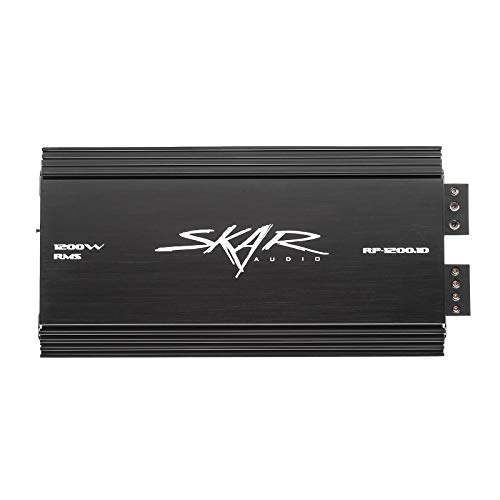
- Best for: A larger subwoofer that needs more than 800 watts RMS of clean power.
- Class D MOSFET monoblock amplifier
- 1,200 watts RMS at 1 ohm
- 1,600 watts peak power
- Frequency response of 20 hertz to 250 hertz
All 3 Picks at a Glance
| Product | Specs | Action |
|---|---|---|
| BOSS Audio R1100M |
| Check price on Amazon |
| Skar Audio RP-800.1D |
| Check price on Amazon |
| Skar Audio RP-1200.1D |
| Check price on Amazon |
Our Top Picks
A factory car stereo can play music, but it cannot drive a subwoofer with any authority. That gap is where a car amplifier earns its place, turning a flat factory sound into bass you can feel in the seat. The choice here is narrow and technical: these are monoblock amplifiers built to power a subwoofer, not full-range amps for door speakers. Match the power to the subwoofer, check the impedance, and the rest falls into place. An amp that is too weak clips, while one that is too strong risks the sub.
This guide is for drivers adding a subwoofer to a factory or aftermarket stereo, and for anyone replacing a tired amplifier with a stronger one. The three amplifiers below were chosen from the names and specifications shown on their Amazon product pages, with attention to power class, output at each impedance, and the controls that shape the bass. All three are monoblock subwoofer amplifiers. Wiring and fusing matter as much as the amp, so budget for both.
Quick Picks
As an Amazon Associate we earn from qualifying purchases
| Product | Best for | Key spec from title |
|---|---|---|
| BOSS Audio R1100M | A first subwoofer amp on a budget | 1100 watts max at 2 ohms |
| Skar Audio RP-800.1D | Efficient power for a single sub | 800 watts RMS at 1 ohm |
| Skar Audio RP-1200.1D | More headroom for a larger sub | 1200 watts RMS at 1 ohm |
How to Choose
Power class and efficiency
Amplifier class decides how much of the power drawn from the battery becomes sound and how much becomes heat. A Class A/B amplifier like the BOSS R1100M is a proven design that sounds clean but runs warmer and draws more current. A Class D amplifier like the two Skar models switches its output rapidly, which wastes less energy as heat and suits a subwoofer well. Class D is the common choice for bass today, since a subwoofer needs power more than it needs the last word in fidelity. Check the class alongside the power figure, since a cooler amp is easier to mount in a tight space.
Matching power to your subwoofer
Power matching is the heart of this purchase, since an amplifier and a subwoofer that disagree will disappoint or break something. Compare the amplifier’s RMS output at the subwoofer’s impedance with the subwoofer’s RMS rating, and aim for a close match rather than a large gap. A weak amplifier clips when pushed, and clipping damages speakers faster than clean power. An amplifier that is far stronger can damage the subwoofer if the gain is set too high. The Skar RP-800.1D at 800 watts RMS suits a single mid-size sub, while the RP-1200.1D at 1,200 watts RMS fits a larger one. Set the gain with care.
Impedance and wiring
Impedance is the electrical load the amplifier sees, and it changes the power the amplifier delivers. The BOSS R1100M is rated 1,100 watts maximum at 2 ohms and 550 watts maximum at 4 ohms, so the same amplifier gives a different result with a different subwoofer. The Skar models are rated at 1 ohm, which is where they make their full RMS power, and they need a subwoofer wired to match. Check the subwoofer’s voice coil layout before ordering, since a dual 2-ohm subwoofer wires differently from a dual 4-ohm one. Use the wire gauge the manual asks for, since thin power wire starves the amplifier and heats up under load.
Controls, protection, and size
Controls and protection decide how the amplifier behaves day to day, and size decides where it can live. A variable low-pass crossover keeps high notes out of the subwoofer, a bass boost adds punch at a chosen frequency, and a remote level control lets the driver turn the bass down without opening the trunk. Protection circuits guard against heat, short circuits, and overloads, and all three amplifiers here list them. Measure the mounting space before ordering, since the Skar models are 16 inches long and the BOSS is about 10 inches. A compact amplifier fits under a seat, while a long one needs a trunk wall or a rack.
The 3 Best Options
BOSS Audio R1100M
- Best for: A first subwoofer amplifier for a driver on a budget.
- Class A/B monoblock amplifier
- 1,100 watts maximum at 2 ohms, 550 watts maximum at 4 ohms
- MOSFET power supply
- 2-ohm stable
A first subwoofer amplifier for a driver on a budget.
Class A/B runs warmer than Class D, so give it room to breathe.
The BOSS Audio R1100M is the budget entry in this guide, a Class A/B monoblock rated at 1,100 watts maximum at 2 ohms and 550 watts maximum at 4 ohms. Its MOSFET power supply feeds a 2-ohm stable output, and a variable low-pass crossover plus bass boost shape the sound before it reaches the subwoofer. A remote subwoofer level control comes with it, so the driver can turn the bass down from the front seat. Thermal, short-circuit, and overload protection guard the amplifier, and RCA plus speaker-level inputs suit factory and aftermarket stereos alike. At 4.4 pounds it mounts easily under a seat or on a trunk wall.
Skar Audio RP-800.1D
- Best for: A single mid-size subwoofer that needs efficient, cool-running power.
- Class D MOSFET monoblock amplifier
- 800 watts RMS at 1 ohm
- 1,200 watts peak power
- Frequency response of 20 hertz to 250 hertz
A single mid-size subwoofer that needs efficient, cool-running power.
The 16-inch length needs a trunk wall or rack, so measure the space first.
The Skar Audio RP-800.1D is a Class D monoblock that makes 800 watts RMS at 1 ohm, with a 1,200-watt peak figure for short bursts. Its MOSFET output stage runs cool enough for a tight install, and a bass EQ of plus 6 or 12 decibels at 45 hertz lets the owner shape the low end. A remote bass knob comes with it, four-way protection guards the circuits, and 4-gauge terminals take the thick power wire a subwoofer amplifier needs. At 16 by 7 by 3 inches it needs a trunk wall or a rack, not a space under a seat.
Skar Audio RP-1200.1D
- Best for: A larger subwoofer that needs more than 800 watts RMS of clean power.
- Class D MOSFET monoblock amplifier
- 1,200 watts RMS at 1 ohm
- 1,600 watts peak power
- Frequency response of 20 hertz to 250 hertz
A larger subwoofer that needs more than 800 watts RMS of clean power.
The extra power needs thick wire and a solid ground, so budget for both.
The Skar Audio RP-1200.1D is the stronger sibling of the RP-800.1D, with the same Class D MOSFET design and a higher 1,200 watts RMS at 1 ohm. Its 1,600-watt peak figure gives headroom for loud passages, and the same bass EQ, four-way protection, 4-gauge terminals, and remote bass knob carry over. The case is a little slimmer at 16 by 6 by 2.5 inches, but it still needs a proper mount and thick power wire. This is the pick when the subwoofer asks for more than 800 watts RMS. A 2-year warranty covers the amplifier, so keep the receipt with the install paperwork.
Which One Fits Your Situation
A first subwoofer on a factory stereo
The BOSS R1100M fits a first subwoofer best, since its speaker-level inputs connect to a factory stereo without a separate converter. Its 550 watts maximum at 4 ohms suits a modest single sub, and the remote level control lets a new owner turn the bass down from the front seat. Keep the gain low at first, and raise it slowly until the bass blends with the door speakers.
One mid-size subwoofer in the trunk
The Skar RP-800.1D is the match for one mid-size sub, with 800 watts RMS at 1 ohm and a cool-running Class D design. Mount it on the trunk wall, run 4-gauge power wire with a fuse near the battery, and set the low-pass crossover so only bass reaches the sub. The remote bass knob lets the driver adjust the level without opening the trunk. Ground it to bare metal.
A larger subwoofer that wants more power
Step up to the RP-1200.1D when the subwoofer is rated above 800 watts RMS, since the extra headroom keeps the sound clean at volume. The same Class D design and protection carry over, so the install is familiar if you have used the smaller Skar. Size the power wire and the fuse for the higher current, and set the gain with a meter rather than by ear.
A tight install under a seat
Only the BOSS R1100M fits under a seat, since it measures about 10 inches long against the Skar models at 16 inches. Give a Class A/B amplifier room to breathe, since it runs warmer than a Class D model, and keep the wiring neat so nothing blocks the airflow. A compact install still needs a fuse near the battery and a solid ground. Measure first, since not every seat fits an amp.
Common Mistakes
- Matching an amplifier to peak watts instead of RMS, so the real power falls short of the subwoofer.
- Wiring a subwoofer to the wrong impedance, which changes the power the amplifier delivers.
- Running thin power wire to a strong amplifier, so voltage drops and the sound suffers.
- Setting the gain by ear at full volume, which clips the signal and damages the subwoofer.
- Skipping the fuse near the battery, which leaves the whole install unprotected.
Frequently Asked Questions
How many watts do I need for a car subwoofer?
Match the amplifier’s RMS output to the subwoofer’s RMS rating at the same impedance. A single mid-size sub usually wants 500 to 800 watts RMS, while a larger sub wants 1,000 watts or more. Peak watts tell you little, since they describe short bursts rather than steady power.
What is the difference between Class A/B and Class D amps?
Class A/B amplifiers sound clean but run warmer and draw more current, while Class D amplifiers switch their output rapidly and waste less energy as heat. Class D is the common choice for subwoofers, since bass needs power more than it needs the last word in fidelity. Both types work when matched to the subwoofer.
Can I install a car amplifier myself?
Yes, if you are comfortable with car wiring and follow the manual. Run a fused power wire from the battery, ground the amplifier to bare metal, and connect the signal wires to the stereo. Set the gain low at first, and check every connection before powering up. If any step feels unclear, a professional install is the safer choice.
Why does my subwoofer sound distorted?
Distortion usually means the amplifier is clipping, the gain is set too high, or the subwoofer is wired to the wrong impedance. Turn the gain down and check the wiring first, since a weak amplifier pushed hard damages speakers faster than clean power. If the problem stays, the amplifier may be too small for the subwoofer.
More from Amazon
Programs that pair well with the guide above. Offers and eligibility are set by Amazon and may change.
Free shipping on eligible items, Prime Video and more. Eligible new members can start with a free trial.
Start a Prime free trialAudiobooks and podcasts to listen to on the go. Eligible new members can start with a free trial.
Try Audible freeAd-free music streaming. Eligible new subscribers can start with a free trial.
Try Music Unlimited freeA free business account with business pricing and bulk-buying tools for work, shop or home office.
Create a business accountAs an Amazon Associate we earn from qualifying purchases.