The best 100–400mm lenses depend on your camera mount and whether you value low weight, maximum autofocus performance, or the extra reach that smaller sensors provide: the Canon RF 100-400mm is the strongest budget choice, Nikon’s Z 100-400mm is the best all-rounder for Nikon users, Sony’s FE 100-400mm GM is the premium full-frame option, and Fujifilm’s XF 100-400mm remains a powerful wildlife lens for APS-C cameras.
Our top picks
 Canon RF 100-400mm F5.6-8 is USM
- lightweight telephoto zoom boasting advanced optical image stabilisation…
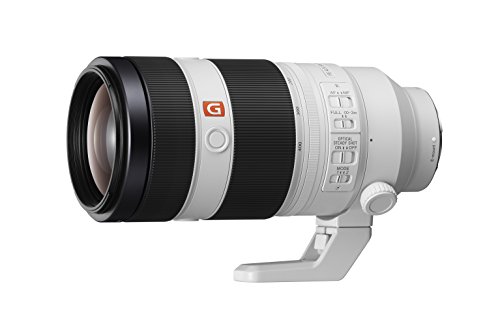 Sony FE 100-400mm F4.5-5.6 GM OSS White
- G Master design combines extraordinary sharpness and smooth…
- 35 mm full-frame.Double-linear and Direct Drive SSM for…
- Optical SteadyShot image stabilization significantly reduces blur
 Canon EF 100-400mm f/4.5-5.6L IS USM Telephoto
- 100-400mm telephoto zoom lens with f/4.5 maximum aperture…
- 2 Image Stabilizer modes make it easy to…
- Flourite and Super UD-glass elements largely eliminate secondary…
| Product | Key specs | |
|---|---|---|
| Canon RF 100-400mm F5.6-8 is USM | lightweight telephoto zoom boasting advanced optical image stabilisation… | Check price |
| Sony FE 100-400mm F4.5-5.6 GM OSS White | G Master design combines extraordinary sharpness and smooth… 35 mm full-frame.Double-linear and Direct Drive SSM for… Optical SteadyShot image stabilization significantly reduces blur | Check price |
| Canon EF 100-400mm f/4.5-5.6L IS USM Telephoto | 100-400mm telephoto zoom lens with f/4.5 maximum aperture… 2 Image Stabilizer modes make it easy to… Flourite and Super UD-glass elements largely eliminate secondary… | Check price |
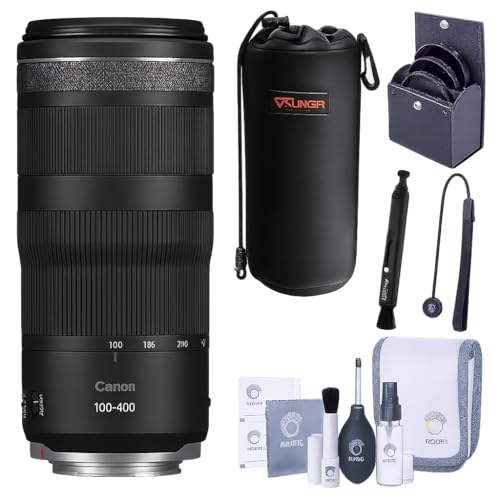 Canon RF 100-400mm f/5.6-8 is USM Lens Canon RF 100-400mm f/5.6-8 is USM Lens | Canon RF 100-400mm f/5.6-8 IS USM Lens |… RF-mount full-frame lens with an extended 100-400mm range,… Advanced optical design with one UD element and… | Check price |
As an Amazon Associate we earn from qualifying purchases at no extra cost to you.
Best 100–400mm lenses at a glance
| Lens | Mount and format | Maximum aperture | Weight | Stabilization | Typical market position |
|---|---|---|---|---|---|
| Canon RF 100-400mm F5.6-8 IS USM | Canon RF, full frame | f/5.6–8 | 635g | Up to 5.5 stops, camera-dependent | Lower-cost |
| Nikon NIKKOR Z 100-400mm f/4.5-5.6 VR S | Nikon Z, full frame | f/4.5–5.6 | 1,435g | Up to 5.5 stops | Premium |
| Sony FE 100-400mm F4.5-5.6 GM OSS | Sony E, full frame | f/4.5–5.6 | 1,395g | Optical SteadyShot | Premium |
| Fujifilm XF100-400mmF4.5-5.6 R LM OIS WR | Fujifilm X, APS-C | f/4.5–5.6 | 1,375g | Up to 5 stops | Upper mid-range |
| Panasonic Leica DG Vario-Elmar 100-400mm F4.0-6.3 II ASPH. | Micro Four Thirds | f/4–6.3 | 985g | Optical image stabilization | Upper mid-range |
| OM SYSTEM M.Zuiko Digital ED 100-400mm F5.0-6.3 IS | Micro Four Thirds | f/5–6.3 | 1,120g | Up to 3 stops optically | Mid-range |
| Sigma 100-400mm F5-6.3 DG DN OS Contemporary | Sony E or Leica L, full frame | f/5–6.3 | 1,140g | Optical stabilization | Mid-range |
Weights and stabilization figures can vary slightly by mount, firmware, and whether the camera combines lens stabilization with in-body stabilization. Always check the specification for your exact version before buying.
Which 100–400mm lens should you buy?
Best value for Canon full-frame mirrorless: Canon RF 100-400mm
The Canon RF 100-400mm F5.6-8 IS USM is the easiest recommendation for wildlife, outdoor sports, and travel when carrying comfort matters. At 635g, it weighs less than half as much as many professional 100–400mm lenses, yet provides a useful 400mm setting and fast, quiet Nano USM autofocus.
Its compromise is the relatively slow f/8 maximum aperture at the long end. In bright daylight, that is usually manageable. At a shutter speed of 1/1000 second for flying birds or field sports, however, you may need to raise ISO quickly. The lens accepts Canon’s RF 1.4x and 2x extenders only on compatible bodies? No—this lens is not designed for Canon’s RF extenders, so buyers should not plan on adding one. That makes its 400mm limit a real limit, although cropping a high-resolution image can still work well.
Best Nikon Z choice: NIKKOR Z 100-400mm VR S
Nikon’s Z 100-400mm f/4.5-5.6 VR S is the more serious wildlife and sports tool. It is brighter than the Canon RF lens, weather-sealed, optically refined, and equipped with a customizable control ring, display, and close-focusing capability. Its internal focusing design helps keep the lens balanced while the zoom range is changed.
The price is weight: approximately 1.4kg before adding a camera and strap. It is a better fit for frequent wildlife outings, demanding sports work, and photographers who regularly shoot in poor light. For occasional holidays, the smaller Nikon Z 180-600mm may offer more reach, but it is substantially larger and is not a substitute for a compact 100–400mm travel zoom.
Best premium Sony option: Sony FE 100-400mm GM
The Sony FE 100-400mm F4.5-5.6 GM OSS combines excellent edge-to-edge image quality, strong subject-tracking autofocus, a dual linear motor system, and a comparatively compact 1.4kg professional build. Its focus limiter, customizable buttons, and weather-resistant construction are useful for birds, motorsport, and field sports.
This is the strongest choice for Sony photographers who want a dependable native lens without moving to a heavier 200–600mm design. The downside is cost: it normally sits in the premium price bracket, often around $2,000–$2,500 depending on region and promotions. Sony’s 70–350mm G is much lighter for APS-C users, but it does not provide the same full-frame coverage or 400mm reach on a full-frame body.
Best for Fujifilm wildlife: XF100-400mm
On Fujifilm’s APS-C system, the XF100-400mm provides an angle of view similar to a 152–609mm lens on full frame. That extra apparent reach is valuable for distant birds and field sports, although depth of field and low-light performance should not be described as full-frame equivalents.
The lens uses a linear motor for autofocus, optical image stabilization, and weather-resistant construction. It is heavy for an APS-C setup, but the 609mm-equivalent maximum framing can reduce the need for a teleconverter. The newer Fujifilm XF150-600mm offers still more reach, while the XF70-300mm is easier to carry; the 100–400mm sits between them as a flexible specialist option.
Best reach per kilogram: Micro Four Thirds options
The Panasonic Leica 100-400mm II and OM SYSTEM 100-400mm both frame like 200–800mm lenses on Micro Four Thirds. That makes them especially attractive for wildlife photographers who need distant subject coverage without carrying a full-frame super-telephoto.
The Panasonic Leica version is the more polished choice for optical performance, construction, and dual image-stabilization compatibility on suitable Panasonic bodies. The OM SYSTEM lens is a practical alternative with a tripod collar included in many packages and useful weather protection. Both are slow at 400mm, so they work best in daylight or with cameras that tolerate higher ISO.
Head-to-head: reach, weight, autofocus, and stabilization
Reach
All of these lenses reach 400mm optically, but sensor format changes the framing. A 400mm lens on Micro Four Thirds gives a 800mm-equivalent field of view, Fujifilm APS-C gives roughly 609mm equivalent, and full-frame cameras give true 400mm framing. Equivalence describes field of view, not identical brightness or background blur.
Weight
The Canon RF 100-400mm is the clear portability winner at 635g. It is suitable for hiking, family travel, and photographers who will leave a heavy lens at home. The 1.1–1.4kg lenses are more stable in the hand during long sessions but demand a stronger strap and a more supportive camera bag. Add approximately 700–900g for a typical full-frame body, and a professional setup can approach 2.5kg.
Autofocus
For erratic birds and fast sports, prioritize a lens with a modern linear or ultrasonic motor, a focus limiter, and a camera with animal or vehicle subject detection. The Sony GM, Nikon S-line, and Canon USM lenses are particularly well matched to their manufacturers’ current mirrorless tracking systems. A lens cannot compensate for a camera with slow readout, unsuitable autofocus settings, or a shutter speed that is too low.
Stabilization
Optical stabilization helps with camera shake when photographing static subjects, but it does not freeze a running athlete or a bird in flight. For action, shutter speed matters more: start around 1/1000 second for birds and fast field sports, then adjust ISO and aperture. For perched birds or landscapes at 400mm, stabilization can make handheld shooting far easier.
Decision matrix by shooting situation
| Your situation | Best direction | Why |
|---|---|---|
| Lowest weight and occasional daylight use | Canon RF 100-400mm | 635g, strong stabilization, modest cost |
| Frequent professional wildlife or sports | Nikon Z 100-400mm or Sony FE 100-400mm GM | Brighter aperture, advanced autofocus, robust sealing |
| Fujifilm body and distant wildlife | XF100-400mm | About 609mm full-frame-equivalent framing |
| Maximum apparent reach in a small system | Panasonic Leica or OM SYSTEM 100-400mm | 800mm-equivalent field of view |
| Sony E or Leica L with a mid-range budget | Sigma 100-400mm DG DN OS | Useful reach and stabilization below premium pricing |
| Mostly travel, walking, and family use | Canon RF 100-400mm or a 70-300mm-class lens | Lower fatigue; 400mm is not always worth extra bulk |
How to set up a 100–400mm lens for wildlife or sports
- Set the shutter speed first. Use about 1/1000 second for fast action, 1/1600 second for birds in flight, or 1/500 second for slower subjects.
- Choose the widest practical aperture. This keeps ISO lower and separates the subject from the background. At 400mm, many lenses are limited to f/5.6, f/6.3, or f/8.
- Use continuous autofocus and subject tracking. Select animal, bird, human, or vehicle detection when your camera supports it.
- Limit the focus range when possible. A limiter prevents the lens from searching through its entire range when the subject is beyond a known distance.
- Stabilize your handling. Keep one hand beneath the lens, tuck your elbows in, and use a monopod or tripod collar for long events. Turn stabilization off when the camera is firmly locked on a tripod unless the manual recommends otherwise.
Ownership, durability, and common mistakes
Zoom rings and external barrels collect dust and grit first, especially when the lens is extended repeatedly on beaches, trails, or sports sidelines. Use a front filter only if it is high quality; a cheap flat filter can reduce contrast and create flare. A lens hood offers better protection against bumps and stray light.
Clean the front element with a blower before using a lens cloth. Do not rub sand across the coating. Check the mount, zoom ring, and tripod collar for looseness after heavy use, and keep firmware current when the manufacturer provides autofocus updates. Weather resistance is not waterproofing: avoid changing lenses in rain, dry wet equipment before storage, and use a sealed camera body if you expect harsh conditions.
The most common buying mistake is choosing by 400mm alone. If you photograph moving subjects in shade, a brighter 100–400mm can outperform a lighter f/8 lens despite its extra cost. If you hike several hours, the lightest lens may produce more usable photographs simply because you can carry and aim it comfortably. Match the lens to the camera mount first, then decide whether your priority is portability, low-light speed, autofocus, or maximum framing reach.
FAQ
Is a 100–400mm lens good for sports?
Yes, particularly for outdoor sports where subjects are separated from the photographer. Choose a brighter model for evening games or indoor arenas, because many 100–400mm lenses become f/5.6 to f/8 at 400mm.
Can I use a teleconverter with every 100–400mm lens?
No. Compatibility depends on the lens mount, optical design, and camera body. The Canon RF 100-400mm, for example, is not an RF-extender lens. Confirm compatibility before purchasing an extender; otherwise, plan to crop or choose a longer native lens.
Is 400mm enough for birds?
It is enough for larger birds, nearby wildlife, and many zoo or reserve situations. Small distant birds may require a crop-sensor body, a Micro Four Thirds system, a teleconverter-compatible lens, or a dedicated 500–600mm lens.