Key takeaways
- For feet and calves: A two-piece foot-and-calf system is a practical starting point if those are the only areas you want to compress. It is generally easier to store than thigh-length gear.
- For coverage up to the thighs: Choose a system with separate thigh, calf, and foot sections, and verify that the thigh wraps fit your measurements. More coverage usually means larger garments and more setup.
- For a first-time user: Look for clearly labeled intensity levels, a simple wired controller, and a default program that is easy to understand. Begin at the lowest setting.
- For frequent use or shared household use: Prioritize adjustable sizing, removable or wipe-clean liners where available, and replacement-wrap availability. Check the storage dimensions before choosing a multi-piece kit.
- For tight budgets: Basic foot-and-calf models commonly fall in the roughly $50–$150 range; more elaborate multi-zone or thigh-length systems can run from about $150 to $500 or more. These are broad market ranges, not a guarantee of current pricing.
Best Air Compression Leg Massagers: Choose by Coverage, Fit, and Routine
The best air compression leg massagers are the ones that cover the areas you want, fit your measurements without forcing the closures, and offer controls you can use comfortably. For full-leg coverage, compare thigh-length systems; for a smaller footprint and simpler setup, consider a calf-and-foot model. Before buying, check the maker’s size chart, pressure options, and whether the unit needs a nearby outlet.
Shortlist by situation
- For feet and calves: A two-piece foot-and-calf system is a practical starting point if those are the only areas you want to compress. It is generally easier to store than thigh-length gear.
- For coverage up to the thighs: Choose a system with separate thigh, calf, and foot sections, and verify that the thigh wraps fit your measurements. More coverage usually means larger garments and more setup.
- For a first-time user: Look for clearly labeled intensity levels, a simple wired controller, and a default program that is easy to understand. Begin at the lowest setting.
- For frequent use or shared household use: Prioritize adjustable sizing, removable or wipe-clean liners where available, and replacement-wrap availability. Check the storage dimensions before choosing a multi-piece kit.
- For tight budgets: Basic foot-and-calf models commonly fall in the roughly $50–$150 range; more elaborate multi-zone or thigh-length systems can run from about $150 to $500 or more. These are broad market ranges, not a guarantee of current pricing.
Compare the specifications that affect everyday use
Product specifications vary by model, and manufacturers do not all measure garments or pressure in the same way. The figures below are practical comparison targets, not specifications for a particular brand. Use each product’s current manual and sizing chart to confirm its actual measurements.
Our top picks

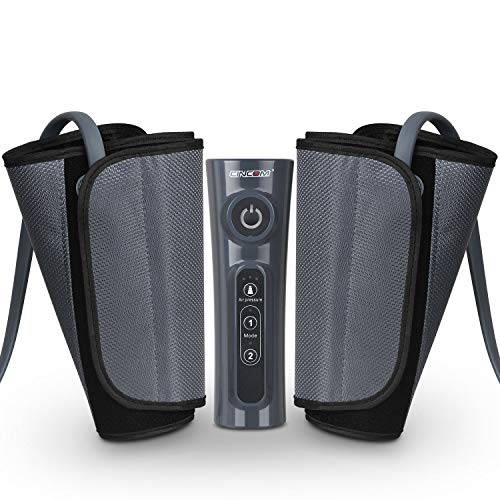


As an Amazon Associate we earn from qualifying purchases at no extra cost to you. Ratings are shown as listed on Amazon.
| System type | Typical coverage | Fit check | Useful control range | Storage planning |
|---|---|---|---|---|
| Foot and calf | Feet and lower legs; often 2 garments | Measure calf circumference at the widest point; check foot length if listed | About 3–5 intensity levels and 2–4 programs | Allow roughly 30 × 25 × 15 cm for folded wraps and controller, depending on design |
| Calf-focused boots | Lower leg, sometimes with a foot section | Check both calf circumference and leg length; a wide calf may need an extended-size option | About 3–6 levels and a timed session, commonly 15–30 minutes | Allow roughly 35 × 30 × 20 cm; hoses and cables may need separate coiling |
| Full leg | Foot, calf, and thigh sections | Measure foot, calf, thigh, and leg length where the maker requests them | About 3–6 levels, with zone selection or multiple sequences on some models | Allow roughly 45 × 35 × 25 cm or more for two wraps, hoses, and controller |
These approximate storage dimensions describe the space to plan for, not standardized packed sizes. If a listing gives only a “one size” label, ask for the garment’s usable circumference and length before ordering. A size that closes only when pulled taut is not a good fit.
How to choose: match the device to your routine
If you want a quick session with minimal setup
A foot-and-calf model usually has fewer pieces to position and put away. Check whether it has separate controls for the feet and calves; independent zones can be useful if you do not want both areas compressed in every session. A wired controller is often straightforward, but make sure its cable reaches your usual chair or resting spot.
If you want coverage above the knee
Look for full-leg garments that explicitly include thigh sections. “Leg massager” does not necessarily mean thigh coverage. More zones can offer flexibility, but they add closures, hoses, and setup time. Confirm that the wrap reaches the intended area on your leg rather than relying on a product photo, where fit can be difficult to judge.
If more than one person will use it
Prioritize a broad, clearly stated fit range and simple adjustments. Some systems use extension pieces, sold separately or included; check the package contents. For household sharing, wipe the interior according to the manual between users, and do not share a garment if doing so would create a fit or hygiene problem.
If you have little storage space
Measure a shelf or drawer before buying. A full-leg set may include two bulky wraps, a pump or controller, and connecting hoses. A compact calf-only model can be the better practical choice even if it covers less. Avoid folding garments sharply over seams or storing them with hoses kinked; repeated stress can damage closures and tubing.
Settings and fit: what to check before the first session
“Pressure level” is not a universal measurement. One brand’s level 3 cannot reliably be compared with another brand’s level 3, and some products do not publish pressure in mmHg. Compare the number of adjustable levels, zone controls, session timer, and whether the manual explains the program sequence. More settings are not automatically better if the controls are confusing.
- Measure the body areas named in the size chart while standing or sitting as instructed. Record measurements for each leg if the chart calls for them.
- Check the maximum circumference and garment length, not just a general size label. Allow the wrap to close without stretching the material or pressing its edges into the skin.
- Place the garments according to the manual, with hoses and cables free of twists. Start at the lowest intensity and stop if you feel pain, numbness, unusual tingling, or other concerning discomfort.
- Follow the stated session duration and rest guidance. Do not assume that a longer or stronger session is more beneficial.
For a simple fit calculation, compare your measurement with the manufacturer’s maximum usable circumference: if your calf measures 43 cm and the wrap’s published maximum is 42 cm, that model is not a suitable fit, even if its “large” label sounds promising. If your measurement is close to the limit, ask the manufacturer whether the figure allows comfortable closure rather than merely reaching the fastener.
Ownership details that listings can overlook
Closures, seams, hose connections, and the pump or controller are the parts most exposed to routine wear. Repeatedly pulling a wrap tight can strain hook-and-loop fasteners and stitching. Tugging on a hose instead of its connector can loosen the connection. Keep garments away from sharp objects, and store them dry and loosely folded.
Most consumer air-compression wraps are not designed to be machine-washed unless the manual explicitly says they are. Unplug the device before cleaning, use only the recommended method, and let garments dry completely before storage. If the system has removable liners, confirm whether replacements are available and whether they are included. Also check the warranty and the availability of replacement hoses or wraps; a low purchase price matters less if a worn garment makes the entire set unusable.
Before settling on a model, verify the return policy for worn or opened garments, the warranty length, power requirements, and what is included in the box. These details can matter as much as an extra program or intensity setting.
Safety and when to ask a professional
Air-compression leg massagers are consumer wellness devices, not a substitute for medical evaluation or prescribed treatment. If you have a vascular or heart condition, reduced sensation, a history of blood clots, recent surgery, or another condition that could affect circulation or skin safety, ask a healthcare professional before using one. Follow the product’s contraindications and stop use if you experience pain, skin changes, numbness, or unusual symptoms.
In short, choose coverage first, fit second, and controls and storage third. A correctly sized calf-and-foot unit may suit a simple routine; a full-leg system makes sense only if you want its additional coverage and have room to use and store it.