Key takeaways
- Compare the best workshop mats for garage bays and bench areas, from interlocking EVA foam tiles to heavy recycled rubber rolls, with thickness guidance.
A garage floor takes a quiet beating. Tool chest feet concentrate weight on four small points, dropped sockets chip bare concrete, brake and suspension work means long stretches kneeling on a cold slab, and an afternoon standing at the bench ends in sore feet and an aching back. Workshop mats address different parts of that problem depending on the material. Interlocking EVA foam tiles are light, inexpensive, and easy to lay in an afternoon. Recycled rubber rolls are heavier, tougher, and built for bays where equipment gets dragged, dropped, and rolled across the floor. This guide compares five options across both families for the home garage, the workbench zone, and the floor under parts storage.

As an Amazon Associate, we earn from qualifying purchases.
Quick answer
For most garage floors, interlocking foam tiles are the practical starting point: the ProsourceFit half-inch tiles cover a bench area in minutes and cushion standing and kneeling work. Thicker BalanceFrom tiles add comfort for floor-level jobs, We Sell Mats tiles cover large areas cheaply, and the IncStores and Rubber-Cal rubber rolls handle the heavy zones where foam would dent and tear.
ProsourceFit Puzzle Exercise Mat, 1/2 Inch
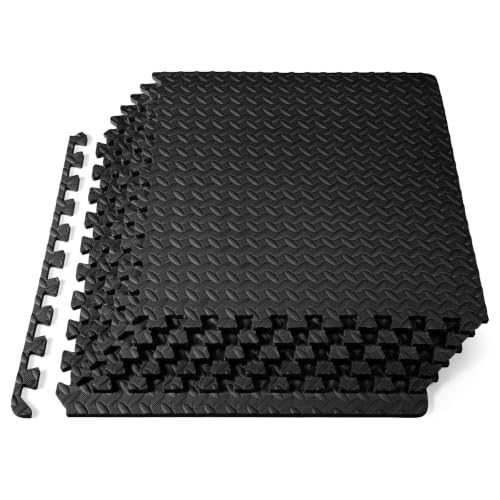
The ProsourceFit tiles are the default workshop foam pick, and the specification explains why. Each tile measures 24 by 24 inches at a half inch thick, and the six-tile pack covers 24 square feet, with detachable end borders included for clean, finished edges along walls and bench legs. The EVA foam carries a textured surface on both sides, which helps the tiles grip the subfloor and gives work boots traction when leaning into a stubborn fastener.
Installation is simple hand work: tiles press together by hand, trim to fit with a utility knife around obstacles, and lift individually if one gets damaged or soaked. The tile under a drain pan or beside the bench grinder wears faster than the rest, and replacing one tile beats replacing a floor. The foam cushions knees during low work, softens the landing for dropped hand tools, and takes the edge off noise from equipment feet.
The limits are the limits of all EVA foam. Heavy tool chest legs can leave permanent dents, and the listing itself warns that foam may compress slightly under heavy objects. Sharp dropped tools will nick the surface over time. Colors include black and gray, coverage expands one pack at a time, and within its role — standing zones, kneeling zones, and under light equipment — this is the easiest garage floor upgrade to live with.
BalanceFrom Puzzle Exercise Mat, 3/4 Inch
BalanceFrom takes the same interlocking tile format and adds thickness. At three-quarters of an inch, these EVA foam tiles carry noticeably more cushion than standard half-inch tiles, which matters for the garage jobs done at floor level: swapping a low exhaust section, wiring under a bench, or spending twenty minutes kneeling on concrete while a wheel comes off.
The pack includes six 24 by 24 inch tiles covering 24 square feet, plus end borders for a finished perimeter. The foam is high-density for a consumer tile, so it springs back better after heavy equipment is moved off it, and the textured surface keeps feet planted when pushing or pulling on stubborn fittings. BalanceFrom sells the line in several thicknesses and coverage sizes, which makes it easy to match the tile to the bay and add packs later.
Thicker foam is still foam: it softens impact rather than stopping it, and the extra cushion can feel slightly soft under a loaded workbench compared with thinner, denser surfaces. Rolling casters and creeper wheels also move less freely across deep foam, so traffic lanes are better served by a thinner tile or bare floor. For multipurpose garages where floor work, standing tasks, and moderate equipment share the same square footage, the added padding earns its place.
We Sell Mats Multipurpose EVA Foam Tiles, 3/8 Inch
We Sell Mats built its name on covering large areas affordably, and these multipurpose tiles show how. At three-eighths of an inch thick, they are the thinnest pick in this guide, which keeps the cost per square foot low and makes them easy to cut, carry, and store. The 24 by 24 inch tiles interlock with the familiar puzzle edge and come in a wide range of colors, a detail that helps in garages shared with storage or laundry.
The thinner profile suits them to light duty: a separation layer over cold concrete in a storage aisle, padding under shelving and parts bins, walkways between benches, and zones where the goal is a cleaner, warmer surface rather than impact absorption. They also work as a base layer under a heavier dedicated mat at a single workstation, so the expensive cushion sits only where feet actually stand.
They are not the choice for dropped tools, heavy bench feet, or caster traffic, and the manufacturer is upfront that foam tiles are designed around bodyweight use rather than equipment loads. Buyers who understand that brief get a great deal of coverage for the money, with the flexibility to expand bay by bay and replace single worn tiles as they age.
IncStores Heavy Duty Gym Flooring Rubber Rolls, 3/8 Inch
When the garage work involves real weight, rubber replaces foam, and the IncStores rolls are the heavy-duty option here. These rolls are made from recycled rubber at three-eighths of an inch thick, a density and weight class that foam cannot approach. Rubber in this thickness absorbs dropped tools and hardware, deadens noise from compressors and bench equipment, and gives workbenches and storage racks a stable, non-slip footing that does not dent, creep, or wander.
Rolls arrive four feet wide in several lengths, so a garage work bay or the floor in front of a long bench can be covered with very few seams, and the material trims with a sharp utility knife and a straightedge. The speckled finish hides dust, grit, and wear well, and the surface sweeps and mops clean after messy jobs — a practical advantage over foam tiles, whose seams trap dirt.
The trade-offs are weight, cost, and odor. Rubber rolls are heavy to position, cost more per square foot than any foam tile, and new recycled rubber carries a smell that takes days of ventilation to fade. Installation is a two-person job in most garages. For a workshop built around heavy equipment, none of that outweighs the protection: this flooring keeps concrete intact under years of work.
Rubber-Cal Recycled Rubber Flooring Roll, 1/4 Inch
Rubber-Cal approaches rubber flooring as a cut-to-length material. The recycled rubber rolls are four feet wide and sold in many lengths at a quarter inch thick, so a buyer can cover a long narrow aisle between storage racks, a lane in front of a bench row, or a full garage bay with minimal waste. The quarter-inch profile keeps the rolls manageable to move and position while still providing real rubber protection against scuffs, dropped hand tools, and machine feet.
Recycled rubber brings the usual benefits: strong grip even when dusty, good sound dampening compared with bare concrete or foam, and a surface that tolerates the temperature swings of an unheated garage or outbuilding. Rubber-Cal sells the same material in several thicknesses, so a heavier equipment zone can step up within the same product family and keep a consistent look across the room.
At a quarter inch, this roll is a protective surface rather than an impact zone: repeated drops of heavy hardware belong on thicker rubber. New rolls also carry the characteristic recycled rubber odor at first, so plan ventilation time before closing the garage up. For workshops that need exact coverage, durable material, and a cleaner, seam-light look than interlocking tiles give, the cut-to-length format is the practical advantage here.
How to choose
Match the material to the load first. Foam tiles serve standing zones, kneeling work, and light equipment; rubber serves heavy benches, rolling loads, and anything that gets dropped. Thickness follows the same logic: three-eighths to a half inch of foam for general coverage, three-quarters where floor-level work dominates, and at least three-eighths of an inch of rubber under the heaviest stations.
Measure the bay and buy coverage with a margin for cuts and mistakes, remembering that tiles cover in four-square-foot units and rolls in four-foot widths. Consider the subfloor too: foam over carpet compresses unevenly, while rubber lies flat almost anywhere. Keep casters in mind — deep foam slows rolling creepers and tool carts, so leave traffic lanes thin or bare.
Two safety points matter in a working garage. First, foam tiles are not a lifting surface: jacks and stands belong on bare concrete or rated rubber, never on compressible foam. Second, check the exact model against the CPSC recall database before ordering, and plan a few days of ventilation for new foam or recycled rubber, since both off-gas an odor at first.
Who should skip
Garages that live on rolling traffic — creepers, carts, and caster chairs crossing the floor all day — should skip thick foam entirely and look at thin rubber or bare sealed concrete. Anyone whose only problem is one standing spot at one bench should skip a full floor and buy a single standing mat instead. And if the floor’s real problem is oil and solvent spills rather than comfort, mats are the wrong purchase: a sealed or coated floor handles chemicals better than any tile laid over them.
Frequently Asked Questions
Are foam tiles or rubber rolls better for a garage workshop?
Rubber is better wherever heavy equipment is involved: it is denser, resists dents from bench and tool chest feet, and survives dropped tools that would cut foam. Foam tiles win on cost, cushioning, and easy installation, and they suit standing zones, kneeling work, and light equipment. Many garages combine both, rubber under the heavy stations and foam everywhere else.
How thick should a workshop mat be?
For foam, a half inch is the standard for general use, and three-quarters of an inch adds comfort for floor-level work like brake jobs and low cabinet tasks. For rubber under heavy benches and equipment, three-eighths of an inch is the practical minimum. Thickness alone is not protection, though: material density matters as much as the number on the box.
Can workshop mats go over carpet or uneven floors?
Foam tiles over carpet usually disappoint, because the carpet compresses unevenly and the tiles separate and shift underfoot. Low-pile carpet under heavy rubber rolls fares better, since the weight of the rubber holds everything in place, but the surface never feels as solid as flooring laid on concrete, wood, or tile. Hard, flat subfloors give the best result for both materials.
How are workshop mats cleaned and maintained?
Foam tiles wipe down with a damp cloth and mild soap, and individual tiles lift out for deeper cleaning or replacement when one wears through. Rubber rolls and mats sweep clean and tolerate mopping with a neutral cleaner; avoid harsh solvents that dry the rubber out. Giving new flooring a few days of ventilation before regular use reduces the initial odor from both foam and recycled rubber.
Final verdict
Most garage workshops should start with foam tiles for general coverage, and the ProsourceFit and BalanceFrom tiles split the difference between value and cushion, while We Sell Mats stretches a budget across the biggest rooms. The moment heavy benches, tool chests, and dropped hardware enter the picture, rubber takes over: IncStores rolls for the hardest-working zones, Rubber-Cal for exact cut-to-length coverage. Measure honestly, match the material to the heaviest thing that will stand or fall on it, and the floor will outlast the equipment above it.
Product and ASIN Reference
| Product | ASIN |
|---|---|
| ProsourceFit Puzzle Exercise Mat, 1/2 Inch | B00B4IHXRU |
| BalanceFrom Puzzle Exercise Mat, 3/4 Inch | B074J6Y2JL |
| We Sell Mats Multipurpose EVA Foam Tiles, 3/8 Inch | B00HX7513O |
| IncStores Heavy Duty Gym Flooring Rubber Rolls, 3/8 Inch | B0098NCFJO |
| Rubber-Cal Recycled Rubber Flooring Roll, 1/4 Inch | B0CYHGJ7J4 |
More from Amazon
Programs that pair well with the guide above. Offers and eligibility are set by Amazon and may change.
Free shipping on eligible items, Prime Video and more. Eligible new members can start with a free trial.
Start a Prime free trialAudiobooks and podcasts to listen to on the go. Eligible new members can start with a free trial.
Try Audible freeAd-free music streaming. Eligible new subscribers can start with a free trial.
Try Music Unlimited freeA free business account with business pricing and bulk-buying tools for work, shop or home office.
Create a business accountAs an Amazon Associate we earn from qualifying purchases.