Key takeaways
- The best rinseless wash products compared: dilution ratios, what each formula leaves behind, and how to wash safely with two gallons of water.
Disclosure: As an Amazon Associate, I earn from qualifying purchases.
A rinseless wash lets you clean a car with a single bucket of water and a stack of microfiber towels — no hose, no rinse step, and no runoff running down the driveway. You mix a small amount of concentrate into about two gallons of water, wash one panel at a time with a soaked towel or sponge, and dry that panel immediately before moving on. It is the go-to method for apartment and condo owners, drivers under water restrictions, and anyone washing inside a garage in winter.
Know the limits before you buy. Rinseless washing is designed for light to moderate dirt: dust, pollen, road film, and a week or two of normal driving grime. Caked mud, heavy winter salt crust, and gritty off-road splatter still need a hose or pressure-washer pre-rinse first — dragging a towel through that kind of grit is how swirl marks happen, no matter which bottle you bought. The five concentrates below differ mainly in dilution strength, what they leave behind on the paint, and how many jobs one bottle can do.
How to Choose
Dilution ratio decides running cost. Most rinseless concentrates mix at 1 ounce per 2 gallons of water (256:1), so a 32-ounce bottle yields roughly 32 bucket washes. Wolfgang Uber stretches further at 1 ounce per 3 gallons. A stronger dilution is not automatically better — it just means you measure less per bucket — but it does change how long a bottle lasts.
Decide what you want left behind. Some formulas are pure cleaners that leave nothing on the surface, which is ideal if you already have a wax, sealant, or ceramic coating you do not want to alter. Others add gloss-enhancing polymers or even carnauba wax, topping up shine as you wash. Neither approach is wrong; the mistake is buying a wash-and-wax product and then wondering why your coating’s water behavior changed.
Polymer versus surfactant formulas. Polymer-based washes (Optimum, P&S, Wolfgang) are the traditional style and tend to feel very slick. Surfactant-based formulas like McKee’s N-914 are popular as paint-prep washes because they leave no film. Makers say their polymers “encapsulate” dirt — treat that as marketing language for lubricity. What actually protects your paint is plenty of solution, light pressure, and fresh towel faces.
Look at the extra dilutions. Most of these bottles also mix into a clay-bar lubricant, a quick detailer, or a stronger waterless spray. If you clay your car or keep a detail spray in the trunk, one concentrate can replace two or three separate products.
Mind your water. If your tap water is hard, a formula with water-softening ability (P&S Absolute, and N-914 as a bucket additive) reduces the spotting risk that comes with a wash method where nothing gets rinsed away.
The 5 Best Rinseless Wash Products
Optimum No Rinse Wash & Shine (ONR), 32 oz

Specs
- Size: 32 fl oz concentrate (model NR2010Q, Version 5 formula)
- Rinseless dilution: 1 oz per 2 gallons of water (256:1)
- Also mixes as: clay-bar lubricant, quick detailer, and waterless spray
- Formula type: polymer-based; no wax or sealant added
- Listed for: paint, ceramic coatings, glass, and interior surfaces
ONR is the product that defined this category, and it is still the default recommendation for a reason. The polymer solution feels slick under a towel, releases dirt from wash media back into the bucket reasonably well, and dries without leaving gloss enhancers behind, so the finish you see afterward is your own wax or coating. Because one bottle also covers clay lube and detail-spray duty, it is the simplest single purchase for a minimal kit. If you want a proven, do-everything concentrate, start here.
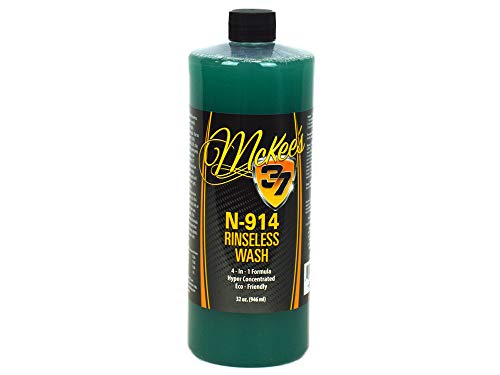
McKee’s 37 N-914 Rinseless Wash V2, 32 oz
Specs
- Size: 32 fl oz concentrate (model MK37-585)
- Rinseless dilution: 1 oz per 2 gallons of water (256:1)
- Also mixes as: waterless wash and clay lube at 128:1; strong mix works as a paint-prep spray
- Formula type: surfactant-based; leaves no wax, gloss enhancer, or film behind
- Scent: green apple
N-914 takes the opposite philosophy from the polymer washes: it cleans and leaves absolutely nothing behind, so it never changes how your existing wax, sealant, or coating looks or beads water. That purity is also why detailers use a stronger mix of it to strip polishing oils before applying a coating. Lubricity is genuinely high for a surfactant formula, and dirt releases from towels into the bucket noticeably well. Choose it if your car already wears protection you like.
P&S Absolute Rinseless Wash, 1 Quart

Specs
- Size: 32 fl oz (1 quart) concentrate (product code F3632)
- Rinseless dilution: 1 oz per 2 gallons of water (256:1)
- Formula notes: polymer blend that emulsifies dirt and softens the wash water
- Surface range: paint, ceramic coatings, vinyl wraps, PPF, and interior surfaces
- Also mixes as: clay lubricant and spray-and-wipe detailer
Absolute is the pick for hard-water areas. P&S builds water-softening chemistry into the formula, which matters more with rinseless washing than with a hose wash, because every drop of solution stays on the panel until you dry it — dissolved minerals are exactly what turn into spots. The listing also covers a wider surface range than most rivals, including wraps, paint protection film, and interior plastics and screens, so one bucket can handle the whole car inside and out. If spotting has ruined previous rinseless attempts for you, this is the formula designed around that problem.
Wolfgang Uber Rinseless Wash, 16 oz

Specs
- Size: 16 fl oz concentrate (model WG-3700)
- Rinseless dilution: 1 oz per 3 gallons of water — the most concentrated wash here
- Waterless dilution: 1/3 oz per 16 oz of water
- Formula type: gloss-enhancing polymers that leave a slick, just-waxed feel
- 4-in-1 use: rinseless wash, waterless wash, clay lubricant, quick detailer
Uber is the gloss lover’s option. Its polymers are blended with gloss enhancers, so panels come away feeling noticeably slicker than with a pure cleaner, closer to a wash-and-wax result without actual wax in the bottle. The 1-ounce-per-3-gallons dilution is also the most economical per bucket in this group, which softens the fact that the bottle is only 16 ounces. The trade-off is that those gloss agents sit on top of whatever protection you already have, so coating purists should look at N-914 instead.
Optimum No Rinse Wash & Wax, 32 oz

Specs
- Size: 32 fl oz concentrate
- Rinseless dilution: 1 oz per 2 gallons of water (256:1)
- Added protection: genuine carnauba wax with UV protectants
- Formula type: polymer wash that leaves a wax layer behind as you dry
- Same core wash system as ONR Wash & Shine, plus the wax component
This is the wash to pick when the car has no other protection and you want cleaning and a basic wax layer in one pass. Each panel you wash and dry gets a thin coat of carnauba, which restores some warmth and water beading to neglected paint and buys a few weeks of light protection between proper wax jobs. The honest caveat: a wash-applied wax layer is thin and short-lived compared with a dedicated paste or spray wax, and you should not use it on a ceramic-coated car, where the wax can mute the coating’s behavior.
Usage Notes
- Pre-soak heavily soiled lower panels with a spray bottle of wash solution before your towel touches them, and always pre-rinse if there is visible grit, mud, or salt crust.
- Work panel by panel, drying each one as you go. Rinseless solution left to air-dry will spot, especially in sun or with hard water.
- Use multiple plush microfiber towels folded into sections, or a dedicated rinseless sponge, and retire a towel face as soon as it looks dirty. Never wring a filthy towel back into your only bucket and keep going on the next panel.
- Wash in shade on a cool panel whenever possible; heat speeds evaporation and streaking.
- Wheels, tires, and exhaust tips come last, with separate towels you do not use on paint.
FAQ
Can a rinseless wash scratch my paint?
It can if the car is too dirty or the technique is sloppy. The solution’s lubricity reduces friction, but the real protection comes from light pressure, plenty of liquid on the panel, and switching to a clean towel face often. On light-to-moderate dirt with that technique, rinseless washing is considered paint-safe by the makers of every product above.
How dirty is too dirty for a rinseless wash?
Visible mud, sand, heavy salt buildup, or grit you can feel thick on the lower panels is too dirty. Rinse that off with a hose or pressure washer first, then finish rinseless if you like. Dust, pollen, water spots, and normal road film are squarely in rinseless territory.
Do I need two buckets or a grit guard?
Not strictly — the classic rinseless method uses one bucket and many towels, discarding each towel after use rather than re-dunking it. If you use a sponge or mitt that goes back in the bucket, a grit guard at the bottom is a sensible precaution so loosened dirt stays out of the media.
Can I use a rinseless wash on a ceramic-coated car?
Yes, and it is a popular maintenance method for coatings. Pick a formula that leaves nothing behind, such as McKee’s N-914 or standard ONR, so the wash does not mask the coating’s own water behavior. Avoid wash-and-wax versions on coated cars.
What is the difference between rinseless and waterless washing?
Rinseless washing uses a bucket of diluted concentrate and a soaked towel, then drying — no hose rinse. Waterless washing uses a ready-to-spray product and towels only, with no bucket at all. Waterless is for very light dust and touch-ups; rinseless handles a genuinely dirty car more safely because the panel stays flooded with lubricating solution.
Conclusion
For most people, the choice comes down to what you want left on the paint. Optimum No Rinse Wash & Shine is the versatile all-rounder, McKee’s 37 N-914 is the purist option that leaves nothing behind, and P&S Absolute solves the hard-water spotting problem. Wolfgang Uber adds the most gloss per wash, while Optimum No Rinse Wash & Wax covers cars that need a little wax laid down as they are cleaned. Whichever you choose, respect the method’s limits — pre-rinse real grit, work one panel at a time, and dry as you go.
More from Amazon
Programs that pair well with the guide above. Offers and eligibility are set by Amazon and may change.
Free shipping on eligible items, Prime Video and more. Eligible new members can start with a free trial.
Start a Prime free trialAudiobooks and podcasts to listen to on the go. Eligible new members can start with a free trial.
Try Audible freeAd-free music streaming. Eligible new subscribers can start with a free trial.
Try Music Unlimited freeA free business account with business pricing and bulk-buying tools for work, shop or home office.
Create a business accountAs an Amazon Associate we earn from qualifying purchases.