Key takeaways
- Bolt-on vs weld-on exhaust tips compared on fit, install effort, durability and looks, with five real tips showing what each mounting style does best.
Disclosure: As an Amazon Associate, I earn from qualifying purchases.
An exhaust tip is the cheapest visible upgrade at the back of a car, and the first decision has nothing to do with style: how does it attach? Bolt-on (and clamp-on) tips slide over your existing tailpipe and fasten with bolts, set screws or a band clamp. Weld-on tips are fused to the pipe with a welder and become a permanent part of the exhaust. Both can look identical once installed, but they differ in fit tolerance, effort, total cost and how they age.
Let’s set expectations first, because tip marketing rarely does: a tip is cosmetic. It does not add horsepower, and it does not meaningfully change exhaust sound. A long or resonated tip can take a slight edge off the tone, but if you want a different note, that comes from the muffler, not the last few inches of pipe. What a tip does change is how finished the rear of the car looks — and how much work it takes to get there.
The Core Difference
A bolt-on tip is a reversible sleeve. It slips over the tailpipe, you center it, tighten the hardware, and you are done in the driveway with basic hand tools. If you sell the car, lease-return it, or simply change your mind, it comes back off. The trade-off is that the joint is mechanical: hardware can loosen with heat cycles and vibration, the sleeve can sit slightly crooked if the pipe is short or curved, and there is always a visible seam where tip meets pipe.
A weld-on tip is a permanent extension. A shop (or a confident home welder) cuts or cleans the tailpipe end, slips the tip on, and welds the joint all the way around. The result is seamless, perfectly aligned, and it will never rattle loose or get stolen with a wrench. The trade-off is commitment: removal means cutting, the install costs shop labor if you do not weld, and a bad weld on thin tailpipe metal can burn through or rust at the seam.
Neither is universally better. Bolt-on wins on flexibility and total cost for most daily drivers. Weld-on wins when the exhaust is already being built or repaired at a shop, when the tailpipe is an odd shape that sleeves fit poorly, or when you want a large-diameter, show-quality finish with zero visible hardware.
How to Choose
Measure the tailpipe first. This is the step people skip, and it causes most returns. Tip sizes are listed by inlet diameter, and the inlet must match the outside diameter of your tailpipe. Measure with calipers or wrap a strip of paper around the pipe, mark it, and divide the length by 3.14. Bolt-on tips tolerate a small range because the clamping hardware takes up slack; weld-on tips need a closer match because the welder bridges only a small gap.
Check the length you have to work with. A tip needs enough straight pipe to slide onto. Bolt-on tips typically need several inches of straight tailpipe before any bend or muffler body. Weld-on tips can go on shorter stubs because the weld itself holds them, and a shop can trim the pipe to suit.
Pick your stainless grade. Most quality tips are T304 or T409 stainless. T304 has more chromium and nickel, stays bright longer, and resists rust best — it is the grade to choose in road-salt country. T409 is magnetic, costs less, and will develop surface discoloration over time, though it rarely rusts through. Chrome-plated steel tips look great on day one but the plating can pit and peel where heat and road spray hit hardest.
Single wall vs double wall. Single-wall tips are a single rolled tube: lighter, cheaper, and the edge can look thin. Double-wall tips fold a second layer at the outlet, giving a thick, finished lip that reads as premium and hides the raw edge. Rolled edges serve the same purpose on single-wall designs.
Count the real cost. For bolt-on, the real cost is the tip plus fifteen minutes. For weld-on, add shop labor for cutting and welding if you cannot do it yourself — often comparable to the tip itself.
Think about the exit style. Slant (angle) cuts shed water and suit sporty cars; straight cuts with rolled edges suit trucks and classic builds; dual-outlet tips need a pipe wide enough to feed them.
Five Tips That Show Both Sides
1. Wesdon Bolt-On Rolled Slant Tip, 2.5-Inch Inlet (Bolt-On)

A big, polished bolt-on for drivers who want maximum visual change with zero commitment. The 5-inch outlet and 12-inch length give it real presence, and the rolled slant edge finishes the opening cleanly. It is the bolt-on formula at its best: measure, slide, tighten, done.
Specs:
– Inlet: 2.50 inches; outlet: 5.00 inches; overall length: 12.00 inches
– Attachment: bolt-on over the existing tailpipe
– Material: polished 304 stainless steel
– Edge style: rolled slant (angle cut)
– Manufacturer part number: WBOSS50012-250-RS-SS
2. HEVLE Adjustable Bolt-On Exhaust Tip (Bolt-On)

The problem-solver of the group. Its inlet adjusts across a range of tailpipe sizes instead of demanding one exact diameter, which makes it a sensible pick when your pipe measures between standard sizes or you are not fully sure of the measurement. The shorter body suits cars where the tailpipe exits close to the bumper.
Specs:
– Inlet: adjustable, fits tailpipes roughly 2.5 to 3.3 inches
– Overall length: about 5.5 inches
– Attachment: bolt-on with adjustable clamping
– Material: stainless steel with chrome-plated finish
– Edge style: rolled edge, straight cut
3. YITAMOTOR Bolt-On Diesel Truck Tip, 4-Inch Inlet (Bolt-On)
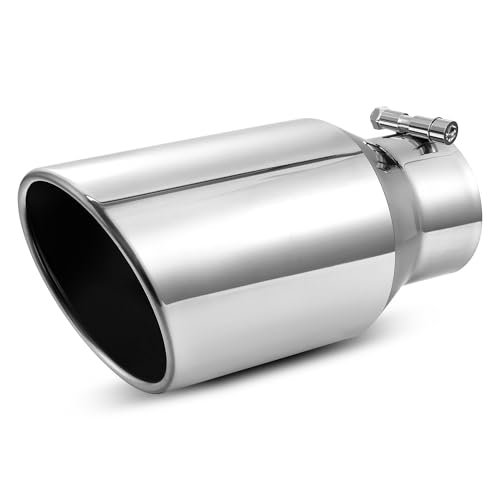
Diesel trucks run larger pipe, and this tip is built for it: a 4-inch inlet stepping out to a 6-inch outlet across 12 inches of polished stainless. Bolt-on hardware scales up fine when sized correctly — but a tip this size is pure theater, and on a working truck a weld-on joint tolerates vibration and knocks better long-term.
Specs:
– Inlet: 4 inches; outlet: 6 inches; overall length: 12 inches
– Attachment: bolt-on
– Material: stainless steel, polished silver finish
– Edge style: rolled angle cut
– Intended use: diesel truck tailpipes
4. LCGP Double Wall Weld-On Tip, 2.5-Inch Inlet, Pair (Weld-On)

The weld-on case in miniature. These short double-wall tips are designed to disappear into a custom exhaust build: the rolled, angled outlet gives a thick finished lip, the T304 stainless matches quality aftermarket piping, and once welded there is no clamp to loosen, align or steal. Sold as a pair for dual-exit setups. Professional welding is recommended, as the listing itself notes.
Specs:
– Inlet: 2.5 inches; outlet: 4 inches; overall length: 5 inches
– Attachment: weld-on (professional installation recommended)
– Material: T304 stainless steel, polished
– Construction: double wall, angled cut with rolled edge
– Quantity: 2 pieces; manufacturer part number SH254005DAC-Dou
5. Upower Dual-Outlet Weld-On Tip, 2.5-Inch Inlet (Weld-On)

A single tailpipe wearing a dual-outlet tip only looks right when the alignment is perfect — exactly the situation welding is for. This Upower piece splits one 2.5-inch inlet into twin 3.5-inch double-wall outlets with a slant edge, and the welded joint lets a shop clock it level and center it in the bumper cutout before committing.
Specs:
– Inlet: 2.5 inches; outlets: dual 3.5 inches; overall length: 9.5 inches
– Attachment: weld-on
– Material: 304 stainless steel, polished finish
– Construction: double wall, slant (angle) cut edge
– Wall thickness: 1.2 mm
Install Notes
For bolt-on tips: clean the tailpipe first — rust scale and soot keep the sleeve from seating evenly. Slide the tip on, rotate it until the cut angle sits level, then tighten the hardware in stages, checking alignment from behind the car as you go. Re-check the fasteners after a week of heat cycles; most bolt-on rattles trace back to hardware that loosened as it settled. A dab of anti-seize on the bolts makes future removal far less miserable.
For weld-on tips: this is shop work unless you own a MIG welder and have practiced on thin tubing. The pipe end must be cut square and cleaned to bright metal, the tip tacked in position and checked for alignment, then welded around the joint. The seam is the first place rust will start, so high-temperature paint on the joint is cheap insurance. Either way, let the exhaust cool completely first, and never work under a car supported only by a jack.
FAQ
Does an exhaust tip change the sound or add power?
No to power, and almost no to sound. A tip is downstream of everything that makes power and nearly everything that shapes the note. Long or resonated tips can soften the tone very slightly, but expectations should stop there.
My tailpipe is slightly oval or curved. Which style fits better?
Weld-on, usually. Bolt-on sleeves need a round, reasonably straight section of pipe to clamp evenly. A shop can trim a curved or damaged pipe end back to a clean stub and weld a tip on square.
Can a bolt-on tip fall off?
It can if the hardware loosens and is never re-checked. Tighten it properly, re-check after the first week, and it will stay put for years. Weld-on tips cannot loosen, which is one reason shops prefer them on trucks that see rough roads.
Which stainless grade should I choose for winter salt?
T304. It costs a little more but keeps its finish and resists pitting far better than T409 or chrome-plated steel in salty, wet conditions.
Can I weld a tip on myself with a cheap welder?
Thin tailpipe metal burns through easily, and a porous weld rusts fast. If you have not welded thin tubing before, paying a muffler shop for the short job is the better spend.
Conclusion
Choose bolt-on if you want the look today, the option to remove it tomorrow, and the lowest total cost — and measure your tailpipe outside diameter before ordering anything. Choose weld-on if the car is already at a shop, the pipe end is an awkward shape, or you want a seamless, permanent finish that never needs re-tightening. Either way, spend the difference on better stainless rather than bigger claims: a T304 tip that still shines in three winters beats a flashy outlet that rusts by spring.
More from Amazon
Programs that pair well with the guide above. Offers and eligibility are set by Amazon and may change.
Free shipping on eligible items, Prime Video and more. Eligible new members can start with a free trial.
Start a Prime free trialAudiobooks and podcasts to listen to on the go. Eligible new members can start with a free trial.
Try Audible freeAd-free music streaming. Eligible new subscribers can start with a free trial.
Try Music Unlimited freeA free business account with business pricing and bulk-buying tools for work, shop or home office.
Create a business accountAs an Amazon Associate we earn from qualifying purchases.