Our Top Picks


Disclosure: As an Amazon Associate, I earn from qualifying purchases.
When the cabin and trunk fill up, extra luggage has to ride outside the vehicle, and there are two classic places to put it: a basket hanging off the rear hitch, or a box or bag strapped to the roof. Both work, and both are sold with headline numbers that flatter them. A hitch carrier advertises its basket capacity, a roof box advertises its cubic feet, and neither number tells you the limit that actually governs your vehicle.
This comparison works through the real constraints on each side — tongue weight versus roof load rating, loading height, weather protection, security and the effect on fuel use — then shows five representative products, from folding steel baskets to a hard roof box, so you can see what each format looks like in practice.
The Core Difference
A hitch cargo carrier moves the load low and behind the vehicle. That position is easy to reach, easy to load, and almost free of wind noise, but everything in the basket counts against your hitch’s tongue weight rating, and the load sits exposed to road spray, exhaust heat and anyone walking past in a parking lot. The carrier also needs a receiver hitch in the first place.
Roof cargo moves the load high and above the vehicle. It leaves the rear hatch, lights and plate completely clear and locks up inside a hard shell if you choose a box, but every item has to be lifted overhead, the vehicle’s roof load rating — often far lower than people expect — caps the total, and the box adds height that matters in garages and parking structures.
Neither is universally better. The right answer depends on which limit your vehicle gives you more of, what you are carrying, and who has to load it.
How to Choose
Start with the governing limit, not the product rating. On the hitch side, the carrier’s own rating is not your limit — the vehicle’s tongue weight rating is, and it is usually the lower number. The carrier’s weight counts too: a heavy steel basket plus its cargo all presses down on the hitch, and many family SUVs are rated for only a few hundred pounds of tongue weight in total. On the roof side, the same logic applies in reverse: the box’s weight plus its contents must stay under the roof load rating in your owner’s manual, and that rating includes the crossbars.
Check what hardware you already have. A hitch carrier needs a receiver, most often 2 inch on trucks and larger SUVs; 1.25 inch receivers exist on smaller cars and sharply limit carrier size and capacity. A roof box needs crossbars. A roof bag is the flexible option: many strap to rails, crossbars or even door frames on a bare roof.
Think about loading height honestly. Hitch baskets load at knee to waist height, which suits heavy, awkward items — coolers, totes, a folded stroller. Roof cargo means lifting every bag overhead, sometimes from a step stool, and doing it again at every stop. If one person loads the vehicle alone, this is often the deciding factor.
Match weather protection to the cargo. An open hitch basket protects nothing by itself; pair it with a waterproof cargo bag or accept that luggage gets road film and rain. A soft roof bag is weather resistant but depends on careful zipper and flap placement. A hard roof box is the only format that shrugs off a full day of highway rain without extra help.
Mind the exhaust and the rear of the vehicle. On hitch carriers, keep heat-sensitive cargo away from the exhaust path — a tailpipe aimed at the basket can melt plastic totes and scorch bags on long climbs. A loaded carrier can also block the license plate and rear lights in some states, so check local rules and add a light kit if yours covers them. Roof cargo has its own clearance issue: measure your total height before entering a garage.
Plan for security at stops. Lock the carrier to the hitch with a locking pin and cable-lock the load; baskets are open and exposed by design. A hard roof box locks shut and hides contents, which makes it the better choice for overnight stops with gear you cannot bring inside.
Five Products That Show the Two Formats
CURT 18153 Basket-Style Hitch Cargo Carrier

The benchmark steel hitch basket: big, folding, and heavy enough that its own weight is a real line item in your tongue weight math.
Specs
- Basket size: 60 x 23.5 x 5.5 inches with 6-inch sides
- Capacity: 500 lb distributed load rating
- Construction: tubular steel with black powder coat finish and mesh base
- Fitment: 2-inch receiver, folding angled shank for ground clearance and storage
- Item weight: about 70 lb
MaxxHaul 70108 Aluminum Hitch Cargo Carrier
The aluminum answer to the CURT’s weight: a smaller basket that trades platform size for a much easier one-person install and no rust worries.
Specs
- Basket size: 49.25 x 22.5 x 7.25 inches outside; 47.25 x 20.25 x 6 inches inside
- Capacity: 500 lb distributed load rating
- Construction: extruded aluminum basket over a steel under-support frame
- Fitment: 2-inch Class III and IV receivers
- Details: high side rails with tie-down points and reflector lenses
MeeFar Hitch Mount Cargo Carrier Bag, 16 Cubic Feet
The weather fix for either basket above: a soft waterproof bag shaped to fill a 60-inch hitch basket, turning an open platform into covered storage.
Specs
- Capacity: 16 cubic feet, sized 58 x 24 x 19 inches
- Material: waterproof soft-shell construction with welded-style seams
- Attachment: 8 reinforced straps sized for steel cargo baskets
- Use: drops into standard hitch baskets; folds flat for storage
- Note: the bag protects against weather, not heat — keep it clear of the exhaust tip
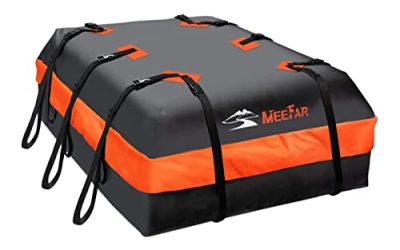
MeeFar Rooftop Cargo Carrier Bag, 21 Cubic Feet
The roof side’s flexible option: a large soft bag that works with or without a rack, then rolls away into a closet between trips.
Specs
- Capacity: 21 cubic feet
- Fitment: vehicles with or without a roof rack
- Included: anti-slip mat, 10 reinforced straps, 6 door hooks and a luggage lock
- Material: waterproof soft-shell fabric
- Storage: folds down small when empty, unlike a hard box
Yakima RocketBox Pro 14 Rooftop Cargo Box

The hard-shell roof option: lockable, weather-shedding and openable from either side of the car, at the cost of permanent storage space in your garage.
Specs
- Capacity: 14 cubic feet
- Access: dual-side opening for loading from either side of the vehicle
- Security: SKS lock cores included
- Mounting: tool-free clamps fitting most crossbar shapes
- Construction: rigid ABS shell, aerodynamic profile
Install and Use Notes
Whichever side you choose, do a short test load at home rather than a first attempt in a hotel parking lot. For a hitch carrier, fit an anti-rattle device or tighten the hitch pin properly — a loaded basket that rocks will fatigue straps and annoy everyone in the car — and confirm the load clears the exhaust outlet with room to spare. Weigh the carrier and cargo together against your tongue weight rating before the trip, not after a failure.
For roof cargo, load the heaviest items low and centered between the crossbars, keep the total under the roof rating including the box itself, and re-check strap or clamp tension after the first few miles. With a roof bag on a bare roof, the anti-slip mat goes down first and door hooks must seat on clean metal, or the bag will walk at highway speed.
On both formats, stop early in the drive and check everything once. Straps settle, bags shift, and the first fuel stop is the cheapest inspection you will ever do.
FAQ
Which carries more weight, a hitch carrier or a roof box?
Usually the hitch carrier, but only if your vehicle allows it. Baskets are commonly rated at 500 lb, yet the vehicle’s tongue weight rating — minus the carrier’s own weight — is the true ceiling. Roof ratings are typically much lower, so roof cargo suits bulky, light items like bedding and duffel bags.
Does roof cargo hurt fuel economy more than a hitch carrier?
Generally yes. A roof box or bag sits in the airflow and adds drag at highway speed, while a hitch basket rides in the vehicle’s wake. The difference grows with speed; around town it is minor either way.
Can I open my rear hatch with a hitch carrier fitted?
With a fixed basket, usually not fully — the load sits right behind the hatch. Folding carriers fold up when empty rather than tilting away loaded, so plan on unloading before wide hatch access. Roof cargo never blocks the hatch.
Is a roof bag as waterproof as a hard box?
No. A good bag with the zipper flap positioned away from the wind-driven rain survives most weather, but a hard box is the dependable choice for all-day rain. Put moisture-sensitive items in dry bags inside either format on long wet drives.
What if my car has neither a hitch nor roof rails?
A roof bag with door hooks is designed for exactly that case, used with its anti-slip mat. Adding a receiver hitch is the other route, but check the vehicle’s tongue weight rating first — some small cars are not rated for carrier use at all.
Conclusion
Choose the hitch carrier when your vehicle has the tongue weight headroom, your cargo is heavy or awkward, and you load it yourself: nothing beats waist-height loading. Choose roof cargo when the rear must stay clear, the load is bulky but light, or locked weatherproof storage matters more than easy access. In both cases, the vehicle’s rating — not the number printed on the product box — is the limit that counts.
More from Amazon
Programs that pair well with the guide above. Offers and eligibility are set by Amazon and may change.
Free shipping on eligible items, Prime Video and more. Eligible new members can start with a free trial.
Start a Prime free trialAudiobooks and podcasts to listen to on the go. Eligible new members can start with a free trial.
Try Audible freeAd-free music streaming. Eligible new subscribers can start with a free trial.
Try Music Unlimited freeA free business account with business pricing and bulk-buying tools for work, shop or home office.
Create a business accountAs an Amazon Associate we earn from qualifying purchases.