Key takeaways
- Cargo bag vs cargo carrier: compare weather protection, security, mounting and storage to pick the right rooftop hauler for your car and trips.
Disclosure: As an Amazon Associate, I earn from qualifying purchases.
When the trunk is full and the back seat is spoken for, the roof is the last big storage space most cars have. The cargo bag vs cargo carrier decision comes down to two very different ways of using that space: a soft bag that straps to the roof and folds away afterward, or a hard-shell carrier (often called a roof box) that clamps to crossbars and locks shut. Both add roughly the same usable volume, but they differ sharply in weather protection, security, mounting requirements, and what you do with them between trips. This guide explains the differences, then lines up three bags and two hard carriers.
The Core Difference
A cargo bag is a flexible shell made from PVC-coated fabric. It has no frame and no fixed shape: it takes the shape of whatever you pack into it, seals with a zipper under a storm flap, and attaches with straps. Those straps can wrap around roof rails or crossbars, or hook to the door frames of a car with a completely bare roof. When the trip ends, the bag empties, folds flat, and goes in a closet or a corner of the garage.
A hard cargo carrier is a rigid box, usually molded ABS plastic, with a hinged lid and a lock. It only mounts one way: clamped to crossbars. In return it holds its aerodynamic shape whether full or nearly empty, sheds weather better, and gives you a lockable, crush-resistant space. The trade-off is that it is a large rigid object year-round, and it cannot go on a car that has no rack.
How to Choose
Start with your roof. If your car has no rails or crossbars and you do not want to add them, the bag is the only option of the two. If you already have crossbars, both formats are open to you.
Next, be honest about weather. Hard carriers keep water out more reliably. Bags are built from waterproof fabric with welded seams, but in practice they are water-resistant rather than sealed: on a long drive in heavy rain, water can work in through the zipper and seams. Whatever must stay dry inside a bag should be packed inside a plastic liner bag first.
Security splits the two formats cleanly. A box locks, and while no lock makes theft impossible, a rigid locked shell is a real deterrent and also keeps gear from being crushed. A bag offers at most a small luggage lock on the zipper, which is a token gesture; do not leave valuables in a bag on an unattended car.
Think about storage and frequency. Occasional users usually prefer a bag because it disappears between trips. Frequent travelers, skiers, and anyone carrying fragile items usually prefer a box because it loads faster, rides quieter, and shrugs off weather.
Finally, respect the roof load limit. Every vehicle maker states a maximum roof load in the owner’s manual, covering the carrier and everything inside it combined. A heavy box eats into that budget before you pack a single item, so check the number for your car, and never exceed it.
The Products
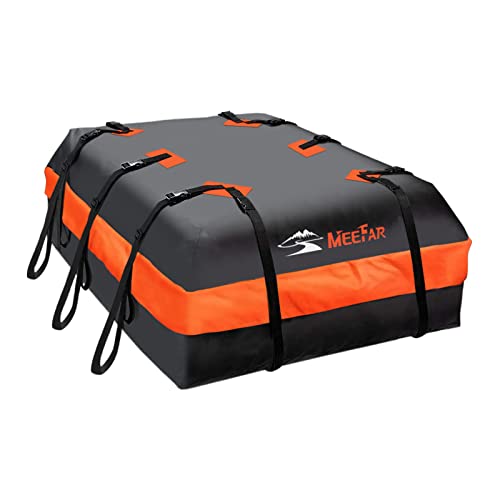
MeeFar Car Roof Bag XBEEK, 20 Cubic Feet
Specs
- Capacity: 20 cubic feet
- Dimensions: 51 x 40 x 17 inches
- Mounting: straps for rack use, plus 6 door hooks for cars without a rack
- Included: anti-slip mat, 10 reinforced straps, luggage lock, storage bag
- Shell: soft waterproof PVC fabric, model MF-BAG-PP
The XBEEK is the bag format in its most complete form: a large soft shell with everything in the carton, including the anti-slip mat that should always sit between a bag and painted roof. Twenty cubic feet swallows soft luggage, sleeping bags, and camping gear for a family trip. Like every bag here, it rests directly on the roof when no rack is fitted, so the mat matters, and its door hooks clip under the door frames.
FIVKLEMNZ Rooftop Cargo Carrier Bag, 21 Cubic Feet

Specs
- Capacity: 21 cubic feet
- Dimensions: 52 x 40 x 17 inches
- Material: 840D PVC fabric
- Mounting: reinforced straps plus 6 door hooks, with or without a rack
- Included: anti-slip mat, luggage lock, storage bag
- Weight: about 10 lb
The FIVKLEMNZ bag is a close rival to the MeeFar, with a slightly larger rated volume and a heavy 840D PVC shell. It makes the same basic bargain as every soft bag: maximum space and rack-free mounting in exchange for modest security and weather sealing that depends on the zipper flap staying put. Pack it evenly, keep hard corners away from the fabric, and treat the included luggage lock as a zipper keeper rather than theft protection.
RoofPax XXL Rooftop Cargo Carrier Bag, 28 Cubic Feet

Specs
- Capacity: 28 cubic feet
- Dimensions: 52 x 46 x 24 inches
- Mounting: 10 heavy-duty tie-down straps and 4 patented door hooks
- Material: 1680D PVC fabric with welded seams
- Included: combination lock and storage bag
- Model: MRP-BAG28
The RoofPax XXL shows how far the bag format stretches: at 28 cubic feet it holds more than most hard boxes, and its door-hook straps are designed for vehicles with no rack at all. That size is a mixed blessing. A bag this tall catches wind, and dense gear can approach a smaller vehicle’s roof load limit faster than owners expect. It suits big SUVs and bulky, light loads such as bedding, tents, and winter clothing.
Thule Pulse Cargo Box, Large (615)

Specs
- Capacity: 16 cubic feet
- Exterior dimensions: 76 x 33 x 16.5 inches
- Weight: 36 lb
- Shell: hard ABS plastic, weather resistant
- Mounting: FastGrip quick-mount clamps on crossbars (rack required)
- Security: central locking system, passenger-side opening
- Load capacity: up to 165 lb of gear
The Pulse is the hard carrier format at its most straightforward: a rigid ABS box that clamps onto crossbars in minutes, locks with a central locking system, and opens from the passenger side for curbside loading. Sixteen cubic feet is less than the big bags above, but every cubic foot is dry, lockable, and protected from crushing. Remember that the box itself weighs 36 lb, and that weight counts against your roof load limit before any gear goes in.
Yakima SkyBox 16 Carbonite

Specs
- Capacity: 16 cubic feet
- Exterior dimensions: 81 x 36 x 15 inches
- Weight: 47 lb
- Shell: hard ABS with Carbonite textured lid
- Opening: dual-sided, with SKS lock cores
- Long-gear fit: skis and snowboards up to 180 cm
- Mounting: quick-install clamps for crossbar spreads of 24 to 36 inches (rack required)
The SkyBox 16 Carbonite is the box to look at if your cargo includes long gear. Its 81-inch length takes skis and snowboards up to 180 cm, the lid opens from either side of the car, and the SKS locks can be matched to other Yakima accessories. It is also the heaviest product in this comparison at 47 lb, which underlines the box format’s main cost: convenience and protection on the road, paid for with weight and storage bulk at home.
Usage and Buying Notes
Whichever format you choose, how you load and secure it matters more than the badge on it. With a bag, always use the anti-slip mat on a bare roof; a loaded bag shifting even slightly will scuff paint over a long drive. Load the heaviest items in the middle, keep the shape low and even, and tuck the zipper flap down so wind cannot lift it. Stop and re-check every strap after the first few miles and again at fuel stops, because straps stretch and loads settle as you drive.
If your car has no rack, the bag’s straps run through the door frames on hooks, and the strap webbing sits against the door seals. That works, but in heavy rain water can wick along the straps past the seals and drip inside, so route straps carefully and expect the possibility on a long wet drive.
With a hard box, confirm your crossbar spread falls in the box’s clamp range before ordering, and measure garage door clearance with the box fitted; a tall SUV plus a roof box does not fit every garage. Center the load, use the internal straps, and check the clamps after the first stop, the same habit as with a bag.
FAQ
Can I use a cargo bag or a cargo box on a car with no roof rack?
A cargo bag, yes: bags are designed to mount with door hooks on bare roofs. A hard cargo carrier, no: boxes clamp to crossbars, so a rack is required first.
Which keeps gear drier, a cargo bag or a hard cargo carrier?
A hard carrier. Its rigid lid and seals keep rain out more reliably, while a bag’s zipper and seams can let water in during a long wet drive. In a bag, pack anything that must stay dry inside a plastic liner.
How much weight can I put on my roof?
Only as much as your vehicle maker allows. The roof load limit in your owner’s manual includes the carrier itself plus all cargo, so a 47 lb box leaves less of the budget for gear than a 10 lb bag.
Is a hard cargo box more secure than a roof bag?
Yes. A box has a rigid shell and a real locking system, which deters casual theft and protects contents from being crushed. A bag’s small luggage lock only keeps the zipper closed and should not be relied on for valuables.
Which is easier to store when it is not on the car?
The bag, by a wide margin. It folds into its own storage bag and fits in a closet. A hard box needs a garage wall, ceiling hoist, or floor space, and stays the same size all year.
Conclusion
Choose a cargo bag if your car has no rack, your trips are occasional, and your cargo is soft and bulky; you get the most space for the least storage hassle, and the three bags above show the format at 20, 21, and 28 cubic feet. Choose a hard cargo carrier if you have crossbars and travel often, carry skis or fragile gear, or need lockable, weather-shedding storage; the Thule Pulse and Yakima SkyBox 16 are the format’s benchmarks. Either way, load within your roof’s rated limit, protect the paint, and re-check straps or clamps early in every drive.
More from Amazon
Programs that pair well with the guide above. Offers and eligibility are set by Amazon and may change.
Free shipping on eligible items, Prime Video and more. Eligible new members can start with a free trial.
Start a Prime free trialAudiobooks and podcasts to listen to on the go. Eligible new members can start with a free trial.
Try Audible freeAd-free music streaming. Eligible new subscribers can start with a free trial.
Try Music Unlimited freeA free business account with business pricing and bulk-buying tools for work, shop or home office.
Create a business accountAs an Amazon Associate we earn from qualifying purchases.