Our Top Picks

Disclosure: As an Amazon Associate, I earn from qualifying purchases.
Once the trail gets dark, stock headlights run out of reach and width long before the obstacles do. That is why auxiliary LED lighting is one of the first upgrades off-road drivers make — and the first decision is the format. Do you bolt on one long LED light bar, or a pair of compact pod lights?
Both use the same basic technology: LED chips in an aluminum housing behind a polycarbonate lens, wired to the truck’s 12V system. What differs is packaging, mounting, and beam spread. A bar concentrates everything into one wide fixture. Pods split the output into small, aimable units you can point forward, angled out as ditch lights, or backward as scene lighting.
One rule applies to both: most auxiliary bars and pods are sold for off-road use and are not DOT-approved for highway driving. Many states restrict when they can be switched on, and some require covers on public roads. Check your local rules before you install, wire any auxiliary light through a relay and a fuse as the maker instructs, and never run either format in a way that blinds oncoming traffic.
The Core Difference
A light bar is a single fixture, typically 6 to 52 inches long, with LEDs in one, two, or three rows. Because all the chips share one housing and one set of optics, a bar throws one continuous wall of light. Long bars with spot or combo optics are the distance champions: a 30- or 50-inch combo bar lights a straight trail farther than any pair of small pods can. Bars also need only one mounting location and one wiring run.
Pod lights (also called cubes) are small fixtures, usually 3 to 4.5 inches, sold in pairs. Each pod has its own bracket and aims independently. That flexibility is the point: pods fit places a bar cannot — A-pillar ditch-light brackets, fog lamp pockets, rear bumpers, roof rack corners — and a pair angled outward covers the trail edges a forward-facing bar leaves dark. Pods are modular, too: start with one pair, add another later, and mix patterns and colors.
The trade-offs mirror each other: a bar is simpler to buy, mount, and wire; pods give aiming freedom and staged upgrades, but each pair adds brackets and wiring.
How to Choose
Start with the job, not the product. For long, open trails where seeing far ahead matters most, a combo or spot bar wins. For tight trails where you need to see rocks and ruts at the edges, pods aimed outward are more useful. Many drivers run both: a bar for distance plus ditch pods for width.
Beam pattern matters more than raw numbers. Spot optics throw a narrow, long beam; flood optics spread light wide and short; combo optics mix both, which is why most bars and many pods use them. Treat headline lumen figures as maker claims rather than measurements — a well-opticed 20-inch bar will out-throw a cheap 50-inch bar with inflated numbers.
Size and mounting. Measure before ordering. Bars need a bumper slot, grille opening, or roof mount wide enough for the housing plus brackets, and roof mounting adds wind noise and hood glare. Pods need far less room but a bracket per location; A-pillar brackets are vehicle-specific, so confirm fitment.
Wiring and switching. Wire every setup with a harness that includes a relay and an inline fuse, per the maker’s instructions, with the switch inside the cab. Big bars draw serious current — a 420W bar on 12V pulls around 35 amps — so wire gauge and relay rating must match the load. Pod pairs draw less per circuit, but multiple pairs still need their own fused circuits.
Weather sealing and build. Look for at least an IP67 rating, an aluminum housing that doubles as a heat sink, and a polycarbonate lens. Heat management decides lifespan: fins and housing mass matter more than the chips themselves.
Legality check. Confirm your state or local rules on auxiliary lights — mounting height, number of lights, cover requirements, on-road use. When in doubt, treat both formats as off-road-only.
The 5 Setups Compared
1. Nilight 20 Inch 126W LED Light Bar — the starter bar
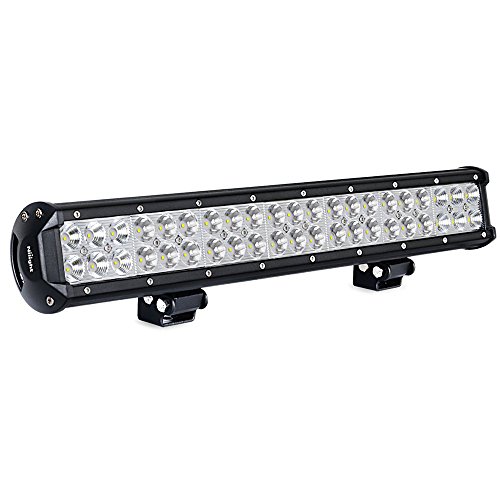
The classic entry point into the bar format: 42 LEDs in a slim 20-inch housing that fits most bumper openings and bull bars, with a combo beam mixing forward reach and side spread for slow trails and rural roads.
Specs
- Length: 20 inches
- Power: 126W (42 x 3W high-intensity LEDs)
- Beam pattern: spot/flood combo
- Color temperature: 6000K–6500K pure white
- Input voltage: 9–30V DC (12V and 24V vehicles)
- Housing: 6063 aluminum profile, polycarbonate lens
- Waterproof rating: IP67
2. Auxbeam 32 Inch 270W 5D Pro LED Light Bar — the distance pick
A step up in size and optics. The 32-inch bar’s 5D projector-style lenses focus the combo beam for more reach down the trail, and the kit includes a 10-foot wiring harness. This is the format at its best: one fixture, one mount, maximum forward light.
Specs
- Length: 32 inches
- Power: 270W
- Output: 33,000 lumens (maker-stated)
- Optics: 5D Pro lens with high-intensity chips
- Beam pattern: spot/flood combo
- Included: 10 ft wiring harness kit
- Voltage: 12V DC systems
3. Auxbeam X-Series 52 Inch 300W LED Light Bar — the full-width roof bar

The maximum version of the format: a 52-inch bar for a roof or full-width bumper mount on a full-size truck. One hundred LEDs in a combo pattern throw the widest single-fixture wall of light here, with a daytime running light built in. It is also the biggest installation job of the five.
Specs
- Length: 52 inches
- Power: 300W (100 x 3W CREE LEDs)
- Output: 30,000 lumens (maker-stated)
- Beam pattern: combo (spot and flood)
- Extra: integrated DRL function
- Mounting: roof or full-width bumper (brackets vehicle-dependent)
- Voltage: 12V DC systems
4. Auxbeam 4 Inch 18W LED Pod Lights, Pair — the flexible starter pods
The pod format in its simplest form: two small flood-beam cubes that mount almost anywhere. They work well as ditch lights or wide bumper fill, and their low draw makes wiring simple. Flood optics mean width rather than distance — pair them with distance lighting for fast trails.
Specs
- Size: 4 inch pods, sold as a pair
- Power: 18W per pod
- Output: 1,800 lumens per pod (maker-stated)
- Beam pattern: flood
- Mounting: adjustable brackets included
- Voltage: 12V DC systems
5. Auxbeam V-Ultra 3 Inch 108W Amber Fog Pods — the dust and weather pods

Pods show their versatility here: a compact pair with amber output for dust, fog, and snow, where white light washes out the trail. Side shooters spread light to roughly 270 degrees, the daytime running light has three modes, and protective covers are included.
Specs
- Size: 3 inch pods, sold as a pair
- Power: 108W per pair (maker-stated)
- Beam pattern: hyper spot with 270° side shooters
- Color: amber fog output
- Modes: 3-mode DRL function
- Included: protective covers
- Voltage: 12V DC systems
Notes on Installation and Legal Use
Whichever format you choose, the installation rules are the same. Disconnect the battery before wiring. Run the harness through a relay triggered by your dash switch, with the fuse as close to the battery as the harness design allows, and route cables away from heat and sharp edges. Follow the maker’s instructions for your kit — wire gauge is matched to the light, and substituting thinner wire is how harnesses overheat.
Aim matters as much as output. Aim bars and pods slightly downward and check the pattern against a wall before tightening down. Ditch pods should light the trail edges, not the trees.
On legality, treat this as a pre-purchase step, not fine print: many of these products state plainly that they are not DOT approved and are for off-road use only. States differ on how many auxiliary lights you may run, where they can mount, and whether uncovered lights on public roads draw a ticket. Covers — included with the V-Ultra pods above — are legally required in some places. And the courtesy rule is absolute: if another vehicle is coming, your lights go off.
FAQ
Is a light bar brighter than pod lights?
Per fixture, yes — a long bar packs far more LEDs into one housing, so it throws more total light down the center of the trail. But pods aimed in different directions can cover a wider total area. Bars win on forward distance; pods win on coverage flexibility.
Can I run a light bar or pods on the highway?
In most places, no. Most auxiliary bars and pods are not DOT approved, and many states prohibit using them on public roads or require covers. Check your state and local regulations, and switch auxiliary lights off around other traffic.
Do I need a relay and fuse, or can I wire straight to the battery?
Use the relay and fuse. A relay lets a small dash switch control a high-current circuit safely, and the fuse protects the harness and truck if a wire shorts. Most quality harnesses include both.
Are amber pods actually better in dust and fog?
Amber light scatters less in dust, fog, and snow than 6000K white light, so it produces less glare back at the driver. That is why amber pods are popular as the weather-focused pair in a two-format setup.
How many amps will a big bar draw?
Divide watts by volts: a 300W bar on 12V draws about 25 amps, a 420W bar about 35 amps. Your harness, relay, and switch must all be rated above that figure.
Conclusion
Choose a light bar for the simplest route to maximum forward light: one fixture, one mount, one wiring run — the 20-inch Nilight is the easy starting point, and the larger Auxbeam bars scale the same idea up. Choose pods if your trails are tight, mounting space is limited, or you want to build in stages and aim light where a bar cannot reach. Either way, wire through a relay and fuse, aim responsibly, and keep auxiliary lights off around other traffic.
More from Amazon
Programs that pair well with the guide above. Offers and eligibility are set by Amazon and may change.
Free shipping on eligible items, Prime Video and more. Eligible new members can start with a free trial.
Start a Prime free trialAudiobooks and podcasts to listen to on the go. Eligible new members can start with a free trial.
Try Audible freeAd-free music streaming. Eligible new subscribers can start with a free trial.
Try Music Unlimited freeA free business account with business pricing and bulk-buying tools for work, shop or home office.
Create a business accountAs an Amazon Associate we earn from qualifying purchases.