Key takeaways
- Wobbling pulley, slipped timing marks or cracked rubber? Compare five proven harmonic balancers for GM, Honda and diesel trucks, plus install rules.
Disclosure: As an Amazon Associate, I earn from qualifying purchases.
The harmonic balancer bolted to the nose of your crankshaft does two jobs at once: it drives the accessory belt, and its rubber-isolated outer ring absorbs the torsional vibration every power stroke sends down the crank. When the rubber bond ages out, the part gives you clear warnings — a visible wobble at idle, timing marks that no longer line up because the outer ring has slipped on the hub, and rubber that is cracked, swollen or squeezing out between the rings. Treat those signs seriously. A ring that separates completely can throw the ring or the belt at speed, taking out the radiator, hoses or wiring on its way. This is a replace-now part, not a monitor-it part. The five balancers below are direct OE-style replacements for common GM, Honda and diesel applications.
How to Choose
Match the OE number, not just the model name. Balancers are engine-specific. Two trucks with the same badge can carry different dampers because the accessory drive spacing differs — GM’s LS family is the classic example, with truck, F-body and Corvette crank snouts placing the belt line at different depths. Cross-reference the original part number stamped in your catalog listing before ordering, and confirm the replacement lists that number.
Know whether your engine is internally or externally balanced. Some engines are externally balanced through the balancer and flexplate, which carry offset weight as part of the rotating assembly’s balance. On those engines the replacement must match the engine’s balance spec exactly — a neutral-balance damper on an externally balanced crank (or the reverse) creates a vibration problem worse than the one you were fixing. If your engine is externally balanced, that requirement is not optional fine print.
Check the construction and the details. Most OE-style balancers use an elastomer ring bonded between the hub and the inertia ring; that is the correct design for a stock replacement. Note whether the part has degree markings if you set timing with a light, whether a woodruff key is included, and whether the listing is for the balancer alone. Plan on a new crank bolt at the same time — on many engines it is torque-to-yield and single-use.
The 5 Best Harmonic Balancers
1. Dorman 594-220 Engine Harmonic Balancer

Specs:
– OEM cross numbers: 12564100, 12571619, 12574399, 12578069
– Interchange: PB1536N
– Construction: steel hub and inertia ring with stress-resistant rubber bond
– Fitment: GM LS 4.8L, 5.3L and 6.0L truck and SUV applications
The 594-220 is the go-to replacement for the LS-powered Silverado, Sierra, Tahoe, Yukon and Escalade generation, an application where the original damper’s rubber ring is a well-known wear item after high mileage and heat cycles. Dorman builds it as a direct replacement matching the original’s fit and function, with a rubber bond rated for strong tensile and impact resistance. If your truck has developed a front-end chirp, a wobbling crank pulley or a belt that keeps walking, this is the first part to inspect and the straightforward fix when the ring has started to separate.
2. A-Premium APHMB084 Engine Harmonic Balancer

Specs:
– OEM cross numbers: 12553118; Dorman interchange 594-127
– Fitment: Chevrolet Camaro 1998–2002 5.7L, Pontiac Firebird 1998–2002 5.7L, Pontiac GTO 2004 5.7L and 2005–2006 6.0L
– Degree markings: none
– Installation hardware included; serpentine drive
Same LS family as the pick above, different balancer — the F-body and GTO accessory drive sits at a different depth than the truck drive, and this is the damper built for that spacing. A-Premium supplies it with installation hardware in the box and a one-year unlimited-mileage guarantee. It is a useful reminder of the core rule for this part category: an LS balancer is not an LS balancer. Order by the OE number for your chassis, not by engine displacement alone, or the belt line will not line up when everything goes back together.
3. Dorman 594-267 Engine Harmonic Balancer

Specs:
– OEM cross numbers: 13810RCAA01, 13810RJA003
– Interchange: PB1545N, SK594267
– Fitment: Honda Accord 2003–2007, Odyssey 2005–2010, Pilot 2005–2008, Ridgeline 2006–2008; Acura MDX 2003–2009, TL 2004–2008, RL 2005–2008; Saturn Vue 2004–2007
– Fit type: vehicle-specific direct replacement
Honda’s J-series V6 powers a huge share of the Accords, Odysseys and Pilots still on the road, and its crank pulley is a documented separation risk as the rubber ages — a failed one can leave the belt drive dead and, on interference engines, turn a cheap part into an expensive day. The 594-267 is Dorman’s direct replacement, built around a stress-resistant rubber bond and matched to the original’s dimensions. Because this balancer also carries the crank position reluctor relationship on these engines, using the correct application-specific part matters more than usual; verify your year and trim against the fitment list.
4. A-Premium APHMB148 Engine Harmonic Balancer
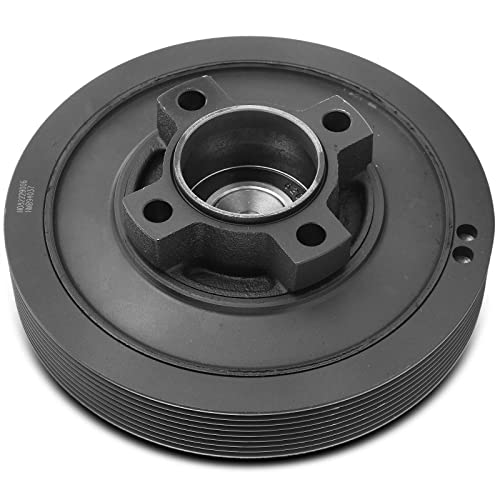
Specs:
– OEM cross numbers: 12557345; Dorman interchange 594-037
– Fitment: GM 6.5L diesel applications — Chevrolet and GMC trucks, Express and Savana vans, Tahoe, Yukon and Suburban, diesel only
– Item weight: 9.9 pounds
– Package dimensions: 9.09 x 8.15 x 3.43 inches
The GM 6.5L diesel is hard on crankshaft dampers: diesel torsional pulses are stronger than a gasoline engine’s, and a tired balancer on this engine is a genuine crankshaft-health issue, not just a noise complaint. This A-Premium unit is the diesel-specific replacement, cross-referenced to the 594-037 application — note that it does not interchange with the gasoline balancers for the same trucks. The extra mass compared with the four-cylinder pick below reflects the damping work this engine asks of the part. On a 6.5, inspect the rubber at every belt service and replace at the first sign of cracking or ring movement.
5. A-Premium APHMB165 Engine Harmonic Balancer

Specs:
– OEM cross numbers: 13810P3F003; Dorman interchange 594-354
– Fitment: Honda CR-V 1997–2001, 2.0L four-cylinder
– Item weight: 7.76 pounds
– Package dimensions: 8.15 x 7.13 x 3.11 inches
First-generation CR-Vs are now old enough that original crank pulleys are living on borrowed time, and this is the correct B-series replacement, cross-referenced to Honda’s 13810P3F003. It is a standard elastomer-style damper matched to the original’s fit, the right answer for a stock engine — resist the temptation to substitute a lightweight pulley here, for the reasons covered in the notes below. A-Premium backs it with a one-year unlimited-mileage guarantee. If your CR-V has a chirping belt, a wobbling pulley or visible rubber cracking at the crank, this is the part that ends the problem.
Usage and Buying Notes
Never hammer a balancer on or off. Driving a balancer onto the crank snout with a hammer — or beating the old one off — can damage the crankshaft’s thrust bearing and the threads in the crank nose. Use a proper harmonic balancer puller to remove it and a dedicated installer tool, which draws the balancer on squarely using the crank bolt threads, to fit the new one. These tools are inexpensive and are the difference between a clean job and a crankshaft repair.
Replace the crank bolt and follow the torque spec. On many modern engines the crank bolt is torque-to-yield: it is tightened to a torque value plus an additional angle, stretches in service, and is single-use. Reusing one risks it loosening or snapping. Fit a new bolt and follow the manufacturer’s torque-plus-angle procedure exactly.
An underdrive pulley is not a balancer. Lightweight “underdrive” pulleys delete or shrink the damping mass to free a small amount of response. That trades crankshaft longevity for it — the torsional vibration the damper existed to absorb goes back into the crank, bearings and timing drive. On a street engine, keep a real damper.
Verify before the first start. After fitting, rotate the engine by hand and confirm the timing marks line up where they should, check the belt tracks straight on every pulley, and watch the balancer run at idle for the first minute — it should spin true with no visible wobble.
FAQ
What are the signs a harmonic balancer is failing?
The classic trio: a visible wobble of the crank pulley at idle, timing marks that no longer line up because the outer ring has slipped relative to the hub, and rubber that is cracked, swollen, bulging or missing between the hub and ring. Belt chirps, unexplained belt wear and a new vibration at cruise rpm often arrive with them.
Can I keep driving with a wobbling balancer?
No — treat it as a replace-now repair. The wobble means the rubber bond is already failing. If the outer ring separates at speed it can throw the ring or the belt into the radiator, hoses and wiring, and on a diesel or an externally balanced engine the undamped vibration is also working on the crankshaft itself.
Do I need a new crank bolt when I replace the balancer?
In most cases, yes. Many crank bolts are torque-to-yield and explicitly single-use: they are tightened to a torque plus an angle and stretch permanently. A new bolt is cheap insurance against the balancer walking loose. Check your service manual — if it gives a torque-plus-angle spec, replace the bolt.
Is an underdrive pulley an upgrade over a stock balancer?
It is a different part with a different purpose. An underdrive pulley is a plain lightweight pulley; it does not damp torsional vibration. Removing the damping may sharpen throttle response slightly, but it returns that vibration to the crankshaft, bearings and timing components full-time. For a street-driven engine, a correct OE-style damper is the right choice.
How do I make sure the replacement matches my engine’s balance?
Cross-reference the OE part number rather than shopping by engine name. If your engine is externally balanced, the balancer carries part of the balance weight and the replacement must be the externally balanced version for that exact application — the catalog listing will state the balance type. When a listing does not state it, choose a different listing that does.
Conclusion
A harmonic balancer is cheap insurance for an expensive crankshaft, and it announces its failure clearly: wobble, slipped timing marks, tired rubber. Match the replacement to your engine by OE number, respect the balance spec, fit it with a puller and installer rather than a hammer, and use a fresh crank bolt torqued to spec. Do those things and any of the five dampers above will quietly do its job for years.
More from Amazon
Programs that pair well with the guide above. Offers and eligibility are set by Amazon and may change.
Free shipping on eligible items, Prime Video and more. Eligible new members can start with a free trial.
Start a Prime free trialAudiobooks and podcasts to listen to on the go. Eligible new members can start with a free trial.
Try Audible freeAd-free music streaming. Eligible new subscribers can start with a free trial.
Try Music Unlimited freeA free business account with business pricing and bulk-buying tools for work, shop or home office.
Create a business accountAs an Amazon Associate we earn from qualifying purchases.