Our Top Picks

Black paint is honest in the worst possible way. Under petrol station lights, in low evening sun, or in a photograph taken at an angle, a black car shows every circular wash mark, every faint towel line, and every patch of haze that a silver or white car would hide. Those circular marks are swirls: very fine scratches in the clear coat, usually left by grit trapped in a sponge, a dry towel dragged across dusty paint, an automatic brush wash, or a polishing pad that was not kept clean. A wax cannot weld those scratches shut, and any product that promises to erase deep damage in one wipe is overstating what a wax can do. What the right wax can do is change how light behaves at the surface. Black-pigmented waxes, polish waxes, and glaze-style products fill the edges of very light swirls, darken the paint around them, and lay down a glossy layer that reflects more evenly. The marks become harder to see, the colour looks deeper, and the panel reads as black again instead of grey and tired.

This guide focuses only on waxes and closely related glaze and sealant products made for black and dark-coloured cars with light swirls. Every product below is the same type of thing: a paint wax or wax-style finish product for dark paint. There are no wash soaps, no tyre dressings, and no interior products mixed in. The differences that matter are format, how much light correction the formula is built to do, how it is applied, and how long the maker says the protective layer should be left to cure or settle before the car is washed again.
As an Amazon Associate we earn from qualifying purchases.
What swirls are, and what wax can and cannot do about them
A swirl mark is not dirt and it is not a stain. It is a shallow groove in the clear coat, the transparent layer that sits over the black base colour. Because the groove catches light from many angles at once, it shows up as a bright circular web even though the scratch itself is tiny. That is why swirls are most visible on black paint under a single strong light source, and why a car can look perfect on a cloudy morning and badly marked an hour later in direct sun.
There are three honest levels of response. The first is filling. Pigmented waxes and glazes contain fine materials that settle into the shallowest marks and optical fillers that reduce the contrast between the groove and the surrounding paint. The swirl is still there, but it reflects less stray light, so the eye passes over it. Filling is temporary and washes away gradually, which is why filled swirls seem to come back after several washes.
The second level is light polishing. Polish waxes combine mild polishing material with wax in one bottle. Worked by hand or with a dual-action polisher, they can level the very top edges of light swirls while leaving wax behind. This suits the fine marks left by ordinary washing far better than it suits a key scratch, a stone chip, or the deep circular damage left by a rotary buffer in the wrong hands.
The third level is protection. Once light marks are filled or lightly polished away, a wax or sealant layer helps water bead and run off, makes the next wash easier, and slows the build-up of road film that forces harder scrubbing later. Protection does not stop new swirls by itself, because new swirls come from contact. It works together with gentle washing: a clean mitt, plenty of lubrication, and towels that are washed and kept free of grit.
If the paint has deep scratches that catch a fingernail, heavy oxidation, or clear coat that is flaking or peeling, wax is the wrong tool. Those problems belong to machine compounding and, in the worst cases, repainting. The products in this guide are for the much more common case: sound black paint that looks hazy and webbed in harsh light and needs its depth back.
How the products below were chosen
Each product had to meet four conditions. It had to be a wax, polish wax, or glaze and sealant made specifically for black or dark paint, not a generic wax that happens to work on any colour. It had to address light swirls or light scratches in its manufacturer description, rather than offering shine alone. It had to be sold on Amazon US under a verifiable listing for the exact product and size named here. And its directions had to be workable by a car owner at home, by hand or with common detailing equipment, without professional-only steps.
Format is the first real choice. A spray wax is the fastest route: spray a small amount per panel, spread it, and buff it off. A liquid polish wax asks for more time and more even pressure, and in return does more of the light correction work. A cream glaze and sealant sits between polish and wax, filling more aggressively and leaving a sealant layer rather than a traditional carnauba layer. None of these is automatically best. The right one depends on whether the swirls are faint wash marks on a newer car, a heavier web of marks on an older daily driver, or a finish that has already been polished and simply needs its depth maintained.
The products
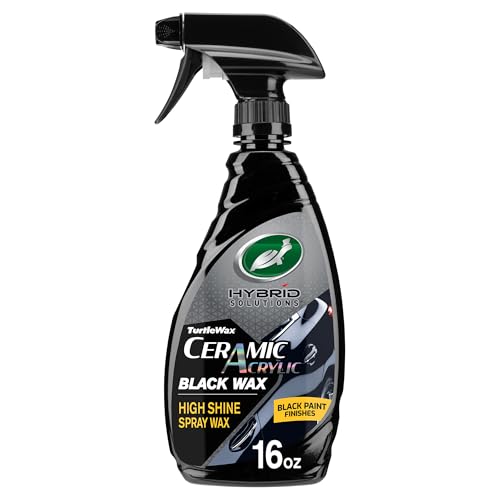
Turtle Wax Hybrid Solutions Ceramic Acrylic Black Spray Wax, 16 oz
This is the spray option in the group, built around black-pigmented carnauba wax combined with ceramic and acrylic polymers. The manufacturer describes it as filling swirl marks, light scratches, and minor imperfections in one step, while increasing the depth of colour on black and dark finishes. That combination is exactly what a black car with light wash swirls needs from a maintenance product: pigment and filler to quiet the marks, plus a polymer layer that repels water and helps the finish stay cleaner between washes.
Application is deliberately simple. The maker directs one to two sprays per panel, spread evenly with a clean folded microfiber towel, then buffed with a separate towel to a streak-free shine. For best results the maker recommends allowing the finish to cure for a full day before washing. That cure note matters. Spraying the car down the same afternoon because dust has settled on it will shorten the life of the layer that was just applied.
The spray is also listed for dark charcoal grey and dark blue finishes, black wheels, and exterior plastics and trim, but it is not intended for light-coloured paint or convertible soft tops. Owners of a black car who also want to tidy dark wheels with the same bottle will find that useful; owners of a two-tone car with a light roof should keep it to the dark panels.
Choose this one when the swirls are light, the car is washed regularly, and the priority is a fast application that can be repeated often. A spray will not out-correct a polish wax on heavier marks, and it should not be asked to. Its strength is how little friction there is between deciding the car looks tired and doing something about it.
Turtle Wax Hybrid Solutions Ceramic Acrylic Black Polish and Wax, 14 oz (Pack of 6)
Where the spray above is a maintenance step, this liquid polish and wax is the correction step in the same family. The listing verified here is a pack of six 14 oz bottles (model 53448-6PK), a sensible supply for repeating the cycle across a season or several dark cars. The manufacturer describes it as removing surface scratches and swirl marks while restoring black paint, using a polishing compound together with black-pigmented carnauba wax. Ceramic polymers in the formula are intended to repel water, dirt, and road contaminants, and an acrylic element is described as protection against fading and oxidation from ultraviolet light.
That extra polishing action changes how it should be used. A polish wax rewards slow, even work in small sections, whether it is applied by hand with a foam applicator or by machine. Rushing it across a whole bonnet at once, letting it dry unevenly, and then buffing hard with a tired towel can add the very marks the product is meant to reduce. Work one panel, or half a large panel, at a time. Keep the applicator clean, turn towels often, and remove residue with a light touch rather than pressure.
This is the more suitable of the two Turtle Wax products for a black car whose swirls are clearly visible in ordinary daylight rather than only under inspection lights. It is formulated for black, dark blue, and charcoal finishes, so it shares the same colour limits as the spray. It also makes a sensible first step before the spray: polish and wax first to deal with the marks, then maintain the result later with the faster spray product, rather than layering spray over uncorrected swirls again and again.
Choose this one when the marks are the main problem and there is time to work panel by panel. If the car is a daily driver that lives outside, expect the filling and polishing effect to be the headline and the protective layer to be a bonus that still needs ordinary maintenance washes to support it.
Chemical Guys Black Light Hybrid Glaze and Sealant, 16 oz
Black Light takes the glaze route. Chemical Guys describes it as a hybrid glaze and sealant for black and dark-coloured cars that adds deep wet shine, fills in minor imperfections, and lays down a layer of sealant in one step. The formula is a cream, sold in a 16 oz bottle under model GAP_619_16, and the maker lists ultraviolet inhibitors among its protective elements. In plain terms, this is a product aimed at the look of black paint first: depth, darkness, and reflections that read as wet rather than merely shiny.
A glaze is the strongest filler in this guide, and that shapes the honest expectation. On paint with a fine web of wash marks, a glaze can make a dramatic visual difference in a single session because so much of what the eye objects to is contrast inside shallow marks. On paint with deeper damage, the same product will improve the overall darkness while the deeper lines remain visible on close inspection. Both outcomes are normal, and the second one is not a product failure.
Application can be by hand or by machine. The maker suggests squeezing a few dots onto a foam or microfiber applicator pad for hand use, working the product over the paint, and allowing time between coats if a second coat is applied. Because a glaze and sealant is not a heavy polishing compound, it suits owners who have already washed and dried the car carefully and want to finish it in an afternoon without committing to a full machine correction session.
Choose this one when depth of colour is the goal and the swirls are light to moderate. It is also a reasonable choice for a black car that is shown, photographed, or sold, where the immediate appearance of the finish matters most and the owner understands that a filled finish is maintained, not permanent.
Which format suits which black car
A newer black car with faint circular marks from a year of careful but imperfect washing usually needs the least aggressive option. The spray wax fills lightly, protects well, and can be reapplied after a wash without turning the job into a full day of detailing. Repeating a gentle product is better for clear coat over the life of a car than reaching for the strongest polish every time the finish looks less than perfect.
An older black daily driver with a visible web of marks in normal daylight is the case for the polish and wax. It has the mild polishing action to reduce the marks themselves instead of only disguising them, and it still leaves wax behind so a separate protection step is not mandatory on the same day. Plan more time, work in shade on cool panels, and judge the result panel by panel rather than stepping back only at the end.
A black car that has been washed, dried, and lightly polished already, but still looks grey rather than deep, is the case for the glaze and sealant. Its filling and gloss are aimed at exactly that flatness. It is also the product to consider before photographs or an event, because its strength is the immediate richness of the finish.
Preparing black paint before any wax goes on
Wax applied over dirt locks the dirt against the paint and turns the applicator into a grinding pad. Preparation is not an optional extra on a swirl-marked black car; it is most of the result. Start with a thorough wash using plenty of water and a clean mitt, working from the roof down and rinsing the mitt often. The goal is to remove loose grit before any towel or applicator makes firm contact with the paint.
Dry with soft, clean microfiber towels and a light touch. Dragging a single towel around the whole car until it is damp and loaded with whatever it picked up is a reliable way to draw fresh lines across a bonnet. Use more than one towel, fold them to expose clean faces, and let the weight of the towel do most of the work.
Work in shade and on panels that are cool to the touch. Hot black paint flashes products dry too quickly, which makes them harder to spread and harder to remove, and hard removal invites pressure, and pressure invites marks. If the car has just been driven, let it cool fully before starting.
Inspect the paint honestly under one strong light before choosing the product strength for the day. Marks that only appear under that light are light marks, whatever they look like in the moment, and they call for filling and maintenance. Marks that are obvious in flat daylight call for the polish wax. Setting that expectation before the first panel prevents the common mistake of judging a filler product by the standard of a body shop correction.
Application habits that avoid adding new swirls
Use clean tools and keep them clean. A foam applicator that fell on a driveway, a towel that dried a wheel earlier, or a pad stored uncovered in a garage all carry grit. On black paint, that grit will write its signature across the panel in a single pass. Keep paint towels separate from wheel and door-shut towels, and wash them separately as well.
Apply thin. A thick layer of wax does not protect twice as well; it mostly dries unevenly and takes harder buffing to remove. Thin, even coverage spreads the fillers where they are needed and wipes away with the light pressure that black paint prefers. If a second coat is wanted, let the first settle as the maker directs rather than stacking wet product on wet product.
Keeping swirls from coming back
Most swirls are made during washing, not during driving. The habits that protect a corrected black finish are unglamorous: rinse loose dirt off before touching the paint, use a mitt rather than a stiff sponge, wash in straight lines where possible so any accidental mark is a faint straight line instead of a conspicuous circle, and never wipe a dusty panel dry. A dry wipe on a dusty black car is the single fastest way to recreate the problem this guide is about.
Finally, accept a maintenance rhythm. Filled and lightly polished finishes fade gradually with washing and weather. A quick spray wax session a few times a year, and a fuller polish wax session when the web of marks becomes visible again in daylight, will keep a black car looking deep without ever escalating to aggressive correction. That rhythm, more than any single bottle, is what separates black cars that still look rich after years of use from black cars that look tired after one winter.
Bottom line
For light swirls and regular upkeep, the Turtle Wax black spray wax is the easiest product here to live with: black-pigmented, quick to apply, and built to fill light marks while it protects. For marks that are clearly visible and need reducing rather than only disguising, the Turtle Wax black polish and wax does the heavier work in the same colour-specific family. For maximum depth and filling on a finish that looks flat and grey, the Chemical Guys Black Light glaze and sealant is the appearance-first choice. Match the product to the severity of the marks, prepare the paint properly, and apply with clean tools and a light hand, and black paint will reward the effort with the depth that made it worth choosing in the first place.
More from Amazon
Programs that pair well with the guide above. Offers and eligibility are set by Amazon and may change.
Free shipping on eligible items, Prime Video and more. Eligible new members can start with a free trial.
Start a Prime free trialAudiobooks and podcasts to listen to on the go. Eligible new members can start with a free trial.
Try Audible freeAd-free music streaming. Eligible new subscribers can start with a free trial.
Try Music Unlimited freeA free business account with business pricing and bulk-buying tools for work, shop or home office.
Create a business accountAs an Amazon Associate we earn from qualifying purchases.