Our Short List of 3


All 4 Picks at a Glance
| Product | Specs | Action |
|---|---|---|
| COMSOON Bluetooth Receiver for Car, Noise Cancelling 3.5mm AUX Adapter (J22) | Check price on Amazon | |
 TUNAI Firefly LDAC Bluetooth Receiver | Check price on Amazon | |
| COMSOON AUX Bluetooth Adapter for Car with LED Screen (Bluetooth 5.3 Receiver) | Check price on Amazon | |
 Scosche BTTRFM-SP1 Portable Bluetooth Transmitter and Receiver | Check price on Amazon |
Key takeaways
- Find the best Bluetooth car receiver for your vehicle, from long-battery AUX adapters to high-resolution LDAC receivers, with a clear compatibility guide.
Millions of perfectly good cars were built just before Bluetooth audio became standard equipment. Their stereos sound fine, their speakers are healthy, and the only thing missing is a way to get music, podcasts, and navigation prompts from a modern phone into the dashboard without a cable. That is exactly the gap a Bluetooth car receiver fills. The best Bluetooth car receiver for most older vehicles is a small adapter that plugs into the car’s auxiliary input, pairs with a phone once, and then quietly reconnects on every drive — no head unit replacement, no dashboard surgery, and no giving up the factory stereo’s built-in controls and appearance.
As an Amazon Associate we earn from qualifying purchases.
This guide explains the different forms a Bluetooth car receiver can take, compares verified options that cover the main use cases, and lays out the compatibility checks that matter before buying. The single most important one comes first: almost every receiver in this category needs a 3.5mm auxiliary input in the car, or a workable alternative such as an FM transmission mode. Confirming what the car actually offers takes two minutes and prevents nearly every disappointing purchase in this category.
How a Bluetooth Car Receiver Works
A Bluetooth car receiver is a one-way bridge. The phone sends audio wirelessly using Bluetooth; the receiver converts that signal and feeds it into the car stereo through a wired connection, usually the 3.5mm AUX port. The car’s own amplifier and speakers do the rest. Because the receiver is only handling audio, it does not change anything else about the stereo — radio, CD, and factory features all keep working exactly as before, and the driver simply selects the AUX source when they want phone audio.
Most receivers also include a microphone, which adds hands-free calling to the package. When a call comes in, the music pauses, the caller’s voice plays through the car speakers, and the built-in microphone picks up the driver’s voice. Microphone placement and noise-cancellation processing make a real difference here, because a microphone buried low in a console has to compete with road and ventilation noise.
Power is the other design split in the category. Battery-powered receivers are portable and can move between cars or double up with home stereos and wired headphones, but they need periodic charging. USB-powered receivers draw power from the car itself, switch on and off with the ignition on many setups, and never need charging — at the cost of staying with the vehicle. Neither approach is better in the abstract; the right choice depends on whether the adapter will live in one car or travel.
What to Look For Before Buying
Bluetooth version is a reasonable starting point. Newer versions generally hold a connection more reliably and use power more efficiently, and they are the versions that support the widest range of phones. For plain music streaming, though, the practical differences between recent Bluetooth versions are modest, and features such as battery life, call quality, and automatic reconnection matter more day to day.
Audio codecs are where a genuine quality difference can appear. The standard codec every device supports is fine for podcasts, calls, and casual listening. Receivers that support higher-resolution codecs such as LDAC can pass more audio detail from a compatible phone, which listeners with good speakers and high-quality music files may appreciate. The phone, the music source, and the car’s speakers all have to support the chain for the benefit to be audible.
Dual connection is worth having in shared cars. A receiver that can stay paired to two phones at once lets a driver and passenger take turns playing music, or lets a work phone and a personal phone both stay connected without a pairing ritual at the start of every trip.
Automatic reconnection sounds like a small thing and turns out to be the feature owners notice most. A receiver that wakes up, finds the phone, and resumes without button presses disappears into the routine of driving. One that needs manual pairing every trip quickly becomes an annoyance, no matter how good it sounds.
Finally, check the physical details: the length and type of cable included, whether the connector is a plug or a cord, where the controls sit, and how the unit is charged or powered. A receiver that blocks a neighboring port or dangles awkwardly will irritate long after its sound quality is forgotten.
The Best Bluetooth Car Receiver Options
The four receivers below are all Bluetooth car receivers built around a 3.5mm AUX connection, but they emphasize different strengths — battery endurance, call clarity, audio resolution, and flexibility — so the right pick depends on how the car is actually used.
COMSOON Bluetooth Receiver for Car, Noise Cancelling 3.5mm AUX Adapter (J22)
The COMSOON J22 is the archetypal modern AUX receiver and a sensible default for a car that will use it every day. It connects a non-Bluetooth car audio system, home stereo, speaker, or wired headphones to a phone through the 3.5mm AUX input, using a Bluetooth 5.0 chip that the listing describes as providing a stable connection, fast transmission, and a wide signal range.
Battery life is its headline practical strength: the listing states up to 16 hours of working time when making calls or playing music, which stretches charging intervals out to occasional rather than constant, and it charges over Type-C. For calls, it carries CVC 8.0 noise cancellation and digital signal processing aimed at keeping the driver’s voice clear, plus a built-in microphone for hands-free use. It also supports connecting two devices, which suits shared vehicles. The package includes the adapter, a 3.5mm AUX cord, a 3.5mm male-to-male connector, a Type-C charging cable, and a user manual, so it can plug straight in or sit at the end of the included cord depending on where the car’s AUX port lives.
View the COMSOON Bluetooth Receiver for Car (J22) on Amazon
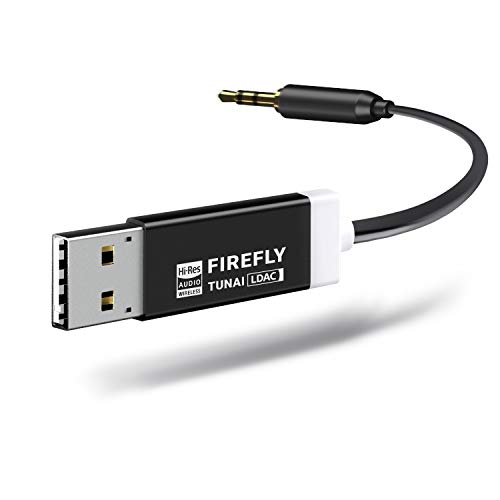
TUNAI Firefly LDAC Bluetooth Receiver
The TUNAI Firefly LDAC is built for listeners who care about audio resolution and for owners who never want to think about charging. Instead of a battery, it draws power over USB and feeds audio through a 3.5mm AUX connection, with a built-in USB DAC in the signal path. The listing highlights Sony LDAC support for high-resolution wireless audio streaming, Bluetooth 5.0, and an auto-on behavior: because it is powered by the car, it wakes with the vehicle and reconnects without a separate power button routine.
That combination — USB power, automatic startup, and a high-resolution codec — makes the Firefly a set-and-forget upgrade for a single car, particularly one with speakers good enough to reward a cleaner source. It is aimed at car and home stereo use through the AUX input, so the same compatibility rule applies: the stereo needs that 3.5mm input, and the car needs a USB port or adapter to power it. Phones that support LDAC will get the most from it, but it also works as a standard Bluetooth receiver with phones that do not.
View the TUNAI Firefly LDAC Bluetooth Receiver on Amazon
COMSOON AUX Bluetooth Adapter for Car with LED Screen (Bluetooth 5.3 Receiver)
This COMSOON model takes the same AUX receiver formula and adds two things: a newer Bluetooth 5.3 connection and an LED screen. The screen shows information such as battery and connection status at a glance, which addresses a small but real frustration with screenless adapters — never being sure whether the unit is paired, charging, or nearly empty until it stops working.
It is a 3.5mm wireless audio receiver for cars, speakers, home stereos, and wired headphones, with support for hands-free calls and music, and dual connection so two phones can stay linked. For a shared family car, that pairing of dual connection and a visible status display makes daily handovers between drivers simpler. As with the J22, it is a battery-powered design, so it can also travel to a home stereo or a pair of wired headphones when it is not in the car.
View the COMSOON AUX Bluetooth Adapter with LED Screen on Amazon
Scosche BTTRFM-SP1 Portable Bluetooth Transmitter and Receiver
The Scosche BTTRFM-SP1 is the problem-solver of this group, because it does not rely solely on an AUX input. It works as a Bluetooth receiver and as a transmitter, and it adds an FM transmission mode, so it can send audio to a car radio through an FM frequency as well as through a 3.5mm connection. For older cars with neither Bluetooth nor an AUX port — the vehicles that are hardest to upgrade — that FM route can be the difference between adding wireless audio and replacing the whole stereo.
The listing describes up to 7 hours of battery life and a range of roughly 30 to 40 feet, with a 3.5mm audio cable and a USB-C charging cable included in the box. Its transmitter mode also makes it useful beyond the car, for example sending television audio to Bluetooth headphones at home. One limitation the listing states plainly is worth noting before buying for call-heavy use: this model does not support hands-free calling, so it is a music and media receiver rather than a call solution. Drivers who mainly want streaming audio in a car with no AUX port will find that trade-off easy to accept; drivers who take calls on the road should choose one of the microphone-equipped receivers above instead.
View the Scosche BTTRFM-SP1 Bluetooth Transmitter and Receiver on Amazon
Setting Up a Bluetooth Car Receiver
Setup is usually a ten-minute job. Charge or power the receiver first, plug it into the AUX input, and switch the car stereo to its AUX source. Put the receiver into pairing mode, find it in the phone’s Bluetooth settings, and pair. After that first pairing, most receivers reconnect automatically when they power on and the phone is in range.
A few placement choices improve the result. Keep the receiver where its microphone has a reasonable path to the driver — clipped near the dashboard or console rather than buried in a glove box — and route the cable so it cannot tangle with the gear selector or pedals. If the audio comes through quietly compared with the radio, check the phone’s volume first: with AUX connections, the phone volume and the stereo volume both affect the final level, and the usual fix is to set the phone volume high and control listening level from the stereo.
Ground loop noise — a whine that rises with engine speed — occasionally appears in AUX setups, especially when the receiver charges from the car while playing. Unplugging the charging cable to run on battery for a trip is a quick diagnostic: if the whine disappears, the noise is arriving through the power connection, and a ground loop isolator or a different power source is the standard remedy.
Bluetooth Receiver or New Head Unit?
A receiver is the right answer when the factory stereo works, sounds acceptable, and the car simply lacks wireless input. It is inexpensive in effort, reversible, and keeps the dashboard original — which matters in cars where the stereo is integrated with climate or vehicle controls. A replacement head unit becomes the better route when the factory stereo is failing, when the car has no AUX input and FM transmission quality is not acceptable, or when the owner wants a touchscreen with full smartphone integration. Even then, a receiver is a painless way to live with wireless audio in the meantime, and battery models can move to another car or a home stereo afterward, so the purchase rarely goes to waste.
Frequently Asked Questions
Will a Bluetooth car receiver work in any car?
It will work in any car with a 3.5mm AUX input, which covers a large share of vehicles from the years just before Bluetooth became standard. Cars without an AUX input need a receiver with an FM transmission mode, a cassette adapter, or a head unit replacement.
Can I take phone calls through a Bluetooth car receiver?
Yes, if the receiver has a built-in microphone, as the COMSOON models above do. Call audio plays through the car speakers and the microphone picks up the driver’s voice. Not every model includes this — the Scosche BTTRFM-SP1, for example, is listed as not supporting hands-free calling — so check before buying if calls matter.
Does a Bluetooth receiver drain the car battery?
Battery-powered receivers use their own internal battery and draw nothing from the car while playing. USB-powered receivers draw a small amount while the car is running; on most vehicles the USB port powers down with the ignition, so parked drain is not a practical concern.
Why does my receiver not reconnect automatically?
Usually the receiver was paired with a different phone last, the phone’s Bluetooth was off when the receiver woke up, or the pairing list needs clearing. Turning the phone’s Bluetooth off and on, or re-pairing once, resolves most reconnection problems.
Conclusion
The best Bluetooth car receiver is the one that matches the car and the driver: a long-battery, microphone-equipped adapter such as the COMSOON J22 for everyday commuting and calls, the USB-powered TUNAI Firefly LDAC for listeners who want high-resolution audio with zero charging, the LED-screen COMSOON for shared cars that benefit from visible status and dual connection, or the Scosche transmitter and receiver for the oldest stereos that lack even an AUX port. Check the car’s inputs first, decide whether calls matter, and any of these will give an older stereo a modern wireless life in minutes.
More from Amazon
Programs that pair well with the guide above. Offers and eligibility are set by Amazon and may change.
Free shipping on eligible items, Prime Video and more. Eligible new members can start with a free trial.
Start a Prime free trialAudiobooks and podcasts to listen to on the go. Eligible new members can start with a free trial.
Try Audible freeAd-free music streaming. Eligible new subscribers can start with a free trial.
Try Music Unlimited freeA free business account with business pricing and bulk-buying tools for work, shop or home office.
Create a business accountAs an Amazon Associate we earn from qualifying purchases.