Key takeaways
- Looking for the best car amplifiers for subwoofers? Compare mono Class D amps by RMS power, impedance, and features to match your sub, system, and budget.
A great subwoofer is only as good as the amplifier driving it. The best car amplifiers for subwoofers are mono, Class D designs built to deliver clean, sustained low-frequency power into one or two ohm loads without overheating, distorting, or draining your electrical system dry. Unlike multi-channel amps meant for door speakers, a dedicated subwoofer amplifier focuses all of its power into a single bass channel, with a low-pass crossover, a subsonic filter, and bass boost controls tuned for the bottom octaves. That specialization is exactly why choosing the right mono amp matters so much: match the power and impedance to your sub, and you get deep, tight, effortless bass. Get it wrong, and you get clipping, thermal shutdowns, or a dead subwoofer.
This guide compares mono Class D amplifiers designed specifically to power car subwoofers, explains how to match an amp to your sub, and walks through the wiring and electrical upgrades that keep a high-power bass system reliable. Every amplifier below is a single-channel subwoofer amp, so you are comparing like with like, and every specification comes from the manufacturer’s published ratings or the Amazon product listing.
As an Amazon Associate, we earn from qualifying purchases.
Quick Picks
| Amplifier | RMS Power | Impedance | Best For |
|---|---|---|---|
| Kicker CXA800.1 | 300W at 4 ohms / 600W at 2 ohms / 800W at 1 ohm | 1-ohm stable | Best overall mono sub amp |
| Rockford Fosgate R2-750X1 | 750W RMS at 1 ohm | 1-ohm stable | Best compact Prime series amp |
1. Kicker CXA800.1 — Best Overall
Brand: Kicker
ASIN: B07ZBM3G3L
Amazon: https://www.amazon.com/dp/B07ZBM3G3L
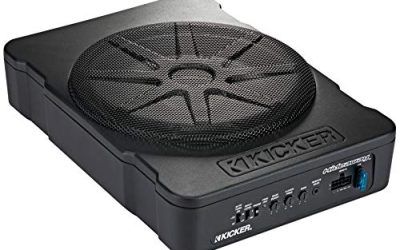
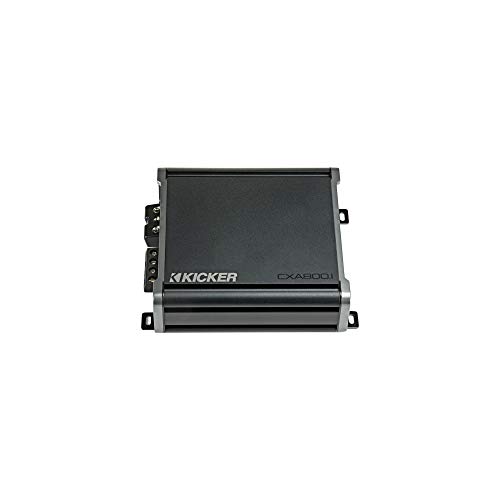
The Kicker CXA800.1 is the most versatile mono subwoofer amplifier in this roundup, and it earns the top spot because it covers the widest range of real-world subwoofer builds. Its published RMS ratings are 300 watts into 4 ohms, 600 watts into 2 ohms, and 800 watts into 1 ohm, measured at 14.4 volts. That spread means the same amplifier can drive a single 300-watt sealed sub, a 600-watt ported 12-inch, or a pair of subs wired down to 1 ohm, and it stays within its rated power at every step. Few amps in this class are as honest about what they deliver across all three common impedances.
The CXA800.1 is built around an efficient Class D power plant, so it runs cooler and draws less current than an older Class AB design of the same output. Its frequency response is 25 to 200 Hz, which is exactly the range a subwoofer needs and nothing it does not. The variable low-pass crossover adjusts from 50 to 200 Hz at 12 dB per octave, letting you blend the sub with your door speakers precisely, while the 24 dB per octave subsonic filter at 25 Hz protects ported enclosures from unloading below tuning. Kicker’s KickEQ variable bass boost adds up to 6 dB at 40 Hz for recordings that need extra weight in the lowest notes.
Installation flexibility is another strong point. The CX-Series accepts speaker-level input signals up to 40 volts, so most factory head units can connect directly without a separate line output converter, and the FIT+ fail-safe integration technology is designed to work with nearly every radio on the road. A three-second turn-on and turn-off delay eliminates pops and unwanted interference when the system powers up or down. The chassis is compact at 8-1/8 by 6-3/4 by 2-3/8 inches, and vertical mounting hardware is included, so it fits under seats, behind panels, and in tight trunk installs where larger amps will not. It is also compatible with the CXARC remote bass control, sold separately, for adjusting bass level from the driver’s seat.
Specs
- RMS power: 300W at 4 ohms, 600W at 2 ohms, 800W at 1 ohm
- Amplifier class: Class D mono
- Frequency response: 25–200 Hz
- Low-pass crossover: variable 50–200 Hz, 12 dB/octave
- Subsonic filter: 25 Hz at 24 dB/octave
- Bass boost: KickEQ variable 0–6 dB at 40 Hz
- Input sensitivity: 250 mV–10 V low level, 1 V–40 V high level
- Signal-to-noise ratio: greater than 95 dB, A-weighted
- Dimensions: 8-1/8 x 6-3/4 x 2-3/8 inches
- Remote bass control: CXARC compatible, sold separately
Pros:
– 1-ohm stable with honest RMS ratings at 4, 2, and 1 ohms, covering single and dual sub builds
– Accepts up to 40 volts of speaker-level input, so most factory stereos need no line output converter
– KickEQ bass boost and a 24 dB subsonic filter give precise control over ported and sealed boxes
Cons:
– The CXARC remote bass control is sold separately, so in-cabin bass adjustment costs extra
– Mono-only design means a separate amplifier is needed if the build also powers door speakers
Best for: Drivers who want one mono amp that can grow with their system, from a single modest sub up to a 1-ohm dual-sub setup, especially in cars with a factory head unit.
2. Rockford Fosgate R2-750X1 — Best Compact Prime Series Amp

Brand: Rockford Fosgate
ASIN: B07XCYG2FX
Amazon: https://www.amazon.com/dp/B07XCYG2FX
The Rockford Fosgate R2-750X1 is a Prime Series Class D monoblock rated at 750 watts RMS and stable down to 1 ohm, built for buyers who want proven Rockford engineering in a compact, no-nonsense package. It sits in the same power class as the Kicker above, aimed squarely at single 10-inch or 12-inch subs and dual-sub setups wired to a 1-ohm final load. Rockford Fosgate’s Prime line has a long track record in daily-driver installs, and the R2-750X1 carries that reputation into a straightforward mono amp with the controls that matter and nothing that does not.
The top panel carries the controls subwoofer owners actually use. The C.L.E.A.N. input gain setup system helps set gain correctly and avoid clipping, which is the single most common cause of blown subwoofers. An infrasonic filter protects the sub from ultra-low frequencies it cannot reproduce, while the Punch EQ bass boost adds low-end impact on demand. An auto remote turn-on switch lets the amp wake from a speaker-level signal, simplifying installation in cars without a dedicated remote turn-on wire from the head unit. Power and protect indicator lights, plus C.L.E.A.N. input and output indicators, make troubleshooting a bad signal or a protection shutdown far easier than on amps with a single LED.
Cooling fins and a compact footprint round out a design made for real trunk and under-seat installs. Like the Kicker, this is a dedicated subwoofer amplifier: one channel, low-frequency only, with no wasted circuitry for full-range duties. It is a strong pick for a buyer who already trusts the Rockford Fosgate brand, wants a clean 750-watt mono amp, and values guided gain setup over a long feature list.
Specs
- RMS power: 750W RMS at 1 ohm
- Amplifier class: Class D monoblock
- Impedance: 1-ohm stable
- Gain setup: C.L.E.A.N. input and output indicators
- Filters: infrasonic filter, Punch EQ bass boost
- Turn-on: auto remote turn-on switch
- Indicators: power, protect, C.L.E.A.N. input and output
Pros:
– 750 watts RMS in a 1-ohm stable Class D monoblock from a long-established car audio brand
– C.L.E.A.N. gain setup indicators help prevent clipping, the leading cause of subwoofer failure
– Auto remote turn-on and compact chassis simplify installation in factory-stereo vehicles
Cons:
– Fewer published power ratings across impedances than the top pick, so matching non-1-ohm subs takes more care
– No included remote bass knob, so in-cabin level control requires an additional purchase
Best for: Buyers who want a compact, brand-proven 750-watt mono amp for a single sub or a 1-ohm dual-sub setup, with guided gain setup to protect their investment.
Buying Guide: How to Choose a Car Amplifier for Subwoofers
Match RMS power to your sub, not peak power
The only power number that matters for matching is RMS, also called continuous power. A subwoofer rated at 500 watts RMS pairs with an amplifier that delivers roughly 400 to 600 watts RMS at the impedance you will wire it to. Retail listings sometimes headline a peak figure that is double the RMS rating or more; ignore it. An amp that genuinely delivers its rated RMS power into your sub’s impedance will sound louder and cleaner than a higher-peak amp that cannot sustain its output.
Understand impedance and wiring
A subwoofer’s voice coils determine the final impedance the amp sees. A single 4-ohm sub presents 4 ohms; two 4-ohm subs wired in parallel present 2 ohms; dual 2-ohm voice coils can wire down to 1 ohm. Every mono amp in this guide is 1-ohm stable, which gives you the most wiring freedom, but the amp delivers different power at each impedance. Always check the RMS rating at your exact final impedance before buying, and never wire an amp below its minimum stable impedance — it will overheat and shut down, or fail outright.
Why mono Class D is the right design
Subwoofers need power in a narrow low-frequency band, and Class D amplifiers are built for exactly that job. They switch their output transistors on and off at high frequency, wasting far less energy as heat than Class AB designs. The result is a smaller chassis, lower current draw, and stable output during long bass passages. A mono, or single-channel, layout means all of the amp’s power goes to the bass channel rather than being split across speakers that need a different kind of amplifier anyway.
Check your electrical system
A 750 to 800-watt RMS amplifier can draw 60 amps or more at full output. Before installing one, check the condition of your battery, the alternator’s output, and the factory ground points. Many daily drivers run a mono amp of this size on the stock electrical system without trouble, but dimming headlights, voltage drops, or a whining noise through the speakers are signs the charging system needs attention. Upgrading the main ground cable, adding a second ground run, and using the correct gauge of oxygen-free copper power wire are cheaper and more effective than adding a capacitor in most cases.
Crossover, subsonic filter, and bass boost
Three controls shape how a sub amp sounds in your car. The low-pass crossover sets the highest frequency the sub plays, usually between 60 and 100 Hz for a blend with door speakers. The subsonic filter cuts frequencies below the port tuning of a vented box, preventing the cone from over-excursing on notes the enclosure cannot support; sealed boxes need it less, but it still protects against extreme low-frequency content. Bass boost, such as Kicker’s KickEQ or Rockford’s Punch EQ, adds output around 40 to 45 Hz, but it should be used sparingly — heavy boost at high volume is a fast route to clipping.
Inputs: factory radio versus aftermarket head unit
If your car still has its factory stereo, look for an amp with high-level speaker inputs, like the Kicker CXA800.1, which accepts up to 40 volts directly from factory speaker wires and removes the need for a separate line output converter. If you have an aftermarket head unit with RCA preamp outputs, low-level inputs give the cleanest signal. Either way, set the gain with a proper method — a multimeter, an oscilloscope, or a guided system like Rockford’s C.L.E.A.N. setup — rather than by ear at full volume.
Size, cooling, and mounting
Mono sub amps live in trunks, under seats, and behind trim panels, so measure your space before ordering. Both amps in this guide have compact footprints, but they still need airflow around their heat sinks. Never mount an amplifier upside down against carpet or inside a sealed compartment with no ventilation. Leave clearance on all sides, secure it firmly so it cannot shift under braking, and keep power and signal cables routed apart to avoid induced noise.
Budget tiers without the guesswork
Entry-level mono amps suit a single modest sub in a daily driver where the goal is fuller sound rather than competition output. Mid-tier amps, like the two in this guide, deliver 750 to 800 watts RMS with proper filters, high-level inputs, and reliable thermal protection, and they cover the large majority of real builds. High-end mono amps move into four-figure RMS territory and demand upgraded alternators, heavy-gauge wiring, and often custom enclosures. For most buyers, the mid-tier is the sweet spot: enough power for a genuinely deep and punchy system without rebuilding the car’s electrical system.
Frequently Asked Questions
What size amplifier do I need for my subwoofer?
Match the amplifier’s RMS output at your sub’s final wired impedance to the subwoofer’s RMS power handling, staying within roughly 75 to 125 percent of the sub’s rating. A 500-watt RMS sub pairs well with a 400 to 600-watt RMS amp. Going far above the sub’s rating risks mechanical damage, while going far below it tempts you to crank the gain into clipping, which damages subs faster than clean excess power.
Is a mono amplifier better than a 2-channel amp for a subwoofer?
Yes, for subwoofers specifically. A mono amp is designed to deliver its full power into a single low-frequency channel and is usually stable down to 1 ohm, which matches how subwoofers are wired. A 2-channel amp bridged to a sub can work, but it typically delivers less power, runs hotter, and lacks the dedicated subsonic filter and bass boost controls of a purpose-built mono amp.
Do I need a 1-ohm stable amplifier?
You need one only if your subwoofer wiring presents a 1-ohm load to the amp. Dual 2-ohm voice coils wired in parallel, or two 2-ohm subs in parallel, create a 1-ohm load. If your final impedance is 2 or 4 ohms, a 1-ohm stable amp still works fine and gives you room to add a second sub later, but it is not required. The advantage of the amps in this guide is that they are all 1-ohm stable, so wiring options stay open.
Can I run a subwoofer amplifier on a factory head unit?
Yes. Both amplifiers in this guide accept speaker-level signals from a factory radio, and the Kicker CXA800.1 takes up to 40 volts of speaker-level input, which covers most factory systems without a separate line output converter. You will still need a turn-on signal, which the Rockford’s auto remote turn-on provides from the speaker signal itself, and a proper power and ground run from the battery.
Why does my amplifier keep going into protect mode?
The most common causes are wiring the sub below the amp’s minimum impedance, a poor ground connection, insufficient power wire gauge causing voltage drop, or the gain set too high so the amp clips and overheats. Check the ground first, confirm the final impedance with a multimeter, and reset the gain properly. If the amp still protects with no speakers connected, it likely has an internal fault.
Conclusion
The best car amplifiers for subwoofers are mono Class D amps with honest RMS ratings, 1-ohm stability, and the filters needed to protect both the amp and the sub. Our top pick is the Kicker CXA800.1, because its 300, 600, and 800-watt RMS ratings at 4, 2, and 1 ohms cover the widest range of builds, its 40-volt speaker-level inputs make factory-stereo installs simple, and its KickEQ boost and subsonic filter give you real control over how the bass sounds in your car. The Rockford Fosgate R2-750X1 is a strong alternative for buyers who want a compact 750-watt mono amp with guided C.L.E.A.N. gain setup. Whichever you choose, match the RMS power to your sub at its final wired impedance, set the gain carefully, and give the amp clean power and airflow — and your subwoofer will reward you with deep, clean bass for years.
More from Amazon
Programs that pair well with the guide above. Offers and eligibility are set by Amazon and may change.
Free shipping on eligible items, Prime Video and more. Eligible new members can start with a free trial.
Start a Prime free trialAudiobooks and podcasts to listen to on the go. Eligible new members can start with a free trial.
Try Audible freeAd-free music streaming. Eligible new subscribers can start with a free trial.
Try Music Unlimited freeA free business account with business pricing and bulk-buying tools for work, shop or home office.
Create a business accountAs an Amazon Associate we earn from qualifying purchases.