Key takeaways
- You already own compatible power-tool batteries: Pick the DeWalt, Milwaukee, or Ryobi model that matches your platform. Avoid paying for another battery ecosystem just to inflate tires a few times a year.
- You want a dedicated emergency kit: A compact built-in-battery unit such as the Fanttik X8 APEX is convenient because it does not require a separate tool battery. Check its charge before a long trip; a stored rechargeable battery can lose charge over time.
- You drive an SUV and correct pressure often: Favor a tool-platform inflator with a larger battery, a sturdy hose, and clear duty-cycle guidance. A small portable unit may handle SUV tires, but it can take longer and need cooling breaks.
- You need the cheapest occasional top-up option: A budget cordless model can work for a passenger car if its pressure readout is legible and its preset function is dependable. Confirm the actual hose length and charging method rather than choosing by maximum PSI alone.
Best Cordless Tire Inflators for Fast, Reliable Roadside Air
The best cordless tire inflator for most drivers is a 20-volt-class model with an accurate preset shutoff, a readable digital gauge, and enough battery capacity to refill all four tires without stopping to recharge. For occasional top-ups, a compact 12-volt rechargeable inflator is easier to store; for repeated SUV or truck use, choose a higher-capacity battery and a threaded hose connection that stays secure under heat and vibration.
Inflation time depends on starting pressure, tire size, battery charge, and temperature—not just the motor’s advertised airflow. The comparison below focuses on practical selection criteria and typical published specifications. Exact performance varies by model and conditions; check the current manual and product listing before buying, especially for battery compatibility and maximum pressure.
Our top picks
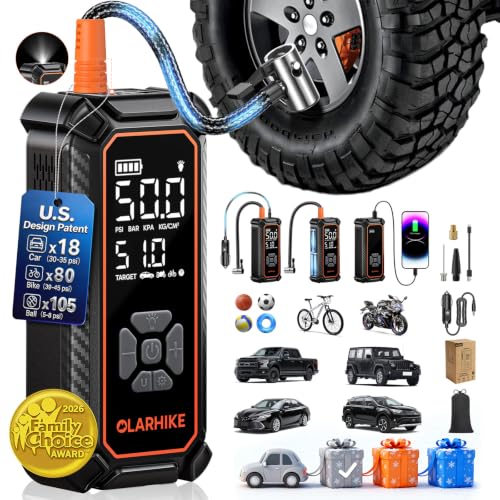

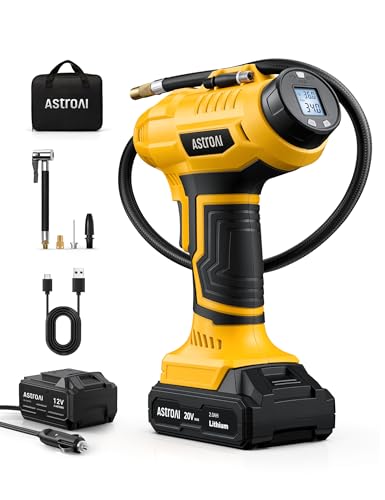

As an Amazon Associate we earn from qualifying purchases at no extra cost to you. Ratings are shown as listed on Amazon.
Quick comparison: cordless inflators worth considering
| Model | Power and battery | Maximum pressure | Hose length | Best fit |
|---|---|---|---|---|
| DeWalt 20V MAX Inflator (DCC020IB) | 20V MAX tool battery; battery sold separately | 160 PSI | Approx. 3 ft high-pressure hose | Drivers already using DeWalt batteries; mixed 12V, battery, and AC power options |
| Milwaukee M18 Inflator (2848-20) | 18V M18 tool battery; battery sold separately | 150 PSI | Approx. 3 ft hose | Frequent use and owners of the M18 battery platform |
| Ryobi ONE+ 18V High Pressure Inflator (P737D) | 18V ONE+ tool battery; battery sold separately | 150 PSI | Approx. 2 ft hose | Budget-conscious households already invested in ONE+ tools |
| Fanttik X8 APEX | Built-in rechargeable battery, approximately 7,800 mAh | 150 PSI | Approx. 2 ft hose | Compact, self-contained kit for occasional car use |
| AstroAI Cordless Tire Inflator (12V rechargeable models) | Built-in rechargeable battery; capacity varies by version | Typically 150 PSI | Varies by version; verify before purchase | Lower-cost, glove-box or trunk storage for passenger-car top-ups |
Hose and battery details can differ among revisions and bundles. A 150- or 160-PSI rating is a pressure ceiling, not a promise of fast inflation at that pressure. Passenger tires typically operate far below it, so airflow, heat management, and usable battery capacity matter more than a headline maximum.
Choose by your situation
- You already own compatible power-tool batteries: Pick the DeWalt, Milwaukee, or Ryobi model that matches your platform. Avoid paying for another battery ecosystem just to inflate tires a few times a year.
- You want a dedicated emergency kit: A compact built-in-battery unit such as the Fanttik X8 APEX is convenient because it does not require a separate tool battery. Check its charge before a long trip; a stored rechargeable battery can lose charge over time.
- You drive an SUV and correct pressure often: Favor a tool-platform inflator with a larger battery, a sturdy hose, and clear duty-cycle guidance. A small portable unit may handle SUV tires, but it can take longer and need cooling breaks.
- You need the cheapest occasional top-up option: A budget cordless model can work for a passenger car if its pressure readout is legible and its preset function is dependable. Confirm the actual hose length and charging method rather than choosing by maximum PSI alone.
What the numbers mean on a real tire
Consider a common passenger-car tire that needs to go from 28 PSI to 35 PSI. That is a 7-PSI correction, not a full inflation from empty. A cordless inflator may complete this kind of top-up in a few minutes, but timing claims are difficult to compare unless they use the same tire size, starting pressure, battery charge, and temperature. A large SUV tire holds more air, so the same pressure increase takes longer and draws more battery power.
For planning, treat manufacturer inflation-time figures as best-case references, not guarantees. If you have four tires to correct, allow for slower final pressure increases, checking each tire, and any cooling pauses. Avoid repeatedly running a compact inflator beyond its recommended duty cycle: heat can reduce performance and shorten the life of the motor, hose, or battery.
Accuracy, reach, and visibility matter more than the pressure ceiling
Preset accuracy
A preset shutoff reduces the chance of overinflation, but it is not a substitute for checking pressure with a dependable gauge. Gauge readings can vary slightly between the inflator and a separate tire gauge, particularly if air escapes while attaching or removing the chuck. Set the target to the vehicle maker’s recommended cold-tire pressure, found on the driver-door placard or in the owner’s manual—not the maximum pressure molded into the tire sidewall.
Hose length and valve access
A hose around 2 feet can reach most wheels if the inflator sits close to the tire, but may be awkward when a wheel is on the far side of a parked vehicle or the valve is tucked behind a spoke. A longer hose gives more placement freedom; a threaded chuck can reduce leakage but takes longer to attach than a quick-connect fitting. Route the hose so it does not drag across a hot brake component or get pinched under a tire.
Display visibility
Look for large digits, a backlight, and buttons that are easy to distinguish in low light. A display angled toward the operator is more useful at night than a high-contrast screen that faces upward. If you expect roadside use, practice navigating the pressure units and preset controls at home; accidentally switching between PSI, kPa, or bar can lead to an incorrect target.
How to use a cordless inflator without wasting battery
- Check cold pressure first. Use the vehicle placard or manual, and measure before driving far. Tires warm during driving, so roadside readings after a long trip may be higher.
- Charge the battery and position the unit. Put the inflator on stable ground near the valve. Keep the vents clear and the hose free of kinks.
- Set the target and verify the units. Confirm PSI, then enter the recommended pressure. Do not assume the previous setting is appropriate for every tire.
- Inflate and recheck. Let the unit stop at its preset, then check with a separate gauge if the result seems inconsistent. Add air in short bursts rather than repeatedly running a hot pump.
- Let the tool cool and recharge it. Follow the manual’s duty-cycle limits. Store the hose clean and dry, and check the battery charge periodically.
Ownership details that are easy to overlook
On a portable inflator, the hose, valve fitting, and battery are the parts most exposed to wear. Repeated bending near the hose connection can cause leaks; cross-threading a screw-on chuck can damage a tire valve’s threads; and grit inside a fitting can prevent a seal. Keep the hose loosely coiled, wipe dirt from the chuck, and do not leave the inflator in a hot vehicle for extended periods unless its manual permits that storage temperature.
Battery-platform models are often better value if you already own compatible packs, but remember that the battery and charger may cost extra. Built-in-battery models are simpler to carry yet become less convenient if the battery ages or is discharged when needed. For any cordless model, a 12-volt car socket or a separate backup inflator can be useful for extended trips—but do not assume a cordless pump can operate while charging unless the manufacturer explicitly says so.
Bottom line
Choose the DeWalt DCC020IB, Milwaukee M18 2848-20, or Ryobi ONE+ P737D when battery compatibility and repeated use matter most. Choose a compact rechargeable model such as the Fanttik X8 APEX for a self-contained passenger-car emergency kit. For SUVs, prioritize battery capacity, a robust hose, and a clear duty cycle over a higher maximum-pressure number. Whichever you buy, verify preset behavior against a separate gauge and use the vehicle’s recommended cold pressure.