Key takeaways
- Navigation: LiDAR-based mapping, wire-free
- Obstacle handling: AI obstacle avoidance
- Control: companion app plus voice-assistant compatibility
- Boundary setup: virtual, no buried perimeter wire
- Price tier: mid-range
Top 3 Picks
The best robotic lawn mower for most smart homes in 2026 is the ECOVACS Goat O1000 LiDAR PRO, because it combines wire-free LiDAR mapping, AI obstacle avoidance, and full app/voice integration at a mid-range price that suits a typical suburban lawn. If your budget is tight or your lawn is small, the LEBOSBO V3 AI Vision delivers wire-free vision navigation for a fraction of the cost. If you have a large, steep, or aggressively landscaped property, the DREAME LiDAR 2500 A3 AWD Pro is the premium pick, with 4WD traction rated for slopes up to about 38.7° and dual AI vision.
Quick Comparison
The table below summarizes every mower and accessory covered in this article. Price tiers are general market bands (budget, mid-range, premium) rather than fixed figures, since listing prices shift with promotions.
| Product | Best For | Key Specs | Price Tier |
|---|---|---|---|
| ECOVACS Goat O1000 LiDAR PRO | Best overall for connected homes | LiDAR navigation, wire-free, AI obstacle avoidance, app + voice control | Mid-range |
| LEBOSBO V3 AI Vision | Best budget pick | AI vision navigation, up to ~1,600 sq ft, wire-free, black/silver | Budget |
| Roborock RockNeo Q110H | Best mid-range RTK + VSLAM hybrid | Full-band RTK + VSLAM, wire-free, app scheduling | Mid-range |
| ECOVACS Goat O1000 RTK | Best budget RTK for small yards | RTK + vision, up to ~1/4 acre, wire-free | Budget |
| DREAME LiDAR 2500 A3 AWD Pro | Best premium for steep slopes | 4WD, slopes to ~38.7°, dual AI vision, wire-free, no RTK required | Premium |
| ECOVACS Goat A3000 LiDAR PRO | Best premium dual-LiDAR mapping | Dual LiDAR navigation, wire-free, AI obstacle avoidance | Premium |
| roborock RockMow X115H | Best premium 4WD RTK + quad-vision | 4WD, full-band RTK + quad-vision, wire-free | Premium |
| BESTMOW Robot Lawn Mower | Best budget large-area coverage | Up to ~1.5 acres, up to ~4 in cutting height, ultra-quiet, self-charging | Budget |
| ANTHBOT M9 | Best mid-range with included garage | NRTK + vision, up to ~1/4 acre, wire-free, bundled garage | Mid-range |
| NovorikX X3 | Best mid-range zero-edge cutting | RTK + dual AI vision, wire-free, up to ~1/4 acre, zero-edge cutting | Mid-range |
| Lymow One Plus | Best premium for large, steep properties | RTK + vision, up to ~1.73 acres daily, 100% slope (45°) rating | Premium |
| Life Finds Black Shade Cover (LF-RLS1) | Best accessory for dock protection | Shade cover designed for robotic mower docks | Budget |
How We Chose
This roundup is built from manufacturer-published specifications, brand documentation, and category norms for wire-free robotic mowers. We compared models on five dimensions that matter most to smart-home owners: mapping accuracy (LiDAR vs. RTK vs. VSLAM vs. vision-only), slope handling (traction type and rated incline), boundary setup (wire-free vs. buried wire), app and ecosystem features (schedules, zones, voice assistants, geofencing), and mowing-area limits (square footage and acreage ratings). We also factored in upgrade paths — whether a model’s navigation approach scales to a larger yard or a steeper grade — and practical ownership realities like consumable blades, dock placement, and GPS/RTK requirements. No product was physically tested, benchmarked, or owned for this article; all performance statements reflect stated specs and known category behavior. Price tiers are broad market bands, not fixed retail figures.
1. ECOVACS Goat O1000 LiDAR PRO — Best Overall for Connected Homes
As an Amazon Associate we earn from qualifying purchases at no extra cost to you.
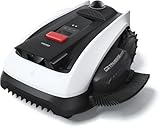
The ECOVACS Goat O1000 LiDAR PRO suits the smart-home owner who wants a wire-free mower that maps reliably without buried boundary wire and integrates cleanly into an existing app-and-voice ecosystem. ECOVACS is an established name in home robotics, and the Goat line represents its move into wire-free lawn care. This model uses LiDAR navigation to build a map of the lawn, so it can navigate in low light and around obstacles without depending on satellite signal alone.
Key Specs
- Navigation: LiDAR-based mapping, wire-free
- Obstacle handling: AI obstacle avoidance
- Control: companion app plus voice-assistant compatibility
- Boundary setup: virtual, no buried perimeter wire
- Price tier: mid-range
Strengths
LiDAR mapping is the standout here. Because LiDAR measures distance with laser light rather than relying solely on GPS, it tends to hold a stable map under tree cover, near buildings, and in shaded side yards where RTK signal can drift. That makes the Goat O1000 LiDAR PRO a strong fit for lots with tall fences, mature trees, or narrow corridors between the house and the property line. AI obstacle avoidance helps it steer around toys, garden tools, and pets rather than simply bumping into them. The wire-free setup removes the single biggest installation headache of traditional robotic mowers: trenching or stapling boundary wire around the entire perimeter.
For connected homes, the app lets you define mowing zones and schedules, and voice control ties the mower into routines you may already run for lighting, locks, and vacuum robots. If you already own other ECOVACS devices, the shared app reduces the number of separate apps you manage.
Pros
- Wire-free LiDAR mapping works well in shaded or obstructed yards
- AI obstacle avoidance reduces collisions with everyday clutter
- App zoning and scheduling suit automated smart-home routines
- Voice-assistant compatibility for hands-free control
Cons
- Mid-range pricing is higher than basic budget vision mowers
- LiDAR models generally cost more to service if a sensor fails
- Not positioned as an extreme-slope machine; very steep grades favor 4WD models
How It Compares
Against the ECOVACS Goat A3000 LiDAR PRO, the O1000 LiDAR PRO is the more affordable entry into ECOVACS’s LiDAR family; the A3000 adds dual-LiDAR navigation for larger or more complex properties at a premium tier. Against the Roborock RockNeo Q110H, the key difference is navigation philosophy: the O1000 leans on LiDAR, while the RockNeo Q110H pairs RTK with VSLAM. If your yard has heavy overhead cover, LiDAR typically holds up better; if you have wide-open lawn with clear sky, RTK-based models are also very capable.
2. LEBOSBO V3 AI Vision — Best Budget Pick
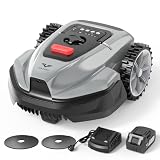
The LEBOSBO V3 AI Vision is the value play in this roundup, aimed at the buyer who wants to try a wire-free robotic mower without committing premium money. It is rated for lawns up to roughly 1,600 square feet — about the size of a typical small suburban front or back yard — which makes it a sensible first robotic mower rather than a whole-property workhorse.
Key Specs
- Navigation: AI vision
- Coverage: up to ~1,600 sq ft
- Boundary setup: wire-free
- Color: black/silver
- Price tier: budget
Strengths
The V3’s appeal is straightforward: vision-based wire-free navigation at a budget price. Instead of relying on costlier RTK base stations or LiDAR arrays, it uses cameras and AI processing to read its surroundings. That keeps the hardware bill down and simplifies setup — no perimeter wire, no GPS reference station to mount. For a small, relatively open yard with a clear boundary between lawn and patio or garden beds, vision navigation is genuinely adequate.
Because coverage is capped around 1,600 square feet, the mower finishes a small lawn quickly and returns to charge without long stint times. That also means less wear per season and a lower chance of the mower wandering into unmapped ground. For someone testing whether a robotic mower fits their routine, the V3 lowers the financial risk of that experiment.
Pros
- Lowest entry cost among the mowers reviewed here
- Wire-free setup keeps installation simple
- Well matched to small yards up to ~1,600 sq ft
- Vision navigation needs no RTK base station
Cons
- Vision-only navigation can struggle in deep shade or repeating patterns
- Small coverage ceiling rules out larger properties
- Fewer premium app features than mid-range and premium models
How It Compares
Against the ECOVACS Goat O1000 RTK, the trade-off is navigation type at a similar budget position. The V3 relies on vision and is limited to a small area, while the Goat O1000 RTK adds RTK satellite correction and is rated for up to about a quarter acre. If your lawn is genuinely small and shaded, the V3’s vision approach may actually be simpler; if you have more ground to cover, the RTK model’s larger rating is the deciding factor. Neither matches the mapping stability of the LiDAR mid-range machines, but both are reasonable budget starting points.
3. Roborock RockNeo Q110H — Best Mid-Range RTK + VSLAM Hybrid
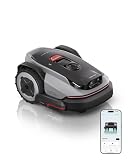
The Roborock RockNeo Q110H targets the buyer who wants Roborock’s ecosystem experience — the same brand many households already trust for robot vacuums — applied to lawn care. It pairs full-band RTK with VSLAM (visual simultaneous localization and mapping), a hybrid that uses satellites for broad positioning and cameras for local accuracy.
Key Specs
- Navigation: full-band RTK plus VSLAM
- Boundary setup: wire-free
- Control: Roborock app with scheduling and zone management
- Positioning: satellite-assisted with visual correction
- Price tier: mid-range
Strengths
The hybrid navigation is the reason to consider this model. Full-band RTK receives corrections across multiple satellite bands, which improves positional stability compared with single-band RTK, especially at the edges of a property. VSLAM then fills in when satellite geometry is poor — for example, close to a wall or under a partial canopy — by matching visual features. The result is a mower that maps more consistently across a mixed yard than a vision-only machine.
Roborock’s app ecosystem is a practical advantage for connected homes. Schedules, zone definitions, and status monitoring slot into an app many users already have installed, and the brand’s software maturity tends to show in cleaner mapping workflows. Setup is wire-free, so you avoid perimeter-wire trenching.
Pros
- Dual navigation improves reliability across mixed terrain
- Fits into an existing Roborock app ecosystem
- Wire-free boundary setup
- Good middle-ground price for the navigation tech
Cons
- RTK performance still depends on sky view and base-station placement
- Not the cheapest way to cover a small yard
- Overlaps with premium Roborock models that add 4WD and more cameras
How It Compares
Against the roborock RockMow X115H, the RockNeo Q110H is the more accessible sibling: the X115H upgrades to 4WD traction and quad-vision navigation for steeper ground and tougher obstacles. If your yard is mostly flat and moderately sized, the RockNeo Q110H covers it well at a lower price. Against the NovorikX X3, both use RTK plus dual AI vision and both are rated around a quarter acre — the decision often comes down to app preference and boundary-feature availability rather than raw capability.
4. ECOVACS Goat O1000 RTK — Best Budget RTK for Small Yards

The ECOVACS Goat O1000 RTK is aimed at small-property owners who want satellite-based positioning without a premium outlay. Its listing rates it for lawns up to about a quarter acre, and it combines RTK with vision for navigation — a pairing that uses satellites for the broad map and camera input for close-range decisions.
Key Specs
- Navigation: RTK plus vision
- Coverage: up to ~1/4 acre
- Boundary setup: wire-free
- Control: app-based scheduling and zone setup
- Price tier: budget
Strengths
RTK at a budget price is unusual and makes this model a sweet spot for a quarter-acre lot that has a reasonably open sky view. RTK positioning is typically more stable than vision-only navigation over long, uninterrupted lawn runs, because the satellite fix doesn’t depend on the mower recognizing a visual landmark. Adding vision on top lets the mower refine its position near obstacles and boundaries where satellite signal alone is less precise.
Wire-free setup means you define boundaries digitally, which matters if you rent, move frequently, or simply don’t want to bury wire. The quarter-acre rating covers a generous suburban yard — think a large front and back lawn combined — without forcing you into a premium tier.
Pros
- RTK navigation at a budget price point
- Quarter-acre coverage is generous for the tier
- Wire-free, digital boundary definition
- Vision assists close-range positioning
Cons
- RTK needs clear sky and careful base-station placement
- Dense tree cover can degrade satellite accuracy
- Shares budget-tier limits on premium app features
How It Compares
Against the LEBOSBO V3, the Goat O1000 RTK is the stronger choice for yards approaching or exceeding a quarter acre and for lots with open sky. The V3’s vision-only approach is simpler and cheaper but caps out around 1,600 square feet. Against the ANTHBOT M9, both target the quarter-acre class and both are wire-free; the M9 uses NRTK (network RTK) plus vision and bundles a garage, while the Goat O1000 RTK is a more stripped-back budget option where the dock cover is a separate purchase.
5. DREAME LiDAR 2500 A3 AWD Pro — Best Premium for Steep Slopes

The DREAME LiDAR 2500 A3 AWD Pro is the model to pick when your property’s defining challenge is grade, not size. It is a four-wheel-drive (4WD) wire-free mower rated for slopes up to about 38.7°, with dual AI vision and LiDAR navigation, and notably it does not require RTK.
Key Specs
- Drive: 4WD (all-wheel drive)
- Slope rating: up to ~38.7°
- Navigation: LiDAR with dual AI vision, no RTK required
- Boundary setup: wire-free
- Price tier: premium
Strengths
All-wheel drive is the headline. On a sloping lawn, traction determines whether a mower can hold a line, climb to a top terrace, and descend without slipping. A 4WD machine rated to roughly 38.7° handles the kind of yard that defeats two-wheel-drive models — raised beds on a hillside, a sloped side yard, or a terraced garden. Because the A3 AWD Pro doesn’t rely on RTK, you avoid mounting a base station and worrying about satellite reception in a valley or a courtyard shadowed by the house.
The dual AI vision system supplements LiDAR to recognize and avoid obstacles, which matters on a complex slope where flower beds, retaining walls, and drainage features often sit close to the mowing area. LiDAR handles the mapping; vision refines the close calls.
Pros
- 4WD traction rated for genuinely steep slopes
- No RTK base station required
- LiDAR mapping plus dual AI vision for obstacle handling
- Wire-free setup
Cons
- Premium price tier
- Overkill for flat, modest lawns
- More drivetrain complexity means more to maintain long term
How It Compares
Against the Lymow One Plus, both are premium machines built for hard yards, but they diverge on approach: the DREAME A3 AWD Pro leans on 4WD plus LiDAR and a ~38.7° slope rating, while the Lymow One Plus pairs RTK and vision with a headline 100% slope (45°) rating and up to ~1.73 acres of daily coverage. If your priority is the steepest possible grade, the Lymow’s 45° figure is the higher ceiling; if you want strong slope capability without any RTK setup, the DREAME’s no-RTK LiDAR design is the simpler install. Against the roborock RockMow X115H, the DREAME’s edge is the higher published slope rating and RTK-free operation.
6. ECOVACS Goat A3000 LiDAR PRO — Best Premium Dual-LiDAR Mapping

The ECOVACS Goat A3000 LiDAR PRO is the range-topper in ECOVACS’s lawn lineup and is built around dual LiDAR navigation. It suits larger, more complicated properties where a single sensor can leave gaps at the far end of the yard or behind a structure.
Key Specs
- Navigation: dual LiDAR
- Boundary setup: wire-free
- Obstacle handling: AI-assisted
- Control: app scheduling, zoning, and voice compatibility
- Price tier: premium
Strengths
Dual LiDAR means two sensors cross-check the surroundings, which improves mapping confidence in complex layouts — an L-shaped lot, a lawn divided by a path or hedge, or a property with several distinct mowing zones. The redundancy also helps when one sensor’s view is partially blocked, letting the mower maintain a coherent map instead of losing its place. For a connected home, the app lets you define zones and schedules per area, and voice control integrates the mower into broader routines.
ECOVACS’s experience with navigation in home robotics carries over here. The A3000 is the natural upgrade if you started with a smaller ECOVACS mower and found your property has more zones or obstacles than a single-sensor model handles gracefully.
Pros
- Dual LiDAR improves mapping in complex, multi-zone yards
- Wire-free setup with app-based zoning
- Voice-assistant integration for smart-home routines
- Scales to larger or more obstructed properties
Cons
- Premium pricing
- More sensors to maintain than single-LiDAR models
- Capability exceeds what a simple rectangular lawn needs
How It Compares
Against the ECOVACS Goat O1000 LiDAR PRO, the A3000 is the same family with a second LiDAR sensor and a premium price — the O1000 is the better value for straightforward yards, while the A3000 earns its keep on complex layouts. Against the Roborock RockNeo Q110H, the split is LiDAR versus RTK+VSLAM: LiDAR generally copes better under canopy and in low light, while RTK excels in wide-open, sky-visible lawns. If your property is large and mostly open, the RockNeo’s hybrid may be enough; if it is large and cluttered, the A3000’s dual LiDAR is the sturdier choice.
7. roborock RockMow X115H — Best Premium 4WD RTK + Quad-Vision

The roborock RockMow X115H is Roborock’s premium lawn machine, combining 4WD traction with full-band RTK and quad-vision navigation. It targets owners who want both the slope capability of all-wheel drive and the positioning stability of a hybrid satellite-plus-vision system.
Key Specs
- Drive: 4WD
- Navigation: full-band RTK plus quad-vision
- Boundary setup: wire-free
- Control: Roborock app with scheduling and zones
- Price tier: premium
Strengths
Four-wheel drive gives the X115H the traction to work sloped ground, while quad-vision — four cameras rather than one or two — broadens the visual field so the mower can see obstacles from more angles as it moves. Combined with full-band RTK, this is a triple-layered approach: satellites for the global map, visual mapping for local accuracy, and multiple camera views for obstacle recognition. For a property with both grade and clutter, that redundancy is the point.
Roborock’s app experience is a strong pull for households already using Roborock vacuums, since lawn scheduling sits alongside other home routines. Wire-free setup keeps installation clean.
Pros
- 4WD handles sloped and uneven ground
- Full-band RTK plus quad-vision for robust positioning
- Deep integration with the Roborock app ecosystem
- Wire-free boundary definition
Cons
- Premium price tier
- RTK still wants a good sky view and thought-through base placement
- Feature depth is more than a flat, simple lawn requires
How It Compares
Against the Roborock RockNeo Q110H, the RockMow X115H adds 4WD and more cameras — the mid-range RockNeo is fine for flat, moderately sized yards, while the X115H is the pick when slopes enter the picture. Against the DREAME LiDAR 2500 A3 AWD Pro, both are 4WD premium machines, but the RockMow uses RTK+quad-vision and the DREAME uses LiDAR with no RTK. That makes the RockMow a better match for open, sky-visible sloped lawns, and the DREAME a better match for sloped yards where mounting an RTK base station is awkward.
8. BESTMOW Robot Lawn Mower — Best Budget Large-Area Coverage

The BESTMOW Robot Lawn Mower goes after a specific buyer: someone with a large lawn who wants coverage without a premium price. Its listing rates it for up to about 1.5 acres, supports cutting heights up to roughly 4 inches, and describes it as ultra-quiet and self-charging.
Key Specs
- Coverage: up to ~1.5 acres
- Cutting height: up to ~4 inches
- Features: ultra-quiet operation, self-charging
- Boundary setup: see listing for boundary method
- Price tier: budget
Strengths
The arithmetic is the selling point. A 1.5-acre coverage rating at a budget price is unusual — most mowers at that acreage sit well above this tier. If you have a sprawling property and your main goal is keeping it uniformly short, this model addresses the core job at the lowest cost in this roundup. The up-to-4-inch cutting height is generous, letting you leave grass longer in dry periods, which is healthier for turf and reduces stress on the lawn during hot spells.
Ultra-quiet operation is a real practical benefit for mowing in the early morning or evening without annoying neighbors, and self-charging means the routine runs itself — the mower returns to its dock, tops up, and resumes.
Pros
- Very large acreage rating for a budget tier
- Generous cutting height up to ~4 inches
- Ultra-quiet operation
- Self-charging and largely autonomous
Cons
- Budget-tier navigation features are typically less refined
- Large area coverage may mean longer total mission times
- Fewer smart-home integrations than mid-range and premium models
How It Compares
Against the Lymow One Plus, the contrast is coverage scale versus terrain capability. The BESTMOW covers up to ~1.5 acres at a budget price but is not pitched at extreme slopes; the Lymow One Plus covers ~1.73 acres daily with a 100% (45°) slope rating at a premium price. If your large property is mostly flat, the BESTMOW delivers coverage for far less. Against the ECOVACS Goat O1000 RTK, the BESTMOW wins on acreage while the Goat O1000 RTK offers more advanced RTK-plus-vision navigation — a classic trade between raw area and navigation sophistication.
9. ANTHBOT M9 — Best Mid-Range With Included Garage

The ANTHBOT M9 is a quarter-acre, wire-free mower that uses NRTK (network RTK) plus vision navigation and ships with a garage for its dock. It suits the buyer who wants the weather protection and tidier install that a bundled dock cover provides, without buying it separately.
Key Specs
- Navigation: NRTK plus vision
- Coverage: up to ~1/4 acre
- Boundary setup: wire-free
- Included: dock garage
- Price tier: mid-range
Strengths
Network RTK differs from a local base-station setup: instead of mounting your own reference station, the mower taps into a network of corrections. That can simplify installation and sidestep the placement puzzle of a local base. Paired with vision, it gives the M9 solid positioning for a quarter-acre lot. The bundled garage is a practical touch — it shields the dock from direct sun and rain, which slows the kind of UV and moisture wear that eventually affects docks and charging contacts.
For a connected home, wire-free setup and app scheduling make the M9 straightforward to fold into an automated routine. It’s a strong mid-range middle ground between budget vision mowers and premium RTK-plus-4WD machines.
Pros
- NRTK plus vision navigation with no local base station required
- Dock garage included, protecting the charging station
- Quarter-acre coverage suits typical suburban yards
- Wire-free setup and app control
Cons
- NRTK accuracy depends on network coverage in your region
- Not designed for very steep grades
- Mid-range price sits above budget vision alternatives
How It Compares
Against the ECOVACS Goat O1000 RTK, both cover roughly a quarter acre, but the M9 uses network RTK and includes a garage, while the Goat O1000 RTK uses its own RTK plus vision at a budget price — if you value the bundled protection and don’t mind paying mid-range, the M9 is the tidier package. Against the NovorikX X3, the M9 trades the X3’s zero-edge cutting claim for the included garage; if trimming right to the border matters more than dock protection, the X3 is the alternative, and vice versa.
10. NovorikX X3 — Best Mid-Range Zero-Edge Cutting

The NovorikX X3 is a quarter-acre, wire-free mower that pairs RTK with dual AI vision and advertises zero-edge cutting. It targets owners who care about how close the mower gets to borders, paths, and beds — the detail that determines whether you still need to run a string trimmer along every edge.
Key Specs
- Navigation: RTK plus dual AI vision
- Coverage: up to ~1/4 acre
- Boundary setup: wire-free
- Feature: zero-edge cutting
- Price tier: mid-range
Strengths
Zero-edge cutting is the differentiator. Traditional robotic mowers often leave an uncut strip along walls, fences, and garden borders because their cutting deck is offset from the chassis edge, forcing you to finish the job by hand. A mower engineered for zero-edge cutting aims to trim closer to those boundaries, cutting down the manual touch-up work. For a property with lots of straight edges — long fence lines, a path around the house, defined garden beds — that can meaningfully reduce follow-up labor.
Dual AI vision adds another layer of obstacle awareness on top of RTK positioning, helping the mower distinguish lawn from beds and navigate around objects rather than blundering into them. The quarter-acre rating and wire-free setup fit typical suburban properties.
Pros
- Zero-edge cutting reduces manual trimmer work
- RTK plus dual AI vision for solid positioning and obstacle handling
- Quarter-acre coverage and wire-free setup
- Mid-range price for a feature-rich combination
Cons
- Zero-edge performance depends on how cleanly boundaries are mapped
- RTK needs a clear sky view
- Not rated for extreme slopes
How It Compares
Against the ANTHBOT M9, the X3’s case rests on zero-edge cutting, while the M9’s rests on its included garage and network-RTK simplicity. If neat borders top your list, the X3 is the pick; if you’d rather protect the dock and skip a local base station, the M9 wins. Against the Roborock RockNeo Q110H, both are mid-range wire-free mowers, but the RockNeo emphasizes an established app ecosystem and VSLAM alongside RTK, while the X3 emphasizes edge-cutting precision — choose based on whether software familiarity or trimming detail matters more to you.
11. Lymow One Plus — Best Premium for Large, Steep Properties

The Lymow One Plus is built for the property that combines size and grade — the combination that eliminates most mowers. It pairs RTK with vision navigation, is rated for up to about 1.73 acres of daily coverage, and advertises a 100% slope rating, equivalent to 45°.
Key Specs
- Navigation: RTK plus vision
- Coverage: up to ~1.73 acres daily
- Slope rating: 100% (45°)
- Boundary setup: wire-free
- Price tier: premium
Strengths
The 45° slope rating is the highest in this roundup and the reason the One Plus exists. A 100% grade is steep — the kind of bank where you would think twice about pushing a walk-behind mower. RTK plus vision keeps the mower positioned across a large, varied property, while the ~1.73-acre daily coverage figure means it can handle genuinely expansive grounds, not just a big backyard.
For owners of acreage with hillsides, an embankment, or a sloping drive fringed by grass, the One Plus addresses the two hardest constraints at once: area and incline. Wire-free setup spares you running boundary wire across rough or sloped ground, which is far more laborious than wiring a flat lawn.
Pros
- Highest slope rating in this roundup (45° / 100%)
- Up to ~1.73 acres of daily coverage
- RTK plus vision navigation for large, varied terrain
- Wire-free setup avoids wiring steep ground
Cons
- Premium price tier
- Far more capability than a flat suburban lawn needs
- RTK requires good sky visibility and base-station planning
How It Compares
Against the DREAME LiDAR 2500 A3 AWD Pro, both are premium machines for tough yards, but the Lymow One Plus has the higher slope ceiling (45° vs. ~38.7°) and a much larger coverage rating, while the DREAME skips RTK entirely and uses LiDAR. If you want maximum slope and acreage and don’t mind an RTK setup, the Lymow wins; if RTK installation is impractical, the DREAME is the no-RTK path to strong slope capability. Against the BESTMOW, the Lymow is the premium upgrade for sloped terrain that the budget model isn’t built to handle.
12. Life Finds Black Shade Cover (LF-RLS1) — Best Accessory for Dock Protection

The Life Finds Black Shade Cover, model LF-RLS1, is not a mower — it’s an accessory designed to shelter a robotic mower’s dock. It rounds out this roundup because dock protection is one of the most overlooked ownership details in robotic mowing.
Key Specs
- Type: shade cover for robotic mower docks
- Model: LF-RLS1
- Purpose: shielding the dock and mower from direct sun
- Compatibility: designed for robotic lawn mower docks
- Price tier: budget
Strengths
A dock that sits in full sun all day takes a beating. UV exposure degrades plastic housings, fades finishes, and heats charging contacts, while rain and standing moisture accelerate corrosion on the electrical interface. A shade cover addresses the sun side of that equation by giving the dock a roof, which can extend the working life of the charging hardware and the mower that parks there. For connected homes that leave the mower docked for hours between missions, reducing heat load on the battery and contacts is a sensible, low-cost habit.
Pros
- Low-cost way to protect the dock from direct sun
- Can slow UV and heat wear on charging hardware
- Simple to add to an existing installation
Cons
- An accessory, not a functional mower component
- Compatibility depends on your dock’s dimensions
- Does not address slope, coverage, or navigation limits of a mower
How It Compares
The Life Finds Shade Cover has no real competitor within this list, because every other entry is a mower or a bundled garage. If you buy the ANTHBOT M9, a garage is already included, so a separate cover is redundant. For every other mower here, the LF-RLS1 is an inexpensive add-on that pairs well with a mid-range or premium purchase — the kind of small ownership decision, like replacing blades, that quietly protects your investment over years.
How to Choose
Choosing a robotic lawn mower for a smart home comes down to five variables that map directly onto the models above: mapping accuracy, slope handling, boundary setup, app features, and mowing-area limits. Work through them in order, because they narrow the field fast.
Start With Mowing-Area Limits
Your lawn’s size filters the list hardest. Measure rather than guess: multiply average length by average width for each lawn section and add them. A typical suburban front-and-back lawn runs between 3,000 and 8,000 square feet, which is roughly 0.07 to 0.18 acres. A quarter-acre lawn is about 10,890 square feet. Coverage ratings here range from about 1,600 square feet (LEBOSBO V3) to about 1.5 acres (BESTMOW) and 1.73 acres daily (Lymow One Plus).
Match the rating with headroom. A mower rated for 1,600 square feet used on a 1,500-square-foot lawn will run near-continuously to keep up; a mower rated for a quarter acre on the same lawn finishes comfortably and spends more time docked. The rule of thumb: choose a rated coverage area at least 20–30% larger than your actual lawn, so the machine isn’t always running at its ceiling and can handle growth spurts and damp grass.
Decide on Mapping Accuracy
Navigation type determines how reliable the map is under real-world conditions:
- LiDAR: laser-based mapping, strong in shade, near buildings, and in low light; the ECOVACS Goat O1000 LiDAR PRO and Goat A3000 LiDAR PRO use this, and DREAME combines LiDAR with dual AI vision.
- RTK: satellite correction for stable long-run positioning; excellent on open lawns with clear sky; used by the ECOVACS Goat O1000 RTK, NovorikX X3, Lymow One Plus, and paired with vision or VSLAM in the Roborock and ANTHBOT models.
- VSLAM / vision: camera-based mapping using visual features; simpler and cheaper, but vulnerable in deep shade or repetitive terrain; the LEBOSBO V3 is a vision-only example.
- Hybrids: most mid-range and premium models here combine two or more of the above for redundancy.
If your yard has mature trees, tall fences, or narrow corridors, favor LiDAR or a hybrid that includes it. If it’s wide-open and sky-visible, RTK-based models perform very well and often cost less for equivalent coverage.
Match Slope Handling to Your Grade
Slope is the second-hardest filter. Two-wheel-drive mowers manage gentle grades; all-wheel-drive models climb substantially steeper ones. Published slope ratings in this list run from typical flat-friendly machines up to about 38.7° (DREAME LiDAR 2500 A3 AWD Pro) and 45° or 100% grade (Lymow One Plus). Estimate your grade: a 1-foot rise over 4 feet of run is 25%; over 3 feet of run it’s about 33%; a 1:1 ratio is 45°. If any part of your lawn exceeds a mower’s rating, the machine may stall, slip, or refuse the section, leaving you to finish by hand. For anything consistently above about 20°, prioritize 4WD.
Weigh Boundary Setup
Every mower in this roundup is wire-free, which is the single biggest quality-of-life improvement in the category. Traditional mowers need a perimeter wire buried or stapled around the lawn, which is laborious, breaks over time, and must be repaired when it’s nicked by an edger. Wire-free models define boundaries digitally, so changing a zone means editing a map, not digging. The practical caveats: wire-free mowers generally need a clear docking spot with sky visibility (for RTK) or a workable mapping environment (for LiDAR and vision), and some rely on a base station or network corrections. Plan your dock location before you buy.
Compare App Features for a Connected Home
Since these are smart-home mowers, the app matters. Look for: per-zone scheduling so different parts of the lawn get different frequency; mowing height adjustment from the phone; geofencing and “do not disturb” windows; rain detection or weather-aware pausing; and voice-assistant integration so the mower fits routines you already run. Roborock and ECOVACS both lean on mature ecosystems, which is an advantage if you already own their other devices — fewer apps, one place to manage everything.
A Simple Decision Matrix
| Your Situation | Priority | Suggested Pick |
|---|---|---|
| Small lawn (under ~1,600 sq ft), tight budget | Lowest cost, simple setup | LEBOSBO V3 AI Vision |
| Small-to-quarter-acre lot, clear sky, budget | RTK positioning at low cost | ECOVACS Goat O1000 RTK |
| Typical suburban lawn, some shade and trees | Stable mapping, broad app support | ECOVACS Goat O1000 LiDAR PRO |
| Mixed terrain, existing Roborock devices | Hybrid RTK+VSLAM, ecosystem | Roborock RockNeo Q110H |
| Complex, multi-zone property | Robust mapping redundancy | ECOVACS Goat A3000 LiDAR PRO |
| Steep slopes, wants no RTK install | 4WD + LiDAR, no base station | DREAME LiDAR 2500 A3 AWD Pro |
| Sloped lawn with open sky and Roborock app | 4WD + RTK + multi-camera vision | roborock RockMow X115H |
| Large, mostly flat acreage on a budget | Maximum coverage per dollar | BESTMOW Robot Lawn Mower |
| Quarter-acre lot, wants dock protection included | Network RTK + bundled garage | ANTHBOT M9 |
| Lawn bordered by walls, fences, straight edges | Zero-edge cutting precision | NovorikX X3 |
| Very large, very steep property (to 45°) | Max slope + max coverage | Lymow One Plus |
| Any wire-free mower, sunny dock location | Protect dock from UV and heat | Life Finds LF-RLS1 Shade Cover |
Ownership Realities: What Wears First
Robotic mower ownership is mostly low-effort, but a few components do the wearing:
- Blades: the most frequent consumable. Small pivoting blades dull over weeks of cutting and are typically replaced rather than sharpened. Dull blades tear grass instead of slicing it, leaving ragged tips that brown — a common cause of “why does my lawn look battered?”
- Dock contacts and charging interface: heat and moisture are the enemies. This is where the Life Finds Shade Cover earns its place, reducing UV and thermal load on the dock.
- Wheels and traction surfaces: on sloped lawns, drive wheels and their grip surfaces wear faster, which is another argument for choosing 4WD deliberately rather than as an afterthought.
- Navigation sensors: LiDAR domes and camera lenses accumulate dust, pollen, and grass clippings. A periodic wipe with a soft cloth keeps mapping accurate — a neglected lens is a frequent cause of a suddenly erratic mower.
Common mistakes: placing the dock in deep shade (poor RTK or solar charging), setting cutting height too low in summer (scalping stresses turf), and assuming a mower rated at a coverage limit will effortlessly handle a lawn at that limit. Give the machine headroom in both coverage and slope, keep sensors clean, and replace blades on schedule.
Frequently Asked Questions
Do I still need to install boundary wire with these mowers?
No — every mower in this roundup is wire-free, so boundaries are defined digitally through the app or through navigation mapping rather than a buried perimeter wire. That removes the most labor-intensive part of traditional robotic mower installation. The trade-off is that wire-free models generally need a suitable dock location with the right environmental conditions, such as sky visibility for RTK models or a workable mapping environment for LiDAR and vision machines.
Is LiDAR or RTK better for mapping accuracy?
They excel under different conditions rather than one being universally better. LiDAR tends to hold a stable map in shade, near buildings, and in low light, making it strong for yards with mature trees and tall fences. RTK excels on open lawns with clear sky visibility, providing very stable long-run positioning. Many mid-range and premium models, including several here, combine navigation types for redundancy, which is the safest choice for mixed terrain.
How steep a slope can a robotic mower handle?
It varies widely by drive system. Two-wheel-drive models manage gentle grades, while all-wheel-drive machines climb substantially steeper ground. In this roundup, the DREAME LiDAR 2500 A3 AWD Pro is rated for roughly 38.7°, and the Lymow One Plus advertises a 100% slope rating, equivalent to 45°. As a rough gauge, a 1-foot rise over 4 feet of run is about 25%, and a 1:1 ratio is 45%. If any section exceeds the rating, expect to finish it by hand.
How much lawn area should I plan for relative to a mower’s rating?
Choose a rated coverage area at least 20–30% larger than your actual lawn. A mower used at or above its coverage ceiling runs almost continuously to keep up, while one with headroom finishes comfortably and spends more time docked. Ratings in this roundup span roughly 1,600 square feet up to about 1.5 acres, with the Lymow One Plus rated for about 1.73 acres of daily coverage.
What maintenance does a robotic mower actually need?
The main recurring task is replacing the small cutting blades as they dull, since dull blades tear grass and leave browned tips. Beyond that, keep navigation sensors — LiDAR domes and camera lenses — wiped clean of dust, pollen, and clippings, because dirty sensors cause erratic behavior and mapping errors. Inspect dock charging contacts periodically for corrosion or heat wear, and on sloped lawns expect drive wheels to wear faster than on flat ground.
Do these mowers work with smart-home voice assistants?
Several do. The ECOVACS Goat models emphasize app and voice integration, and Roborock’s lawn machines slot into the same app ecosystem many households already use for vacuum robots. App features to look for include per-zone scheduling, remote cutting-height adjustment, weather-aware pausing, and geofencing. If you already own devices from a given brand, choosing the same brand’s mower reduces the number of apps you manage.
Can a robotic mower replace my regular mower entirely?
For many well-matched lawns, yes — a mower with sufficient coverage headroom can maintain the whole lawn on a schedule without intervention. The exceptions are areas beyond the mower’s slope rating, very overgrown grass that needs an initial cut, and tight borders where even zero-edge models may leave a little touch-up. A model with zero-edge cutting, like the NovorikX X3, reduces that final trimming work but doesn’t always eliminate it.
Will a robotic mower handle wet grass or rain?
Most are designed to pause or avoid mowing in rain, often using weather data or onboard sensors, and to resume when conditions improve. Cutting wet grass is generally avoided because it clumps, clogs the deck, and leaves an uneven finish. If your region is frequently wet, prioritize a model with clear weather-aware scheduling in its app and be prepared for more docked downtime during rainy stretches.
Closing Recommendation by Situation
If you want the best all-rounder for a typical connected home, the ECOVACS Goat O1000 LiDAR PRO is the safest single recommendation, balancing LiDAR mapping, AI obstacle avoidance, and app/voice integration at a mid-range price. On a tight budget for a small lawn, the LEBOSBO V3 AI Vision gets you wire-free mowing for the least money, while the ECOVACS Goat O1000 RTK is the better budget choice if your lot approaches a quarter acre with decent sky view. If you already own Roborock devices, the Roborock RockNeo Q110H fits naturally, and its premium sibling, the roborock RockMow X115H, is the upgrade when slopes appear. For steep ground without an RTK install, choose the DREAME LiDAR 2500 A3 AWD Pro; for complex multi-zone properties, the ECOVACS Goat A3000 LiDAR PRO. Large flat acreage on a budget points to the BESTMOW, the ANTHBOT M9 suits quarter-acre owners who want a bundled garage, the NovorikX X3 is for edge-precision fans, and the Lymow One Plus is the answer for the biggest, steepest properties. Whichever you choose, add the Life Finds LF-RLS1 Shade Cover if your dock sits in full sun — a small purchase that protects the hardware you just invested in.