Key takeaways
- Compare the best wheel coatings for cars, from ceramic wheel armour to graphene kits, with real specs on heat resistance, durability, and cure times.
Disclosure: As an Amazon Associate, I earn from qualifying purchases.
Wheels live in the harshest environment on the car. They sit inches from brake rotors that heat up with every stop, collect hot metallic brake dust, and take road salt, tar, and grit at speed. A dedicated wheel coating puts a hard, slick, heat-tolerant layer between that abuse and the finish, so contamination bonds less strongly and washes away with less scrubbing.
Be clear about what a coating does and does not do. It makes brake dust rinse off easier; it does not stop dust from landing, and black dust will still appear between washes — it just releases more easily when you clean. The durability and temperature numbers quoted below are maker claims under ideal prep conditions, not guarantees for a daily driver. And no coating fixes a damaged wheel: curbed, peeling, or corroded finishes should be repaired first, because a coating locks in whatever surface it is applied over.
How to Choose
Prep decides the result. Every product below assumes the same groundwork: wash the wheels, remove iron fallout and tar, dry them completely, and wipe them down with a panel wipe so no oils or old wax remain. For a proper job the wheels should come off the car so the barrels and inner spokes can be coated too. Coating a dirty or greasy wheel face through the spokes is the most common reason these products “fail” within weeks.
Check finish compatibility. Most wheel coatings suit painted, clear-coated, powder-coated, and polished wheels, but matte and satin finishes need a product that will not add unwanted gloss. If your wheels are matte, look for an explicitly matte-safe formula and test a hidden area first.
Read the heat claim in context. Makers quote temperature resistance from a few hundred degrees to well over a thousand. Treat these as lab figures for the cured film, not a promise the coating survives track use unchanged. For a street car, chemical resistance under strong wheel cleaners usually matters more day to day.
Match the format to your patience. Small-bottle true coatings (15–30 ml) are applied with a suede applicator in small sections and buffed within a short window; they reward careful work with the longest claimed durability. Larger multi-surface kits and sprays are more forgiving and faster, but their protection claims are usually more modest on wheels.
Respect the cure. Coatings need a dry cure window — typically several hours to overnight — before the wheels see water. Plan for a day the car can sit.
The 5 Best Wheel Coatings
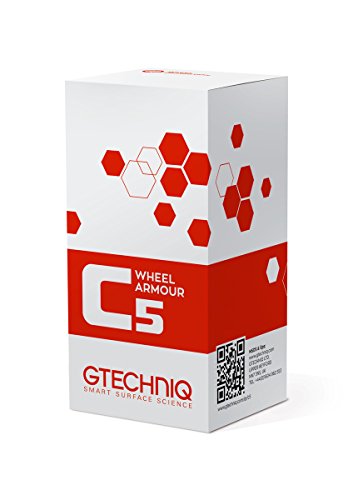
1. Gtechniq C5 Wheel Armour
Specs
- Bottle size: 15 ml (a 30 ml size is also sold)
- Stated temperature resistance: up to 600°C (about 1112°F)
- Stated durability: 1 to 2 years (maker claim)
- Finishes: gloss, satin, and matte wheel finishes; also used on brake calipers
- Application: suede applicator after a panel wipe; buff within about a minute; roughly 12 hours indoors to cure
C5 Wheel Armour is the benchmark dedicated wheel coating, with a published temperature figure and a defined application method. The coating chemically bonds to the wheel surface, which is why the prep standard is strict: Gtechniq directs a panel wipe first, working no more than about half a wheel at a time and buffing promptly. The 15 ml bottle looks tiny, but only a thin film is applied, and one bottle is generally enough for a set of wheels and calipers. If your priority is a wheel-only coating with a long track record and you are willing to prep properly, this is the reference pick.
2. CarPro CQUARTZ DLUX Wheel and Trim Coat

Specs
- Bottle size: 30 ml
- Kit contents: coating bottle, 1 applicator sponge, 4 suede microfiber cloths
- Coverage stated on the listing: up to 1 year
- Surfaces: alloy wheels plus exterior plastic, rubber, and metal trim
- Chemistry: silane-based glass coating with more than 50% silica content
- Wipe-off window: about 1 to 10 minutes depending on ambient temperature; keep water off for 1 to 3 hours
DLUX earns its place by doing two jobs in one afternoon: it is formulated for wheels and for the faded black plastic and rubber trim around them. On wheels it lays down a semi-gloss, hydrophobic film that sheds dirt and makes brake dust removal easier. The trade-off is method: wipe-off timing shifts with temperature, and CarPro’s guidance calls for an eraser-style prep wipe and decontamination first. Consumption is low — the maker notes roughly 10 ml can cover four wheels and a car’s trim. Choose DLUX if your wheels and trim both need attention.
3. Gyeon Q² Rim EVO

Specs
- Bottle size: 30 ml kit
- Stated heat resistance: up to 1400°F per the listing
- Finish: satin look that suits alloy and painted rims
- Stated durability: around 1 year on a regularly driven car (maker claim)
- Positioning: dedicated wheel coating for high-temperature, high-impact use
Gyeon’s Q² Rim EVO is the specialist for cars that brake hard. Its listing leads with heat resistance up to 1400°F, the highest figure in this roundup, and the formula is aimed squarely at wheels rather than doubling as a paint or trim product. The satin finish flatters modern alloy designs without the wet look some drivers dislike. Like the other bottled coatings here, it demands thorough decontamination and degreasing first, and its realistic durability on a daily driver is about a year of easier cleaning, not permanent protection. For performance cars and heavy brake-dust producers, this is the focused pick.
4. Adam’s Advanced Graphene Ceramic Coating (Standard Kit)

Specs
- Bottle size: 60 ml (2.03 fl oz)
- Hardness claim: 10H, which the maker states is verified by SGS testing
- Durability claim: 9+ years of protection (maker claim, aimed mainly at paint)
- UV tracer technology: coating glows under a UV light so missed spots are visible
- Listed surfaces include painted surfaces, glass, trim, chrome, and wheels
This is the multi-surface option: one bottle the listing explicitly rates for wheels among many other surfaces, suiting owners who want a single coating for the whole car. The UV tracer is genuinely useful on intricate spokes, where thin or missed areas are hard to see under normal light. Set expectations correctly, though: the headline multi-year durability claim is written for paint, and wheels — with their heat cycles and aggressive cleaning — are a tougher environment, so treat the wheel lifespan as shorter than the banner number.
5. McKee’s 37 Ceramic Wheel Cleaning and Sealant Kit

Specs
- Format: two-part kit (model MKCS-WHEEL) with a wheel cleaner and a ceramic wheel sealant
- Chemistry: SiO2 ceramic series sealant, positioned as a high-temperature brake dust repellent
- Wheel types: alloy, chrome, and aluminum wheels
- First listed: February 2021
The McKee’s 37 kit takes the most approachable route here: instead of a small bottled coating applied with suede cloths, it pairs a dedicated wheel cleaner with a spray-and-wipe ceramic sealant, so the clean and protection steps are designed to work together. That makes it the easiest entry point for coated-wheel behavior — a slick surface that resists brake dust bonding and rinses cleaner — without removing wheels or managing short buffing windows. The honest trade-off is longevity: a sealant kit will not match the multi-season claims of the bottled coatings above and should be reapplied as part of regular wheel care.
Usage Notes
Work one wheel at a time, in the shade, on a wheel that is cool to the touch. Bottled coatings flash quickly in heat, and a rushed buff leaves high spots that show as dark smears on gloss finishes. Use a fresh suede cloth per wheel and keep a second clean microfiber for the final wipe.
After curing, maintain coated wheels with a pH-neutral wheel cleaner or normal car shampoo. Strong alkaline or acidic cleaners shorten coating life quickly; the point of the coating is that you no longer need them for routine washes. A soft wheel brush or mitt is still fine — the coating reduces scrubbing effort, it does not make contact washing unnecessary.
If a wheel is curbed or the clear coat is failing, repair or refinish it before coating. Coating over lifting clear coat seals in a failing surface, and the result peels with the paint, not with the product.
FAQ
Do wheel coatings stop brake dust from building up?
No. Dust still lands on the wheel; a coating makes the surface slicker and more hydrophobic so the dust bonds less strongly and rinses or washes off with less effort. Heavy-dusting brake pads will still dirty coated wheels between washes.
How long do wheel coatings really last?
Makers claim anywhere from about a year to several years, but those figures assume ideal prep and gentle maintenance. On a daily driver cleaned with pH-neutral products, the bottled coatings here are realistically a one-to-two-year proposition before cleaning becomes noticeably harder again; sealant-style products need reapplication sooner.
Can I apply a wheel coating without removing the wheels?
You can coat the faces with the wheels on the car, but you cannot properly clean, decontaminate, or coat the barrels and inner spokes that way, and those areas collect the most brake dust. Removing the wheels gives a far more complete and durable result.
Are wheel coatings safe on matte or chrome wheels?
Most of these products list matte, satin, painted, and chrome finishes as suitable, but matte wheels need a formula that does not add gloss, and any coating should be spot-tested on a hidden area of a delicate finish first. Always follow the specific maker’s finish guidance over general advice.
Can I use a paint ceramic coating on my wheels instead?
Many paint coatings are listed as wheel-safe, and the Adam’s kit above is one example. The difference is heat and chemical tolerance: dedicated wheel coatings are formulated and tested for the hotter, dirtier wheel environment, so a wheel-specific product is the safer choice for aggressive braking or strong cleaning routines.
Conclusion
For a dedicated, proven wheel coating, Gtechniq C5 Wheel Armour remains the reference, with CarPro DLUX close behind for anyone who also wants to restore trim in the same session. Gyeon Q² Rim EVO suits hard-driven cars, the Adam’s graphene kit is the convenient one-bottle answer for the whole car, and the McKee’s 37 kit is the low-effort route to ceramic-style wheel protection. Whichever you choose, the prep — spotless, decontaminated, degreased wheels and a full cure — matters more than the badge on the bottle.
More from Amazon
Programs that pair well with the guide above. Offers and eligibility are set by Amazon and may change.
Free shipping on eligible items, Prime Video and more. Eligible new members can start with a free trial.
Start a Prime free trialAudiobooks and podcasts to listen to on the go. Eligible new members can start with a free trial.
Try Audible freeAd-free music streaming. Eligible new subscribers can start with a free trial.
Try Music Unlimited freeA free business account with business pricing and bulk-buying tools for work, shop or home office.
Create a business accountAs an Amazon Associate we earn from qualifying purchases.