Key takeaways
- Compare the best car fuse testers and circuit testers, from fuse monitors and digital test lights to powered probes and relay testers, plus honest limits.
Disclosure: As an Amazon Associate, I earn from qualifying purchases.
A dead radio, a blower that quits, or a power seat that stops mid-travel usually traces back to a blown fuse or a circuit no longer delivering power where it should. The right tester tells you which one in seconds instead of an afternoon of guessing. The catch is that “fuse tester” covers very different tools, from a pocket monitor that reads the current flowing through a fuse to a powered probe that can feed power to a component on demand.
This guide compares five proven options across those categories. One honest limit applies to most of them: a lamp lighting up, or even a voltage number on a screen, shows power is present at the probe tip — not how much survives under load. Voltage drop testing still calls for a digital multimeter, and no tool here replaces one. Within those limits, these testers are the fastest first step in electrical work.
How to Choose
Match the tool to the job. If your usual problem is “which fuse blew,” a fuse-focused tester is the quickest route. If you chase dead circuits, broken grounds, and faulty switches, a probe-style circuit tester earns its keep. Relays are their own failure point, and a dedicated relay tester answers in one cycle whether a suspect relay is worth swapping.
Check the voltage range. Most cars are 12-volt only, but trucks, RVs, and some equipment run 24-volt systems. A tester rated for both saves you owning two, and a 12-volt-only tool on a 24-volt circuit can be damaged.
Think about reach. Fuse boxes hide under dashboards, behind kick panels, and deep in engine bays. A long or coiled cord lets you clip to a solid ground once and walk the probe across every fuse in the panel. A poor ground clip is the number one cause of misleading readings.
Understand LED versus incandescent draw. Traditional test lights use an incandescent bulb that pulls a few hundred milliamps, loading the circuit slightly in a crude but real way. LED testers sip current, which is gentler around sensitive electronics but can glow faintly from stray voltage that would never run anything. Digital test lights split the difference by showing an actual voltage number. None should ever probe airbag wiring, as the safety notes below explain.
Consider what the result really proves. A fuse monitor showing live current is the only style here that can hint at a parasitic draw. Everything else is a go or no-go check: fast, useful, and honest about its limits.
The 5 Best Car Fuse Testers and Circuit Testers
1. Power Probe PPFUSE Fuse Monitor

Specs:
– Tests Mini, Maxi, and ATC blade fuses without pulling them
– Displays live current readings up to 80 amps through the fuse
– Replaceable probe tips for worn or damaged contacts
– Built-in flashlight for dark fuse panels
– Model PPFUSE, made by Power Probe
Instead of asking only whether a fuse is blown, the PPFUSE answers a better question: how much current is flowing through this circuit right now? Touch the tips to the test points on a blade fuse and read the draw on the spot. That makes it the standout pick for hunting parasitic drains, since you can walk a whole panel and spot the circuit that stays awake after the car should be asleep, without pulling fuses and waking modules back up. It is a specialist, but for fuse work nothing else here comes close.
2. KAIWEETS VT501 DC Smart Automotive Test Light

Specs:
– Voltage range of 0.8 to 100 volts DC with 0.1-volt display resolution
– LCD digital display with green backlight
– Smart mode auto-recognizes voltage, continuity, and resistance
– Coiled cable stretches to 78.74 inches with a large alligator clip
– Runs on one AAA battery, with built-in flashlight and continuity buzzer
The VT501 is what the classic test light grew up into. Rather than a bulb that simply glows, it shows the actual voltage on a backlit screen, separating a healthy 12.6 volts from a sickly 8 volts that would still light a bulb. Smart mode is genuinely convenient at a fuse box: touch the test points across a fuse and it reports continuity, so a blown fuse announces itself without being pulled. The coiled cord reaches from a chassis ground to most under-dash panels, and the tool is light enough to live in a glove box. Never use it on AC circuits.
3. INNOVA 5420 PowerCheck Powered Circuit Tester

Specs:
– Powered circuit tester that applies power or ground to components
– Built-in display and voltmeter for voltage readings at the tip
– Works on 12-volt and 24-volt systems
– 45-degree swivel head for reaching awkward test points
– Built-in LED flashlight for dark work areas
– Model 5420 PowerCheck, made by INNOVA
A passive test light can only listen. The PowerCheck can talk back: connect it to the battery and it feeds power or ground to a switch, relay socket, fan motor, or window regulator while showing the voltage that actually arrives. That turns “is this motor dead or just unfed” into a ten-second test. The swiveling head sounds like a gimmick until you are reaching a fuse block tucked against a firewall. Because it actively powers circuits, it demands more care than a test light — confirm what a wire does before energizing it, and follow the vehicle maker’s service information for module-controlled circuits.
4. Power Probe III Circuit Tester (PP3CS)

Specs:
– Full-featured voltmeter and continuity tester for 12 to 24 volt systems
– Supplies power and ground to components with a rocker switch
– 20-foot cable reaches from the battery to anywhere around the vehicle
– Audible and visual indicators plus two LED headlights
– Clamshell kit, model PP3CS, made by Power Probe
The Power Probe III is the tool the others get compared against, and it remains the deepest single purchase here. The 20-foot lead means you clip onto the battery once and test at the tail lights without moving the connection. It reads voltage digitally, checks continuity, finds bad grounds, and powers up components, all from one probe. It also punishes careless users: power on the wrong pin of a module circuit is an expensive mistake, so it suits owners who understand basic circuit layout.
5. Electronic Specialties 190 Relay Buddy
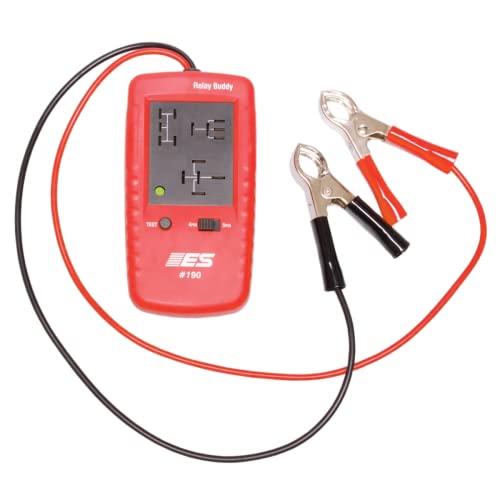
Specs:
– Dedicated go/no-go tester for common automotive relays
– Settable for 4-pin and 5-pin relay configurations
– Powered by the vehicle 12-volt battery
– Cycles the relay repeatedly and flags inconsistent operation
– Model 190, made by Electronic Specialties
Relays fail in sneaky ways: they click, so they sound fine, yet the contacts inside are burned and pass little or no current. Swapping in a known-good relay works only if you have a matching spare. The Relay Buddy removes the guesswork by cycling the relay repeatedly in seconds and reporting whether it passes consistently, catching the intermittent ones that work on the bench and fail in traffic. It does exactly one job, so it suits anyone maintaining several vehicles or chasing recurring electrical gremlins — but at that job it beats any amount of listening for clicks.
Usage and Safety Notes
Start every diagnosis by confirming your ground. Clip the tester lead to bare metal or the battery negative terminal and touch a known power source; if the tool does not respond there, fix the connection before trusting any reading downstream.
Work through a fuse panel methodically, testing both exposed points on each blade fuse with the circuit switched on. The same reading on both sides means the fuse is intact; power on one side only means it has opened. Some circuits are live only with the ignition on, so a dark reading can be normal.
Never probe airbag or SRS wiring with a test light, a powered probe, or any tool that can inject current. Airbag circuits use yellow connectors and conduit, and deploying a bag or damaging the module is a real risk. Leave restraint work to the maker’s service procedure and proper scan tools.
Powered testers like the PowerCheck and Power Probe III should never energize a wire until you know what it feeds. Check a wiring diagram first, and keep power applications brief. Finally, remember the limits: a glowing lamp or a voltage reading proves presence, not health under load. When readings look odd, graduate to a multimeter and a voltage drop test rather than replacing parts on suspicion.
FAQ
Can a test light replace a multimeter?
No. A test light is faster for yes-or-no checks, but it cannot measure voltage drop, resistance precisely, or parasitic draw in milliamps. Serious electrical work needs both.
Why does my LED test light glow faintly on a dead circuit?
LED testers draw almost no current, so stray voltage that could never power a component can still light them faintly. Confirm a suspicious reading with a loaded test or a multimeter before condemning a part.
How do I find a parasitic draw with a fuse tester?
Let the vehicle sit until its modules sleep, then measure across each fuse without pulling it. A fuse monitor showing live current, like the PPFUSE above, reveals which circuit still draws when everything should be off.
Is a 24-volt rating worth having for a normal car?
For a 12-volt car, no — but if you also work on diesel trucks, RVs, boats, or farm equipment, a dual-range tester avoids carrying a second tool.
Can these tools test relays without removing them?
Most relay testing requires pulling the relay and plugging it into a tester like the Relay Buddy. A probe tester can confirm power, ground, and signal at the socket, but a dedicated tester gives the clearest verdict.
Conclusion
For most owners, the KAIWEETS VT501 covers the everyday work — checking fuses, confirming power, verifying grounds — with a clarity a bulb-style light cannot match. If parasitic drains are your recurring headache, the Power Probe PPFUSE is the specialist to own. Step up to the INNOVA 5420 or Power Probe III when you need to power components during our research, and add the Relay Buddy when relays keep landing on your suspect list. Buy the tool that matches the faults you actually chase, and electrical diagnosis gets much shorter.
More from Amazon
Programs that pair well with the guide above. Offers and eligibility are set by Amazon and may change.
Free shipping on eligible items, Prime Video and more. Eligible new members can start with a free trial.
Start a Prime free trialAudiobooks and podcasts to listen to on the go. Eligible new members can start with a free trial.
Try Audible freeAd-free music streaming. Eligible new subscribers can start with a free trial.
Try Music Unlimited freeA free business account with business pricing and bulk-buying tools for work, shop or home office.
Create a business accountAs an Amazon Associate we earn from qualifying purchases.