Key takeaways
- Compare the best test lights and circuit testers, from a basic 12V probe to powered circuit tools, with voltage ranges, lead lengths and safety notes.
A dead blower motor, a trailer light that will not come on or a fuse that keeps blowing all start with the same question: is power actually reaching the part? A test light answers that in seconds. Clip the lead to a good ground, touch the probe to the circuit, and the handle tells you whether voltage is present. The five testers below cover the full range of the type, from a simple 12 volt probe to digital display models and powered tools that can feed power or ground to a component on demand.
As an Amazon Associate, we earn from qualifying purchases.
Quick answer
For a basic, inexpensive probe, the Innova 3410 covers everyday 12 volt checks. Drivers who want a number instead of a glow should pick the JASTIND digital tester or the WINAMOO 3-48V model, while the Power Probe 3 and Autel PowerScan PS100 add the ability to supply power and ground to components during diagnosis.
Innova 3410 Test Light and Circuit Tester

The Innova 3410 is the classic version of this tool: a handheld probe with a ground clamp, an indicator in the handle and nothing to configure. Innova rates it for 12 volt DC systems only, and the job is simple presence testing, touching the probe to a wire, terminal or fuse contact to learn whether voltage is there. That covers the checks home mechanics run most often: confirming power at a trailer socket, finding which side of a fuse is live, verifying a ground point, or walking a lighting circuit until the indication stops and the break is located. The maker’s own instruction card draws clear boundaries that are worth respecting. The 3410 is not for use on computer circuitry, it must never be used on air bag or safety restraint circuits, and the probe should not be used to puncture spark plug wires. Within those limits it is a sound glovebox tool, because a circuit either lights it or does not, with no menus or ranges to set. Buyers who work on newer vehicles packed with control modules should treat this as the conventional-circuits tool and pair it with one of the low-draw digital testers below for anything electronic.
Power Probe 3 Circuit Tester, Green, PP3CSGRN

The Power Probe 3 moves well beyond a passive test light. It connects straight to the vehicle battery on a 20-foot cord, long enough to work from the battery to any corner of most cars and light trucks without moving the connection. Used as a tester, it works as a voltmeter and continuity tester with audible and visual indicators, and two built-in LED headlights light the work area, which matters when the connector in question sits behind a dash panel or under a seat. Its defining ability is the rocker-controlled output: the tool can supply battery voltage or ground through the probe tip, so a fuel pump, cooling fan, window motor or horn can be powered directly to prove whether the component or its wiring is at fault. That single feature replaces a pocketful of jumper wires and guesswork. The package includes the tool with its 20-foot cord, battery hookup clips and an instructional DVD. Because it applies power rather than only sensing it, this is a tool for methodical users: feeding voltage into the wrong circuit, especially a module or sensor line, can cause damage, so the wiring diagram should lead and the probe should follow.
Autel PowerScan PS100 Circuit Tester 2.0
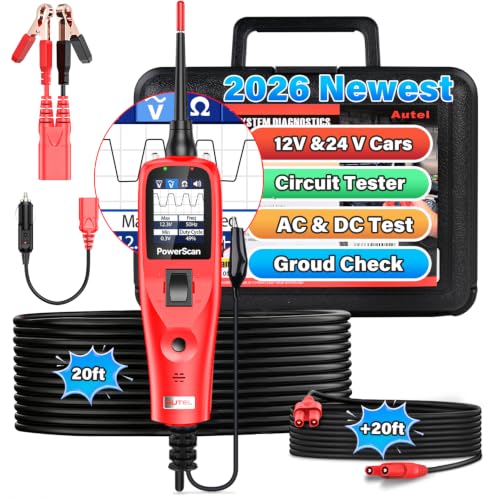
The Autel PowerScan PS100, model A-M017-00-US in this 2.0 listing, is Autel’s entry in the powered circuit tester class and is built for 12 and 24 volt vehicle systems. Like the Power Probe, it clips to the battery and works over a 20-foot cable, and it combines several instruments in one handle: it reads DC voltage, measures resistance, checks continuity and bad grounds, follows and locates short circuits, and activates components by supplying power or ground through the tip. A built-in flashlight covers dark footwells and engine bays. The value of the format shows up on intermittent faults, where watching a live voltage reading while a harness is wiggled tells more than a lamp that only glows or stays dark. It also suits trailer and truck work, where the 24 volt rating and long cable earn their keep. The cautions mirror those for any powered probe: it is a diagnostic instrument for conventional power and ground circuits, not a substitute for a scan tool, and power should never be applied to air bag circuits or delicate sensor lines unless the factory service procedure specifically calls for it.
JASTIND Heavy Duty 3-65V Backlit Digital LCD Circuit Tester

The JASTIND digital tester keeps the simple test light shape but replaces the bulb with a backlit LCD that shows the actual voltage at the probe. Its stated range is 3 to 65 volts DC, the widest of the passive testers in this roundup, which makes one tool serve 12 volt cars, 24 volt trucks and low-voltage accessory circuits alike. The lead is a 140-inch extended spring wire, a coiled cord that stays compact in the toolbox yet stretches across an engine bay when clipped to the battery or a chassis ground. The probe is stainless steel, suited to piercing insulation or seating into the back of a connector. A numeric readout changes the quality of the diagnosis: a circuit showing well under system voltage points to resistance in a corroded connection or a failing ground, something a plain lamp reports only as a dim glow, if it reports it at all. For buyers who want more information than a bulb gives but do not need the power-supplying functions of the Power Probe or Autel tools, this is the balanced middle pick, and the backlight keeps the display readable in a dark footwell or under a dashboard.
WINAMOO Test Light Automotive 3-48V Digital LED Circuit Tester

The WINAMOO tester, model WITL101A0999, is the budget route into digital test lights. It covers 3 to 48 volts DC, which spans 12 volt passenger cars and 24 volt light trucks, and shows readings on an LED digital display with 0.1 volt resolution, so a weak circuit reads as a low number instead of a faint glow. Dual-color polarity indication separates the two basic findings at a glance: red for positive and green for negative, which speeds up fuse checks and ground verification. The listing describes an ABS body with a transparent finish, an ergonomic handle, a large alligator clip for the ground connection and a board-level line protection function. A built-in lighting function helps in dark work areas. There is no power-output mode, so it cannot run a component the way the Power Probe 3 or PowerScan can, and it does not replace a multimeter for resistance or parasitic-draw measurements. What it does offer is the core test light job with a real number attached, in a tool light enough to live in a glovebox or door pocket for roadside fuse and lighting checks.
How to choose
Start with the indicator type. A bulb or simple LED tester answers yes-or-no questions fastest and costs least, but it cannot show a weak circuit. A digital display tester adds the actual voltage, which exposes voltage drop across corroded terminals. A powered probe such as the Power Probe 3 or PowerScan goes further and supplies power or ground, at the cost of more ways to misuse it. Match the voltage range to the fleet: a 12 volt only tool like the Innova 3410 should never be used on 24 volt truck systems, while the JASTIND and WINAMOO ranges cover both. Respect current draw near electronics. Bulb testers pull enough current to risk damage on module and sensor circuits, and Innova’s own instructions bar the 3410 from computer circuitry entirely; low-draw LED and digital testers are the safer choice there, and no tester of any type belongs on air bag circuits. Lead length decides how much of the vehicle one battery connection can reach, with coiled cords trading reach for tidiness. On recalls: the CPSC and Kole Imports recalled about 4,000 Sterling-brand ML-24 screwdriver-type circuit testers sold in 2000 because they could fail to indicate current was present, creating a shock risk. None of the five testers above is that recalled Sterling model, and no recall covers the other picks; even so, check the exact model against the CPSC database before buying, especially used.
Who should skip
Skip a test light entirely if your electrical work is mostly reading fault codes or watching live sensor data, since that is scan tool territory and a probe adds nothing. Skip the simple bulb models if you regularly work around engine computers, body modules or hybrid systems, where their current draw is the wrong tool for the circuit. Skip the powered probes if you are new to electrical diagnosis, because a tool that can feed battery power down any wire rewards a wiring diagram and punishes guessing. And skip the whole category if you already own a good multimeter and only check a fuse twice a year.
FAQ
Can a test light damage a car’s computer?
A traditional bulb tester can, because the bulb draws enough current to overload delicate module and sensor circuits, which is why Innova bars its 3410 from computer circuitry. Low-draw LED and digital testers are far safer near electronics, but the cautious rule stands: follow the vehicle service procedure, and never probe air bag or restraint circuits with any tester.
What is the difference between a test light and a multimeter?
A test light shows whether voltage is present at a point, and digital versions show how much. A multimeter does that plus resistance, continuity with the power off, current draw and diode checks. The test light is faster for power and ground hunting; the multimeter is the measuring instrument. Many garages keep both, using the light for triage and the meter for confirmation.
Can I use a 12 volt test light on a 24 volt truck system?
Only if the tester is rated for it. The Innova 3410 is specified for 12 volt DC systems only, so it does not belong on a 24 volt truck. The JASTIND tester is rated from 3 to 65 volts and the WINAMOO from 3 to 48 volts, so either covers 24 volt work. Check the rating printed for the specific model before connecting it.
Why does the test light glow dimly on some circuits?
A dim glow usually means the probe is seeing reduced voltage, often from resistance in a corroded connector, a damaged wire or a poor ground on the circuit under test. Confirm the ground clip is on clean metal first, then compare the reading at the battery. A digital tester turns the guess into a number, showing exactly how much voltage the circuit is losing.
Final verdict
Every garage that touches vehicle wiring benefits from one of these five. The Innova 3410 is the simple, honest pick for conventional 12 volt circuits, the JASTIND and WINAMOO digital testers add the voltage numbers that make voltage-drop diagnosis possible, and the Power Probe 3 and Autel PowerScan PS100 serve heavier diagnostic work where powering a component is the quickest proof. Choose by indicator type and voltage range, keep bulb testers away from computer circuits, and the tool will pay for itself the first time a dead circuit gives up its secret in seconds.
Product and ASIN Reference
| Product | ASIN |
|---|---|
| Innova 3410 Test Light and Circuit Tester | B0014DINF6 |
| Power Probe 3 Circuit Tester, Green, PP3CSGRN | B01HQBVOTG |
| Autel PowerScan PS100 Circuit Tester 2.0 | B0BW48DKFG |
| JASTIND Heavy Duty 3-65V Backlit Digital LCD Circuit Tester | B07PX16XDX |
| WINAMOO Test Light Automotive 3-48V Digital LED Circuit Tester | B0C53KKT16 |
More from Amazon
Programs that pair well with the guide above. Offers and eligibility are set by Amazon and may change.
Free shipping on eligible items, Prime Video and more. Eligible new members can start with a free trial.
Start a Prime free trialAudiobooks and podcasts to listen to on the go. Eligible new members can start with a free trial.
Try Audible freeAd-free music streaming. Eligible new subscribers can start with a free trial.
Try Music Unlimited freeA free business account with business pricing and bulk-buying tools for work, shop or home office.
Create a business accountAs an Amazon Associate we earn from qualifying purchases.